Archive for the ‘architecture’ Category

A Presence of Permanence

August 6, 2010


   Last week while riding my bike along the swollen Mississippi, my mind took me back to the architect selection process for the Figge Art Museum.  One of the reasons David Chipperfield was chosen was that he’d designed several projects alongside rivers, most notably (at that point*) the River and Rowing Museum by the Thames near Henley.

  We first met Mr. Chipperfield (now Sir) at that site and listened to him describe how even more stringent were flood plain building requirements in the UK than in the states.  And how, in any case, a river is a force of nature with which one best not trifle.  He quoted TS Eliot in that regard: “A river has a permanence far greater than mere humans.”

  That respect, in part, led him to set the volumes upon concrete columns thus placing them just above flood level.  Their shape was inflected first by the long obtusely peaked tents set up during the annual Henley Regatta.  The rooflines of traditional wooden barns of Oxfordshire were the second important influence. 

  The structure thus “fit in” and assuaged fears of local conservatives.  Chipperfield also though endeavored to clearly interject something new by having it appear to float over the site – resting it upon nearly invisible walls of glass.  The raised platform also bears resemblance to pavilions in Japan where will be found most of his early built work.
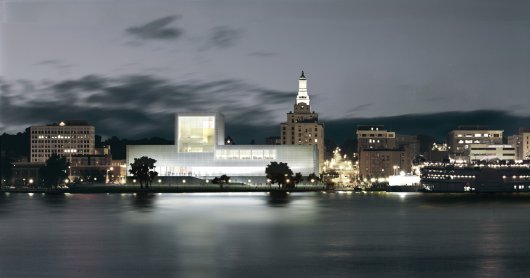
  The hovering effect was achieved for our project by exactly opposite means.  FAM looks like a glistening rectilinear crystal made to appear to float by its stark contrast with the dark concrete plinth upon which it rests.  Though the scale of the two buildings differs significantly, important similarity does not end there.  Both buildings honor their contents without sequestration. 
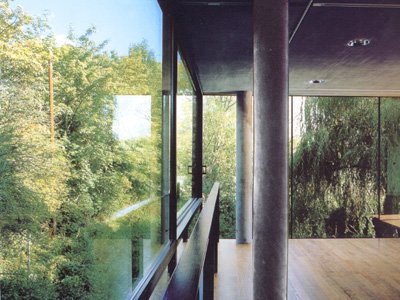
  Both employ skylights to allow for some natural lighting**, but more importantly both set up an opportunity for the visitor to visually interact with mother nature.  At Henley it’s the embrace (if not caress) of poplars around one small glazed room while here it’s the invigorating slap in the face one receives exiting fourth level exhibition space to look out and over the mighty Mississippi through a huge window sixty-one foot tall and nearly as wide.  Our own Grand Canyon.

*Chipperfield’s recently completed Neues project on Museum Island in the River Spree in Berlin was for ten years one of Europe’s largest.  It’s received raves.  Hope to visit one day…

**The skylights at Henley have been said to have been inspired by those at the Kimball.  Indeed, during our visit, Chipperfield was heard to say that “he’d work very hard to make the building what it wants to be” a phrase made famous by Kimball Architect Louis Kahn.

***cf June 26, 2009 – For a nearby work of Frank Lloyd Wright’s by a river.  There are some similarities as well as fundamental differences.  Wright’s has roots.

****cf June 5, 2009 to read about bridge builders and nature.
Psychic Rewilding

February 12, 2010

  In last Sunday’s New York Times Magazine there was an article by Daniel Smith entitled “Is there an Ecological Unconscious?” which addressed the stress and discomfort visited upon the psyche of those subjected to forced dislocation (eg Trail of Tears) or environmental degradation (eg exploitation of newly discovered nearby coal deposits).

  Researcher Glenn Albrecht coined the term solastalgia to describe this condition of “place pathology” leading to the diminution of “one’s heart’s ease”.  The article reminds us that Freud attributed just about everything to sex and how modern psychology is primarily concerned with urban interpersonal interaction, largely ignoring the primal bond between humankind and the rest of nature.

  The premise of echopsychology is that “an imperiled environment creates an imperiled mind” and that there might be a relationship between a resilient environment and a resilient mind.  Research shows that natural settings are far more effective than urban for the enhancement of cognition.  Researcher Peter Kahn calls for a ‘rewilding’ of the psyche.

   Well, yippee ki-yay, I quite agree.  “More and more”, he writes, “the human experience of nature will be mediated by technological systems.  We will, as a matter of mere survival adapt to these changes.  The question is whether our new, nature-reduced lives will be impoverished from the standpoint of human functioning and flourishing.”

  How much of a stretch is it then to ask about the degree to which TV, digital social networking, video games, etc are responsible for global warming?   Well a lot I guess, but you get my point.  How can one have a meaningful sense of self and surroundings without a vigorous dose of the environment from time to time?

  Paradoxically, it dawned on me that an emerging departure from rectiliniarity in architecture enabled by technology might be relatedly salubrious.  I have long been interested in the emotional generosity inherent in good design and wonder if this will prove to be an unexpected and fecund vector.

  Japanese architect Toyo Ito has said that: “I sometimes feel that we are losing an intuitive sense of our own bodies.  Children don’t run around outside as much as they did.  They sit in front of computer games.  Some architects have been trying to find a language for this new generation, with very minimalist spaces.  I am looking for something more primitive, a kind of abstraction that still has a sense of the body.”     

  I have only read about and seen photos of Ito’s built work and am eager to one day experience a product of his line of thinking.  New York Times critic Nicolai Ouroussoff calls him an “urban poet”, “someone who has been able to crystallize, through architecture, the tensions that lie buried in the heart of contemporary society.”*

  No two of his projects are alike, maybe not even remotely similar.  Ouroussoff: “By embracing ambiguity, his work forces us to look a the world through a wider lens.  It asks us to choose the slowly unfolding narrative over the instant fix…  A building that seems to have been frozen in a state of metamorphosis”

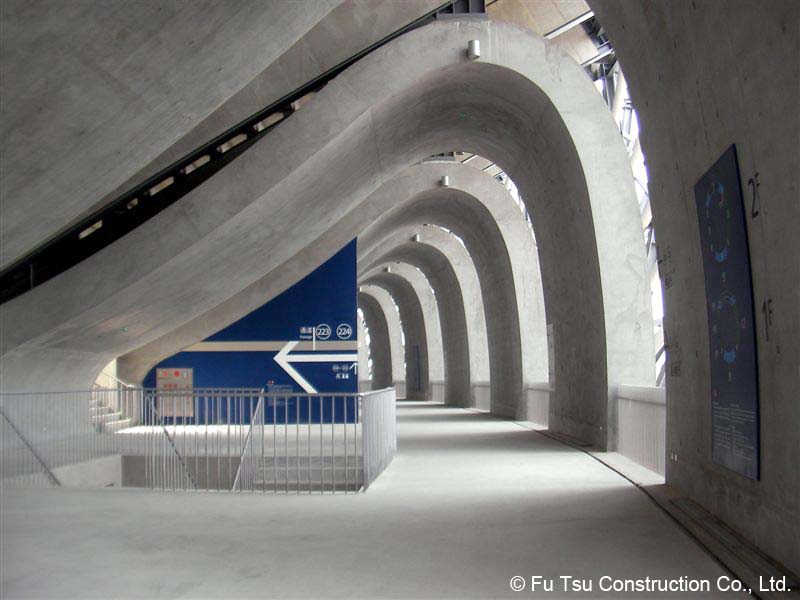
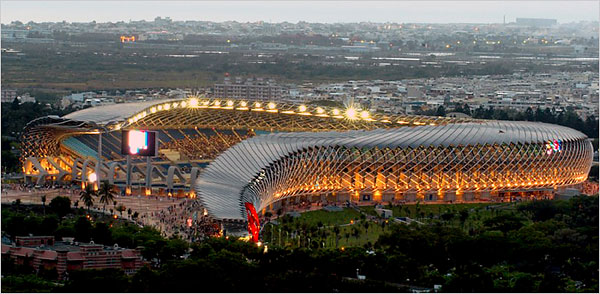
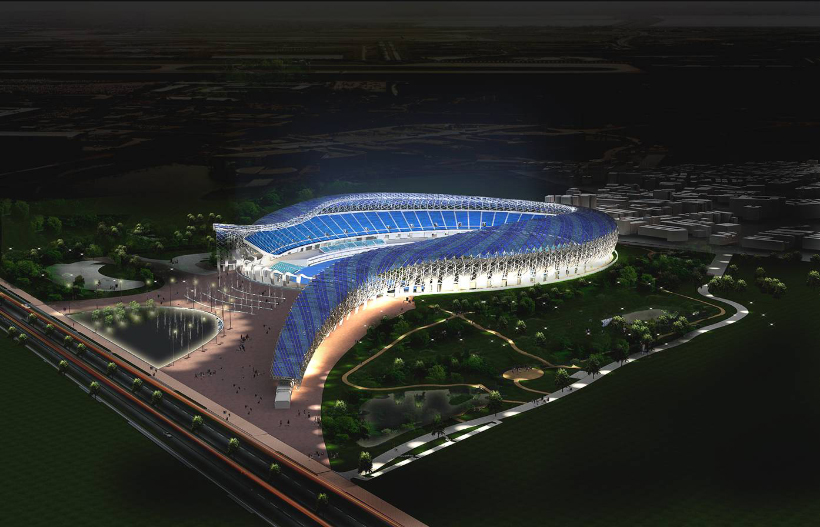
  The photos are of his stadium in Kaohsiung, Taiwan.  Ouroussoff tells us that it is “a space that manages to maintain the intensity and focus of a grand stadium without that intensity becoming oppressive.”  As opposed to other stadiums, “it seeks to maximize our awareness of (the outside world) while still creating a sense of enclosure.”

  Might such places help relieve solastalgia?  Help rewild a psyche, even?

*NYT 6 12 09

Hearts and Hope

November 6, 2009

  This week, courtesy of NPR, I had occasion to listen to a fascinating program about stem cells on Speaking of Faith.  Host Krista Tippett visited the regeneration lab of Fr. Doris Tayor at the University of Minnesota.

  Problem with organ transplants is rejection.  Patient has to take powerful drugs for life to avoid a new heart from making an Alien-like exit.  Ms Taylor is working on a method to build a new heart out of one’s own cells. 

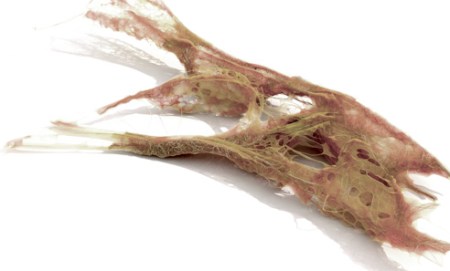
  Not yet in human trials, she starts with a heart from a rat cadaver and washes out all cells leaving an interstitial “scaffold”.  Then she uses stem cells to build a new heart upon that structure.  Below you can watch a video showing steps in the process culminating in a new beating heart!*

   Speaking of Alien: the video reminded me of the horrible part of Alien Resurrection where Ripley stumbles upon a lab filled with disturbing experiments with/on humanoids eerily similar in presentation to Dr. Taylor’s rat hearts in beakers.

  For her part, Taylor says she wouldn’t undertake anything she wouldn’t do on her mother.  People tell her that “she isn’t building hearts, she’s building hope”.  “The universe has given me tools: I’m going to use those tools.”  Progress is a series of discoveries.  When ill, our ancestors chewed on willow bark which we now use in the form of aspirin.

  Marveling over the beauty of the natural architecture of a heart with Dr Taylor, moderator Tippett said that “One of the things that I’ve been fascinated in… with scientists in general is how scientists have such a regard for beauty”.  Reminded me of a post far above in which I discuss nuclear weapon development by scientists eager to push forward savoring the “sweet technological problems…” 

  I’m all for progress and favor stem cell research, but I’m beginning to disagree with Keats’ famous lines from Ode to a Grecian Urn

Beauty is truth, truth beauty.  That is all
Ye know on earth and all ye need to know 

  This here universe is a whole lot more complicated than that.   Billowing cumulus might be beautiful, but so is a mushroom cloud.  Taylor indeed does give us hope.  We can make ourselves sick (physically or metaphorically), but we can also make ourselves well.

  All parts of our bodies are continually regenerating and the stem cells do the work.  Taylor calls it “endogenous repair, internal repair”.  Ageing of tissues and bodies is the failure of stem cells.  Stress ages stem cells by a known process. Decrease stress increase the life of a cell and a body.

  “… there’s a spiritual component to all of this” Taylor says.  “What we think impacts who we are.  She recruited well known Tibetan Buddhist monk Mathieu Ricard and measured stem cells in his blood before and after a meditation session.  “What we found was a huge increase in the number of positive stem cells in blood.”

  In an unrelated study of the neurological correlates of happiness at the University of Wisconsin – Madison Ricard was subjected to an extensive  examination with hundreds of sensors affixed to his noggin for a three hour ride in an MRI.  He was so far outside normal parameters that he was dubbed the “happiest man on earth”.  Wonder what he knows.

*Interestingly (but I guess not surprisingly), process sounds very much like morphogenetic architecture in which a pattern or process is observed in nature, algorithms developed, computer let loose, and voila: an, uh, as yet unbuilt research lab for the Santa Fe Institute designed by son and friends.

Andrew Surface 1


** For the complete interview and more video go to:http://speakingoffaith.publicradio.org/programs/2009/stem-cells/

Jewel Box

July 31, 2009

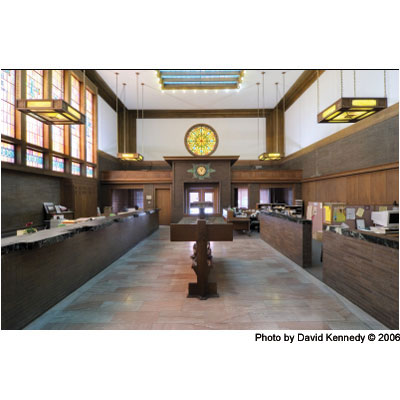
  Horace Greely famously told Josiah B. Grinnell to “Go west, young man, go west”.  The Congregational minister did and ended up in the middle of Iowa and a town here now bears his name.  It is a wonderful place with much to see and do.  Grinnell College is there and its campus is magnificent.  Make sure to visit the Bucksbaum Center for the Arts, a neat building designed by Cesar Pelli.  North facing light catchers bathe the stuff on display in its Faulconer Gallery with slightly blue toned light.

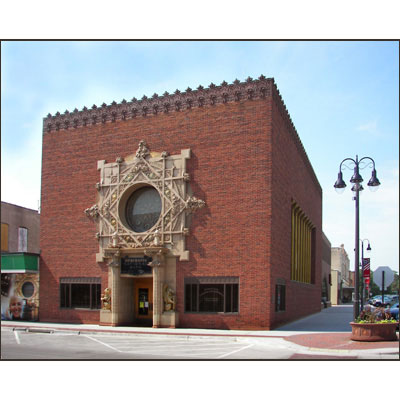
  But another building is even more interesting and alone worth the short trip north from I-80.  It is Louis Sullivan’s Merchant National Bank.  It is the finest example of the several “Jewel Box” banks that he designed in second half of his career.

Sullivan Grinnell 1

  Sullivan is famous for his “form ever follows function” which is often misinterpreted it seems to me.  Sullivan didn’t mean minimalism or the absence of adornment.  One look at the entrance to the bank and its explosion of terra-cotta should put any such though to rest. 

  A reporter wrote at opening on January 1, 1915 that something “must have worked like hashish” on the architect to induce such a vision.  Such a thought would not grace any review of, say, David Chipperfield’s Figge Art Museum.

  Sullivan meant that a building’s ultimate form should be the organic emanation  of the spirit of the place and its people.  This bank was built as a repository for the fruits of the labor of area farmers with reverence for the hard work signaled thereby.

Sullivan Grinnell 2

  The entrance faces south and thus for most of the year and most of each day sun pours through the beautiful stained glass window.  There is also stained glass on the east which fills with light till noon or so and sky blue glass on the ceiling***.

  The effect of the glass and light is beautiful, but perfectly not profound.  No “metaphysics of light” here****.  A lesser hand would have combined the same elements to a more clerical effect which would have not only been disrespectful to Fr Grinnell’s gothic church (which used to be just across the street to the east) but also to the local common consciousness.

  The ceiling height is about twenty feet creating a spatial experience which (without too much of a stretch) could be said to allude to one in a barn or in a field looking toward the sky.  Or, indeed, like being a gem in a jewel box – but one with some of the dividers missing.Sullivan Grinnell 3

  The interior was changed and a touch diminished by the removal of the cages over the teller areas which originally served more of a purpose of tradition and proportion than security.  The effect is as if an element had been removed from a piece of abstract sculpture.   You would feel the absence of something even if you had no way to know what was missing.

  That extirpation would seem to have been unnecessary because a functioning bank was appended on the north and Sullivan’s jewel appropriately repurposed to house the chamber of commerce.  The commission for the addition must have been intimidating, but was done with respect and rhythm by Davenport firm Stewart-Robison-Laffan.

  Finally, this may be hard to believe, but the building was more comfortable in context in 1915 than now.  It was then of similar size and proportion to that of its immediate neighbors.  Roof lines met.  Now to the west is a low slung bit of impermanence and the aforementioned addition obvious in its respectfulness.

  Sullivan has been called the “father of the skyscraper”, yet the grand part of his career had been long over at the time of this commission.  Perhaps sensitized by intervening vicissitudes he found himself able to channel the essence of Grinnell and show what he “meant when he talked about the genius of America.*****

*Words of a reporter in the 1,1,15 Grinnell Herald.

** The glass was done by Louis Millet who was related to Jean-Francois Millet, the French painter know for his paintings of peasant farmers such as The Gleaners

***Term coined by Abbot Suger in the early stages of Gothic Architecture

**** January 1, 1915 Grinnell Herald

***** Some of the above came from the book by Bill Menner which is well represented in this website: 

http://www.grinnelliowa.gov/SullivanBank/HistoryRoad.html

Do You Know Where You Are?

July 17, 2009

  birds foot 6 001

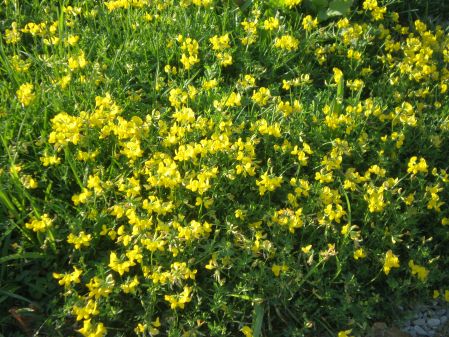
    No, alas, this is not in my yard.  Not yet anyway.  It’s called Bird’s Foot Trefoil (Lotus corniculatus to a botanist) and is a member of the huge Pea or Bean (Fabaceae or Leguminosae) family.  The photo was taken along the interstate at the end of our ravine.

  The name Trefoil comes from Latin via Old French meaning three leaves -like the clover to which it is related.*  It has just come into bloom now and will remain so for most of the summer. This bright delight is not native to North America having been imported from Europe for forage.

  According to Iowa State University Extension, it was only first planted in 1938 but now covers more than 500,000 acres in Iowa alone.  Farmers like it because it is hardy once established; will withstand close grazing; is highly nutritious; and non-bloating.  It has provided daily weight gains in cattle exceeding a 30% premium over fertilized grass.

birds foot 4

  Laterly the plant became popular with road crews whose mission was/is to stabilize roadside growth.  It creates a dense low mat, will crowd out plants with a yearn to grow tall, blooms low and so can be cropped close.  If you live around here and are not agoraphobic, it will doubtless and frequently play a role in your field of view.

  Not surprisingly, citing almost exactly the same factors listed above, the philistines about consider it invasive, a weed, and incredibly difficult to control. “An ecological threat”  Control by conflagration not only doesn’t work, but instead increases seed germination!  Ha!

birds foot 6 002

  There is a new book out** that explores the chasm between us and our setting – the green movement notwithstanding.  The author writes of the seafarers of Puluwat in the South Pacific who can navigate by means of subtle swell patterns.  And of the Inuit who do the same with wind.  The Bedouin the stars.  Here in suburbia some use a GPS to cross town.  What’s up with the disconnect?  Is there a cost?

   The Trefoil’s beautiful, isn’t it?  Shades of yellow pea-like flowers with clover-like leaves.  The seed pod arrangement sort of resembles a bird’s foot hence the name. birds foot seed pod Doesn’t the fact that a lowly weed can be so gorgeous and have such a wonderful back-story give you pause?  Makes me think of Blake: 

To see a world in a grain of sand,
And a heaven in a wild flower,
Hold infinity in the palm of your hand,
And eternity in an hour. 

*The word also serves as a term in Gothic architecture referring to a manner of ornamentation by foliation or cusping. Look for it in church window-lights. 

trefoil

**The book is You Are Here Why We Can Find Our Way to the Moon but Get Lost in the Mall, by Collin Ellard.  It was reviewed in the NYTBR Sunday July 12 by Jonah Lehrer.

Canvas Cover for a Soul

July 10, 2009

 Yurt door 010

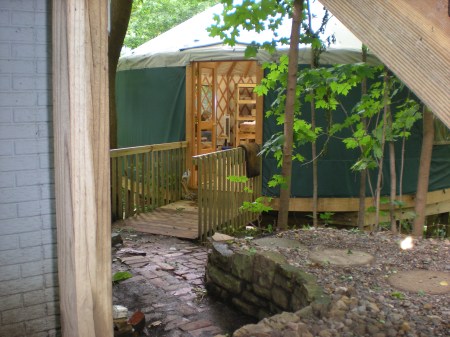
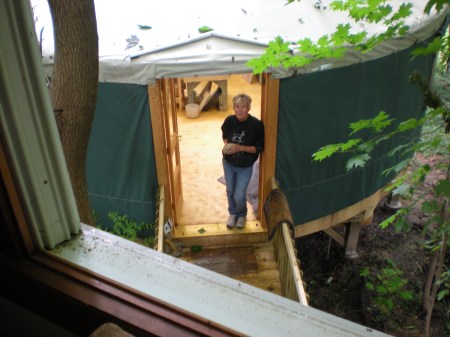
   The aforementioned yurt serves as divine studio space for my potter wife.  It replaces a cold wet cryptish corner off our basement which made a cell at Guantanamo something for which to yearn.

  Development of that transmigration required more than a few days and much ideation.  First thought was a familiar exercise in rectilinearity set akimbo in our front yard.  Then an appendage also in front.  Then she considered the expansion of the existing dingy cellar.

  Somehow the tent-like structure more common on the steppes of Central Asia came into her consciousness and she quickly concluded that yurt it would be.  (Well, she and the dog…)

  It is wonderful, even from this visitor’s perspective.  Its shape and nature fit organically on the side of the ravine in back of our house.  It looks almost to have grown there.

  We’re in the middle of town and abut an interstate.  Even so, from within looking out, all that can be seen is green.  Work started after woods leafed out, and thus I’ll bet neighbors (not far) across the way won’t have seen it till fall.

  It really is neat, made all the more special by being a few paces away from the house.  Going from one to the other in the rain you’ll get a bit wet.  Perfect.  Forces awareness of one’s place in the universe.

  To this philistine, it seems also perfect for the artist. Entering, it’s like stepping into a cloud with the world left far behind.*  I can’t wait to see where it takes her.

  Reminds me of some of Tadao Ando’s work in which sun, wind, and clouds are design elements.  His Azuma house, with which he first gained recognition similarly forced residents to interact with nature. 

  Contrast these to the emphasis on surface gloss found all too often in new additions to the built environment both public and private.  Lipstick might look nice, but it doesn’t necessarily tell much about the pucker.  Know what I mean?

  Anyway, this arrangement of site, structures, and stuff combine at night to make a softly glowing spot for wife to consider what another potter called “The Mud-Pie Dilema”**.

Yurt door 005

  More later. 

*Speaking of which – you should hear what heavy rain sounds like therein.  No need for thunder!

**The Mud-Pie Dilemma: A Master Potter’s Struggle to Make Art and Ends Meet by John Nance

Cedar Rock

June 26, 2009

  Walter 10

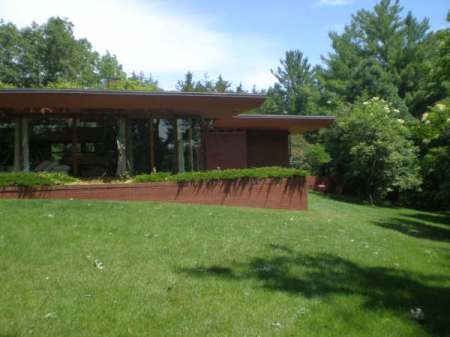
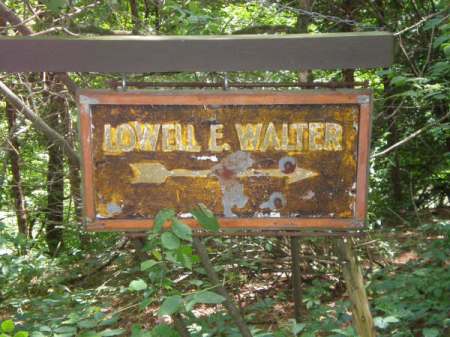
  Of the ten structures in Iowa designed by Frank Lloyd Wright, the one nearest my home is in between Dubuque and Waterloo, just south of Highway 20 near Quasqueton.  The original owner, Lowell Walter named it Cedar Rock for the limestone formation on the site at the shore of the Wapsipinicon River. 

  It is one of Wright’s designs for which he coined the term “Usonian” – short for United States of North American.  His intent with this departure from the more well known Prairie Style was to make innovation and good design affordable and available to Middle America*.

Walter 3

  The site is of a spectacular beauty that would surprise those many not familiar with Iowa away from Interstate 80.  It is secluded, heavily wooded, and perched above a wide and swift Wapsipinicon river.  Local lore has it that a Native American tragedy akin to Romeo and Juliet played out nearby.

Walter 8

  The design is called tadpole in plan with the ‘head’ being the all important open square “Garden Room” and ‘tail’ the rectangular living spaces articulated forty-five degrees off the southeast corner.  Wright wrote Walter “there will be no basement or attic” which tone pervades every square foot.

  He designed each space, selected every object, and arranged it all with incredibly great painstaking care.  Upon a return visit, he would scold and say “you can use that pitcher, but it must be returned to its original position precisely so”.  The Walters wanted a queen sized bed, but Wright would not have it.  He insisted upon two doubles like a curator establishing symmetry in a gallery.

  It is a wonderful sculptural object well rooted, plinthless, in its site like an earth toned dolman laid flat.  But it wouldn’t be a great place in which to live.  Once shorn of initial zeal, it’d stale one’s concept of heaven.  Who’d want to live in a monastery? 

  It must though be said that compared with the contemporaneous Farnsworth House (Mies van der Rohe) and the Glass House (Philip Johnson) Wright’s ‘Organic’ approach makes the Walter’s Garden Room more down to earth.  

  There is an antiphonal relationship between the greenery inside and out made possible by the abundant glass and light surrounded by the solitude of the site.   It should come as no surprise that Wright was familiar with Japanese gardens and the “capturing with window” technique. ***

   Also, there were several elements of the original design that would today evince environmental concern including in floor heating and related elements of passive climate control as well as a thick concrete roof intended to be covered with fertile soil and vegetation.

  There is one bit of neat whimsy.  Wright’s Prairie Style homes often have stained glass windows which would be too expensive for the Usonian concept.  Here, Wright arranged brilliant blobs of colored glass in small niches in a wall by way of allusion. 

Walter 7

  The boat house is down a path about fifty yards away and is serene.  It sits above the river with wide views up and downstream.  There, one could indeed quietly revel in the sound of water and muse about our place in the universe.

*The Walters were not middle class having built a fortune and retired in their forties.  Original project budget was $20,000, but ended up at $150,000.  And that was in 1950. Today that’d be more than a $1 million.  Walter wrote Wright of his frustration with delays and overruns to which FLW responded: “We were brave men to try to set up the last work in heaven way off in the mid-western prairie-miles from anywhere?”

**See post of November 7, 2008

*** The Walters left a $2 million trust to provide for the well being of their cherished country home.  The trust is now bust and it will be interesting to see what the Iowa DNR will do with the place especially in these turbulent times. 

Walter 12

**** Do visit.  It is part of the state park system and the staff are fervent, knowledgeble, and enthusiastic.

http://www.iowadnr.gov/parks/state_park_list/cedar_rock.html

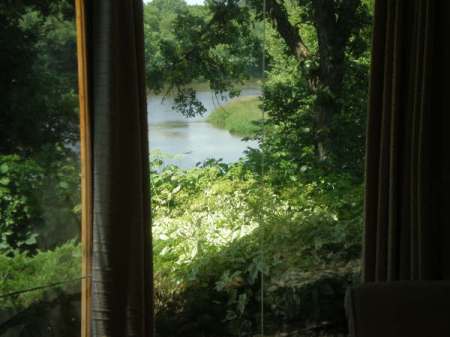
*****The top photo is of the entrance at the articulation point between Garden Room and living spaces.  Garden Room to the left.  Second photo is from the Garden Room looking through a glass corner.  Third photo is same place outside looking in.  Fourth photo is looking downstream from the boathouse.  Last photo is perhaps extreme, but not undemonstrative.

Carpe Diem? Huh? And Then What?

May 22, 2009

Andrew grad Franklin field 09 

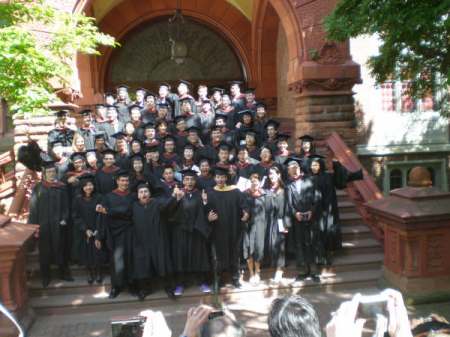
  Carpe Diem seems like the most natural and obvious of exhortations to shout at a graduation.  Seize the day.  Certainly, commencement exercises must constitute a major point of transition (fulcrum hopefully) for most participants.  But “hurry up and get on with your life” is probably not the best advice for a young broadly educated mind.

  Graduation ceremonies should always be powerful experiences for all attendees and the aforementioned such was no exception.  As the students and faculty began to file in the orchestra began to play and the trickle soon became a swarm.  I first thought back to graduations past until I noticed that tears had welled up in the eyes of both sisters as brother came into view.  Wife choked a bit, and well, me to.

   Made me think of brain science and what it can and cannot explain.  We have what have been called mirror neurons.  A set of neurons fires when you do something.  Mirror neurons fire when you observe somebody do that thing.  Researcher V.S. Ramachandran calls them “Ghandi” neurons because “they’re dissolving the barriers between you and me”.*

  That’s neat and interesting, but incomplete.  Other researchers have shown that phenomena related to consciousness can be observed, measured etc, but not consciousness itself.  Some think it a matter of time till it is seen how thoughts emerge from the brain, but none do now.

    As I’ve said above, while it may well be understood one day, I do not believe it will be found to be a sum of the parts sort of thing.  Stuart Kauffman again: “Whatever its source, consciousness in emergent and a real feature of the universe…. These phenomena, then, appear to be partially beyond natural law itself.”

  It is much easier for me to consider tenderness amongst siblings with that observation in mind than, say, mirror neurons.  We are more than the sum of the parts.

  While in Philadelphia I saw one of the two of Galileo’s telescopes known to be still in existence.  Fascinating to look at and think about.  They got him into trouble.  Not so much for debunking heliocentrism as for challenging the then prevalent western world view that spirituality was the only source of knowledge.    

  In her remarks the wonderfully enthusiastic Penn President Amy Gutman told those in cap and gown that their toughest challenge would be to find: “What matters most to me?”.  Not an easy question for most to answer, but indeed perhaps the most important.  I’d add that it is probably be just as important to learn to live in that question.  If you carpe diem with questions answers will follow.

Andrew grad Myerson 09

   That’s what Galileo did.  “It [the earth, not the sun] moves” he told the Pope and was placed under house arrest for blasphemy. He continued wide ranging research for the next ten years until his death investigating the speed of light and the nature of tides among other things.  Very significantly,  he developed the basic principle of relativity.

   Einstein wrote: “Pure logical thinking cannot yield us any knowledge of the empirical world; all knowledge of reality starts from experience and ends in it.  Propositions arrived at by purely logical means are completely empty as regards reality.  Because Galileo saw this, and particularly because he drummed it into the scientific world, he is the father of modern physics – indeed of modern science altogether”.

  Or as Uncle Ed helped translate from another tradition: “Whatever you see is a reflection of your own mind.  The essence of mind has, from the very beginning, has been free of conceptual limitations.  Having recognized this truth, free your mind from grasping at phenomena and clinging to thought…”**

Andrew Board spring 09

*New Yorker May 11, 2009: Profiles

**Path of the Bodhisattva, Vimala Publishing

***Hint: Above image is not through a telescope, has not really yet been seen in 3D, but is indeed way out there and has not been seen before.

Reading About Reincarnation Is Not The Same Thing As Being Reborn

April 24, 2009

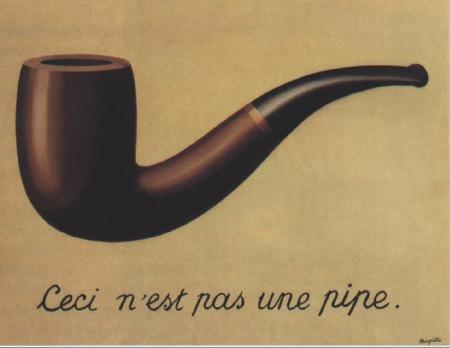
  Consideration of a work of architecture suffers from anything less than an actual visit.  A virtual representation of a painting, pot, or, well, turd* can only approximate a real-time in-person experience.  But a photo of a building conveys even less information of value.  A well known Magritte picture makes the point:

magrittepipe1

  The title is Ceci N’est Pas Une PipeIt Is Not A Pipe.  It’s not – it’s a painting of a pipe.  A photo or digital representation of a building bears even less resemblance to an intimate experience of it than the Magritte picture to the pipe.

  Thus the award of the annual Pritzker architectural prize must hold far more mystery (and allure) for the public than an Oscar, Pulitzer, or Grammy.  One can easily develop a relationship with the body of work of an actor, writer, or musician.  Very few knowingly visit multiple examples from the oeuvre of one, let alone several prominent architects.

  It is then quite ironic that most of us must in fact peruse the works of critics and photographers to develop any sort of opinion at all.  It is not impossible that we could admire the words and pictures, but find ourselves surprised or disappointed upon a visit.  Ceci N’est Pas Une Batiment.

  This year’s Pritzker winner for example, Peter Zumthor, leads a very small practice the output of which is almost all to be found in or near his native Switzerland.  The jury citation tells us that: “he develops buildings of great integrity – untouched by fad or fashion…only accepts a project if he feels a deep affinity for its program…modesty in approach and boldness in overall result are not mutually exclusive…”  It calls his chapel in Wachendorf, Germany “a universal breath of faith”.

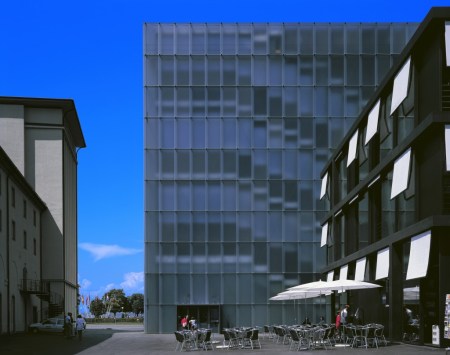
  I’ve had the good fortune to visit one of his projects – The Kunsthaus Bregenz on the shore of Lake Constance in Bregenz Austria.  I had read about the building in preparation for the visit and expected not to like it.  I found the photos unattractive and befitting the “severe” label given by several critics.  Plus, it would have no views out from its perch on the eastern shore of a beautiful lake in-between Austria, Germany, and Switzerland.

bregenz-exterior

  All too true.  However, it worked.

  The overlapping etched glass plated exterior has tremendous effect both inside and out.  Its translucency both allows sun to pour into the six foot inter-floor light catching spaces and then down upon the rooms and their contents. The non-reflective nature of its exterior mitigates the potential for glass to transgress a site.  No blinding glare.  Finally, the angles and lines one can just make out through the rough glass sheets relate to the lines and castellation of the surrounding buildings enabling it to fit in.

  The building is deeply rooted in the site.  The nature of the glass curtain wall allows one to peer below grade (along with the sun) toward lecture and service spaces. A subdued office/shop/restaurant structure nearby works with the museum building make a pleasant open space.

bregenz-interior

  Ground floor reception is indeed severe if not foreboding.  The walls are bare highly finished concrete, floors gray terrazzo. The lighting of the 80 sq ft by 14 ft space creates an austere numinous experience.  Three exhibition levels lie above and one doesn’t know whether to expect a Teutonic warlock with an obsidian blade or a priest to deliver last rites. 

  Attention acutely engaged, the similarly proportioned and finished temp spaces do way heighten the impact of the narrow range of objects and talismans not overwhelmed or neutered.  Shows have been primarily if not exclusively contemporary.  The Peter Kobler installation there during my visit was up to the task and provided perfect counterpoint.  Almost hallucinatory.  A tour felt like the traverse of a difficult transmigration.

kogler

  Zumthor likes tennis, cigars, margaritas, and jazz.  Apparently he doesn’t allow his professional and private lives to overlap.  Kunsthaus Bregenz is dead serious.

* I had a professor once who asked the class “If a bear shits in the woods, is that art?”  Stuck with me.

* The museum’s homepage: http://www.kunsthaus-bregenz.at has a neat bit of embedded flash animation showing elevations, interiors, and detail.  Check it out.

Mirabile Dictu

April 3, 2009

toilet-1

Ever concerned that I relentlessly hone my intellectual acumen, son gave me a special book for Christmas.  Toilets of the World.  It is a colorful tour of this important, but often overlooked corner of the built environment.

From a rugged plein-aire outhouse in British Columbia to an aluminum one that pops up like a periscope at night in Soho in London, to the dual culture stool in India upon which you can stand or sit, we visit all manner of approaches to these bits of the daily life of every single person on the planet.

toilet2

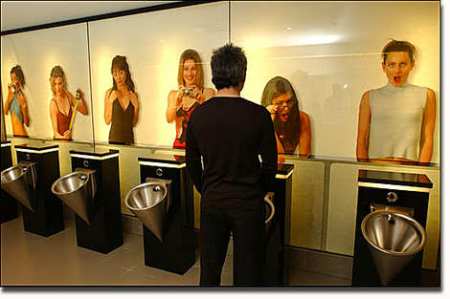
You may find this hard to believe but(!), there is even a website devoted to the best restrooms in our country.  www.bestrestrooms.com Even more surprising is that the facilities in our local airport were voted #5 in the USA in 2006!  The one in the video below (21C Museum Hotel Louisville, KY) was voted #2 last year and  I’m proud to say that I was a able to add it to my tick list when in that city for a ceramics convention with guess who.

Perusal of the not quite coffee table tome led me to reminisce and recall related memorable moments of my own.  And lest you think poorly of me for so indulging I will hasten with the reminder that I’m far from the first to incorporate such, uh, organic matters into exposition.

Take Aristophanes, for example, who several thousand years ago in Athens wrote a play (Peace) in which a major character rode to heaven on the back of a dung beetle.  Why?  Perfect feedback loop.  Passenger doubles as source of fuel.

Anyway, the list of course is endless.  Writing names in snow with my brothers.  Lifting a lid and watching railroad ties pass beneath.  Using snow for the hygiene part.  Standing at a urinal in a fancy hotel (see above) and watching people in fine evening attire make their way through the hallway.  Stack of books in my own special place at home…

No regular visitor to this space will find it difficult to believe that my fondest such memories are set in the out-of-doors.  Once a friend and I were stuck nearly frozen on a ledge knees to chest in a blizzard for two days.  When the storm broke I commenced up the next part soon to feel an intense churning deep within.

My partner was directly below me holding my rope and I was thus loath to do anything to annoy him.  Took all of my will power to both make the necessary progress and purse a certain orifice till I made it to the top of that pitch, tied off and moved to the side.  I won’t go into any more detail, but will speculate that the occasion may well have led to the new National Park Service regulation that thenceforth climbers in that park must step off terra firma with a means of not leaving anything behind.

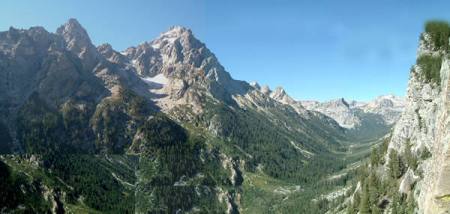
The last experience with which I will regale you was as an observer.  Years ago a friend (became my brother-in-law) and I were doing a route called Guides Wall in the Tetons.  Mid-way up on an adequate ledge that sloped back to front, he realized that there was business to be done.  He undid what was necessary, backed up, leaned against the wall, and lost himself in thought.  Unfortunately, the sloping geometry allowed the ‘fruit’ of his efforts to roll down upon and into his knickers.

Oh well, be honest, who hasn’t found themselves in something of the same predicament?

And, oh, the view!

view-from-guides-wall