Archive for the ‘Art’ Category

Sunlight and Socks

September 23, 2011


  Next time you’re trying to match a pair of dark socks and fold them up into one of those little balls, go to the trouble of holding them next to each other in direct sunlight.  Don’t be surprised if two first thought to be mates turn out not to be when smiled upon by the sun.

  Sunlight of course is a natural cause of degradation – stuff fades.  But it also is by far the best source of illumination with which to regale an object’s reflection toward perception by a visual system human or otherwise. 

  That quality is behind the motivation of some architects to go to great and expensive lengths to incorporate natural light into special spaces by means of skylights and elaborate translucent roofing systems.

Though such design elements can be problematic (leak), their effects upon objects below can be magnificent.

  Italian architect Renzo Piano established his career with series of museums exploring such possibilities with first the Menil, then Twombly* in Houston, the Beyeler in Basel, and lately the top floor of the new addition to the Art Institute in Chicago.

  Andy Sedgwick of Arup was the engineer of several of those solutions and it is his sketch of the light boxes for the Figge Art Museum that you see above.  Though rough, it is conceptually demonstrative of the finished product. 
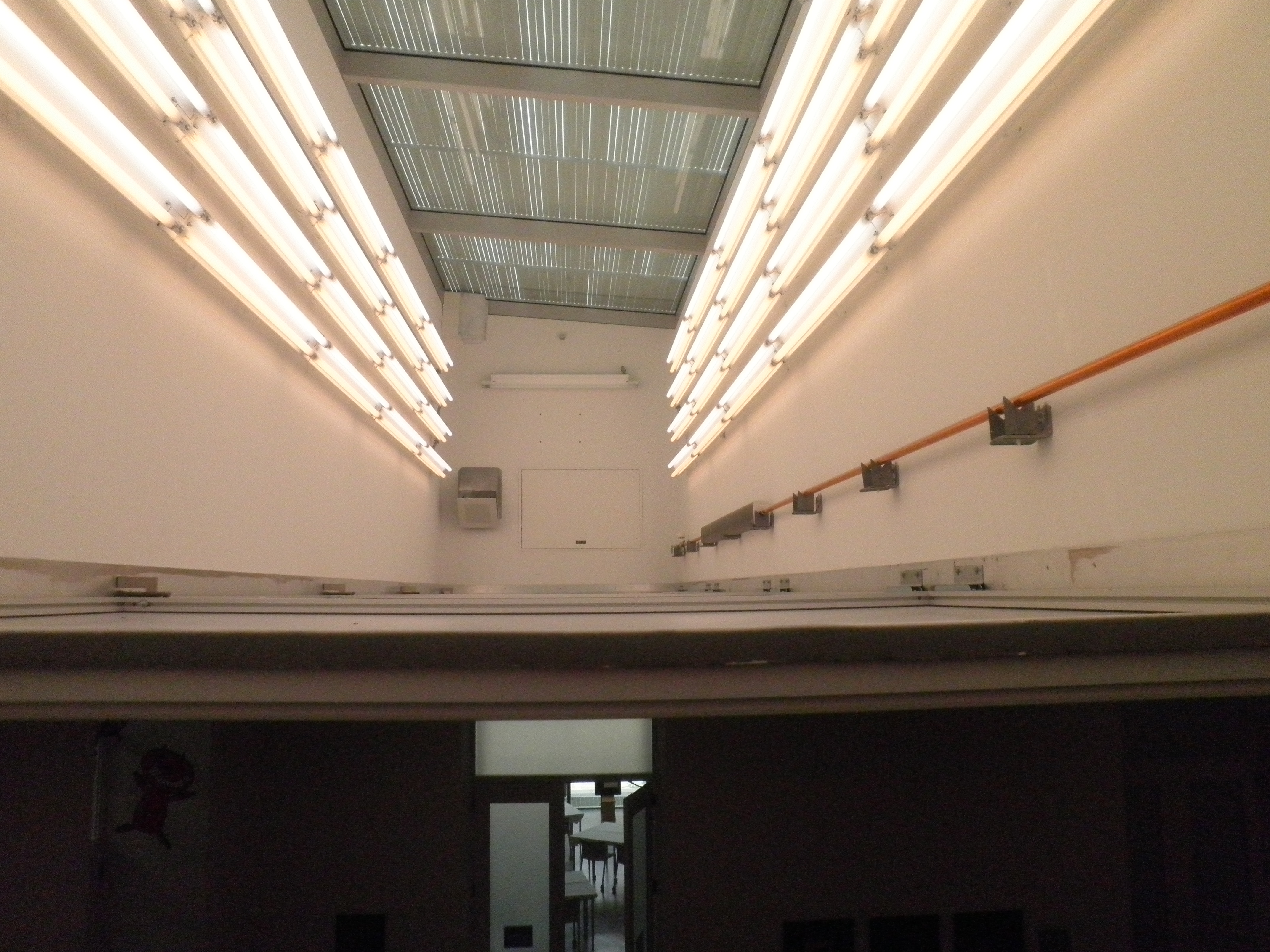
  Their several components begin with the glass lights (panes) on top, then mechanical louvers to allow for modulation, then on the sides supplemental fluorescent tubes (cloudy days, night), and finally “stretched diffusing fabric”.  This last, in the end, turned out to be special scrim imported from France.
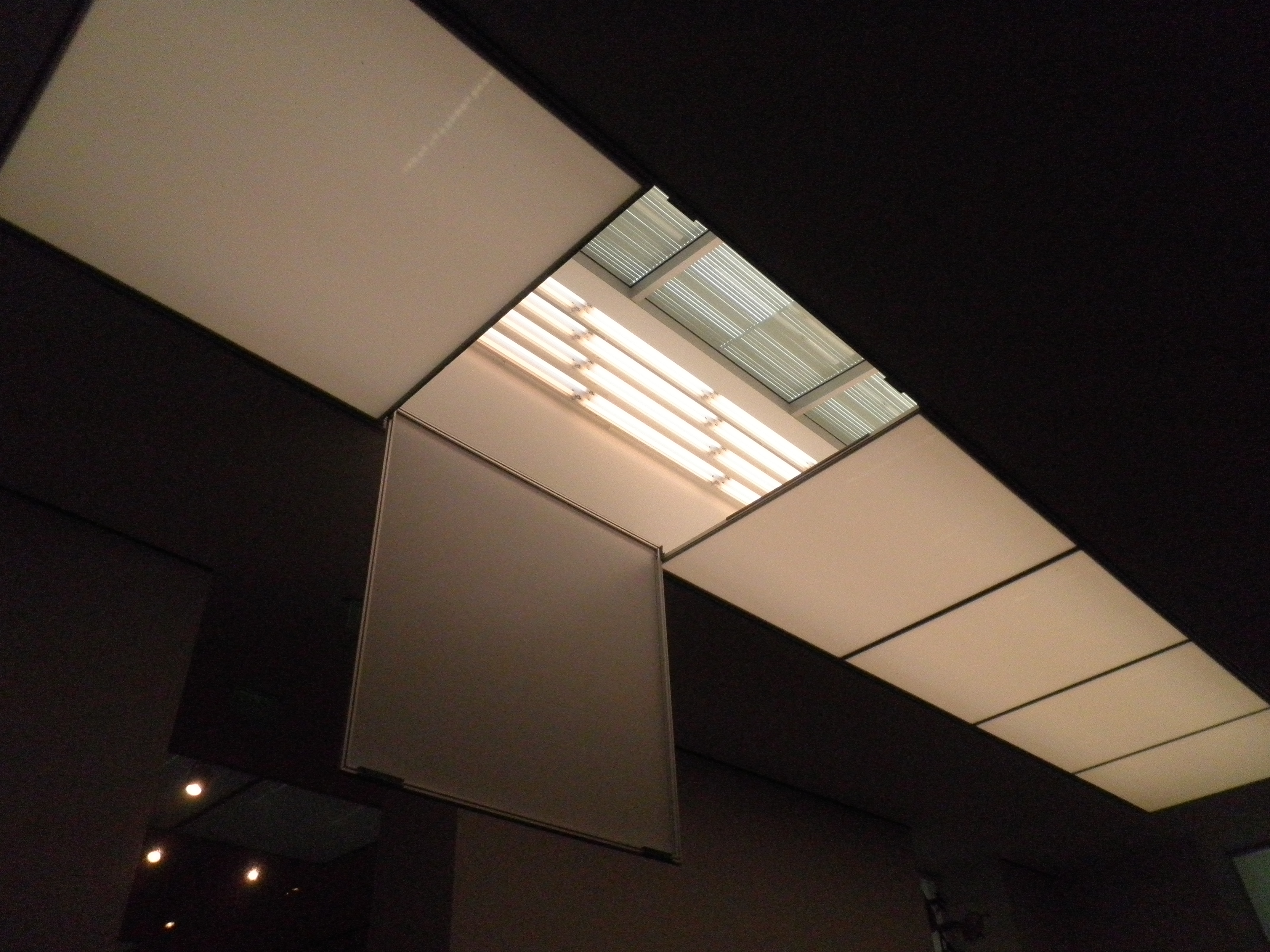
  Louvers opened, the finished product exudes the sort of generosity that Abbott Suger referred to during the early stages of gothic architecture as the “metaphysics of light”.  Standing below one once on a sunny summer afternoon, I looked down from Chase’s Mrs. Chase in Pink **to watch shadows of huge Midwestern cumulus roll across the floor.  Sent shivers up and down my spine.

*The light in the Twombly reminded me of a near death experience: cf 3/4/11 below.

**And Mrs Chase and I go way back: cf 4/10/09

Think With Your Hands

September 9, 2011


  OK, the other day I was near a bookstore in its final death throes, having been killed by the internet, Amazon, et al.  Sign said “80% off” so I decided to go in and see if there was anything interesting left.  There was!  Edward Tufte’s Visual Explanations – Images and Quantities, Evidence, and Narrative. 

  The Boston Globe calls the book “A Visual Strunk and White”.  The New York Times calls Tufte: “The Leonardo of Data”.  No understatements.  With wit, verve, and beauty the author convincingly shows how good design matters.

  One of many cases in point.  We learn that it was poor design that allowed the Space Shuttle Challenger to explode, and I’m not referring to the engineering of the Shuttle or its launch vehicle themselves, but rather that of charts engineers used the day before the launch in an unsuccessful attempt to convince NASA that an explosion was likely.

  The physical problem was that the cold temperatures predicted for launch date would attenuate the resilience of critical rubber o-rings allowing propellant to escape and conflagrate.  The chart below is but one of several holding data describing the danger.  Of their many faults Tufte cites inadvertent visual dissembling: “Chartjunk”. In contrast “Good design brings absolute attention to data”.

  Then he recounts the famous experiment undertaken by the Nobel Prizewinning Physicist Richard Feynman in front of the commission investigating the accident.  Using a small c-clamp he’d brought with him, he squeezed an o-ring and put it in a glass of ice water for a few moments.

  As he removed and released the bit of rubber, it became immediately apparent that the cold kept it from springing back.  “I believe that has some significance for our problem”.  The utter clarity of his presentation and his deadpan understatement blew the minds of the masses who saw it on TV or read about it in the printed press.

  “Never have so many viewed a single physics experiment.  As Freeman Dyson rhapsodized:  “The public saw with their own eyes how science is done, how a great scientist thinks with his hands, how nature gives a clear answer when a scientist asks her a clear question.”

  So, now, my questions are first: Without shelves loaded with books in a store through which to meander, how will one be able to occasion such moments of serendipitous edification?  Seriously.  And more important (again) what will the internet do to the potential for the development of great minds that “think with their hands”? 

  Here’s a response to question #2.  Reformed nerd Nick Carr has written a Pulitzer nominated book, The Shallows, What the Internet is Doing to Our Brains and penned an article for The Atlantic titled “Is Google Making us Stupid?”  Slate called his work “Silent Spring for the literary mind”.        

  Carr believes that “…there’s legitimate reason to be fearful.  I’m just suggesting that data technology is becoming so dominant that we’re losing the opportunity and the encouragement to engage in what I think is the highest form of thought.”*

  I’m gonna get some sort of grip exerciser. 

*”The Reluctant Luddite.  Nicholas Carr is a Net user of the first order, but he believes his brain is paying for it.”  Article by Dirk Olin in the Sept/Oct ’11 Dartmouth Alumni Review.


Joe, Joe, and Joe

August 26, 2011


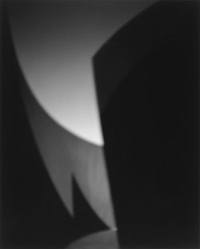
  Artist Hiroshi Sugimoto did a series of black and white photographs of Richard Serra’s Joe, a sculpture which sits in an outside courtyard at the Pulitzer Foundation for the Arts in St. Louis.  Sugimoto’s work is interesting for a variety of reasons not least because of Serra’s own surprise: “This is not about me”.

  The several ton piece was Serra’s first torqued spiral and he was shocked that the Japanese photographer had not undertaken a documentary style project.  Instead, Sugimoto used the opportunity to create a work  of his own and with it a more effective conveyance of the sense of Serra’s ideals than a more literal interpretation ever could. 

   The images abstract and cerebrate the unexpectedly complex physical experience of the huge hot rolled steel spiral.  The two dimensional representations are thus elemental forms manifested and manipulated by Serra and returned to the Platonic realm by Sugimoto.

  Furthermore, fascinatingly, Sugimoto doesn’t see Joe as relating to its namesake, Joseph Pulitzer.  “I see it as related to my seascape series as a metaphor of human memory.”  He tells us that a seascape is likely the least changed vista since the rise of consciousness.  A gaze upon one thus shares an ethereal resonance with those of our earliest ancestors as well as all those between.

  An early product of this awareness was remembrance of the dead.  The first proto-human efforts beyond feeding, fighting, fleeing, or f______ (making babies) were the creation of graves, tombs, and then cenotaphs.  Sugimoto calls Joe a “metaphor and system of remembrance”.  Seems to me that the relationship between Joe and Photographs of Joe is a metaphor for the evolution of consciousness.

*Quotes from the exhibition brochure “Hiroshi Sugimoto – Photographs of Joe; edited by Matthias Waschek; published by the Pulitzer Foundation for the Arts; 2006.

**cf “Conquistadors of the Useless” 1/21/08

… the ongoing danger of collectively creating scapegoats

August 6, 2011


  Last week one lone deranged man killed seventy-three young people on an island near Oslo, Norway.  That terrible event was sort of an inverted reflection of another horror that took place in the far north of that country many years before.  During the course of the seventeen century,  the 3,000 citizens of county Finnmark convicted ninety-one men, women, and young girls of witchcraft and burned them at the stake.

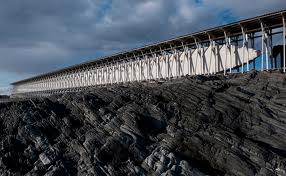
  If you’re with me so far, you’ll find it quite the coincidence that a memorial for the earlier event opened just this past June.  It is the Steilneset Memorial To The Victims Of The Witch Trials and was a collaboration between Swiss architect  Peter Zumthor* and the late great nonagenarian Louise Bourgeois.  During the ceremony, presided over by Queen Sonja, general secretary of the Vardo Church City Mission Sturla Stalsett that “the memorial is meant to remind us of the ongoing danger of collectively creating scapegoats”.**

   Zumthor designed two structures for the barren rocky site.  Of the first, pictured above he said: “I didn’t want an aggressive massive monument.  Creating a light delicate structure was best for this rough space”.  It is 410 feet long, narrow, and has ninety-one randomly placed windows.  Behind each is suspended a single light bulb.  “The feeling is like being in the stomach of some prehistoric creature…except there is a glimmer of light”.

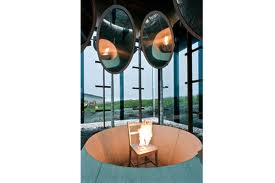
  At the south end a gangplank leads into the other glass and Cor-Ten cubiform volume housing Bourgeois’ work pictured below.  It is comprised of an aluminum chair with flames emanating from the seat and is encircled by seven oval mirrors.  “…like judges circling the condemned”.

  The location is remote, but not off of the beaten path.  The Varanger National Tourist Route program consists of eighteen major routes to facilitate interesting travel while punctuating the country’s magnificent geography with integrated points of interest.  It is overseen by the Norwegian Public Road Authorities and is scheduled to be complete in 2020.  Phew.  Guess don’t need to hurry

 *For more about Zumthor read post of 4/24/09 “Reading about Reincarnation is not the same thing as being reborn”

**Much of the information above was drawn from an article by Suzanne Stephens in the August 2011 edition of Architectural Record.

Probably Not PC

July 2, 2011

  I’ve always loved fireworks and come naturally by that I guess.  Dad always had ordnance around in abundance.  He went fishing once with dynamite up in Canada.  I love the memory of him relishing the retelling.  It was Bikini Atol revisited with boats rolling gunwale to gunwale; all soaked to the bone; and non-swimmers trembling uncontrollably.  But no fish.

  Explosives have successfully been employed to kill things of course,but – in an incredible yet elementally characteristic paradox of this universe – as modes and expressions of creativity as well.  Several examples:

  First, well first “Let there be light”.  The Big Bang from whence arose all beautiful metaphysical wondering.  Whether or not you believe these fireworks were orchestrated by a dude in robe and slippers you’ll have to admit its unfolding to date is amazing to behold.

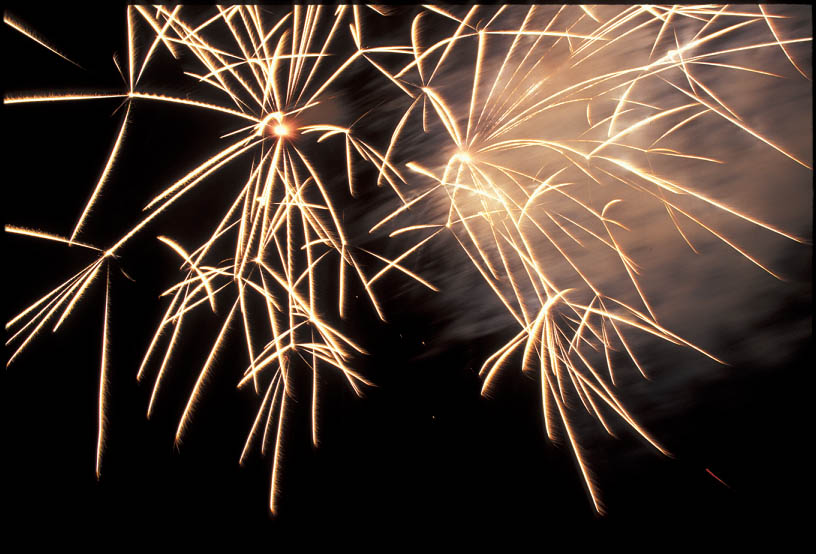
  Isn’t that what comes to mind each July 4th or 14th or whatever national holiday or celebration as you watch maybe a chrysanthemum burst first forth

  and then a palm

  and then a crossette

  and then a kamuro

  All followed by first the light and then the resound of the mighty salutes?

  Fireworks were invented in China some 2000 years ago.  The story goes that a Chinese cook accidentally mixed the key ingredients too close to a fire and thus soon saw a flash.  Duly impressed with himself, he made more, packed it in a bamboo tube, and then, well, however you say ‘voila’ in Chinese.  Marco Polo took the stuff back to Florence where color was added and pyrotechnics joined the other arts of the Renaissance with which you might be more familiar.

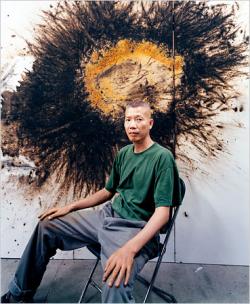
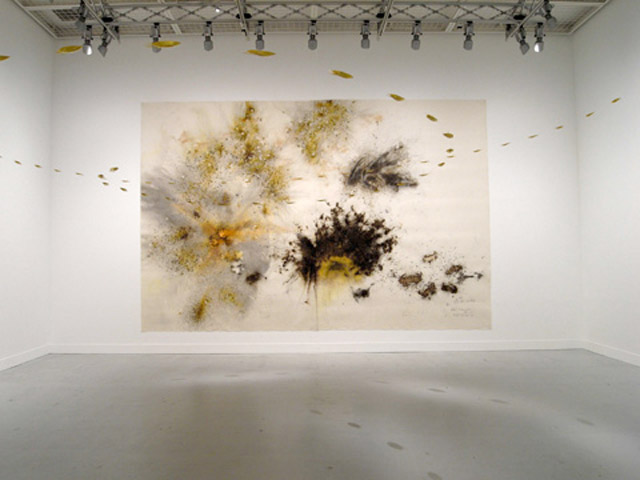
  More recently, Chinese artist Cai Guo Qiang (b 1957 in Quanzhou) has built a career with gunpowder as the original component of his medium.  He’s big stuff.  He first employed it in the creation of (believe it or not) works on paper – ‘gunpowder drawings’- embodying spontaneity and confronting authority.  They’ve been the subjects of exhibitions in prominent museums around the world including one at the Hirschorn in 2004 over which wife, daughter #1 and I marveled.

  From there he’s gone on to create magnificently choreographed “explosive events” including one watched by billions – the opening of the Beijing Olympics in 2008.  His work is not just of chemistry.  It incorporates motifs, metaphors, and representations of shanshui paintings, Mao*, fengshui, and much more.

  After all of this one should not be surprised to learn that a certain pair became engaged on one July 4, watched the show from a mountain top, and had Handel’s Fireworks  play at the ceremony some weeks later.  It’s been a blast!

*cf Post 2/13/09

I’m Glad I Don’t Have A Tail

May 13, 2011


  Please, please, please don’t repeat this to anyone.  Last Friday wife and I rode our bikes along the river to a brew pub for dinner.  On way home via a different route just before dusk she (up ahead) exclaimed: “Is that what I think it is!?  Let me have your knife!”

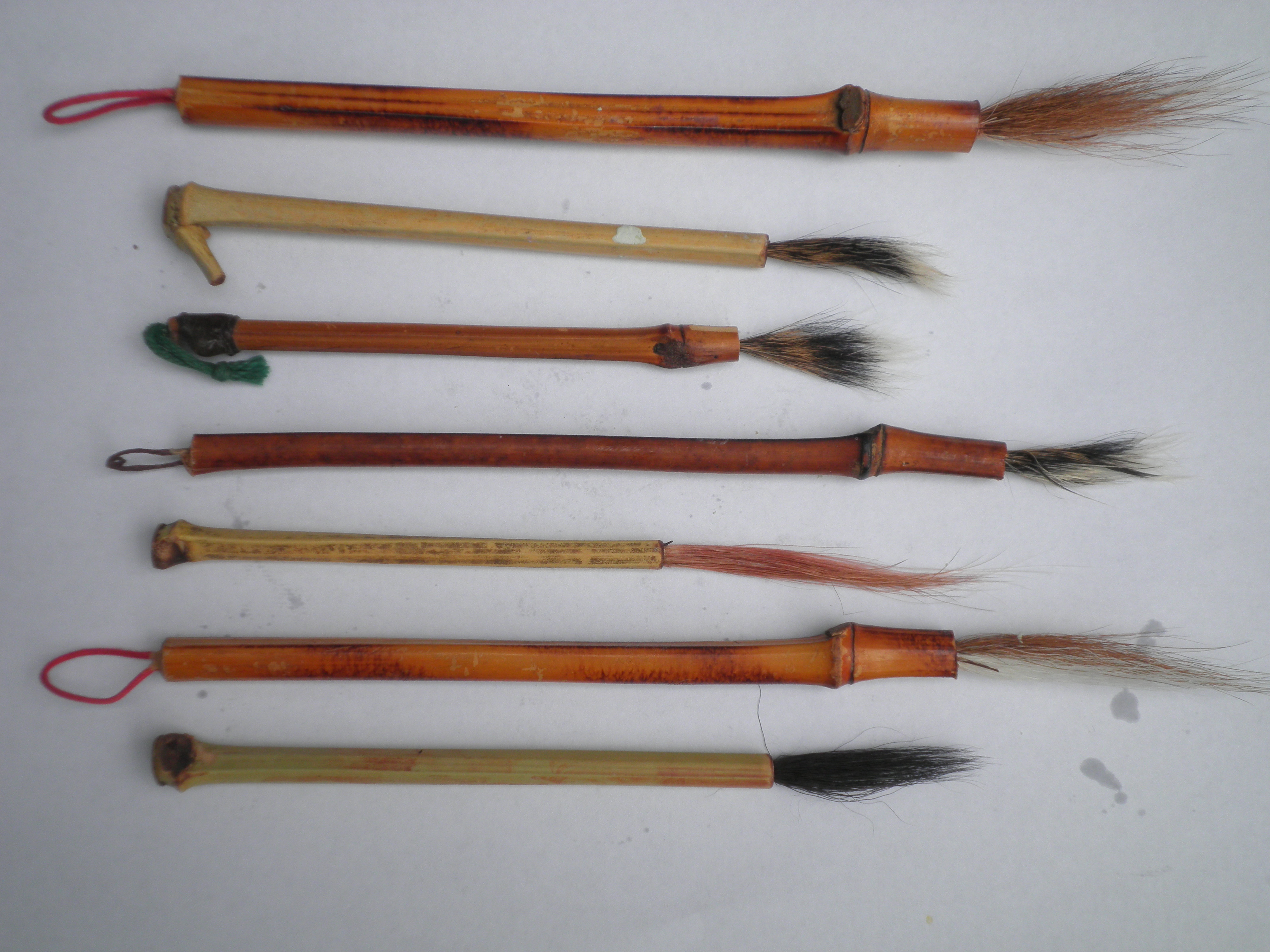
  I did so and then watched as she cut the tail off of a dead black squirrel.  Jeesh.  Unfortunately I’ve many times found myself part of that peculiar sort of excision separating tail from torso of skunk, deer, raccoons, and more.  All in service to art.  She makes fine brushes with the hair.

  Jung wrote some interesting stuff about artists: “The artist’s life cannot be otherwise than full of conflicts for two forces are at war within him (her) – on the one hand the common human longing for happiness, satisfaction and security in life, and on the other a ruthless passion for creation which may go so far as to override every personal desire”.

  Furthermore: “The artist is not a person endowed with free will who seeks his (her) own ends, but one who allows art to realize its purposes through him (her)”.*  Mission for god as the Blues Brothers put it.

  Demanding a muse might be, but a grand thing which to follow should an audience later manifest.  What a way to live if people would cathect emotion and fork over dinero in response to what might express from the depths of one’s soul through a trained and tamed skill set.  Two examples:

  Mick Jagger arranged for Lucien Freud to paint his then wife Jerry Hall and baby.  Sitting for Sigmund’s grandson is an arduous process and Mrs. Jagger spent many many hours in his studio over the course of four months. 

  One day Freud called his dealer William Acquavella: “I want you to be the first to know, the painting’s had a sex change.”  “What!” Acquavella responeded.  “Well, Jerry didn’t show up for two sittings so I changed her into a man”.  Jagger rang up Acquavella but there was nothing that could be done.** 

  Similarly, if not quite as obstinately, architect Peter Zumthor picks his clients not visa versa.  “Normally architects render a service.  They implement what other people want.  This is not what I do.”  What he does is to take the measure of a site and client from which to distill his vision.  Not theirs.

  Actor Toby Maguire hoped for a Zumthor house in the LA hills.  The architect said he’d look at the site if Maguire’d educate himself by visiting several projects in Europe such as his spa in Vals Switzerland and museum in Bregenz Austria.  House went ahead.  Maguire asked for a basketball court, but apparently got a garden instead.***

  Uhm, I’m glad I don’t have a tail.

*Both Jung quotes are from his book Modern Man in Search of a Soul

**WSJ Weekend April 2011 by Tom Vandrbilt

***New York Times Magazine by Michael Kimmelman


Beyond the Blare of the News

May 6, 2011


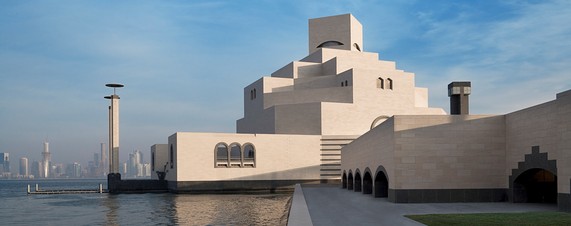
  There are small minds everywhere, but fortunately there are about big ones too.  Above you see the Museum of Islamic Art in Doha, Qatar.  It was designed by IM Pei who went to very great effort – wide peregrination and deep cultural immersion – to find the heart of Islamic architecture.  “Might it not lie in the desert, severe and simple in its design, where sunlight brings form to life?”*

  Most collections of Islamic art are in the west, minded by non Muslims.  The original vision of The Emir and his wife Sheikha Moza was not only to emplace fine objects in the region of their origin, but also to provide a center of culture and education.  “Here is a museum in the Muslim world capable of bridging the gap between tradition and modernity” said the original curator Sabiha Al-Khemir.

  As you may know, pictorial representation contravenes a precept of Islam.  There is thus no tradition of landscape or portraiture.  Think then about how it must currently be for visitors to that museum to look upon the likes of Rembrandt, Hals, and Vermeer for the first time in an exhibition of the Dutch golden age.

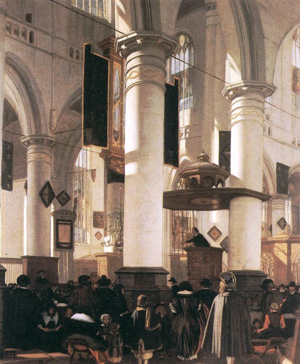
  For an article in the May 2011 Art Newspaper editor Anna Somers Cocks toured the show with a young volunteer.  The responses of the latter to Ms Cocks’ “just tell me what you see” were fresh and felt and fascinating.  About Church Interior by Emanuel de Witte (below) she said:

  “I like this very much; if you stand back you feel like you can go inside it.  I like that he drew if very well; you can see the small things like the details of the column.  They told me that they put dead people under the floor and I said how can you prey with dead people beneath you? I am told that when a woman got married the only thing she could do for fun was to go to church.”

  Above you see Jan Steen’s The Very Merry Family: “Because everybody is happy about something, everyone is doing a different thing, but because they are ignoring each other, the small child is on its own, drinking.  So this is a troubled family and very dirty and things are falling down.”

  She liked Rembrandt’s Self Portrait: “I love this person because he has been painting himself since he was young.  Maybe this is his last portrait.  I have heard that he painted himself all through his life, how his face, how his body changed.  It’s a very nice idea.  You can feel he is very old, even from how he is drowning his hair.  He does not put in many details so that you can focus on the face”.

  Hmm.  There is so much behind and beyond the blare of the 24/7 news cycle…

*I.M. Pei Complete Works by Jodido and Strong, Rizzoli, 2008

Tornado in a Lumberyard

April 29, 2011


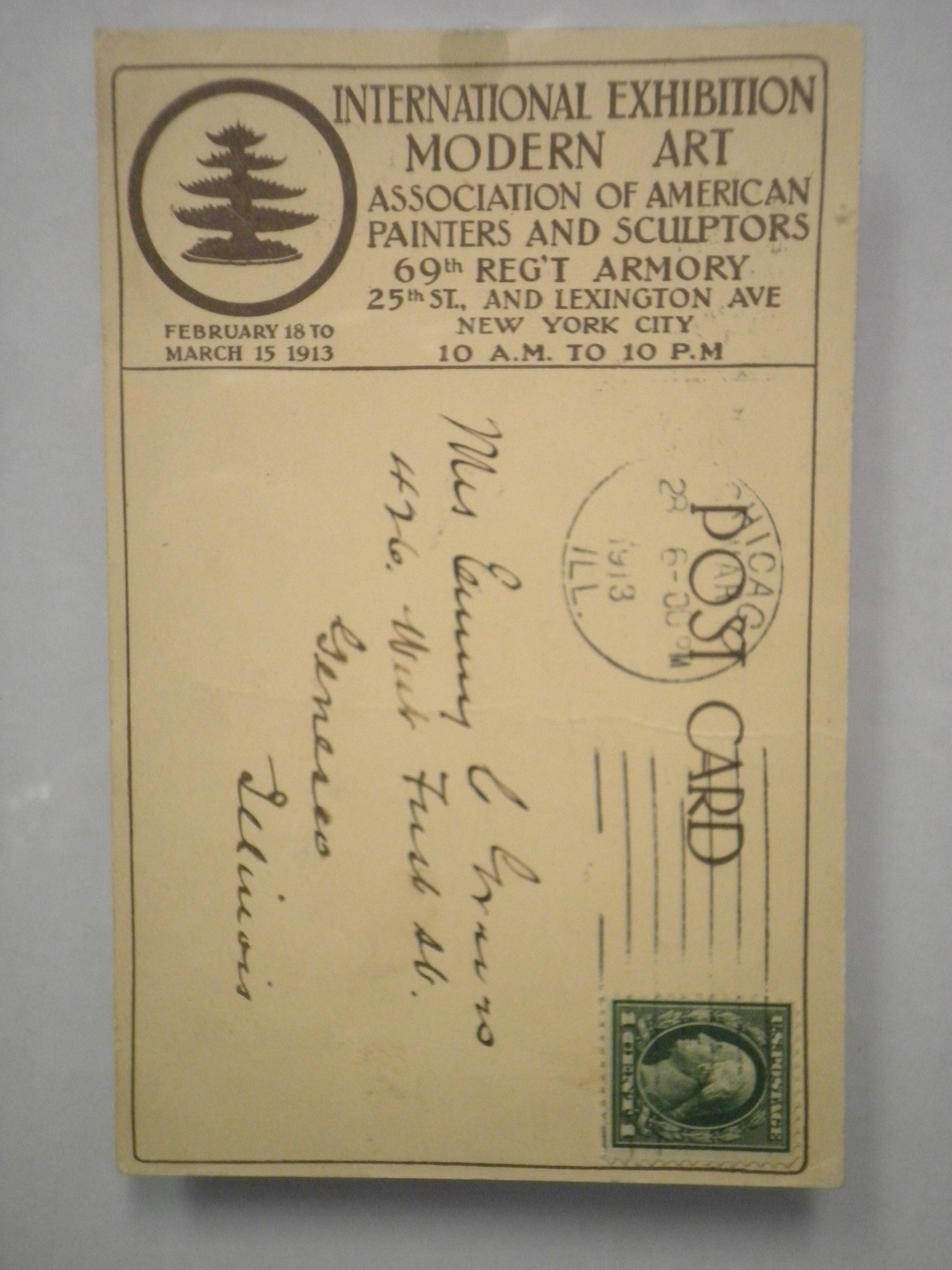
  The 1913 Armory Show was arguably the most important exhibition of art ever organized on this continent.  It introduced cubism, futurism, Cezanne, Duchamp, Picasso, and much more to audiences on this side of the pond and inflected the NA zeitgeist like nothing else before or since.    

  It was up in NYC from February 17 to March 15 of that year and then traveled to Chicago where it hung in the Art Institute March 24 to April 16.  From there it went back east to Boston.

  The postcard image above is, of course, Duchamp’s Nude Descending a Staircase.  My great-grandfather sent it to my great-grandmother from the Chicago venue.  His handwriting encircling the picture reads:

 “This is a photo of one of the cubist pictures.  It is said to be a picture of a nude woman walking down stairs.  I don’t think any of the postal authorities will object to it as improper as it goes through the mails.  I have one more I will bring home with me.” 

  “There is no news.  I went to see this exhibit and must say it is a fright.  Yet I heard one or two fools raving over the beauty of these daubs.  It was worth going to see however just to see what some will praise.  Lorado Taft* says it reminds him of nothing so much as a lumber yard after a tornado.  Home as usual tomorrow at 6.  Yours, EC”

  My great-grandfather was a judge who frequently traveled between Geneseo, Illinois and Chicago.  He died young and left my grandmother, one of five offspring to survive, and great grandmother to fend for themselves.  Grandma adored her father and held dear precious memories and memorabilia through to the end.  Interesting now to allow them to take one back…

   Compare the image on top with the one just above and you will get an idea of an experience none of us will ever again have.  An in-person audience with a work of art will always be different than one with a reproduction**, but any potential for shock and awe has been removed by the quality and ubiquity of virtual experience.

  On second thought, I retract that observation.  Or qualify it I guess with the addition of the following phrase:  given current knowledge of our universe…

*Lorado Taft (1860-1936) was a prominent American sculptor and teacher.  His studio was in Chicago and he taught at the Art Institute.

**I’m pretty sure I’ve used this in a previous post, but in case you’ve forgotten, New Yorker critic Peter Schjeldal wrote: “Reproductions are like pandering ghosts, they show us what we want to see”. 


Astonished

April 2, 2011


Ok, here’s what to do next time you visit Chicago’s Art Institute to scintillate the constellation of your synapses. Enter through the original portal between the lions on Michigan Avenue, negotiate admission, and go down and right to room 109 – The Ando Gallery.

As I’ve mentioned before (4/4/08) this particular confluence of space, cirumstance, and spirit engenders the sort of roundedness for which pilgrims yearn. Experience with the objects in this serene room is one of communion not idolatry. you leave imbued with far more than didactics alone could possibly convey.

Make your way down the hall that used to be lined with swords, armor, and coats of mail, but now Buddha, Hinduism, and the way of the Tao. At its end (decorative arts to the right) go left and be overwhelmed by the cavernous great hall of the new wing. Whoa.

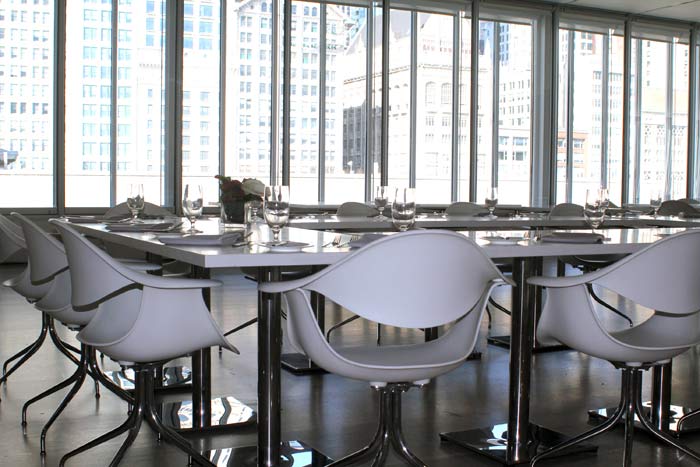
Continue north to its end and climb the stairs (!) to the Terzo Piano* – the restaurant on three. It is neutral but well fenestrated inside and breathtakingly open on the outside deck. maintain composure, walk around, and choose a perch.


From any point of vantage you will join the ebullience of this big shouldered city breaking bread head to head with the work of Burnham, Gehry, et al. Enjoy the fine repast, your friends, and the skyline. It’s astonishingly fine to be human. There may yet be hope for us all.


*Terzo Piano – A play on words. It means third floor in italian, but also refers to the architect of the new wing – Italian Renzo Piano.

**Sorry about last week.

Been on a whorl wind road trip. On train now. About all that later. Photos for this post too.

I’ll Have What She’s Having…

March 11, 2011


  Normally, I hesitate before expounding upon something I have not yet seen in person.  More to the point, I avoid even thinking about a building in which I have not actually been.  It’s the “Ce N’est Pas Une Pipe” thing.  It’s not a pipe, it’s a painting of a pipe.**  So to be clear, what follows is my impression of a building of which I’ve only seen photos and read reviews***.

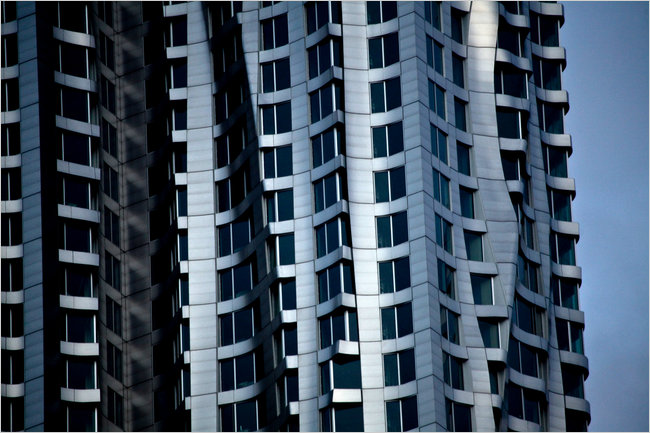
  It’s Frank Gehry’s first skyscraper – an apartment/mixed use building at 8 Spruce St in NYC.  It is the tallest such building in the city standing some seventy-six stories and holding more than nine hundred apartments, a gym, a swimming pool, and a new public school.  The assemblage of those spaces is reportedly pleasingly functional, but the building’s allure is far greater than their sum. 

  Something immediately tingled inside me when I turned to that page, but it was Gehry’s description of his motivation that brought me full flush:  “I had one of those eureka moments, at three o’clock in the morning, when I thought of Bernini.  Michelangelo is rounder, Bernini is edgier”. Right on.

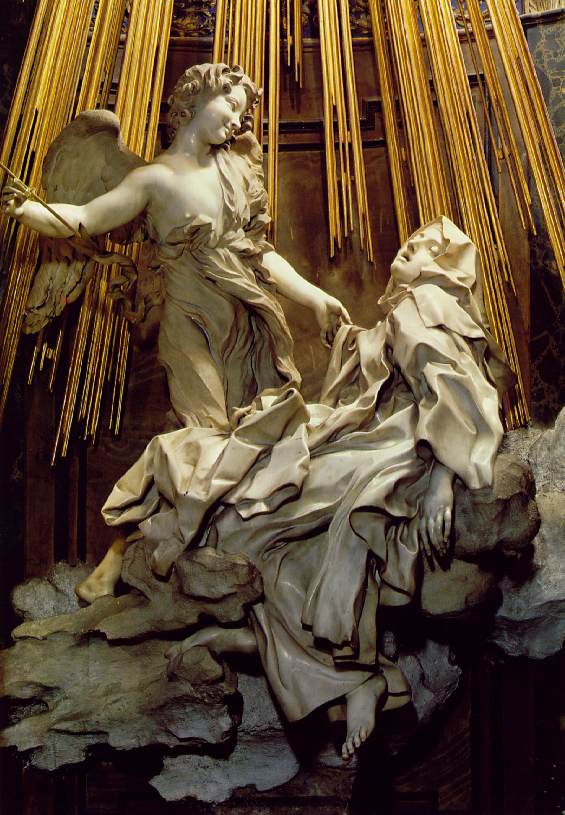
  I’m in awe of the subtle manner of Michelangelo’s graceful conveyance of form and tension in his sculpture, David for example.  It’s cool and I’ll not forget the experience of it.  But, well, when one thinks of Bernini, how could not the image of the Ecstasy of St. Teresa leap into one’s mind? 

  In a book about art and beauty Umberto Eco wrote of the expression of pain in the visage of that St Teresa.  How could he possibly have had that reaction?  He needs to see an ophthalmologist or shrink maybe.  That woman is in the throes of something grand whether the tumescence was spiritual or otherwise.

  I have been in, on, and around several Gehry projects and enjoyed those experiences.  There’s often an element of exuberance.  But this is different.  Does not that building appear to be on the verge of a shudder? 

  This might be a stretch, even for me, but the east elevation of 8 Spruce St makes me think of Katy Perry:

I might get your heart racing
In my skin tight jeans
Be your Teenage Dream tonight
Let you put your hands on me
In my skin-tight jeans
Be your Teenage Dream tonight…

*If you don’t get this allusion, that’s your problem

**cf post of April 24, 2009

***Photo at top by Richard Barnes in a review by Paul Goldberger in the 3/7/11 New Yorker.  Other photo of the building is from article by Nicolai Ouroussoff in the 3/9/11 NYT