Archive for the ‘Art’ Category

Mirabile Dictu

March 4, 2011


    News reports regarding the Catholic Church over the last few years have largely been ugly.  It was thus a relief to read yesterday of  praise for Pope Benedict.  Though issues related to his regard for actions of Pope Pius XII in Europe during WWII are yet unresolved, his statements exonerating Jews of complicity in the death of Jesus Christ were very clear.

  About the Pope’s remarks Israeli Prime Minister Netanyahu said: “…I commend you for forcefully rejecting in your recent book a false charge that has been the foundation for the hatred of the Jewish people for many centuries…”

  Brought to mind an enlightened French cleric about whom I’ve read and with whom I’ve metaphorically crossed paths several times.  Father Marie-Alain Couturier fought and was wounded in WWI, became a Dominican priest in 1930, and was vigorously outspoken in refutation of Anti-Semitism in Vichy France*.
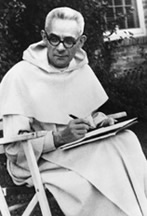
  “…I beg of you, remember that you are Christians, that charity tolerates no anti-Semitism, and that even if certain measures seem politically inevitable among those who have been conquered, at least let us maintain the integrity of our hearts…. As for myself, I love only freedom, and as I get older, I couldn’t care less about the rest”

  Another component of Father Couturier’s career (and my initial point of contact) had to do with the integration of art and the sacred.  As an artist and founder of the journal “L’Art Sacre”, he sought to invigorate that relationship as had Abbot Suger centuries ago with the development of the first Gothic cathedral.  Suger coined the marvelous term “metaphysics of light”.
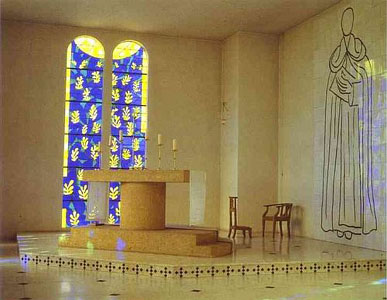
  Fr Couturier worked closely with Matisse on the Chapel de Rosaire in Vence on the Riviera.  Matisse was a lapsed Catholic, but Fr Couturier said: “Better a genius without faith than a believer with talent…Trusting in Providence, we told ourselves that a great artist is always a great spiritual being, each in his own manner…”

  Similarly, when commissioned to provide a sculpture of the Virgin Mary, Jacques Lipchitz asked the priest: “But, don’t you know I am a Jew?”  “If it does not disturb you, it does not disturb me” was the answer.

  Perhaps even more radical was Couturier’s decision to work with twentieth century giant Le Corbusier who “had no place for institutionalized religion within his ideal society”** and sought to demolish historic Paris and replace it with “machines for living” – expressways and high rises.

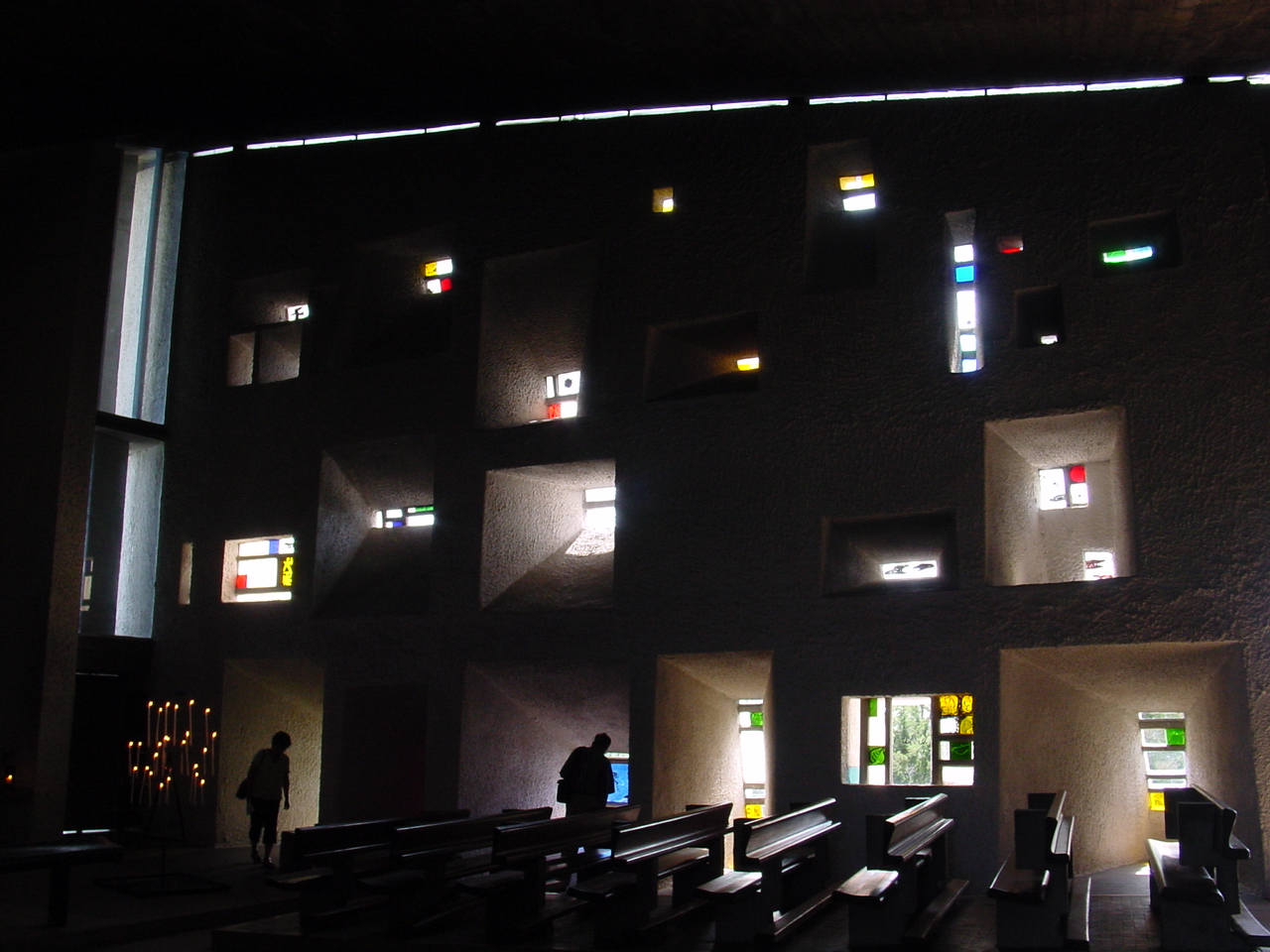
  Interesting, then, that the most well known project of their collaboration was the chapel at Ronchamp (photo way above and interior just below) which was a decidedly uncharacteristic departure for Le Corbusier.  About it he said: “People were at first surprised to see me participate in a sacred art.  I am not a pagan.  Ronchamp is a response to a desire that one occasionally has to extend beyond oneself, and to seek contact with the unknown”.
  In prewar Paris Fr Couturier had met John and Dominique de Menil who were captivated by his vision.  He told them that a museum is a place where “you should lose your head”.  Heirs to the Schlumberger fortune they fled France to the USA settling in Houston where they assembled an incredible collection of art, architecture, and good works.

  Italian architect Renzo Piano designed two wonderful museums for them there both incorporating the powerful Texan sun to sublime effect.  The Menil holds an eclectic collection of western and African art.  The other only the works of Cy Twombly and if you’ve never seen his stuff start there.

  It is the first of Piano’s experimentations with translucent roofing systems.  The lid of Twombly filters the natural light through a four part system with tautly drawn Italian sailcloth forming the interior ceiling.  The combination of the refined light, the character of the space, and Twombly’s work yields an experience of preternatural transcendence.

  Once, upon entering, a woman disrobed to bathe in the light.  French philosopher Roland Barthes recalled that he there felt as if in the thrall of a Buddhist awakening.  Several years after my visit, allergic reaction shocked into a near death episode, the quality of the ‘white light’ evoked therein seemed identical.  No foolin’. 

  The major work is the fifty foot triptych “Say Goodbye, Catullus, to the Shores of Asia Minor”.  Catullus was a Roman poet whose brother died and was buried in part of what is now Turkey.  As if crossing west across the Mediterranean, the painting leaves color behind on the right, reading left toward pale shades of emptiness.

  I was bowled over even though I didn’t know the story of the picture at the time of my visit – only upon a bit of research once back home.  That knowledge gives special poignancy to memory of the experience because it was on that day one of my two younger brothers underwent surgery for a cancer that claimed his life some months later. 

  He was an independent thinker, extremely intelligent, creative, sensitive, and spiritual.  His challenges to my world view catalyzed significant personal growth.  Hmmm…  His Tibetan Buddhist friends could engage in interesting speculation related to the fact that Father Couturier died about nine months before Ed was born.

*Father Marie-Alain Couturier, O.P., and the Refutation of Anti-Semitism in Vichy France; Robert Schwartzwald, UMass/Amherst.

**”Almost Religious”; Dennis MacNamara, The Institute for Sacred Architecture, Volume 2.

***Mdm de Menil once offered one of Barnett Newman’s Broken Obelisks to the city of Houston which declined because it was dedicated to the memory of Martin Luther King.  It now is in front of the nearby Rothko Chapel.  With President Carter, she formed the Carter Menil Human Rights Foundation.  The Rothko Chapel gives an award to those struggling against oppression.  Another, The Oscar Romero Prize, was named for the murdered El Salvadoran priest. 
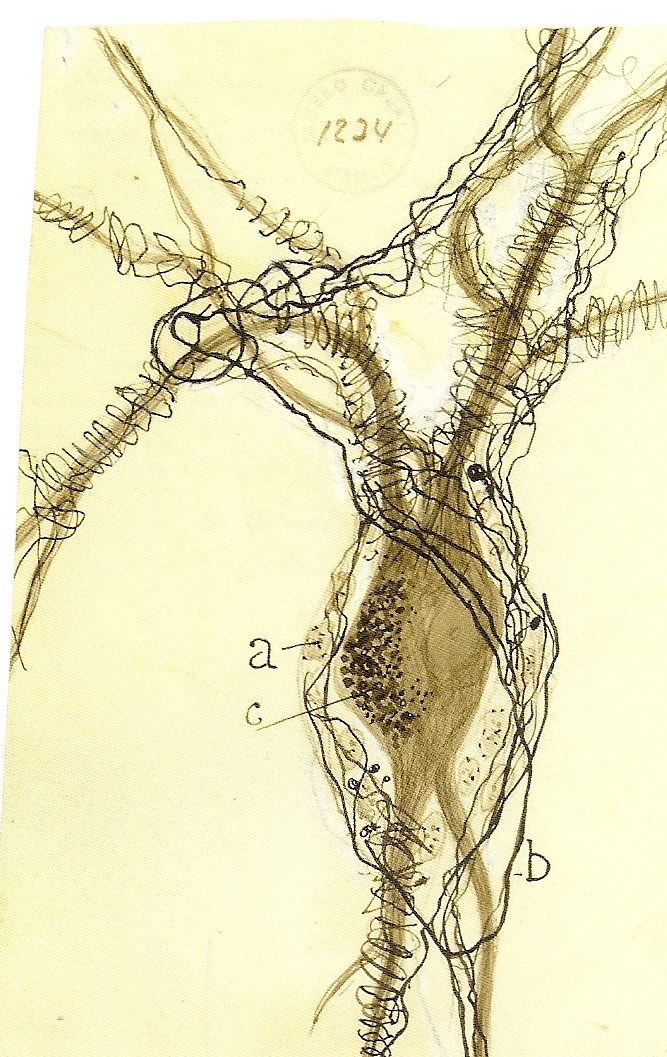
Hand to Mind

December 31, 2010


  The drawing above, by Santiago Ramon y Cajal, appears in the spectacular new book: Portraits of the Mind.  It is a fascinating tome leavening a narrative of the development of neuroscience with extraordinary images of milestones along the way.

  The exquisite quality of many of the images conveys a sense of wonder in three different regards: of the brain’s incredible intricacy; of the genius of the techniques invented to make that observation possible; and of the incredible talent employed in a variety of media bearing witness.

  Jonah Lehrer writes in the forward: “Keats knew that truth exists in a tangled relationship with beauty, and nothing illustrates that poetic concept better than these scientific images.  Their empirical power is entwined with their visual majesty.”  Yep.

  Nobel laureate (1906) Ramon y Cajal has been called the father of modern neuroscience.  Using a technique developed by his contemporary and co-Nobel recipient Camillo Golgi*, he found that the “fundamental organizational and functional units of the nervous system are individual cells” – neurons.  This ‘Neuron Doctrine’ supplanted the Reticular Theory which had held that the nervous system was a vast unorganized, unstructured, tangled net.

  The work above depicts axons wrapped around a neuron.  Specifically those of a thalamus.**  The draftsmanship is stunning – one gets a sense of three dimensions by the manner in which he manipulated the quality of the axon lines about the bulbous soma and its dendrites.  The axons have come from other neurons with messages.  The interaction is exquisite. 

  I was so moved in contemplation that a particular drawing of Albrecht Durer’s came to mind.  Look at the Head of Dead Christ below and see how his fine touch gave Christ’s beard a wondrous 3D tactility. Jordan Kantor wrote of the work that: “Through the miracle of Durer’s facile hand, the charcoal itself almost becomes the dead body of Christ”.***

  From vastly different perspectives, but with similar apparent simplicity, two great men have managed to take our breath away in  meditation on the nature of mind, man, and the human condition. 

*They didn’t like each other, didn’t work together, and spoke ill of each other during their acceptance speeches.

**Interestingly, Ramon y Cajal’s work showed that neurons and their parts differ from one part of the brain to another.  “Each part of the brain bears its own signature architecture of axons”.  The breadth of shapes and sizes (as depicted by R y C) is amazing.

***Durer’s Passions, Harvard

Inexhaustable Flux

November 26, 2010

  From these temporal, geographical, and cultural points of remove, it is impossible to have a sense of the tumult in Japan at the end of WWII.  Among all else, the Emperor had been believed by many to have been a direct descendent of the sun.  Very few had seen him or heard him speak.  That his first public appearance was to announce the unconditional surrender of the centuries old dynaasty had to have been a shock of seismic proportions. 

  The zeitgeist of the uncommonly homogeneous and hierarchical island nation bore witness.  By the late fifties, any reticence to question or challenge authority had long since passed.  There were student riots.  Japan’s highly refined aesthetic patrimony convulsed.   

  One result was Butoh, an example of which you’ve just finished watching.  It is a typeof performance said to havebeen a reaction against traditional Japanese Noh, which dates back to the 14th century as well as to an incipient movement to imitate things western.  Almost unclassifiable, the term refers to a variety of inspirations, movements, or lack thereof.  

  Nonetheless, Butoh’s first proponents, Tatsumi Hijikata and Kazuo Ohno, having been dancers, that somecall ikt a form of modern dance is not surprising.  There is no set style, but white makeup and tightly controlled motion seems common.  Sankai Juku is the troupe most well known outside Japan.  It gathered much media coverage in 1985 when a rope suspending a performere from a tall building broke and he died.

  One artist,  Iwana Masaki, describes Butoh thus:  “I regard present day Butoh as a ‘tendency’ that depends not only on Hijikata’s philosophical legacy but also on the development of new and diverse modes of expression.  The ‘tendency’ that I speak of involved extricating the pure life which is dormant in our bodies”. 

  Sankai Juku recently gave a series of performances across North America.  Linda Sehlton, exectutive director of the NYC venue, said in an 11/0/10 WSJ interview that:  “you can interpret [the performance] in many different ways or not at all.  You can just enjoy how beautifully, peacefully they move and how visually stunning it is…”

  Sankai Juku translates as “studio of mountain and sea”.  The piece being performed below, Tobari, means screen or curtain.  It is subtitled “As if in inexhaustible flux”.  About it (in the WSJ bit) troupe founder Ushio Amagatsu said: “When human beings see stars, they see light emanated millions of years ago.  They are seeing something both in the far past and present.  That’s the reality of human beings.  We as individual human beings – our life span is limited.  However, we are part of a long history of life.  It’s so long that it’s continuous.”

  Yep.


Wake Up!

November 5, 2010


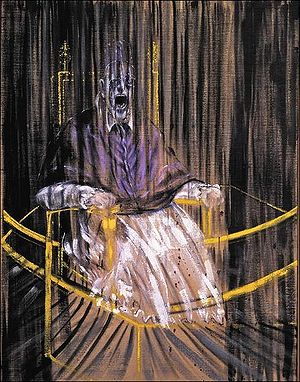
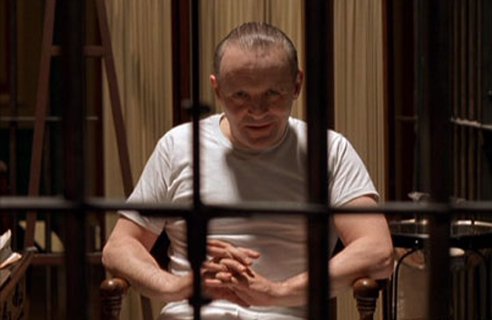
  The picture above is Study After Velasquez’ Pope Innocent X by Francis Bacon.  The one just below* is a shot of lead character Hannibal Lecter from the film Silence of the Lambs directed by Jonathan Demme.  I think that the similarity of the two images is striking. 

  Demme’s an art collector (though most well known for his Haitian stuff) and had to have been aware of Bacon’s oeuvre.  The cell in the Memphis courthouse is certainly not an exact transcription of the painting’s motif and could have been done subliminally or even completely by accident.  But, as someone once said “ mediocre artists borrow, great artists steal”.

  The arrangement of the prominent vertical brushstrokes in the Bacon work has the same visual impact and conveys a similar carnal apprehension as do the bars of the cell in the flic.  Both characters pervade beyond any limitation.  Like nightmares.

  Bacon said that he “had nothing against popes” and simply found their garb to be uniquely suitable for the colors with which he was then working.  Sure seems disingenuous to me.  He painted forty some in the series and the power of the images suggest otherwise.  Even though screaming heads appear throughout his body of work, they’re a fungible conceit.  It would be easy to impute certain recent horrific revelations and wonder about the possibility of the cathexis of earlier manifestations through Bacon’s brush.

  At any rate, the two images project – to me at least – horror from nearly opposite perspectives.  Bacon’s pope nearly empties himself in sanctimonious rage while Dr. Lecter speaks with the quiet confidence only available to a psychopath.  The former just barely obscures the abyss with his robes and incantations while the latter revels from its depths.  Bacon’s pope is like an exploding star while in Lecter Demme and Hopkins conjure up a black hole.

*Unfortunately, this is the scene, but not the shot I had in mind when I cobbled these thoughts together.  Those who’ve seen the film will remember the shinning cupola shaped cell assembled in a Tennessee courthouse for the sole purpose of containing Dr. Lecter.  There is drapery, furniture, and a comfortable chair.  Next time notice how it recalls the Bacon picture.

How To Feel Good About Yourself

October 22, 2010

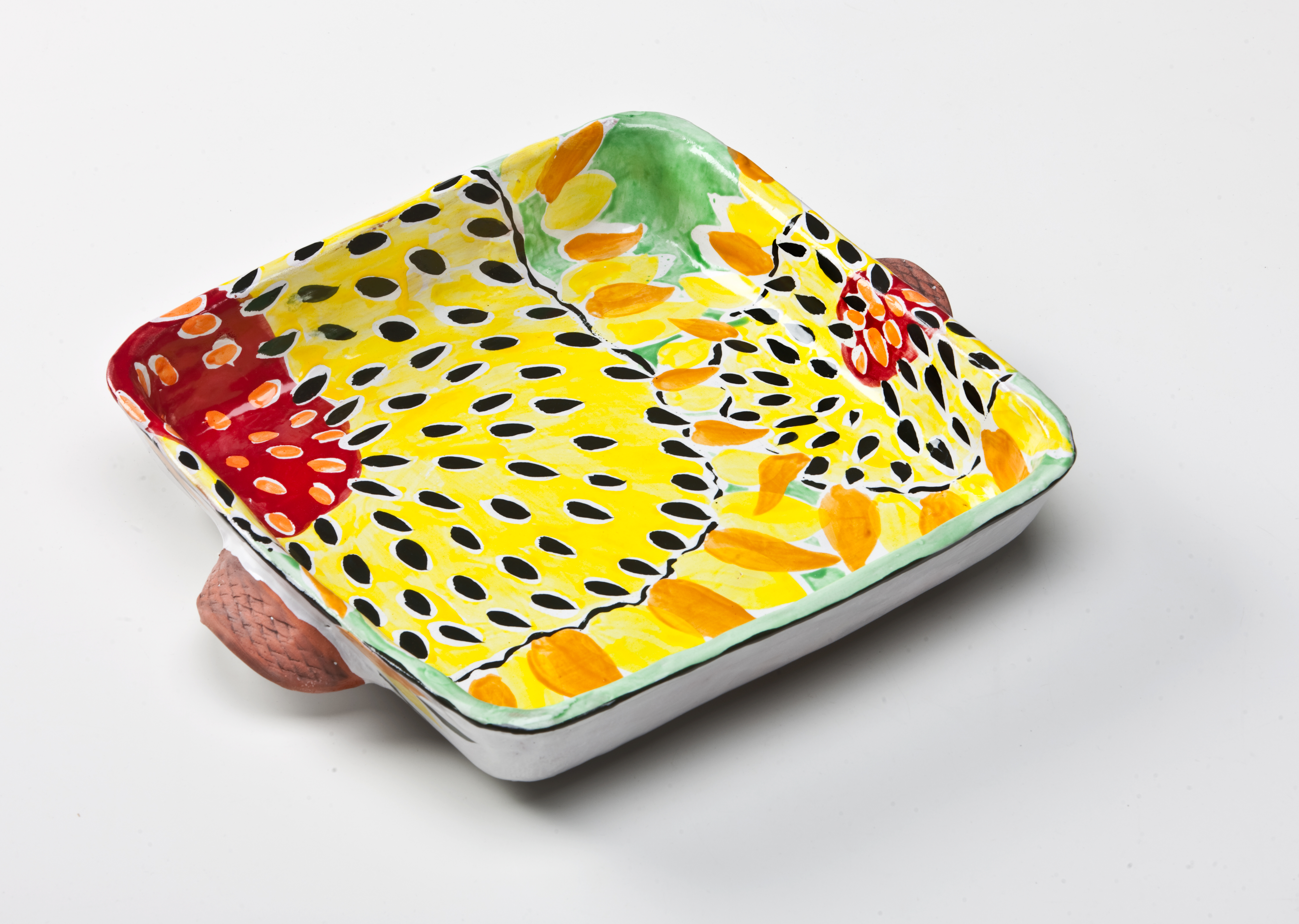
  Majolica is a type of earthenware ceramics characterized by rich design, broad and bright pallet, and glossy surface.  These attributes arise due to the presence of tin as the flux in the glaze.  The resulting relatively high viscosity restricts flow during firing and thus enables a sharpness of detail unusual in the surface treatment of fired clay.

  This ceramic style originated in the Middle East and accompanied the spread of Islam across Northern Africa and into Spain.  It got to Italy via the island of Majorca from whence the name.  Similarly Faenza, Italy was eponymized after sending examples to France where vessels of that nature to be called faience.  The Dutch waited for proficient differentiation and felt ok calling it Delftware.

  These centuries later, after mastering the requisite considerable skill, artists take the technique wherever their hearts might lead.  Well, my favorite artist has a huge heart and as you see here above and below, her work exudes joy and exuberance in uncommon measure. 

  The pieces are clearly functional and meant – no, yearn – to be used.  They engender the sort of feeling with which one finds him/herself imbued after a leisurely stroll through a fine farmer’s market lush with produce still sparkling with morning dew.

  That it is of a special nature I learned anew while reading an article* about, of all things, prosopagnosia – the impairment (slight to severe) of face perception.  Oliver Sacks wrote about an extreme case in his Man Who Mistook His Wife For A Hat.  While for that man the cause had to do with Alzheimer’s, in many it is simply a part of their neurological constitution.  

  I think my artist would agree that I have much greater facility with names and faces than does she though she can nonetheless quickly (and enthusiastically!) pick loved ones out of any crowd and that’s the point.  Observation and research suggests that emotion plays a large and discrete role in face recognition and in my artist emotion flows like the Amazon.

    Jane Goodall has the condition and is unable to put a name with a face (human or chimp) before some degree of a relationship has had a chance to evolve.  It’s no news flash that her heart and mind are well connected and it’s tough now not to speculate about the extraordinary manifestations of her particular constellation of synaptic connections.    

  Most interestingly, for the purpose herewith, is that well known portrait artist Chuck Close is severely prosopagnosic.  He believes that the condition “has played a crucial role in driving his unique artistic vision” which amplifies an initial visual impact into something just this side of a wonderful hallucination.

  I think that my artist is wired up in such a way that her manners of perception interweave with her ebullience to create a constantly evolving yet unmistakable body of work – from kids, to dogs, to food, and yes, to pots.  Look at her stuff, doesn’t it make you feel better about yourself?

*”Face-Blind”, by Oliver Sacks in the 8/30/10 New Yorker. 

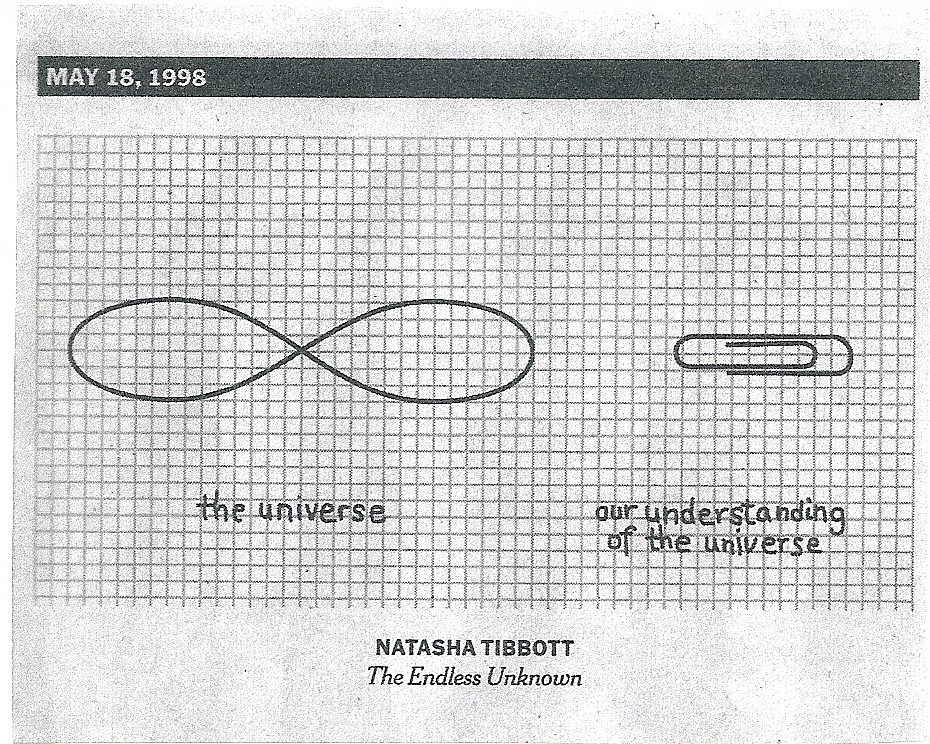
The Endless Unknown

October 15, 2010


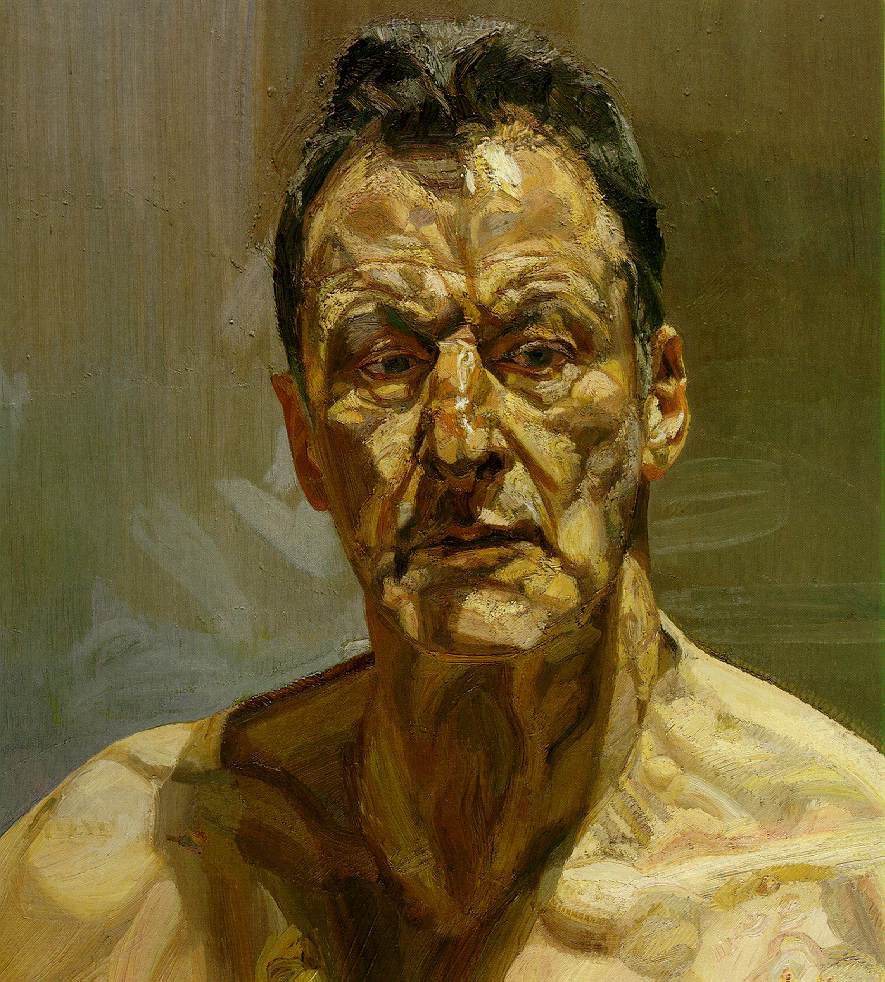
  In his work Lucian Freud conveys incredible emotional depth and complexity.  It should surprise no one that he is the grandson of Sigmund Freud and furthermore, for me, his oeuvre proves that the founder of psychoanalysis was on to something no matter what modern critics might say. 

  (L) Freud has said that: “Quality in art is inextricably bound up with emotional honesty”, which is not to say transparency.  He goes on: “The advantage of taking so long is that it allows me to include more than one expression”.  Ya  There’s a lot going on in the mind of the fellow above and it would take a lifetime of analysis or a lobotomy for any hope of eventual serenity.

  It is difficult to leave the gaze of a Freud subject such as the one above without, first, feeling the rumble of one’s own complexes.  The title of the picture above conveys this sense perfectly: “Reflection”.  Then, as you walk away, you realize that the frame of reference is much larger and you wonder about universal truths.

  Are there any?  I’ll bet that Freud would not be surprised to learn that recent research indicates that the laws of physics might not be consistent across the whole of our universe.  Or that some think that the human mind has reached its capacity for understanding the cosmos.  For the time being anyway.

  Juxtaposed with cave paintings or ancient petroglyphs carved into rock, Freud’s art embodies a sense of the degree to which consciousness has evolved thus far.  Oh, for a take some 10,000 years hence.  Try to imagine a state of mind holding an image of Freud in the same regard as we do not an ancient stick figure!

*The quotes have been drawn from an article in the 9/25/10 Economist.  Where else?

**The bit was a review of a new book I can’t wait to read: Man with a Blue Scarf: On Sitting for a Portrait by Lucian Freud.  The author, Martin Gayford calls Freud “omnivorous” in his search for “weight, texture and irreducible uniqueness of what he sees”.  I know the feeling.  See 1/31/09 and 4/10/09 below.

***Interestingly, just as a face or the representation of one can project outwardly with great force, so can inwardly a simple facial tactile experience.  The relative density of neuronal connections on a face is huge.  A recent experiment showed that continuous tweaking of just one whisker on the muzzle of rat stroke victim was enough to stimulate sufficient redirected blood flow to alleviate major damage.  WSJ 7/27/10

****Cartoon from the NYT


We’ll Always Have Paris…

September 17, 2010


     That’s Manet’s Olympia and it came to mind for several reasons.  First, while following an Economist online debate* over the legal status of prostitution, the tone and argument of some of the sex workers who weighed in made me realize that the range of their experience is extreme.  For some (like those I wrote about below 5/21/10) it’s a living hell while for others (like lady above) it’s a hell of a living.  Fulfilling even.

  Seventy-seven percent of respondents were in favor of legalization.  The moderator cited the following main reasons: “governments should not … legislate for morals; …part of human nature; …decriminalization would make it easier to apply laws against sexual violence; criminalization distracts from real problems – trafficking, abuse, disease etc; and people become prostitutes for a variety of reasons, including voluntarily.”

  Manet presented the painting to the Salon in 1865**.  There was some praise, but much scorn.  Why? Paternalism.  Nudity has been part of art since stick figures were first scratched in the dirt.  Issue with Ms Olympia was her exudation of confidence and self assurance.  Comfortable in her birthday suit, further familiarity would be by her choice and hers alone.

  I first saw a representation of this picture during a lecture in college.  Beautiful I certainly thought she was.  However, that experience couldn’t have prepared me for an in-person take during a 1972 term abroad.  The picture hung by itself on a wall at the end of a rectangular room in the Jeu de Paume on the grounds of the Louvre.  Pulse way quickened, I returned many times.

  A decade or so later, I was in the neighborhood with my father who I knew would enjoy an introduction.  That painting and the rest of the Louvre’s Impressionist stuff by then had moved to a remodeled train station now called the Musee d’Orsay.  Initially overcome by the scale and expanse of the new space I used a map to hurriedly escort Dad to Manet’s masterpiece. 

  We rounded the corner and – I’ll never forget it – she looked like a pole dancer on break. I found myself apologizing for the big build up.  What could have happened?  It was obviously not the painting that had changed and I’m here to tell ya neither had my, uh, joie de vivre.    

  It was a whack in the side of the head.  I began to realize just how critical are placement and context.  My inchoate understanding was greatly aided by Victoria Newhouse in her Art and the Power of Placement.  Casually looking through that book I was shocked to find a chapter that began with that exact experience: “Forced out of what was to a generation of viewers Olympia’s flattering ‘dress’, the painting was suddenly thrust into something hideously unbecoming”.

  Simply put, the soft and intimate conditions of the Jeu de Paume had made for a transcendent experience.  At the d’Orsay paintings are hung on the walls of brightly lit masonry rooms like decorations on those of a columbarium.  Oh well, we’ll always have Paris – err, The Jeu de Paume.****  

*http://www.economist.com/debate/overview/182 There were more than 300 comments; some instructive and some very interesting.  The effective difference between decriminalization and legalization for example.

**The same year the Civil War ended and the Matterhorn was first climbed.

***If you don’t get the allusion, you should.

… and then get back on your sled

August 13, 2010


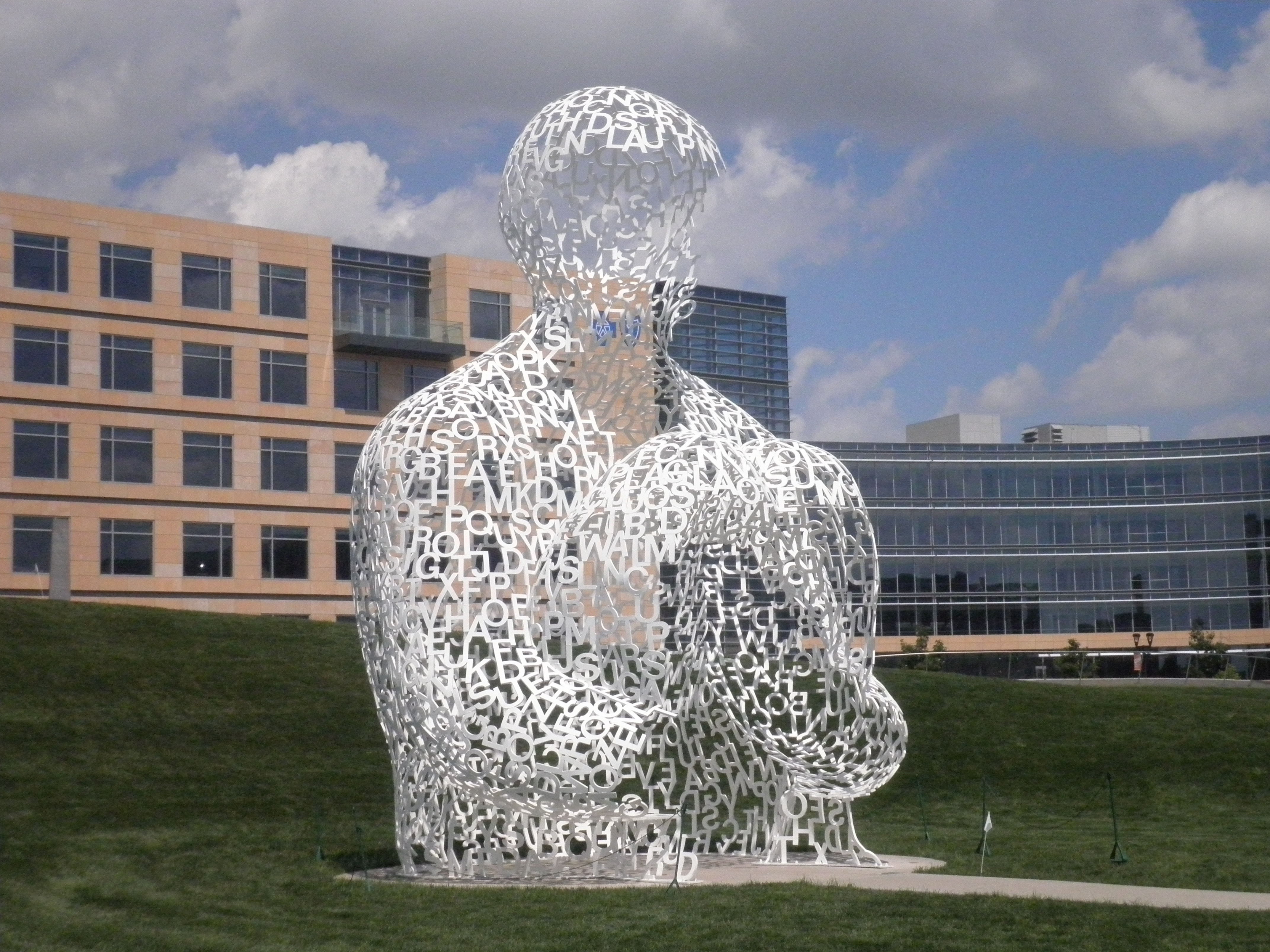
  That’s Nomade by Spanish (Catalan) artist Jaume Plensa.  It sits in Des Moines, Iowa’s Pappajohn Sculpture Park.  Plensa says that the form of the figure relates to the knees to chest contemplative position his son assumes from time to time.  Pretty cool.

  Though subtly, it is even more engaging than his wildly popular (and similarly scaled) Crown Fountain in Chicago’s Millennium Park.   A visitor’s connection with the fountain is quite physical – it literally spits at you. The experience is more cerebral in downtown Des Moines.

  Though quite large it does not impose, but rather floats somewhere in between concept and materialization.  The name ‘Nomade’ is French not for nomad, but for nomadic or wandering. An aspect of an open mind.  One can travel far from a state of quiet repose lingering wherever thoughts might crystallize – whether that be into person, place, or thing.

  Far as we know, we’re alone with that ability and along with an ability comes responsibility.  About another, very different work “La Larga Nit” Plensa recalled Catalan writer Vincent Andres Estrelles “who wrote that it is the responsibility of the poet to watch out for the whole community”.

  Plensa said about his Nomade: “It is made to embrace you as you walk into it, to transform the body as it creates a home for it.”  It may have been the heat, but I felt electrified.  Beam me up Scotty! 

*The Poppajohns gave $1.65 million for this sculpture at Art Basel Miami in 2007. 

**The park has work by many other artists including: Caro, Bourgeois, Butterfield, Kelly, Burton, Cragg, LeWitt, di Suvero, and Serra.

**The Poppajohn Sculpture Park is just west of the center of downtown.  If you’re going by on I-80 you could be All-American and see all of the installations without even getting out of your car.  But you’d be a dope to do that.  Get out, walk around, explore the nearby new public library designed by David Chipperfield, have lunch at Centro, then get back in your car, drive a bit west until you come upon the spectacular Des Moines Art Center. Check out its three wings: Saarinen, Pei, Meier. Then get back on your sled a new person and move on.

Mermaid Who’d Lost Her Way

May 21, 2010


  I’ve been driving from the same office to the same house for thirty plus years and have always enjoyed the opportunity to unwind a bit and look forward to getting home.  I do though like variety and thus frequently change my route.

  It’s long enough (+/- ten miles) that many alternatives present themselves and by now I’ve tried most.  Attendant cerebrations are the typical jumble of present past and future unless I take one certain very short industrial stretch connecting two busy streets with windowless rusty buildings on either side.         

  I first got the sense of the place years ago when a vehicle slowed down in front of me, passenger door opened, woman jumped out, and car sped away before door was properly shut.  Suspicions aroused I began to notice the demeanor and countenance of the disheveled females standing there all alone.

  Yep, sometimes, there stands a prostitute with her hook in the water and I’m forced to review my narrow take on reality.  None of them have ever reminded me of Julia Roberts (Pretty Woman) or Xaviera Hollander (“The Happy Hooker”) or even Ashley Dupre (Eliot Spitzer). They’re unkempt, furtive, wary, and certainly don’t evince a high level of job satisfaction.  In all of these years I have never seen one smile.

  What could have happened to these poor souls?  They had to have been once sweet and innocent.  What terrible journey led them to solicit all manner of horror here, in a small town, not far from a bend in the river?   

 Fable of the Mermaid and the Drunks

by Pablo Neruda

 All these fellows were there inside
when she entered utterly naked.
they had been drinking, and began to spit at her.
recently come from the river, she understood nothing.
she was a mermaid who had lost her way.
the taunts flowed over her glistening flesh.
obscenities drenched her golden breasts.
a stranger to tears, she did not weep.
a stranger to clothes, she did not dress.
the pocked her with cigarette ends and with burnt corks,
and rolled on the tavern floor in raucous laughter.
she did not speak since speech was unknown to her
her eyes were the colour of faraway love,
her arms were matching topazes.
her lips moved soundlessly in coral light,
and ultimately, she left by that door.
hardly had she entered the river than she was cleansed,
gleaming once more like a whitel stone in the rain;
and without a backward look, she swam once more,
swam toward nothingness, swam to her dying.

 Fabula de la Sirena Y los Borrachos

 Todos estos senores estaben dentro
cuandoella entro comletamente desnuda
ellos habian bebido y comenzaron a escupirla
ella no entendia nada reciensalia del rio
era una sirena que se habia extraviado
los insultos corrian sobre su carne lisa
la inmundicia cubrio sus pechos de oro
ella no sabial llorar pore so no llorba
no sabia vestirse pore so no se vestia
la tatuaron con cigarillos y con corchos quemados
y reian hasta caer al suelo de la taberna
ella no hablaba porque no sabia hablar
sus ojos eran color de amor distante
sus brazos construidos de topacios gemelos
sus labios se cortaron en la luz del coral
y de pronto salio por esa puerta
apenas entro al rio quedo limpia
relucio como una piedra Blanca en la lluvia
y sin mirar atras nado de Nuevo
nado hacia nunca mas hacio morir.

 *The image above is of a print from a series by Eric Avery.  An artist MD with a social conscience.  “His social content prints explore such issues as human rights abuses and social responses to disease, death, sexuality, and the body”.  Check out his stuff at www.docart.com His work can be found in the collections of (among others) The Fogg, The Library of Congress, The Philadelphia Museum of Art, and The Boston Museum of Art.

How To Wire Up A Beauty Or A Beast

March 26, 2010

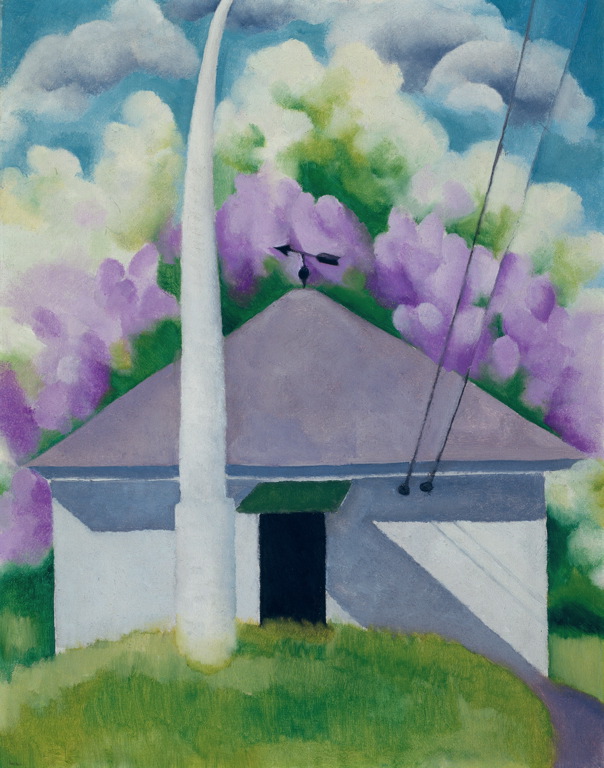
  In the house on her parent’s farm, Georgia O’Keefe was born November 15, 1887 near Sun Prairie, Wisconsin.  She was not taken outside during the cold, dark, and long upper Midwestern winter.  Spring did arrive and with it, verdancy, warmth, and the color of the sun.      

  Georgia was carried out and “placed on a handmade patchwork quilt spread on the new grass and propped up by pillows.  Those very first moments of seeing in the brilliant sunlight became indelibly etched in her memory: She precisely remembered the quilt’s patterns of flowers on black and tiny red stars…*

  I remembered that while reading a review of a new book: The Philosophical Baby: What Children’s Minds Tell Us about Truth, Love and the Meaning of Life by Alison Gopnik**.  O’Keefe was exceptional (duh!) in that virtually no memories form in most babies’ minds until about age 5.

  Their brains are different.  The part (prefrontal lobe) that filters out distractions and thus enables ‘internally driven attention’ is not yet fully formed.  “What rouses them is what is in front of their eyes, the first burst of information about cause and effect in the physical world”.

  Open to all stimuli and unable to shut any out, they are in a sense more conscious than are adults.  Gopnik compares “the lantern consciousness of childhood to the spotlight consciousness of ordinary adult attention”.  Very young brains require such copious amounts of neurotransmitters to process this inundation that they require relatively higher doses of anesthesia before surgery.

  As I know I’ve mentioned many times in this space, at birth the human brain has more connections among its 100 billion neurons as there are stars in the universe.  Some strengthen and some wither in a process labeled neural Darwinism by Gerald Edelman***.  Those connections in receipt of stimuli flourish and those that don’t disappear. 

  So in a very real sense what one does not see, hear, feel, etc as a baby one never will.  If, for some reason there is a patch on an eye over a crucial brief period neural connections will degenerate rendering it irreversibly blind.  Buckminster Fuller had poor vision, but a grand capacity for spatial visualization that he believed arose from early manipulation of blocks and other solid shapes.

  Similarly, “although empathy does seem to be innate… the flourishing of empathy is not guaranteed”.  Which brings me to Swiss child psychologist Alice Miller.  In her book For Your Own Good, Hidden Cruelty in Child-Rearing and the Roots of Violence we read her take on the provenance of Hitler’s depravity.  She wrote “I have no doubt that behind every crime a personal tragedy lies hidden… every persecutor was once a victim”. 

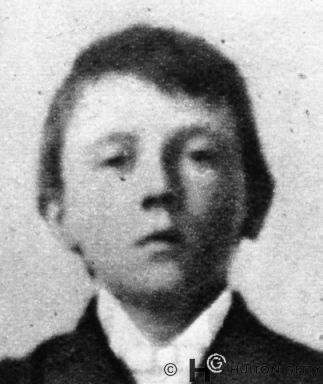
  Ten years or so before Edelman developed his theory of neuronal selection Miller described the structure of the constellated narrative.  And it had nothing to do with innate drives.  Hitler’s youth was itself unmitigated horror.  He was beaten, humiliated, and demeaned by his parents while being commanded to love and respect those who might treat him thus.

  “My pedagogy is hard.  What is weak must be hammered away…I want the young to be violent and cruel… They must be able to bear pain… There must be nothing weak or gentle about them… The free, splendid beast of prey must once again flash from their eyes…”  Adolf Hitler.

  Most of Miller’s work addresses life after age five and actually gives us hope.  She holds that if a youth has an opportunity for just one positive connection, whatever might have characterized those first years, a good life is possible.  “The human soul is virtually indestructible, and its ability to rise from the ashes remains as long as the body draws breath.” 

*Portrait of an Artist by Laurie Lisle
**What Babies Know and We Don’t by Michael Greenberg; New York Review of Books March 11, 2010
***Edelman won the Medicine Nobel in 1972 for his description of the
immune system.  His theory of neuronal development remarkably, but I guess logically, parallels his earlier work.  
****Painting on top is “Spring by Georgia O’Keefe from the Art Institute in Chicago.
*****Photo is of a young Adolf Hitler
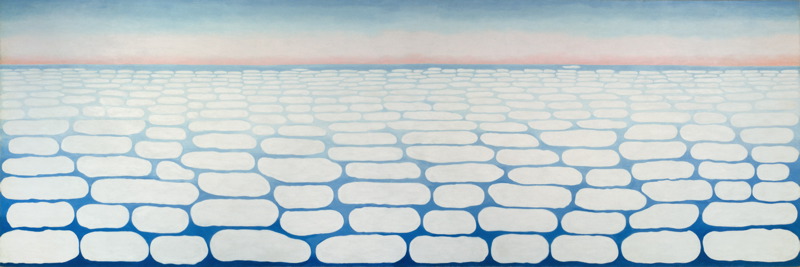
******Painting at bottom is “Sky Above Clouds IV by Georgia O’Keefe from the Art Institute in Chicago.