Archive for the ‘Art’ Category

“There is nothing so useless as doing efficiently that which should not be done at all.”*

November 20, 2009


    At least two august publications, the Economist and Harvard Business Review, chose to prominently mark the centennial celebration (yesterday, November 19) of the birth of Peter Drucker.  HBR asks on its November cover, ”What Would Peter Do? How his wisdom can help you navigate turbulent times.” The Economist says that “Four years after his death Peter Drucker remains the foremost management guru”.

  Author of dozens of books and hundreds of articles, he engaged me first in 1980 with his Managing in Turbulent Times just as the farm belt entered a difficult decade.  He advised: “A time of turbulence is a dangerous time, but its greatest danger is a temptation to deny reality.”  I was green, didn’t get it right off and the glue of our business model slowly dissolved.  But for a friendly banker we might have gone under.  Finally a light went on, I reread, and have been a fan ever since.

  Drucker was born in Vienna, moved to London in 1933 after falling into disfavor with the incipient fascist movement and moved to the US in 1933.  In 1939 he published his first bestseller, The End of Economic Man, in which he held that there was more to being a boss than worrying about the cost of payroll.

  Through the ensuing years, he was always out front.  “Management by objectives” and “knowledge worker” were his.  He foresaw the postwar rise of Japan and the tremendous importance of marketing.  He warned about public perception of oversized management compensation – in the mid eighties.  He famously said that the major consideration is not to figure out what to do, but “what to stop doing”.  Drucker devoted a significant part of his career to nonprofits which he thought formed a crucial part of a dynamic society.

  His take was always holistic and it will forever be fascinating to read him connecting disparate dots.  His preternatural perspicacity had to have been related to his interest in art.  During his forty year tenure at Claremont College he gave courses in both management and Japanese painting.

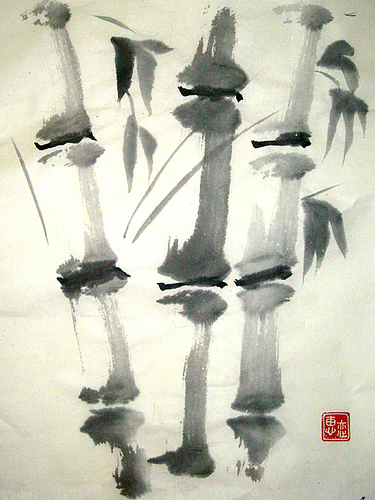
  An interviewer once took note of a “few black smudges on a yellow piece of paper” on a wall in his study.  Drucker said “I bet you don’t see much in that”.  Nope.  He then said that a Zen contemplative could offer the essential nature of a tree or whole landscape with a few quick strokes of a brush.  Forest gets lost in the trees all too often.
  Drucker was also an avid mountaineer.  He once said that: “I have always been a loner… I work best outside.  That’s where I’m most effective.  I would be a very poor manager.  Hopeless.”  Uh, yep, yep, and yep.

  Reminds me of Butch Cassidy and the Sundance Kid.  When they’re in the mountains of Bolivia looking for work, the Strother Martin character asks the Kid to shoot a few blocks of wood he tossed out so as to test Kid’s skill set.  Kid misses – to Martin’s disgust.  Kid asks “Can I move?”  Martin says “huh?”  Kid rolls into action with Smith and Wesson shock, awe, and accuracy.

  ‘Scuse me while I step outside.

*If you don’t feel like reading any of his books, search for quotes and you’ll find something that resonates:

– “Management is doing things right.  Leadership is doing the right things.”

– “The best way to predict the future is to create it.”

– “Follow effective action with quiet reflection.  From the quiet reflection will come even more effective action.”

– “People who take risks generally make about two big mistakes every year.  People who don’t take risks generally make about two big mistakes every year.”

– “So much of what we call management consists of making it difficult for people to work.

– “The computer is a moron.”

Dunes

October 17, 2009

PA110378 

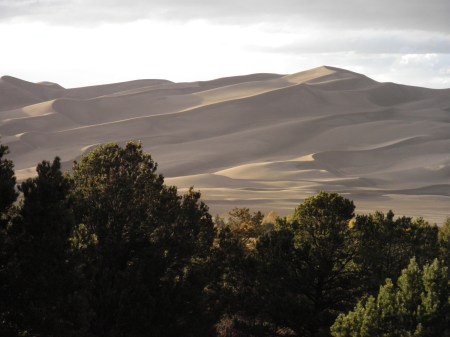
The huge dunes in the foreground were formed by the interaction of wind, water, and stone over the course of many eons.  They are the largest and most extensive (330 square miles) in North American and comprise the Great Sand Dunes National Park in south central Colorado.

PA050284 

  Most of the sand came from the San Juan Mountains to the west, but the larger grains were shed from the Sangre de Christos on the east such as Kit Carson and Crestone (pictured below) – two of Colorado’s fourteeners.

PA130413

  The dunes loom some 700 feet above the sand sheet and sabkha just to their west.  The visual effect of the afternoon sun upon them is unforgettable.  Why should the sun on a big pile of sand have such an impact?  Well, not long (in cosmic terms) after life evolved beyond a simple unicellular state, as ability to discern between light and less so developed.

PA120405

  Billions of years later we see in 3-D and Technicolor, but the pre-primal legacy still influences our perceptions.  The incredible lights and shadows of the dunes mediated by the undulating ridges transfix one’s gaze.

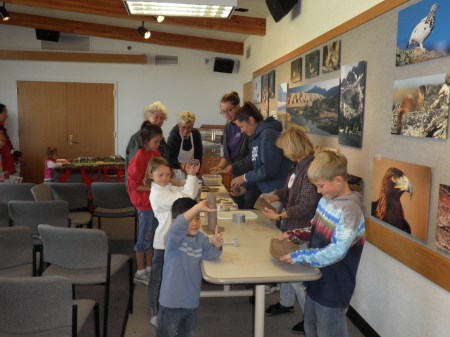
  All visitors thus moved, if only for a moment, what better place for an artist to imbue and convey?  Wife is artist-in-residence here and as usual has made the most of the situation.  Observations from many points of vantage have inflected her current work while observers, young and old alike, have added tactile impressions to their experience of this unique bit of terra firma NA.

PA110368

PA100346

  Bonus for this here strong back is that the location of the park, far far removed from the nearest town makes for a similarly prehistoric level of noise and light pollution.  Have seen more falling stars than I’ve fingers and toes.  Me lucky boy.

Ah, The Peonies!

October 9, 2009

Heat

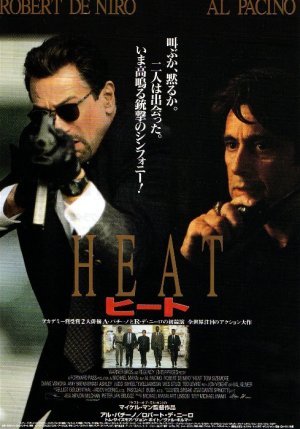
    Ever see the movie Heat?  It’s a really great cop v robber flic with Pacino (cop) and De Niro (robber).  Val Kilmer is a steely with chinks bad guy too.  Ashley Judd’s his wife.  De Niro and crew are skilled, astute, and only go after the largest of hauls.  Last one eight figures.  Movie is wonderful, mesmerizing, in your face violence.  In fact, De Niro demands that his last victim “look at me, LOOK AT ME!” before delivering the revenge fueled coup de grace.

  My savor of the gunplay and bloodletting came to mind while reading a bit about the President of Liberia – Ellen Johnson Sirleaf – the first female president of an African country.  Question: “If women ran the world, would wars still exist?” Answer: “No. It would be a better, safer, and more productive world. A woman would bring an extra dimension to that task – and that’s a sensitivity to humankind.  It comes from being a mother.” 

  Question: “But if women had power, they would be more likely to acquire the negative traits that power breeds, like selfishness and territorialism.”  Answer: “It would take a very long term of women absolutely in power to get to the place where they became men”.*

  What is up with us men?  I remember studying the Yanomamo people who inhabit a bit of the jungle between Venezuela and Brazil.  Napoleon Chagnon wrote the best selling anthropology treatise of all time about them.**  They were fascinating for having been theretofore untouched by civilization.  Real time look at primal.  Garden of Eden it was not.  Guys sat around blowing hallucinogenic drugs up each other’s noses all day while women slashed, burned, and cooked.  Third of the men died violent deaths.

yanomamo

  I’ve read elsewhere that our incredible inability to get along is what led to the original diaspora from Africa.  Group gets to 5,000 or so in size, factions arise, violence attends, they spread out.  Years on, given half a chance, a group more technologically advanced wipes out one less so.  Jeesh.

  Somehow though we’ve made it this far.  Truth and beauty do exist and are known to exist by men and women alike.  President Sirleaf might well see more soulful women than men, but some men have tamed or cathected their urges and transmogrified their blood lust. 

  Mountaineers, for example, challenge gravity and weather to suffer a cold and frightful experience risking their contribution to the gene pool all the while.  First ascensionists get to pick the line and have naming rights when successful.  Sometimes position and kinesthetics combine to make a stairway to heaven.  On the massive Gogarth Sea Cliffs in North Wales for example, Ed Drummond put up a spectacular route which he named “Dream of White Horses”. 

Dream of White Horses

  Or – just saw an exhibition of Cy Twombly’s late work.***  Unspeakable beauty.  Unspeakable.  The representation below of one picture from his “Peony Blossom Paintings” conveys only the slightest of hints of an in-person experience, but alongside panel six he has a haiku by Takarai Kikaku inspired by 14th century samurai Kusunoki Masashige: 

Twombly Peony 2

Ah, The Peonies

For which

Kusonoki

Took off his Armour

Cool, huh?

* NYT Mag, 8/23/09

** Yanomamo, The Fierce People by Napoleon Chagnon, Holt Rinehart Winston 1968

***Cy Twombly: The Natural World Selected Works 2000-2007.  The Art Institute of Chicago May 16 – October 11, 2009

Rescuing Power

September 25, 2009

  Knee hurts, so instead of running early AM I’ve been riding my bike lately.  Trouble is it’s now fall and dark.  Oh well – the better…  Upon the razor’s edge once again.  More juice.  Might coast from time to time, but better not drift mentally till sunup.

  Right turn and fifty yards out of my drive I drop down a steep hill.  Feel like Batman falling off a lofty ledge Gotham dead of night.  Shirt flutters, cool air streams by my face, I use my night vision to search for potholes.

  Zoom through intersections and by homes asleep to another steep hill the climbing of which has me off the seat, pounds my heart, and puts me into oxygen debt. Just near the top, a light goes on in house on left.  Kitchen.  Lady.  Uh, sweet!

  Roll down other side a short way turn right and up beneath trees spread both sides touching middle.  Blocks the little starlight not already filtered out by clouds.  Hit puddle, sprayed from behind feel wet line up back must look like skunk.  Then nearly toppled by an acorn, but it crunches.

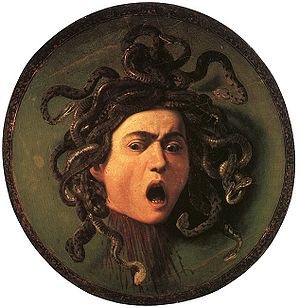
  Level out, cool down, cross a busy road against the light.  Down longest hill yet into a park and a cloud.  Thought of last time through  and a gorgeous field of daisy-like flowers stretched toward dawn.  Now though, dream dark, came to mind Piazza Campo Di Fiori* in Rome upon which a tennis match played 1606 ended with the brutal murder of one opponent by the other – great painter (and brawler) Caravaggio.

caravaggio medusa

  Funny, vigorous exercise almost always exorcises my demons. Or at least quiets them for a while.  Especially if hair on the back of my neck is up.  Quoting Holderlin Jung wrote: “Danger itself fosters the rescuing power”** 

  Out of the cloud mine sleep as I climb another hill then glide down the far side sharp turn right under bridge along swift creek.  Best Chinese restaurant in town on far side.  Ducks float in eddy to avoid Peking.

  Up last hill by kids’ elementary school (man, that was a long time ago…) turn left & coast to driveway. Twenty mile loop complete.  Stow bike  hose off French roast pat dog KISS WIFE ok. 

*”Field Of Flowers” in Italian.

**Carl Jung, Modern Man In Search of a Soul

***Painting is Caravaggio’s Head of Medusa which hangs in the Uffizi in Florence

Cuckoo

September 18, 2009

  Here is Eakins’ Agnew Clinic.  Similar to his picture above, this honors a retiring surgeon also emphasizing his service as an educator.  The roiling factor here though is more subversive.

Agnew Clinic

  Eakins thought that there was nothing more beautiful than the human body and went to great lengths to provide his students with the benefits of his talents.  Including once disrobing for a young coed to show a real male body in motion.

  On several occasions he allowed mixed gender life drawing classes.  Such disregard for the mores of the time brought trouble upon him and he was released from his position.  His choice of subject matter in the Agnew Clinic – a partially nude woman undergoing a mastectomy – was his retort.

  Eakins was born in Philadelphia in 1844 and thus lived his early years hearing whispers of war, was sixteen when the Civil War broke out, and twenty-one when it ended.   The mood in the birthplace of our nation must have been especially dark and turbulent through those developmentally crucial years.  The ramifications upon his fertile cortex must have been like that of acid rain on a forest.

  Jump forward a hundred years.  World War II had been won, factories were busy, and our democratic engine of capitalism had a full head of steam.  Everything was great – as long as one was white, straight, male, and in conformity.  Unbeknownst to the “Fathers Who Knew Best” there grew an undercurrent of disquiet and seething.

  The wake left on the leading edge of American consciousness shaped the art of the 1950s.  Its profile is just as impossible to capture in one work or one artist as during the 1850s, but a glimpse of an inflection might be had just as with Eakins.

  Robert Rauschenberg has been called a Neo-Dadaist which as defined by Oxford is “a movement characterized by anarchic revolt against traditional values”.  Here’s one of his pieces.  I’m not going to say that it foreshadows the incredible tumult of the sixties, but it sure does raise a few questions.  It’s called Monogram and was completed in 1959

rauschenburg

  The 1960s did come and saw foment and ferment of historic proportions.  Cuban Missile Crisis.  The Vietnam War brought response in all sorts of protest art.  Pop Art mocked the rise of our Consumer Society.  In One Flew Over the Cuckoo’s Nest  (1962), the sane and savvy, if sketchy, McMurphy was lobotomized for trying to help.

cuckoo

  “One flew east and one flew west and one flew over the cuckoo’s nest”.

Gross

September 11, 2009

  From the early days of the republic through the antebellum years, the American zeitgeist had been ebullient, dynamic, and filled with ambition and wanderlust.  Lewis and Clark, The Oregon Trail, Santa Fe, etc. The War Between the States however, catalyzed a wrenching change in its trajectory.

  600,000 lives were lost during the horrible conflict that followed our nation’s youthful exuberance – over 1% of the population. That’d translate into an incomprehensible 3,000,000 today.  Impossible for that not to be transformational, but the nature of the impact was not reserved to society’s human fabric.  As Lewis Menand wrote in his The Metaphysical Club: “… the United States became a different country.  The war alone did not make America modern, but the war marks the birth of modern America.”

  The secession of the south allowed what was left of congress to be a venue of action not seen since.  Progress.  It created the first system of national taxation; first national currency; public universities; completion of the transcontinental railway; and set the Republican Party up to promote industrial capitalism for years to come.

  The impact upon the common consciousness was darkly profound.  Democracy was supposed to progress with ayes and nays not blood and gore.  A proud American culture had given way to astonishing horror and irrationality.  “To some the war seemed not just a failure of democracy, but a failure of culture, a failure of ideas.”

  This came to mind the other day when I was thinking about a picture I’d seen in Philadelphia Museum of Art a few months ago while paging through a tome on American Art at home the other day.  In the book I saw an image of the picture below, Fur Traders Descending the Missouri painted by George Caleb Bingham twenty years before the Civil War.  I know nothing of the history of that work, but can imagine the take of contemporaneous urban viewers. 

Fur Traders

  “Wow.  Wish I was there instead of behind this desk headed for idle conversation with friends this evening.  That.  That’s living.  Trap a few beaver.  Fish.  Float down the river.  I want to be part of the wild west.  See stuff not seen before (Well, except for by Indians)”  In actual fact, thousands of people paid to view such pictures and get their only taste of the frontier.

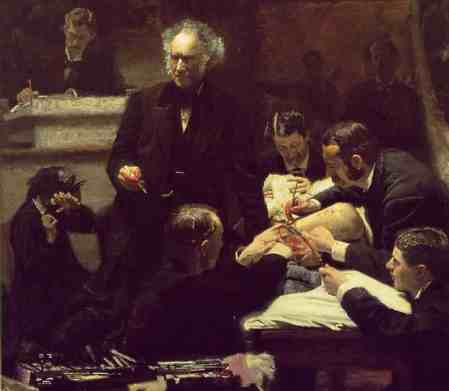
  Now look at the picture from Philadelphia painted by Thomas Eakins ten years after the war’s end.  Gross*.  The title is The Gross Clinic.  “This is what our guts look like folks.  Get used to it.  Shit happens.  We obviously can not predict the outcome of this case just yet.  He might die.  Whatever.  We’re learning from our mistakes.”  Eakins thought this the best of his work.  He submitted it to the 1876 Centennial Exhibition in Philadelphia only to see it rejected.  He sold it to Jefferson Medical College for $200. 

gross clinic

  The above is hardly scholarly, but it is impossible for me to imagine either picture to have been executed at the time of the other.  The spirit of a time is also a great reality.

*I heard somewhere that usage of the word “gross” to mean disgusting dates from this work.  A perusal of the OED yields nothing that would hold to the contrary.

**The Metaphysical Club, Louis Menand, Farrar Straus Giroux, 2001

Wing to Wing

September 4, 2009

 Much the same as a bird convincing its brood that their wings will indeed lift them, in his poem The Master Speed, Robert Frost describes the incipient power of their union to a young couple.  “No speed of wind or water rushing by” though, this is something far beyond the physical realm.

  At the heart of the “master speed” is “the power of standing still” – the ability to simply be fully present and find the mundane extraordinary. Ironic the difficulty that pace presents to assume, especially in these harried days.  But only thus can a way begun to be found to live lives “wing to wing and oar to oar”.

  Frost spent a few years at the same college from which I graduated and that thought took me to my freshman year roommate.  He’s now an artist and in 2003 produced a series which comprised his Monogamy Project. 

  In the catalogue he wrote “ Painting and monogamy are dated practices oversteeped in tradition and held in suspicion.  Having thus been marginalized they become, surprisingly, areas that are ripe again for truly liberative activity.  It is my intention to celebrate these options.”

  There are six paintings in the series: Was a boy; Was adolescent; Am a man; Is a woman; Is a cellist; Am a father.

  Here’s Am a Man:

Stockwell Am a Man

  At first it surprised me that therewith my artist friend discussed the philandering of poet William Carlos Williams.  He includes Williams’ poem Asphodel, That Greeny Flower in which a tortured regret and plea for forgiveness are conveyed.  “Having your love, I was rich…”

I get it now.

  Here’s Is A Woman:

Stockwell Is a Woman

  Here he allows himself to “make this a beautiful painting… Follow all of my desires that call for full color and ripe shapes… To desire is to be alive… Desire gets us off the couch…”  Being my father’s son, and even though he wasn’t much into poetry, I get this part right away.

  The catalogue, in its entirety, comprises a provocative “love poem” and at the end of a recent reading I reconsidered Frost’s beautiful metaphor of wings and oars.  The visual images of the generative rhythms pop up right away, but what gives it its power is thought of the epic voyage that follows. 

*Craig Stockwell is the erstwhile roommate.  www.craigstockwell.com

Canvas Cover for a Soul

July 10, 2009

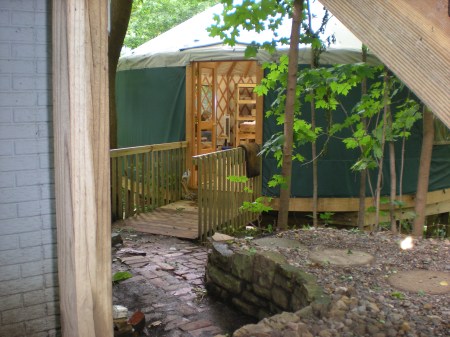
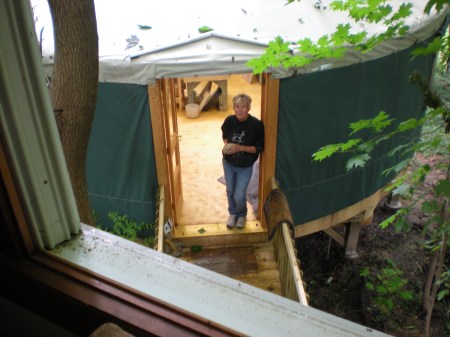
 Yurt door 010

   The aforementioned yurt serves as divine studio space for my potter wife.  It replaces a cold wet cryptish corner off our basement which made a cell at Guantanamo something for which to yearn.

  Development of that transmigration required more than a few days and much ideation.  First thought was a familiar exercise in rectilinearity set akimbo in our front yard.  Then an appendage also in front.  Then she considered the expansion of the existing dingy cellar.

  Somehow the tent-like structure more common on the steppes of Central Asia came into her consciousness and she quickly concluded that yurt it would be.  (Well, she and the dog…)

  It is wonderful, even from this visitor’s perspective.  Its shape and nature fit organically on the side of the ravine in back of our house.  It looks almost to have grown there.

  We’re in the middle of town and abut an interstate.  Even so, from within looking out, all that can be seen is green.  Work started after woods leafed out, and thus I’ll bet neighbors (not far) across the way won’t have seen it till fall.

  It really is neat, made all the more special by being a few paces away from the house.  Going from one to the other in the rain you’ll get a bit wet.  Perfect.  Forces awareness of one’s place in the universe.

  To this philistine, it seems also perfect for the artist. Entering, it’s like stepping into a cloud with the world left far behind.*  I can’t wait to see where it takes her.

  Reminds me of some of Tadao Ando’s work in which sun, wind, and clouds are design elements.  His Azuma house, with which he first gained recognition similarly forced residents to interact with nature. 

  Contrast these to the emphasis on surface gloss found all too often in new additions to the built environment both public and private.  Lipstick might look nice, but it doesn’t necessarily tell much about the pucker.  Know what I mean?

  Anyway, this arrangement of site, structures, and stuff combine at night to make a softly glowing spot for wife to consider what another potter called “The Mud-Pie Dilema”**.

Yurt door 005

  More later. 

*Speaking of which – you should hear what heavy rain sounds like therein.  No need for thunder!

**The Mud-Pie Dilemma: A Master Potter’s Struggle to Make Art and Ends Meet by John Nance

Reading About Reincarnation Is Not The Same Thing As Being Reborn

April 24, 2009

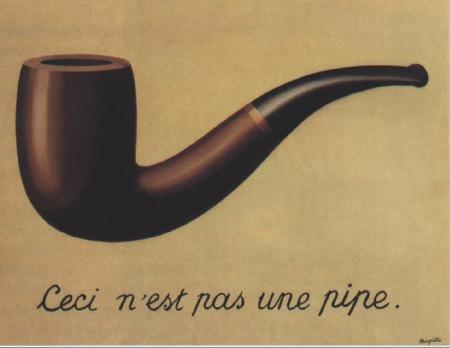
  Consideration of a work of architecture suffers from anything less than an actual visit.  A virtual representation of a painting, pot, or, well, turd* can only approximate a real-time in-person experience.  But a photo of a building conveys even less information of value.  A well known Magritte picture makes the point:

magrittepipe1

  The title is Ceci N’est Pas Une PipeIt Is Not A Pipe.  It’s not – it’s a painting of a pipe.  A photo or digital representation of a building bears even less resemblance to an intimate experience of it than the Magritte picture to the pipe.

  Thus the award of the annual Pritzker architectural prize must hold far more mystery (and allure) for the public than an Oscar, Pulitzer, or Grammy.  One can easily develop a relationship with the body of work of an actor, writer, or musician.  Very few knowingly visit multiple examples from the oeuvre of one, let alone several prominent architects.

  It is then quite ironic that most of us must in fact peruse the works of critics and photographers to develop any sort of opinion at all.  It is not impossible that we could admire the words and pictures, but find ourselves surprised or disappointed upon a visit.  Ceci N’est Pas Une Batiment.

  This year’s Pritzker winner for example, Peter Zumthor, leads a very small practice the output of which is almost all to be found in or near his native Switzerland.  The jury citation tells us that: “he develops buildings of great integrity – untouched by fad or fashion…only accepts a project if he feels a deep affinity for its program…modesty in approach and boldness in overall result are not mutually exclusive…”  It calls his chapel in Wachendorf, Germany “a universal breath of faith”.

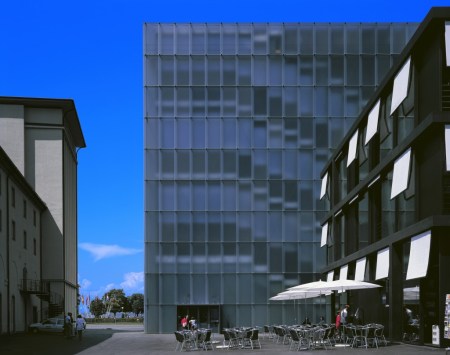
  I’ve had the good fortune to visit one of his projects – The Kunsthaus Bregenz on the shore of Lake Constance in Bregenz Austria.  I had read about the building in preparation for the visit and expected not to like it.  I found the photos unattractive and befitting the “severe” label given by several critics.  Plus, it would have no views out from its perch on the eastern shore of a beautiful lake in-between Austria, Germany, and Switzerland.

bregenz-exterior

  All too true.  However, it worked.

  The overlapping etched glass plated exterior has tremendous effect both inside and out.  Its translucency both allows sun to pour into the six foot inter-floor light catching spaces and then down upon the rooms and their contents. The non-reflective nature of its exterior mitigates the potential for glass to transgress a site.  No blinding glare.  Finally, the angles and lines one can just make out through the rough glass sheets relate to the lines and castellation of the surrounding buildings enabling it to fit in.

  The building is deeply rooted in the site.  The nature of the glass curtain wall allows one to peer below grade (along with the sun) toward lecture and service spaces. A subdued office/shop/restaurant structure nearby works with the museum building make a pleasant open space.

bregenz-interior

  Ground floor reception is indeed severe if not foreboding.  The walls are bare highly finished concrete, floors gray terrazzo. The lighting of the 80 sq ft by 14 ft space creates an austere numinous experience.  Three exhibition levels lie above and one doesn’t know whether to expect a Teutonic warlock with an obsidian blade or a priest to deliver last rites. 

  Attention acutely engaged, the similarly proportioned and finished temp spaces do way heighten the impact of the narrow range of objects and talismans not overwhelmed or neutered.  Shows have been primarily if not exclusively contemporary.  The Peter Kobler installation there during my visit was up to the task and provided perfect counterpoint.  Almost hallucinatory.  A tour felt like the traverse of a difficult transmigration.

kogler

  Zumthor likes tennis, cigars, margaritas, and jazz.  Apparently he doesn’t allow his professional and private lives to overlap.  Kunsthaus Bregenz is dead serious.

* I had a professor once who asked the class “If a bear shits in the woods, is that art?”  Stuck with me.

* The museum’s homepage: http://www.kunsthaus-bregenz.at has a neat bit of embedded flash animation showing elevations, interiors, and detail.  Check it out.

Please Don’t Let My Wife See This Either

April 16, 2009

  A while back* I described the joy I take in the gorgeous array of dandelions that presents itself every year at about this time.  More subtle (at least visually) as well as more interesting is the ground ivy which is just beginning its ephemeral (again visually) resplendency.

ground-ivy-2

  To all but those who take pride in their bluegrass and fescue, the lavender blanket is a welcome sign of spring.  That the color lasts but a week or so makes it worthy of a Basho haiku.  He’s long no longer with us so: 

Lush thick lavender.
Funeral blanket for the
Mouse the hawk swooped up? 

  It’s scientific name is Glechoma hederacea and is found just about everywhere.  When in flower, it stands only a bit taller than the newly awakened and as yet uncut lawn.  It is a member of the mint family and spreads even more aggressively than the Derby Julep eponymous component.

  I find it interesting on account of its provenance.  Settlers from Europe brought it to the new world to help in the brew of their beer.  Its use predates hops and was called Alehoof and employed widely by Saxons for the flavoring, clarification, and preservation of their favorite beverage.

  There should be no surprise that it found its way to these parts given the large scale nineteenth century emigration of people from that region of Germany to our area.  Some of my own ancestors, even.  Prost!

  Most of the time when we hear about mankind abetting the migration of some species or other from here to there it is with a more or less negative tone.  Like zebra mussels across the inland waterways, or rabbits to Australia, or (believe it or not) everything not winged or finned to New Zealand.

  Diets of the developed world would be far less kaleidoscopic had it not been for, say, potatoes coming north from Peru, tomatoes and corn to Europe, and ground ivy from our Teutonic ancestors.  And the sun in my every breakfast, oranges.

orange

  Columbus himself brought them to these shores (well close), but they are thought to have originated in China near the South China Sea.  From there they made their way down the Malay Peninsula and then probably with the Indian Ocean current to the east coast of Africa.

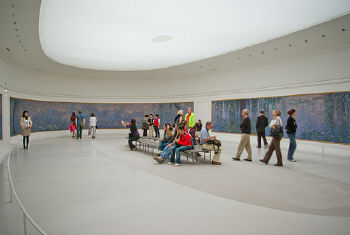
  Caravan north to the Mediterranean and thence throughout Europe. In Paris Louis XIV thought so highly of his 3000 orange trees that 1n 1617 he built the Orangerie in the gardens of the Louvre to house them.  In that pre-Versailles palace is no longer a citrus arbor, but rather a display of Monet’s water lilies of incredibly ineffable beauty.  It’s a 360 degree experience and imbues even the most stolid with a wonderful spiritual tumescence.

orangerie

  Funny how stuff works out.  Just think of all that would be lost if we were alone in this universe and collided with an asteroid.  Poof.  Remember, In Heaven there ain’t no beer. 

*5/9/08: Please don’t let my wife see this.

**If you like oranges read John McPhee’s Oranges  It’s fascinating.