Archive for the ‘Art’ Category

Philadelphia

April 10, 2009
        Had a great few days visiting son in Philadelphia.  Undertook examination of several different important bits of our culture. 
      First was Kenny Powers, the lead character of the HBO show Eastbound and Down which you’ll find disgustingly hilarious if you’re a guy.  Only disgusting if you play for the other team. 
      Kenny never read any Greek tragedies otherwise he’d have recognized his hubris and the show would have been one-of and not a series.  It starts with him, as a rookie pitcher, winning the World Series for the Atlanta Braves.  He immediately develops a hugely oversized ego, declares himself a free agent, and begins a long obnoxious fall.  
      Our star levels out as a substitute high school gym teacher living with his brother and family.  He happily tells the school principal that his fiancé was an old KP flame and the flame that he was still in love with her chest. Drunk and high on ecstasy at the school dance he parts the crowd to strut his stuff for her.  
      There is a video of it on You Tube which I thought about inserting here, but didn’t after wife said “You better be careful, I’m a substitute too.”  Matter of fact, I looked at all of the clips on You Tube and found none appropriate for this more or less PG space.  
      Next day son and I went to an incredible show at the Philadelphia Museum of Art – Cezanne and Beyond – which intersperses about sixty works by the master with over a hundred by his heirs.  The experience makes for the enlightenment of even the most benighted philistine.*  Just take the two pictures below. 
      On the left Painting with Two Balls 1960 by Jasper Johns and (one of many of) M. Cézanne’s Mt. St Victoire (1903) on the right. johns-j-painting-with-two-balls  There is an elemental simularity – without the balls and thrust of the mountain both would be pure abstraction.  In a cezanne-msv-2very real sense the one by Johns is a reflection of the other.  Relation I mean.  Cezanne himself said “In my thought one doesn’t replace the past, one only adds a new link to it”.  So here we have the Fin de Siècle revolutionary dressed up for the 60’s.  Shows the truth in the saying: “Mediocre artists borrow.  Great artists steal”. ** 
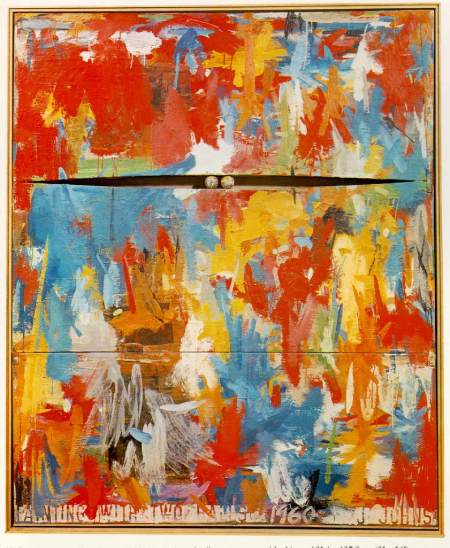
      Son then had to take an exam (Mr.”I got ’em all right…” since the crib) and I went to another museum – the Philadelphia Academy of Fine Arts where many great American artists took training.  Importantly for me, this included William Merrit Chase whose (one of many) portrait(s) of his wife hangs in our museum here in town.
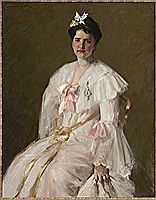
    chase-mrs-chase-in-pink1

      I have returned many times to visit  Mrs Chase In Pink starting years ago when I was younger than both then were to now older making all manner of attempts to divine something of the nature of their relationship.  Without success.  I was never able to learn anything.
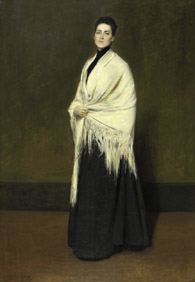
    chase-portrait-of-mrs-c

      Thus I was pleased to find another portrait of her at a much younger age in PAFA thinking that a youthful impetuosity might betray something for me.  No luck.  Thinking about this while reading a review of the Cezanne show I came across a description of M. C’s portrait of Mme. C calling her his “inscrutable muse”.  Aha!

      I’ve written in a post below how it feels to be caressed by the cerebrations of an artist/spouse and realized first that both women enjoyed each sitting.  More to the point neither was a mistress, but a life partner and a hint of ire or eroticism or pretention or whatever (while well within the power of the artist/ husband) would indeed be a betrayal of confidence and likely the last such opportunity.

      Later that afternoon as I was relaxing in son’s apartment enjoying the urban street noises below and waiting for him to return I looked through a book by one of his professors: Arup Uber Engineer Cecil Balmond.  In it (Element)  he draws attention to the, uh, congruence of all the myriad wonderful patterns found the world about  and says: “We are the nervous system of a great mystery”
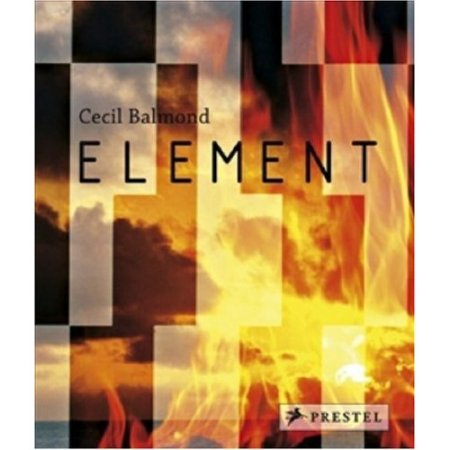
    balmond-element

      Ya, but I’m working on it. 

    *Given a hint and some time, even Kenny would figure out to what the two balls relate…

    ** Jasper Johns said about a Cezanne picture: “As for the Cezanne, it has a synesthetic quality that gives it great senuality-it makes looking equivalent to touching”.

My Kind Of Town

March 27, 2009

chicago-skyline-day-2

  Next time you stay overnight in Chicago and get up for your morning run, make sure to go south along the lake a bit, past the Shedd Aquarium, and then east out the Solidarity Drive peninsula to the Adler Planetarium.  Then turn around and look back. 

  You will see why the Economist called it “…architecturally the most interesting city in America”.  And a better point of vantage could not be had.  If done just as I described you’ll already be on an endorphin high and with your first look, your breath will be taken away as it was just after first hearing the major movement of some great piece of music.  You will agree with (Chicagoan) Frank Lloyd Wright that “architecture is nothing more than frozen music”.

  With each repeat of this experience, I get the feeling that the final reverberation ended just the second before I turned.  Instruments are at rest.  Orchestra standing about to bow.  Remember – this is far removed from the sounds of the city.  In the early AM there is near silence out there.

  When I noticed a nearby statue I figured it must be of a great composer, seated, listening to a performance of his finest work.  Upon closer inspection however, it turned out to be of Copernicus which in a sense is just as appropriate.

  Chicago’s architecture would not be nearly so moving and dramatic had it not been for the great fire of 1871 which burned a wide swath to the ground.  From the ashes arose what is there now there to be seen.  A big bang of sorts.  It thus makes sense to have that important early cosmologist looking upon what hath been wrought.

KC-GULL-3C-830PM_MET 0624 C03 KOZ24

  It is especially fulfilling to consider this particular measure of the built environment as of a whole rather than of its pieces.  It is a nearly perfect oeuvre of quite large scale and, in comforting contrast to the terror and turmoil about these days, shows what can be achieved through harmonious collaboration. 

  Iris Murdoch wrote: “Good art, whatever its style, has qualities of hardness, firmness, realism, clarity, detachment, justice, truth.  It is the work of a free, unfettered, uncorrupted imagination.  Whereas bad art is the soft, messy self-indulgent work of an enslaved fantasy.  Pornography is at one end of that scale, great art at the other end.”*   Hardness, firmness, realism; doesn’t that sound like Chicago?

  It is incredible to learn that the city was built upon a swamp; that its name relates to the onions found therein by Native Americans; and that the land from Michigan Avenue to the lake was reclaimed and filled with the conflagration’s remains;

  As Carl Sandburg wrote in his Chicago Poems:

Come and show me another city with lifted head singing
so proud to be alive and coarse and strong and cunning

  And:

By night the skyscraper looms in the smoke and the stars
and has a soul

  My kind of town.

chicago-skyline-night

I Am Not Myself

February 27, 2009

  That’s Swedish singer Karin Dreijer Andersson in When I Grow Up from her Fever Ray project.  The video was directed by Martin De Thurah. DJ Dirt McGirk introduced me to the piece calling it stunning and mesmerizing.  I agree.

  From an initial brief placidity, the music quickly lets you know that something’s awry in suburbia.  Rounding a corner we see a disheveled waif atop a diving board facing away.  With contorted steps backward, she gathers strength and begins to writhe and sing as if possessed.  The water initially trembles with potential, but soon roils to her incantations.  She turns and communes with the water beast which displays its spiritual tumescence.

  At the peak of the tumult we briefly see a man through glass darkly – a minder, intermediary, sacerdote there to make sure things don’t get out of hand.  He’s like dark energy, the 70% of the universe about which we know nothing and looms large for the fact.

  Spent, our shaman folds her wings and the water calms.  Even though she did all of the work, it was good for us too and we’re newly invigorated.

  Clearly this is not just a “silly little love song” or anything else we’ve previously seen or heard.  (Well, at least not this 56 yr old technophobe.)  And more than any other video  I’ve seen neither meaning nor valence can be teased out of the lyrics alone. Here’s the first verse:

When I grow up, I want to be a forester
Run through the moss on high heels
That’s what I’ll do, throwing out boomerang
Waiting for it to come back to me.

  It’s oracular.  Like, say, the I Ching.  Jung wrote in the introduction to the Wilhelm translation that “The heavy-handed pedagogic approach that attempts to fit irrational phenomena into a preconceived rational pattern is anathema to me.”  Let it sift for a while, let the other side of your brain kick in.  What does it mean to me

  Indeed, Andersson says that “half of what the songs are about is the subconscious… A lot of it is like daydreaming, dreaming when you’re awake, but tired.  I try to write when I’m in that state.”

  The piece brought immediately to mind African maskers – dancers wearing those beautiful/grotesque wooden masks seen in museums.  They are fascinating and often spectacular objects in and of themselves, but purposeful and part of a larger whole in their use.  Wearing one, a dancer says “I am not myself” meaning he/she has become the evocation of a spirit. 

  Perhaps enabling a rite of passage in this case.  Try something out.  Throw something out there.  Wait for feedback…

  Masks in museums are shorn of much decoration attendant to them when in use such as raffia, textiles, animal hides, feathers, leaves etc.  Their makers say that “their work actually came from the spirits who revealed themselves in a dream or vision…”*

mask-2

  Joseph Campbell wrote in his incredible Hero With a Thousand Faces that: “It would not be too much to say that myth is the secret opening through which the inexhaustible energies of the cosmos pour into human cultural manifestation”.  I know Jung would agree, but probably also would an African dancer and Andersson herself.

  There’s lot’s at stake.  Close to the end she sings:

On the seventh day I rest
for a minute or two
then back on my feet and cry for you

  Perhaps she needs our help.  Nikos Kazantzakis, author of Zorba the Greek wrote in his The Saviors of God “Gather your strength and listen: the whole heart of man is a single outcry.  Lean against your breast to hear it; someone is struggling and shouting within you.”

  At the very least, as the author of a tome on African Masks** says of them, cultural myths, and Fever Ray also “represent part of a larger cultural ethos”. 

  That old zeitgeist again.  Where, exactly, are we?  To enjoy one’s stay here it is important to be comfortable living in that question.

*African Masks from the Barbier-Mueller Collection

**Andersson is the mother of two young kids and all I know is that if I had seen my mom (or my kid’s mom) acting like that I’d think that she’d had too many of what the Stones called “mother’s little helpers”.

*** I once heard Kazantsakis’ widow speak.  She said that he’d held that humankind’s biggest problems were the comforts of life and syphilis.  The former, at least, seems to be taking care of itself these days…

Very, Very, Very Fine House

November 28, 2008
nikon-transfer-497
Our house, is a very, very, very fine house
With two cats in the yard
Life used to be so hard,
Now everything is easy ’cause of you. 

      Graham Nash wrote “Our House” in 1969 when Sally and I were in high school dating (though she in Massachusetts and I in Iowa).  While certainly a CSN fan, I was not particularly fond of that song. It thus came as quite a surprise when its lyrics began to run through my mind some thirty-five years later.

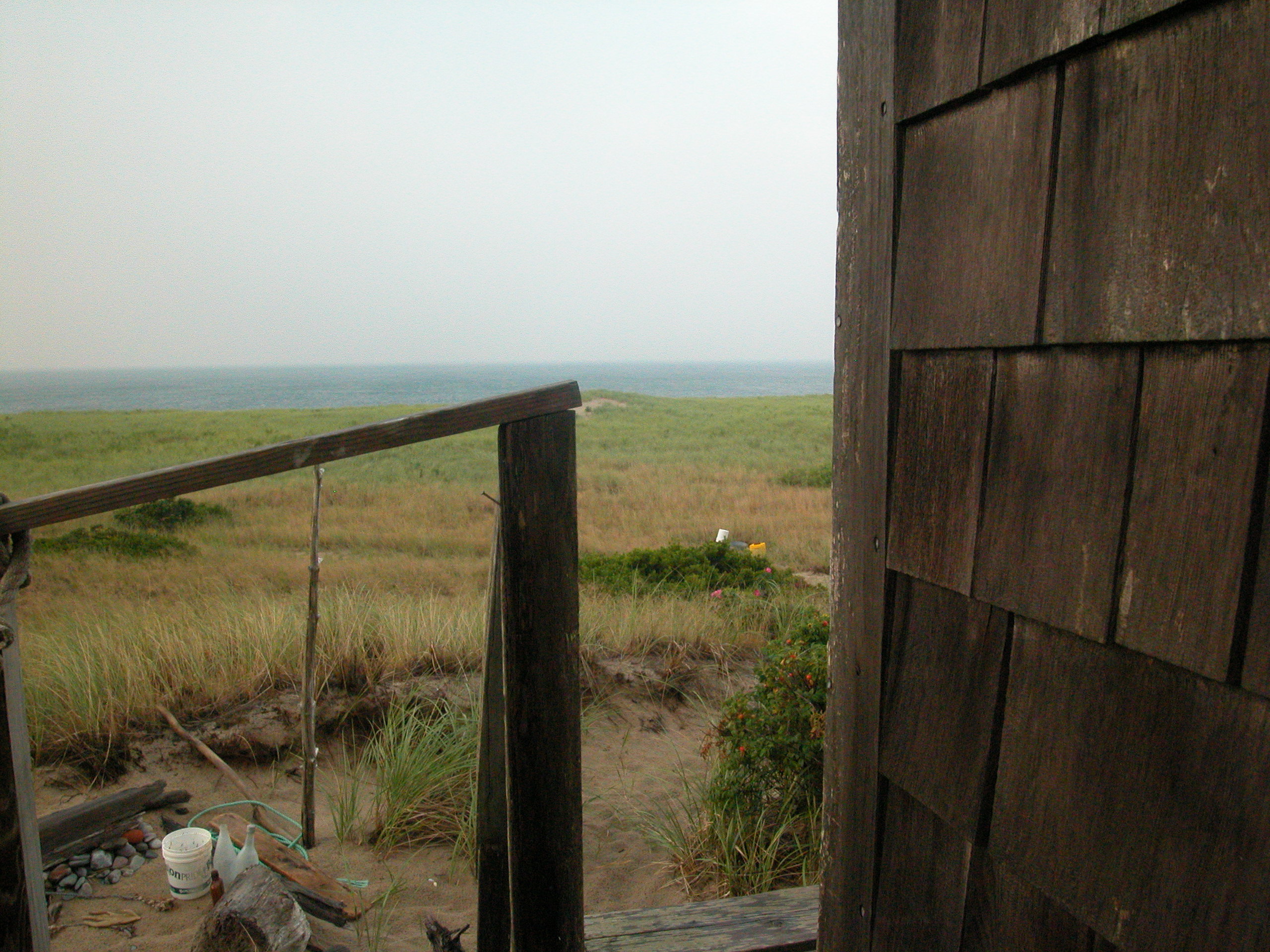
      We were on Cape Cod in an isolated one-room shack that was perched upon a sand dune.  It looked as in and out of place as a piece of driftwood – one that had been part of a tree, gone through the hands of man, and back to those of nature over the course of many many years.

      While not exactly alone, it was hundreds of yards from its closest neighbor, which was similarly bereft of electricity or running water.

      My wife was one of several, out of hundreds of artist applicants, to have an opportunity to live in the cabin for two weeks alone (or almost) with their thoughts and work.  I was only able to visit for three days, but even so they were several of the best of my life.

      The shacks were originally built in the 1800s to serve as life saving stations offering aid to the victims of shipwrecks just off the coast.  Thousands have occurred since the Mayflower first furled her sails nearby.  They fell into disuse after 1914 with the construction of a strategic canal that obviated the dangerous passage.

      The then empty gray boxes were discovered by those who had already made nearby Provincetown a dynamic and vibrant artists community.  Maybe America’s first.  Thoreau spent time there.  Eugene O’Neil was living in one when he learned of his first Pulitzer Prize.  Kurt Vonnegut wrote Player Piano there. Norman Mailer had a place.  Painters such as Hans Hoffman, Mark Rothko, and Helen Frankenthaler have lived and worked in these parts.

      Jackson Pollack visited the area several times and apparently had even stayed in the shack in which we found ourselves. He was thereabouts heard to have said that “he fucked Mrs Benton” (Mrs Thomas Hart…) which episode though must have taken place in town – not in the shack.  It’s too far from anywhere for an illicit tryst.  Not the place for a quickie.  Wrong juju.

      The hike in sets the tone emotionally and otherwise.  You park your car just outside of Ptown at the intersection of Snail Road and US Highway 6, pack your things and enter a natural archway through a thick wood. 

The trees end suddenly though, leaving one to face the steep slope of a fifty-foot sand dune.  A one-hour trudge up down over and across hot sand leads to the north coast. The two steps forward and one back routine make it much tougher going than most mountain trails. 

      And a horse of a different color at night.  Once, after a wild time in Ptown we made it back to a quiet fogbound trailhead at 10:00 PM.  We nonchalantly chattered about the evening for an hour or so until we realized that we’d lost our way.  Fortunately, as I’ve mentioned before, I always carry a compass and with a few course corrections soon found ourselves home.

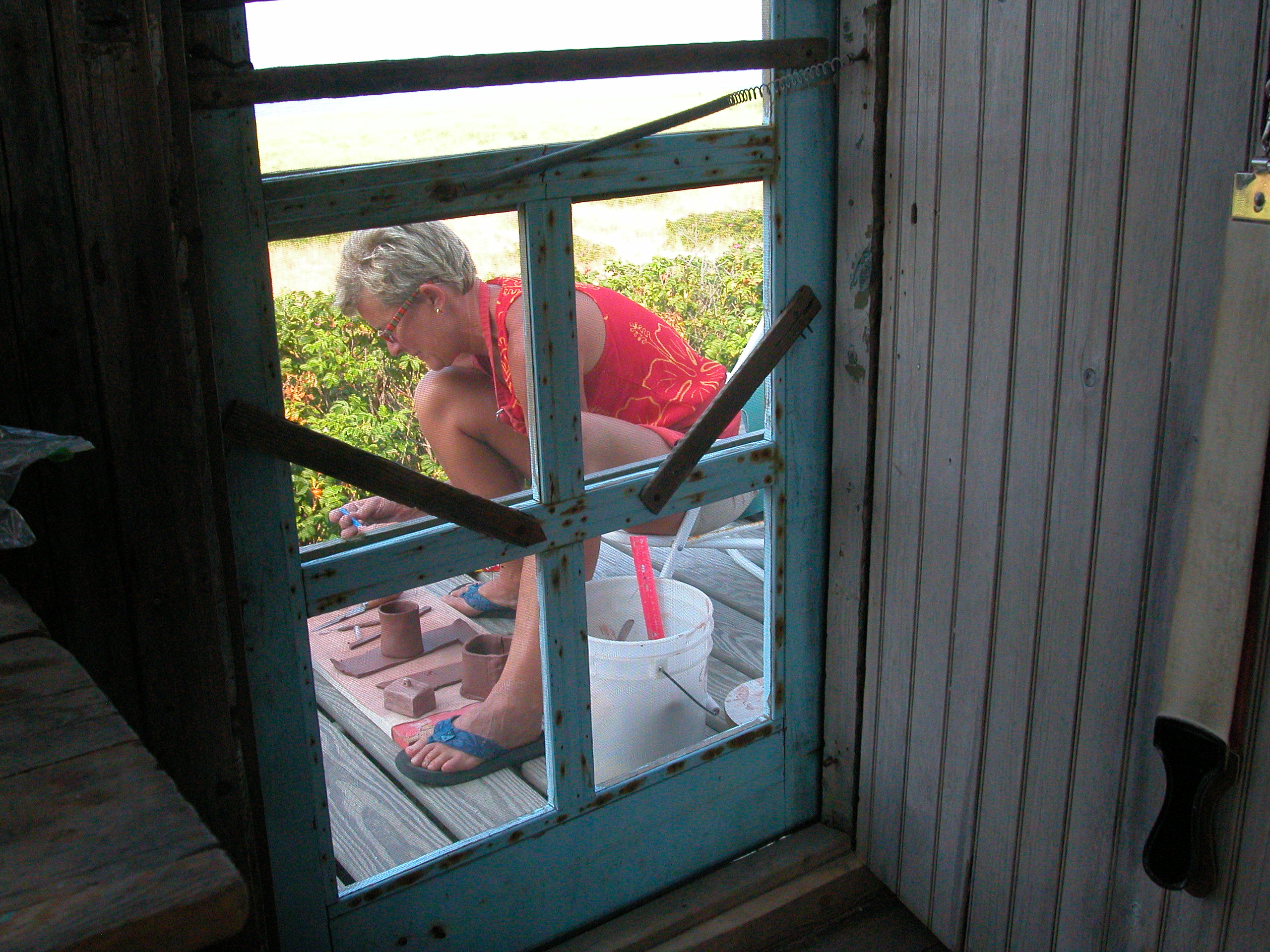
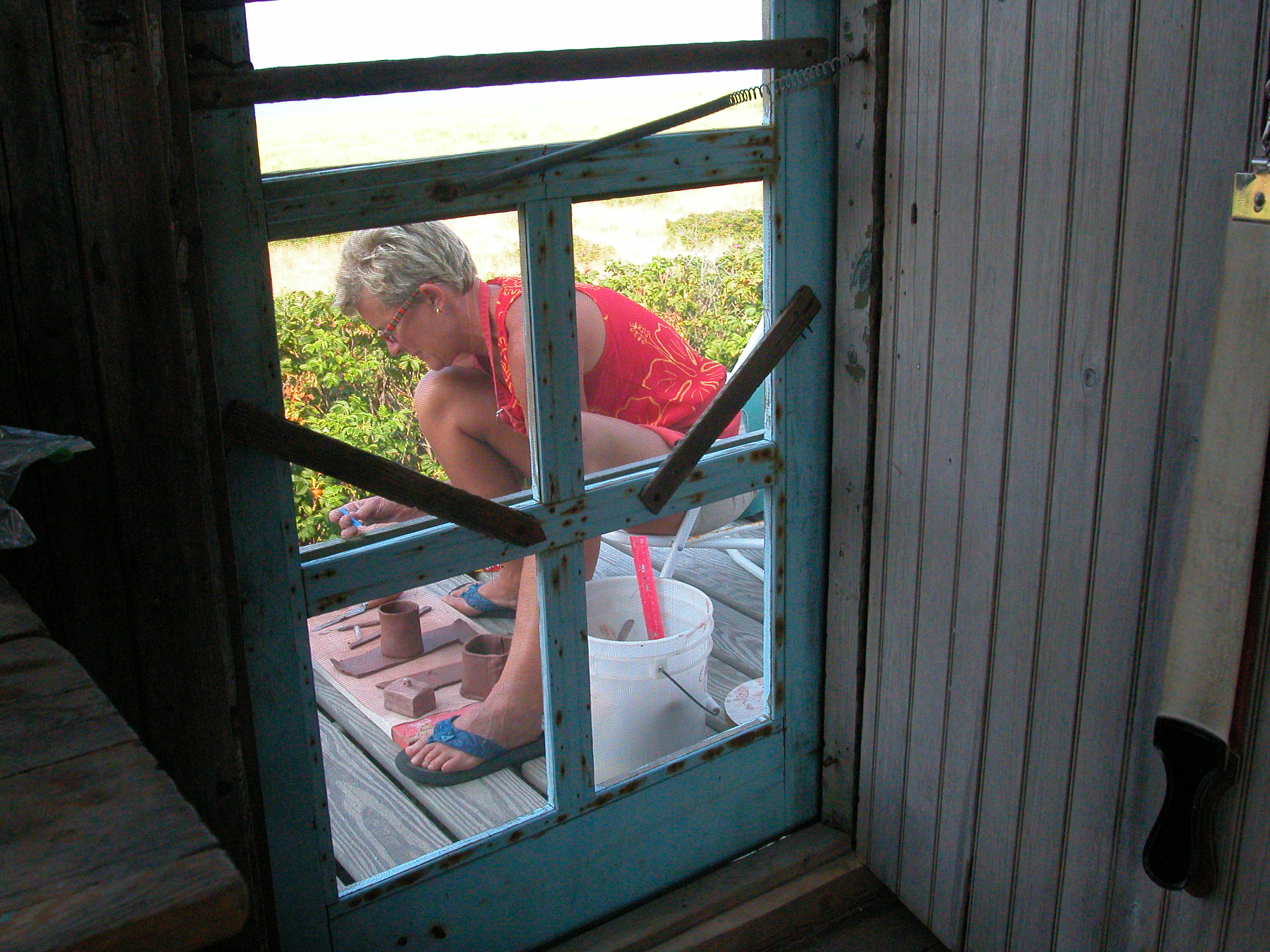
      Upon awakening the first morning there, I turned slightly to look through the screen door to watch Sally on the deck intent upon her clay.  The ocean rolled in the distance and fishing vessels bobbed about.  She hadn’t always worn glasses, but looked great in them.  Her long honed mode of concentration was at its peak. 

nikon-transfer-4791

      Other mornings were similar.  After watching her work a bit, I’d make a pot of filtered coffee, we’d eat a bit of breakfast, and then walk on the beach.  Sometimes for hours without seeing another soul.  Only twenty miles from Boston and the whole eastern seaboard! 

     We were lucky though.  During most of the year vehicular traffic is apparently allowed on the shore, but through the course of our sojourn the endangered piping plovers were breeding.  The National Park Service makes certain that their relationships are allowed to flower.

      Ya, during our walks over those few days we did talk about our kids, folks, work, world events, etc, but they somehow seemed far away and ok.  Life used to be so hard.

      Upon conclusion of our strolls we’d disrobe and swim.  Not an original thought. Thomas Hart Benton wrote in 1937 “once or twice I’ve seen a young Venus come naked out of the Martha’s Vineyard sea, but generally it’s something to make you wish you hadn’t lived so long.”  Well, I’m still aiming for 100.

      Then lunch, after which Sally would put in several more hours of work at her clay or watercolors.  I’d usually take a well-deserved nap.  Just before dinner we’d bathe in water we’d drawn from the well several hours before and allowed to warm in a galvanized tub out front.

      Once home – without her – the song continued to play in my head and I was somehow compelled to locate and read letters that Sally had written to me back in high school.  The nature of the relationship manifest therein was, well, syncopated, but the tone, the sparkle of their author was clearly recognizable and fresh.

      Déjà vu.

November 7, 2008

bedroom-fall-11

  The two main types of Japanese garden design are almost perfectly complementary.  The first, “shakkei” or “borrowed scenery” involves the incorporation of distant scenery into the experience of the visit.  For example, shrubs may be trimmed and limbs of a maple tree pruned so that a distant mountain is perfectly framed.

  The other garden type, the courtyard, employs its elements – rocks, water, flowers, bushes, etc – to “create the illusion of more than can be seen”*.  Descendents of special gardens carefully arranged to enhance and facilitate tea ceremonies, the more modern urban courtyard gardens often include steppingstones, lanterns, and a ritual water basin in addition to raked gravel and greenery.

  In both cases nature is viewed as an ally – not something to be wrestled into submission.  All elements of each were (are) considered to be alive and importantly to remain alive.  They’d obviously change with the seasons and would impact the visitor differently with each turn.

  It may seem obvious (and should be obvious to an architect), but one of many formal techniques used to “borrow” scenery is called “capturing with window”.  It is far from the most subtle of methods, but effective nonetheless. 

  Once, in 16th century Japan the respected leader of early Edo culture Kobori Enshu criticized the garden of a powerful territorial lord for being cramped and confining.  Infuriated, the daimyo ordered an artificial hill removed and a window cut in the guesthouse to perfectly frame two mountains and a lakeshore.

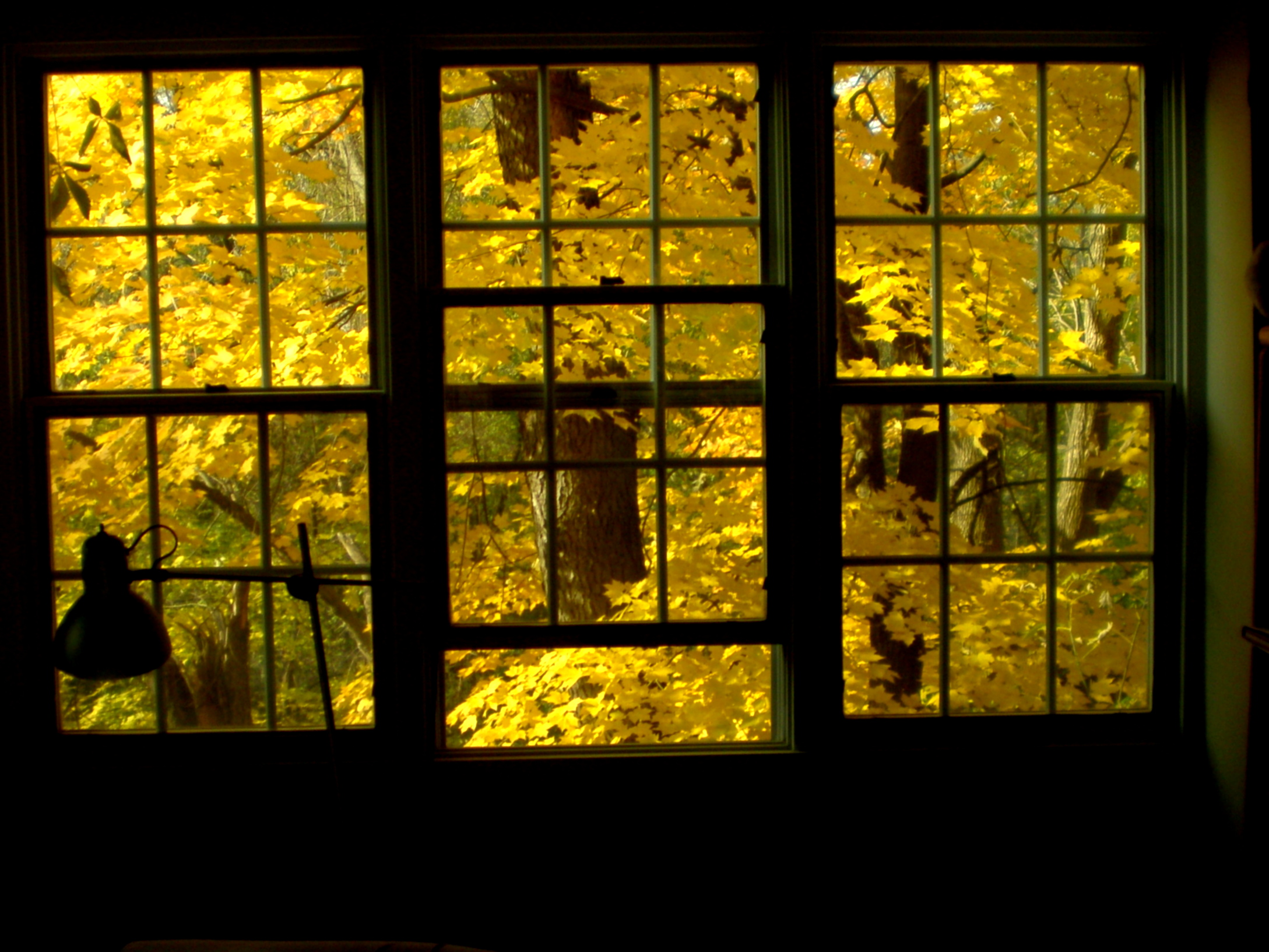
  The small ravine behind our house can certainly not be said to have been cultivated exactly, but as you can see above the presence of the latter upon the former has been salubrious.  Especially during these few days of fall.

  The maple tree is on the west side of our house, just behind our second floor bedroom.  Was it not there, the tree’s leaves would bear the brunt of the full force of the sun every day.  The juxtaposition that does exist however serves to shield the leaves from most of the day’s direct sunlight.  Thus, once the photosynthetic pigments are drained for the season, those that remain are able to luxuriate.

  A fortuitous circumstance I’m sure all will agree.  At its peak, the quality of the light infuses one with an incredible spiritual tumescence.  As the days progress and familiarity is bred, the mind is led from one happy memory to another. School in New England, expansive western hillsides covered with Aspen, and oh ya, Maine just a couple weeks ago…

  “Although this house may lack solutions to a great many of its occupants’ ills, its rooms nevertheless give evidence of a happiness to which architecture has made its distinctive contribution.”  Alain de Botton  The Architecture of Happiness 

*Space and Illusion in the Japanese Garden by Teiji Itoh

Before Shit Happened…

August 8, 2008

  If you buy the idea that developments in the arts of a time or  civilization are due to tremors in its underpinnings, then get this: the cave paintings of Paleolithic artists were largely unchanged for some twenty five thousand years! Must not have been any neurotic cavemen.  Or angst.  Or civil displeasure.  I read this in an interesting article by Judith Thurman in the 6/23 New Yorker.

  Isn’t that amazing?  Just think of all of the different movements of art that rode tumultuous waves of change in the twentieth century alone: Fauvism, Die Brucke, Cubism, Futurism, Orphism, Der Blaue Reiter, Constructivism, Suprematism, Dada, De Stijl, Art Deco, Bauhaus, Surrealism, Regionalism, Abstract Expressionism, Op, Pop, Minimalism, Conceptualism, Performance, Earth, Post Modernism, etc, etc. 

  She writes: “Paleolithic artists transmit[ed] their techniques from generation to generation for twenty-five millennia with almost no innovation or revolt.  A profound conservatism in art is one the hallmarks of a classical civilization.  For conventions of cave painting to have endured four times as long as recorded history, the culture it served… must have been deeply satisfying – and stable to a degree it is hard for modern humans to imagine.”  In addition, she points out that there has not been found any depiction of human conflict in cave art.

  Thurman tells us that the life expectancy way back then was about eighteen.  The brevity of the average was due to high infant mortality.  However, those making it through could expect to live for another thirty or so years due “to the rarity of infectious diseases and abundance of protein… considerably longer than the Greeks, the Romans, or the medieval peasants who built Chartres”.

  The zeitgeist way back then – for all of those centuries and all those generations – must have been characterized by an overwhelming sense of natural rhythm.    

  Must have been sweet.  But then we invented agriculture and began to try to remake the world according to an endless variety of parochial visions.  Shit happened and the rest is, well, history.

  As I have asked before, and will again, now that we are all elbow to elbow and our existence is at the very least wildly syncopated:  whither now that zeitgeist?

Feed Your Head

May 23, 2008

  Picasso once said that “Computers are useless – they can only give you answers”.  True, they have enabled incredible productivity and played a large role in tremendous economic expansion.  But Bill Gates would still be a geek without game (or a college degree) if he hadn’t asked:  Software or hardware?  Steve Jobs would still be a hippie if he hadn’t wondered “are these things just for nerds?”.

  Staring into one’s screen, it is now awfully easy to be drawn mindlessly along. And spew out report after report without getting ‘out of the box’.  You come up with the same garbage you would have without a computer – just faster or more frequently.

  America’s first billionaire, shipping magnate Daniel Ludwig, thought about that and asked himself: “paperless office?”.  He didn’t buy it and developed a massive project in Brazil to produce paper on a theretofore unheard of scale.  He foresaw the reams you’ve “borrowed” from your office to feed the machine at home.

  Artificial intelligence has a long way to go. It has no counterpart to the older parts of our brain – those controlling respiration, fight or flight, and lust for example.  That neat stuff complete with its incredible cortical wrapper make quite the cosmic organ.

  A tool kit comprised of only 1s and 0s, or circles and rectilinearity will be no help in discerning between cheese and mold or making lemonade from lemons or evaluating risk or associating truth and beauty.  Or painting Les Demoiselles d’Avignon. (Or being a misogynist for that matter I quess.)

  Gonna have to keep on thinkin’ – daydreaming at the very least…

Spiritual Fecundity in Chicago

April 4, 2008

  Be interesting to know what were like the childhoods of architect Tadao Ando and ceramicist Toshiko Takaezu.  The installation of a selection from the oeuvre of the latter in a gallery designed by the former together create an experience far beyond corporeal beauty. 

  If there can be a soul of a building, one such numinous sanctuary is Ando’s space in Chicago’s Art Institute. Commissioned in 1989 to exhibit from the Institute’s Japanese screens, the small room is unforgettable.

  Upon entering, through the center of the short end of the dimly lit rectangular room, one looks through four rows of one foot square oak columns.  The vitrine is arranged along the long wall on the right and continues across the back wall straight ahead.  It is illuminated.  The view through the oak and cast shadows is to be as if, upon the porch of a traditional Japanese house, one looks inside.

  Ando says: “Not everything can be accounted for reasonably…there are things in society that cannot be explained just in functional terms. I have provided functionless columns and walls…I feel this irrational quality is important. The modernism of the past became insipid because it rejected such irrationalism”.

  Takaezu’s pots draw from the range of her career and are interspersed with several from important mentors and contemporaries.  Well represented in the twenty or so are examples of her vertical closed vessels.  She says of these: “The most important part of a piece is the dark, black air space that you can’t see.  Just as what’s inside each person is also the key to humanity”.

  Some of her pieces are indeed human scale and elsewhere stand outside in fields or gardens.  Some, holding small ceramic balls, sound when gently shaken.  Visitors here might be disappointed at their inability to move around and touch her work.

  Like a compassionate abbess, Takaezu must be fine with it.  “When I was a small girl in Hawaii, I was fascinated by my shadow because it was taller than I.”  Here her pots are stroked by even taller shadows.  Her fertile dark spaces are clearly manifest behind the glass, but reserved.

  She knows that if, on the opposite benches perhaps, you linger long enough with an open heart, with her invitation, and with Ando’s generosity, you just might get a glimpse inside.

  An audience with the screens too is very fine, but different – for the historicity.  Come back in a few months and see them if you have yet not.  But don’t miss this.     

  At the Art Institute of Chicago through June 8, 2008.

Razor’s Edge

February 20, 2008

  Somerset Maugham ended his book The Razor’s Edge with an epigram taken from the Katha Upanishad:  “The sharp edge of a razor is difficult to pass over, thus the wise say the path to salvation is hard”. 

  Those few words are a clean distillation of his story of a fighter pilot returning from the horrors of WWI.  The flyer decides not to resume the mode of his previous existence.  Instead, he will seek transcendence while his old friends and acquaintances tootle on in neutral.  

  Perhaps the pilot was cruelly fortunate to have had the devil hold his face over the abyss.  The line between good and bad is not always so clearly drawn.  It can prove hauntingly easy to start down a dark path when everything is gray.  

  Even a somewhat voluntary encounter with the grim reaper can provide new perspective.  Stuck in a storm far at sea, or frozen and hungry on a ledge high up on the side of a big mountain, or lost with a young family camping in the wilderness will have been an extra-ethical experience.  The burn from the searingly intense ontological lens does not soon fade.  

  Back in a modern urban embrace of course, the mundane resurfaces and temptations and distractions reconvene.  Still, the lesson in values won’t easily be forgotten.  Only at one’s peril will it be drugged or drowned into submission.  

  Bill Murray was in the second Hollywood take on the Maugham novel and the thought of him choosing that role makes one realize what a positive important purpose celebrities can serve.  Why not Ghostbusters $Umpteen$?  

  At the pinnacle of popular culture with nowhere left to go, some few see what the pilot saw and return determined to tell us about it.  As Iris Murdock wrote: “There’s a truthfulness to great art…  pornography is at one end of the scale and great art at the other…”