Archive for the ‘consciousness/psychology’ Category

Don’t Light A Match

September 30, 2011


  Well, news from CERN has it that there are particles moving faster than the speed of light.  Sounds like a big deal given E=MC2 and all of that.  However, reading through the blogs, it seems that Einstein’s theory already allowed for neutrinos of the “Tachyonic” sort to exist always at faster than light. 

  Dang complicated though and they’d not theretofore been detected. Guess we’ll have to wait for review of the evidence to see what, if anything, new was discovered.  But don’t you wonder where this stuff comes from in the first place though?  Scientific insights I mean? Here’s what erstwhile Princeton Psych Prof Julian Jaynes had to say about it:

  “The picture of a scientist sitting down with his problems and using conscious induction and deductions is as mythical as the unicorn.  The greatest insights of mankind have come more mysteriously.  The literature is full of insights which have simply come from nowhere.*”  Said Einstein of his theory: “Suddenly the happiest thought of my life came to me”.  And “Why is it that I get my best ideas in the morning while I’m shaving?”

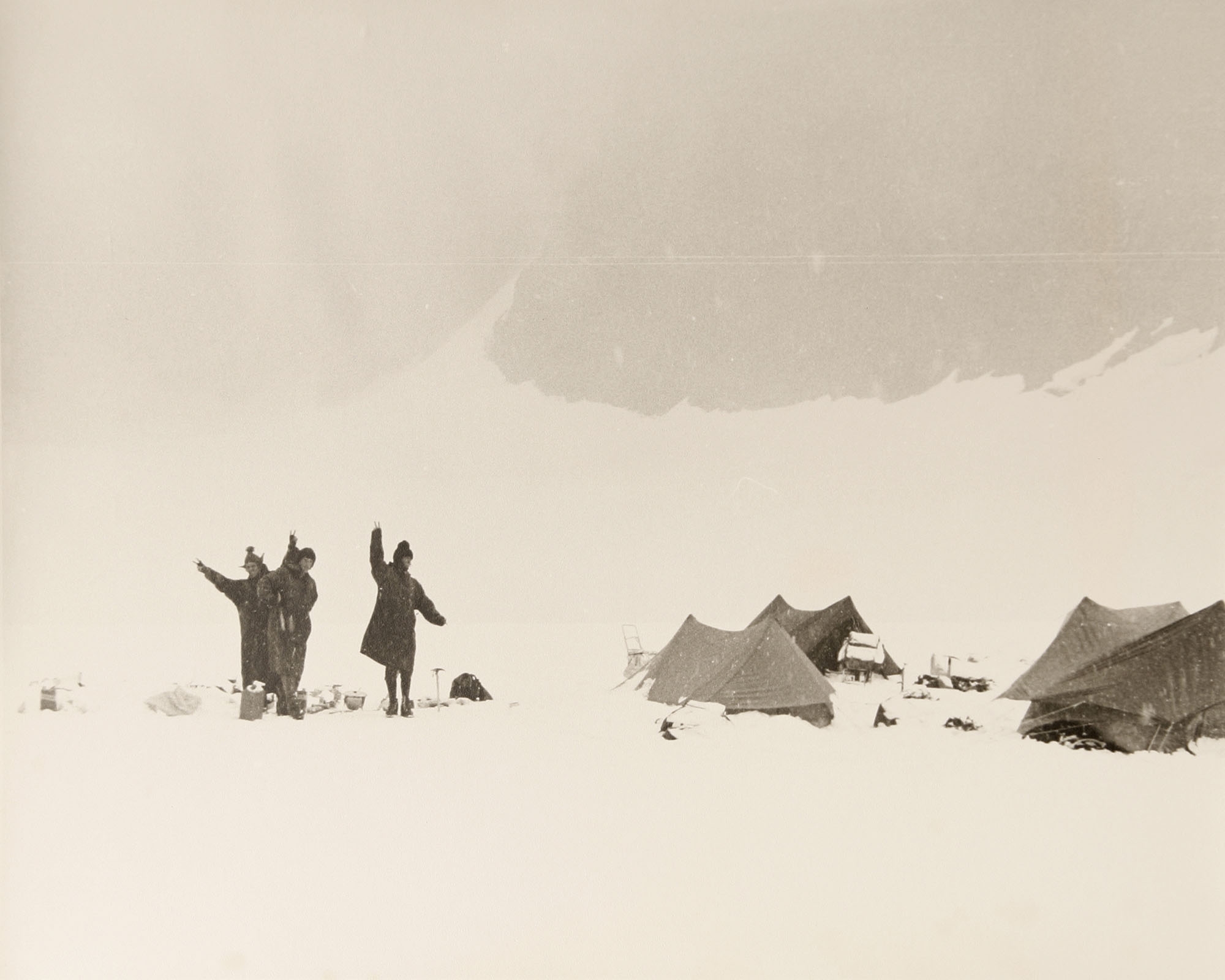
  Insights come when you stop thinking about the problem.  For example, years ago friends and I were encamped upon a glacier dreaming of first ascents up in the Interior Ranges of BC.  A storm set in and held us down for days.  One member of our party never left his tent and became more morose by the day.  Seriously depressed after several. 

  “We’re gonna die” he’d wail from inside his tent.  The situation wasn’t pleasant, but wasn’t that serious either.  Finally I decided to stick my head in and try to assuage his fears only to be nearly overcome with horrible odor of freeze-dried frijoles begotten methane.

  “Hey man” I said to him in recoil, “get the hell out of there and breathe some fresh air before you get really sick.  You got something muy bad goin’ on in there.  Don’t light a match.  Seriously.”  He moaned a bit, I persisted, and soon he emerged. 

   Five minutes later he was smiling.  Storm hadn’t broken, but his head was clear and he offered a few suggestions for elegant new routes of which no one had yet thought and which ended up years later with multiple stars in a guidebook.  Same here.  My best ideas always come  shazam while breathing outside air.

*From his Origins of Consciousness in the Breakdown of the Bicameral Mind – to which I’ve previously and frequently referred.

**Gotta be honest.  I came up with some of this while perusing two books that’ll I’ll shortly wrap and give as birthday gifts:

The Courage to Create by Rollo May and Confronting the Quantum Enigma by David J. Kreiter.  And dang if, since I just bought them yesterday, I’m not going to have to go out and buy again for myself.

Think With Your Hands

September 9, 2011


  OK, the other day I was near a bookstore in its final death throes, having been killed by the internet, Amazon, et al.  Sign said “80% off” so I decided to go in and see if there was anything interesting left.  There was!  Edward Tufte’s Visual Explanations – Images and Quantities, Evidence, and Narrative. 

  The Boston Globe calls the book “A Visual Strunk and White”.  The New York Times calls Tufte: “The Leonardo of Data”.  No understatements.  With wit, verve, and beauty the author convincingly shows how good design matters.

  One of many cases in point.  We learn that it was poor design that allowed the Space Shuttle Challenger to explode, and I’m not referring to the engineering of the Shuttle or its launch vehicle themselves, but rather that of charts engineers used the day before the launch in an unsuccessful attempt to convince NASA that an explosion was likely.

  The physical problem was that the cold temperatures predicted for launch date would attenuate the resilience of critical rubber o-rings allowing propellant to escape and conflagrate.  The chart below is but one of several holding data describing the danger.  Of their many faults Tufte cites inadvertent visual dissembling: “Chartjunk”. In contrast “Good design brings absolute attention to data”.

  Then he recounts the famous experiment undertaken by the Nobel Prizewinning Physicist Richard Feynman in front of the commission investigating the accident.  Using a small c-clamp he’d brought with him, he squeezed an o-ring and put it in a glass of ice water for a few moments.

  As he removed and released the bit of rubber, it became immediately apparent that the cold kept it from springing back.  “I believe that has some significance for our problem”.  The utter clarity of his presentation and his deadpan understatement blew the minds of the masses who saw it on TV or read about it in the printed press.

  “Never have so many viewed a single physics experiment.  As Freeman Dyson rhapsodized:  “The public saw with their own eyes how science is done, how a great scientist thinks with his hands, how nature gives a clear answer when a scientist asks her a clear question.”

  So, now, my questions are first: Without shelves loaded with books in a store through which to meander, how will one be able to occasion such moments of serendipitous edification?  Seriously.  And more important (again) what will the internet do to the potential for the development of great minds that “think with their hands”? 

  Here’s a response to question #2.  Reformed nerd Nick Carr has written a Pulitzer nominated book, The Shallows, What the Internet is Doing to Our Brains and penned an article for The Atlantic titled “Is Google Making us Stupid?”  Slate called his work “Silent Spring for the literary mind”.        

  Carr believes that “…there’s legitimate reason to be fearful.  I’m just suggesting that data technology is becoming so dominant that we’re losing the opportunity and the encouragement to engage in what I think is the highest form of thought.”*

  I’m gonna get some sort of grip exerciser. 

*”The Reluctant Luddite.  Nicholas Carr is a Net user of the first order, but he believes his brain is paying for it.”  Article by Dirk Olin in the Sept/Oct ’11 Dartmouth Alumni Review.


Joe, Joe, and Joe

August 26, 2011


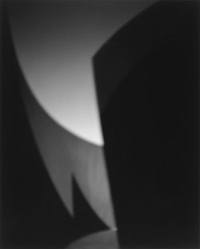
  Artist Hiroshi Sugimoto did a series of black and white photographs of Richard Serra’s Joe, a sculpture which sits in an outside courtyard at the Pulitzer Foundation for the Arts in St. Louis.  Sugimoto’s work is interesting for a variety of reasons not least because of Serra’s own surprise: “This is not about me”.

  The several ton piece was Serra’s first torqued spiral and he was shocked that the Japanese photographer had not undertaken a documentary style project.  Instead, Sugimoto used the opportunity to create a work  of his own and with it a more effective conveyance of the sense of Serra’s ideals than a more literal interpretation ever could. 

   The images abstract and cerebrate the unexpectedly complex physical experience of the huge hot rolled steel spiral.  The two dimensional representations are thus elemental forms manifested and manipulated by Serra and returned to the Platonic realm by Sugimoto.

  Furthermore, fascinatingly, Sugimoto doesn’t see Joe as relating to its namesake, Joseph Pulitzer.  “I see it as related to my seascape series as a metaphor of human memory.”  He tells us that a seascape is likely the least changed vista since the rise of consciousness.  A gaze upon one thus shares an ethereal resonance with those of our earliest ancestors as well as all those between.

  An early product of this awareness was remembrance of the dead.  The first proto-human efforts beyond feeding, fighting, fleeing, or f______ (making babies) were the creation of graves, tombs, and then cenotaphs.  Sugimoto calls Joe a “metaphor and system of remembrance”.  Seems to me that the relationship between Joe and Photographs of Joe is a metaphor for the evolution of consciousness.

*Quotes from the exhibition brochure “Hiroshi Sugimoto – Photographs of Joe; edited by Matthias Waschek; published by the Pulitzer Foundation for the Arts; 2006.

**cf “Conquistadors of the Useless” 1/21/08

Meager Tools of Consciousness

August 12, 2011


  Do you dream in black and white or color?  Interesting that in the 50’s most respondents to that question would say b&w.  Now most say color.  What’s up with that?  Humanoid brains have evolved and grown in size, but not that much that fast…

  A philosopher* holds that the real answer is neither.  Those choices just happen to have been the most convenient metaphors or analogies for a given place and time – conjured up by those exposed to black and white film in the case of the former and color TV of the latter. 

  “Dreams don’t have to be pictures of any kind at all.  They could be simply thoughts – and thoughts, even thoughts about color, are neither colored nor noncolored in themselves.”

  We struggle with the meager tools of conscious experience to interpret the relationship between our brains – by far the most complex things in the universe – and everything else.  And to make it even (to me) less comprehensible, everything is relative.

  Know how if a tree falls in an empty glade there can be no sound?  Well, even should said tree remain upright, if there is no eye to look upon it, there is no color either.   Sight and sound are by definition the result of the interaction of stimuli, organ, and cerebral processor.

  At least to start with.  Research has shown that, for example, some originally sighted folks gone blind retain the ability to think in color, remember shapes of letters and faces while some do not.  Makes me wonder from time to time what one’s gray matter could cook up on its own.  Like, could one completely and forever sensory deprived somehow engender a hallucination? 

  Obviously, such experimentation has not been done on humans.  Unfortunately though. it has been on animals – monkeys.  Makes ‘em stark raving mad.  Would the far greater complexity of our neural networks make a difference?  For me the question comes down to the nature of consciousness.  Is it an emergent property dependent for its existence upon that meat pudding up there or does it exist independent of material origin?  There are respected thinkers on both sides of that issue. 

  At any rate, the richness of our interior lives is directly related to that of our experience.  Consider how different must be those of the two beings in the paragraph below: one an accomplished mountaineer on a ledge high of the side of a difficult and dangerous mountain and the other a peasant far below:

  ..We melt snow on our campstove.  Constellations cast flickering stories of gods, heroes and animals against a coal-black sky.  The earth spins, and for a few sleepless hours we linger far above the horizon.  We hover between the bliss of the heavens and the chaotic life on earth.  Time feels suspended: it’s as if we can view our planet from another, ephemeral world.  Far below, in the tangled rhododendron forest, the villagers of Moxi and Xinxing enjoy a rare cloudless evening.  With my headlamp, I signal our story to one resident, and he acknowledges our presence with his own flashing light…”**

*Perplexities of Consciousness by Eric Schwitzgebel reviewed by Nicholas Humphrey in the NYT BR 7/31/11.

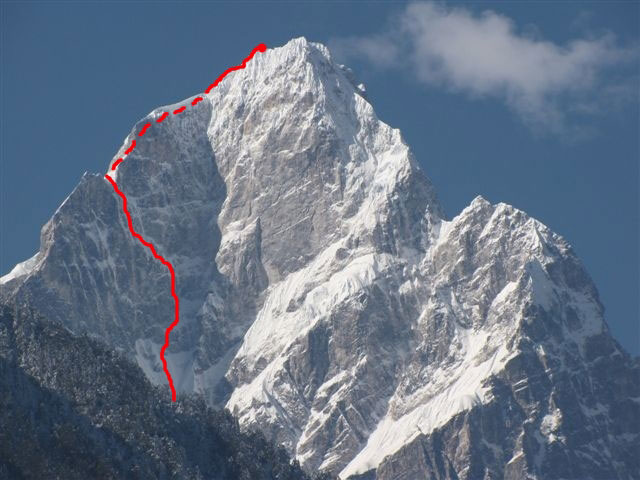
**”Out of Darkness” by Kyle Dempster in Alpinist 35/Summer 2011 His and partner Bruce Normand’s route on Mt Edgar pictured above

Short Circuit Enculturation?

July 29, 2011


  In the 7/23/11 Economist there is an interesting article about the evolution of gender roles in societies across our planet.  It cites convincing (to me) studies holding that the nature of agriculture in the land of one’s ancestors determines much about the economic roles of women in that society.

  Up to the fifth millennium BC Mesopotamian women did the farming, tilling their fields with hoes.  The invention of the plow somewhere around 5,000 BC changed things.  Women didn’t have the requisite upper body strength and men took over. 

  “Women descended from plough-users are less likely to work outside the home, to be elected to parliament or to run businesses than their counterparts in countries at similar levels of development who happen to be descended from hoe-users.”

    Things can change and have to some extent in the western world where much farming was done from behind plows, but it took the cataclysm of WWII.  Rosie the Riveter et al moved into jobs vacated by soldiers and sailors headed toward the battlefield.  Still, even now, sixteen per cent fewer adult women than men work outside the home in OEDC countries.

  Makes one think of other long long term ramifications.   Hmmm.  In her book French Ways and Their Meaning Edith Wharton wrote: “…one may safely say that most things in a man’s view of life depend on how many thousand years ago his land was deforested.  And…when…men…are plunged afresh into the wilderness of a new continent, it is natural that in many respects they should be still farther removed from those whose habits and opinions are threaded through and through with Mediterranean culture and the civic discipline of Rome.”

  For example: “There are more people who can read in the United States; but what do they read? The whole point, as far as any real standard goes is there.  If the ability to read carries the average man no higher than the gossip of his neighbours, if he asks nothing more nourishing out of books and the theatre than he gets in hanging about the store, the bar and the street-corner, then culture is bound to be dragged down to him instead of his being lifted up by culture.”

  I’ve recently been entertained by labor strife in France related to an attempt to raise the retirement age from sixty to sixty-two.  But now in light of the likelihood that the leaders of the richest country in the world have squandered our credit rating, the concept of joie de vivre rings with new resonance.  I’m thinking of short circuiting the slow evolution of enculturation by moving to the Cotes d’Azur.

Mens Sano In Corpore Sano

July 24, 2011


  I’d been wondering why my MD brother had no TV in his place (none!) till I began paging through another of his JAMAs (Journal of the American Medical Association).  I figured it out when the following heart pounding sounding title caught my eye: “Television Viewing and Risk of Type 2 Diabetes, Cardiovascular Disease, and All-Cause Mortality”.

  Made me think of the phrase above from the first line of Juvenal’s Satire X which reads in full: “It is to be prayed that the mind be sound in a sound body”.  It will come as no surprise that I’m in agreement and don’t think that either will be enhanced in front of a tube.  (cf “couch potato category tab below right.)  Still, it is fun to see actual peer reviewed evidence (for which I need a dictionary to understand!) in support.

  The study “revealed a linear increase in risk with the number of hours per day of TV viewing for both type 2 diabetes and cardiovascular disease; the association with all cause mortality appeared stronger with TV viewing time of greater than three hours per day”.

  Interestingly, the authors also relate that for a group of nine year olds, reduced time in front of the television slowed increases in body mass index even without change in physical activity.  No thoughts of “free” Happy Meals and “Livin’ It”.

  Or like Mason Williams* wrote in 1969, “Network television wants to keep you stupid so you’ll watch it”.  And: “Television is not a salesman with his foot in your door, it’s a salesman with his foot in your head”.  

*Mason Williams is an incredible creative force.  He recorded his “Classical Gas” on twelve string guitar in 1968 and won two Grammys.  He was a writer for the groundbreaking Smothers Brothers Comedy Hour the cancelation of which was in part the motivation for the book the cover of which you see above.  He was briefly head writer for Saturday Night Live and could be said to have conceived of music videos and recorded the first one.

Awake

July 10, 2011


  Recently had the incredible privilege and good fortune to be the only dude in a camp for girls and young women.  For a week and a half I was there to help (well, watch) wife orchestrate a ceramic mural commemorating the camp’s centennial.

  The name of the camp is a Native American word which translates as the imperative “awake”.  Perfect.  Separated from all electronic devices for seven weeks and immersed in nature, the arts (studio and performing), and each other the campers must indeed emerge anew.

  I greatly enjoyed watching and listening to what only could be described as reveille to taps ebullience.  And very happily benefited by this most positive manifestation of emotional contagion.  I felt my psyche reconstellate as neuroses disappeared.  No foolin’.

  Every meal time is characterized by singing.  Songs in thanks, songs for dropping stuff, birthdays, introductions, goodbyes, everything.  I sort of felt like I was missing a gear.  Anyway, one evening after the meal was over, table cleared, and awaiting dessert, I was the only one who’d not retained a fork.

  I asked the sweet young thing next to me what was up.  She looked at me with something between mirth and pity and said “dessert”.  I then asked how all but I knew that it was going to be something for which one needed a utensil. 

  “Mr. Budge, we sang the song!”

  Sung to the tune of Frere Jacques: 

Save your forks
Save your forks
For dessert
For dessert
If they’re dirty lick them
Save your forks
Save your forks 

  It was a slap in the side of the head for which I’m grateful.

  I was sad to leave though knew that I was at least as much of a distraction as would have been cell phones, computers, Ipods etc.  Now back behind my desk at my office I understand how the similar experiences of wife and daughters leavened their lives and enhanced their sense of self.*  Needy they’re not.

*cf  Lucifer 7/30/10 

**Couldn’t help but recall that Buddha means “Awakened One”.


Ripple Patterns

June 24, 2011


  After innumerable vehicular gridlocked approaches to Chicago’s skyline over the last nearly sixty years, a recent one from the east afloat through mist and fog was ethereal and otherworldly.  It was like walking into a theater with the most magnificent of backdrops and a smoke generator laying cover for the first act.

  It was incredible.  We were sailing downwind in a light breeze, so it was silent at first.  All one could do was stare.  Time passed, we continued toward the marina at Monroe and Lake Shore Drive.  The air cleared a bit and the sounds of water lapping at hulls and unladen halyards woke us up.  Sun burned and we soon saw more clearly the iconic rectilinearity, strangely yet bereft of the usual downtown din.

  The experience reminded me of something I read about the ascent of man, how “From the stone age to ancient Greece to the Maya to modern Japan, the most technologically advanced and economically successful human beings have often been seafarers and fisheaters”*

  “…people reached the Andaman islands, Melanesia and Australia, all of which required sea crossing, within a few thousand years – whereas it took them tens of thousands of years even to begin to oust our Neanderthal rivals from Europe and inland Asia.

   I wonder about the conscious (or not so) experience of those voyages eons before even Columbus.  Were they reckless forays into the truly unknown or an adventurous hewing to a vestigial instinct?  I’ve read about Polynesian navigators able to find their way through open sea solely by reading ripple patterns on its surface. 

  Something’s gotta be going on there.  Something not to be found on a cruise ship.  Something the zeitgeist lost somewhere between the acquisition of language and literacy.  I need a compass.  Scratch that – I need a GPS.

*WSJ”We Are the Apes Who Took to the Sea”, Matt Ridley, WSJ 3-12/13/11


Pas Timide

June 17, 2011


  Can you believe the news of men of late?  Deeds done that you’d call inane if not for collateral damage, ramifications, and victims?  A presidential candidate with a love child.  A governor with one too.  A congressman broadcasting his ‘package’.  The French president of the International Monetary Fund accused of violent sexual abuse.  Jeesh.  Brings to mind the first line of a Neruda poem: “It so happens I am sick of being a man”.

  Well, I don’t wish I played for another team and understand those actions to be, like, mutations in the drive without which none of us would be here.  Still, what’s up?  Take the last incident cited above.  How could one of the most prominent men on the planet undertake such horror?  From whence could he have come?

  First reports from France conveyed a sense of outrage for the fact that a front runner for their next presidential campaign was seen across all media doing a perp walk.  Soon though came reports of other unwanted encounters with DSK and then, amazingly, of a broader related permeation of French society.

  It was incredible to listen to a female editor of the prominent French newspaper, Le Monde, describe conditions for women, though not perfect, as much better here in the USA than en France.  This from a culture in which the employment of idiomatic Americanisms can be illegal and American taste and popular culture vilified. 

  Made me break out de Tocqueville.  “In France… women commonly receive a reserved, retired, and almost conventual education… then they are suddenly abandoned, without a guide and without assistance, in the midst of all the irregularities inseparable from democratic society.”

  Yikes!

  “Long before an American girl arrives at the marriageable age, her emancipation from maternal control begins: she has scarcely ceased to be a child, when she already thinks for herself, speaks with freedom, and acts on her own impulse.  It is rare that an American woman, at any age, displays childish timidity or ignorance.”

  Democracy in America was first published in France en Francais in 1835.  Perhaps “plus ca change plus ca meme chose” – More things change the more they remain the same.  The American women with whom I’m most familiar would most definitely not be taken for ignorant or timid.  Toward one should an uninvited paw be extended, a bloody stump would be what was pulled back. 

*Walking Around

**cf post of 10/9/09 for more examples of neat stuff us guys think up

Florence Shore – End of the World as We Know It

June 3, 2011


  An interesting article in the current Economist (5/24-6/3) reminds us that before Copernicus, it was thought that the earth was at the center of the universe and that we upon it were all thus imbued with God’s grace.  As the sciences evolved the perception of our position devolved to the point where, well, that “we are stardust”.

  Yep, old news.  The point of view now gaining traction though is that humankind has assumed the central role debunked long ago – at least insofar as our planet is concerned. Clear cut forestry, strip mining, large scale farming, carbon based energy etc and all the related ramifications are “bringing about an age of planetary change”.

  Geologists call the more or less discrete (geologically, meteorologically, etc) epoch in which we’ve been for the last 10,000 years the Holocene.  Scientist Paul Crutzen came to the belief that the wake the coming of man left behind has begun to shape something new.    He’s suggested we call the new age the “Anthropocene”.

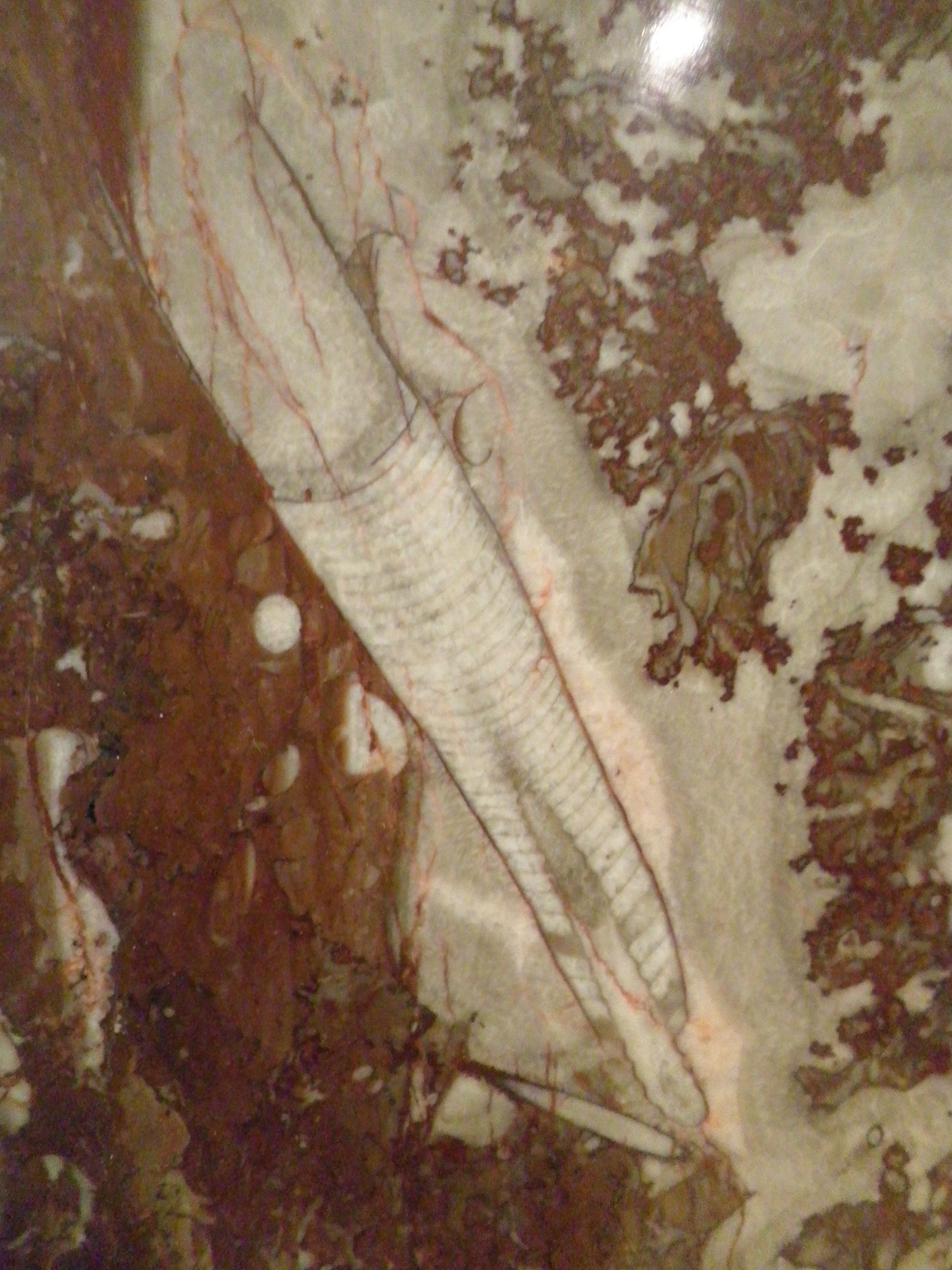
  I was thinking about this the other day while in the bank with MD erstwhile geologist brother when he pointed out the ‘captured’ fossil pictured above on an interior wall.  He said it was a “cephalosomething” embedded in metamorphic limestone aka marble. He went on to say that some buildings and groups of buildings (college campuses e.g.) have maps and guidebooks locating and describing incredible arrays of such stuff.  The Burgess Shale as interior decoration!

  I realized that at some distant point in the future these buildings will have collapsed into the ground, archaeology will sort of transmute into paleontology, and given the trajectory of the average level of intelligence worry that whoever is doing the research be really confused. “How did this cephalosomething get here?  They went extinct eons before the other stuff in this layer…”

  I follow the logic above, but hesitate to adopt the new perspective.  There are too many dopes around who will get the wrong idea.  Might even think the changes we’ve wrought are something of which to be proud.  In 2005 Patagonia founder and environmentalist Yvon Chouinard said: “Forty-eight percent of people in America still don’t believe in evolution… don’t believe in global warming because it relies on scientific interpretations of core samples that are hundreds of thousands of years old, and they think the earth is only six to ten thousand years old”*.

  Some of us are even dimmer.  Jersey Shore is in its fourth season.  They’re in Florence!  People watch.  Rest my case.**

*Alpinist 12 Autumn 2005

**OMG It gets worse.  On NPR with Terri Gross Newsweek journalist Maziar Bahari describes being beaten in Teheran’s notorious Evin prison while his torturer asked about New Jersey – his interest having been piqued by the show.