Archive for the ‘consciousness/psychology’ Category

Anthropology of the Wild West

January 7, 2011

  About halfway through Silverado the Kevin Kline character, Paden, takes interest in Rosanna Arquette’s Hannah whose husband had just been killed:

PADEN
He acted bravely out there, Hannah. 
Just bad luck his getting hit.  Could
have been any one of us.
HANNAH
I don’t believe in luck.  I know what
Conrad was like. Don’t tell me what you
think I want to hear.
PADEN
Never will again.
HANNAH 
We got married just before this trip,
so we could come out here and try
the land.  It’s hard to find a man
willing to take on a life like that.
Love isn’t the only important thing.

    The Kevin Costner character gives Paden a hard time: “Jeez, her old man ain’t even cold yet” as they ride off for action and adventure leaving Hannah and the other settlers to make their way.  After the passage of some time, their paths cross again.  Hannah asks Paden to admire her land:

HANNAH
…Mine starts right over there.  It’s all I’ve
ever wanted.  Pretty land isn’t it?
      PADEN
And a pretty lady.
      HANNAH
A lot of men have told me that.  Maybe it’s true.
I guess some women are slow to believe it.
      PADEN
Believe it.
      HANNAH
They’re drawn to me by that.  But it never lasts.
      PADEN
Why?
      HANNAH
Because they don’t like what I want.
      PADEN
What’s that?
      HANNAH
I want to build something, make things grow.
That takes hard work – a lifetime of it.
That’s not why men come to a pretty woman.

  Well, maybe not right off.  Both parties would agree, however reluctantly on the part of the men, that it is good for the woman to be wary.  Which makes the above exchange an interesting study in anthropology.

  Recent research shows that the nature of the environment bifurcates the decision path of a woman’s choice in mates.  “Whenever a woman has to choose a mate, she must decide whether to place a premium on the hunk’s choicer genes or the wimp’s love and care.”* 

  In other words: “It’d be great if Dad would stick around (and not beat me), but if he doesn’t, how likely is his/our baby to survive?”

  Turns out that the more disgusting, depraved, and/or difficult the environment the higher up the hunk scale woman are likely to chose.  Hmm. Guess I’m gonna tell myself that it was lucky that I did the last part of my courtin’ in a relatively rugged neck of the woods…

  Just like Hannah and Paden.  At the end of the movie as they stand side by side friend Emmett says:

      EMMETT
You might make a farmer yet.
      PADEN
I’ve got a job.

  As he puts his arm against the post, and his coat is drawn back to reveal the shiny sheriff’s badge on his vest.  Thus, not likely to ever be the “yes honey” type or care much for yard work Paden seems about to be invited into the gene pool. After evaluating her experience and circumstance Hannah chose not to make the same mistake twice.

*Economist: 12/11/10   
 

Hand to Mind

December 31, 2010


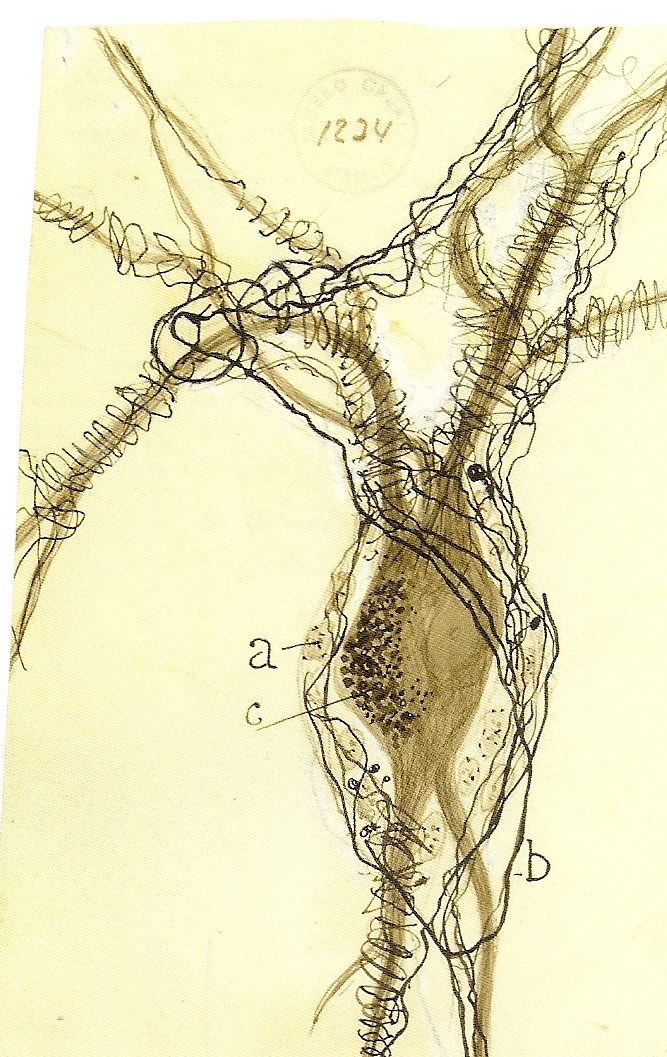
  The drawing above, by Santiago Ramon y Cajal, appears in the spectacular new book: Portraits of the Mind.  It is a fascinating tome leavening a narrative of the development of neuroscience with extraordinary images of milestones along the way.

  The exquisite quality of many of the images conveys a sense of wonder in three different regards: of the brain’s incredible intricacy; of the genius of the techniques invented to make that observation possible; and of the incredible talent employed in a variety of media bearing witness.

  Jonah Lehrer writes in the forward: “Keats knew that truth exists in a tangled relationship with beauty, and nothing illustrates that poetic concept better than these scientific images.  Their empirical power is entwined with their visual majesty.”  Yep.

  Nobel laureate (1906) Ramon y Cajal has been called the father of modern neuroscience.  Using a technique developed by his contemporary and co-Nobel recipient Camillo Golgi*, he found that the “fundamental organizational and functional units of the nervous system are individual cells” – neurons.  This ‘Neuron Doctrine’ supplanted the Reticular Theory which had held that the nervous system was a vast unorganized, unstructured, tangled net.

  The work above depicts axons wrapped around a neuron.  Specifically those of a thalamus.**  The draftsmanship is stunning – one gets a sense of three dimensions by the manner in which he manipulated the quality of the axon lines about the bulbous soma and its dendrites.  The axons have come from other neurons with messages.  The interaction is exquisite. 

  I was so moved in contemplation that a particular drawing of Albrecht Durer’s came to mind.  Look at the Head of Dead Christ below and see how his fine touch gave Christ’s beard a wondrous 3D tactility. Jordan Kantor wrote of the work that: “Through the miracle of Durer’s facile hand, the charcoal itself almost becomes the dead body of Christ”.***

  From vastly different perspectives, but with similar apparent simplicity, two great men have managed to take our breath away in  meditation on the nature of mind, man, and the human condition. 

*They didn’t like each other, didn’t work together, and spoke ill of each other during their acceptance speeches.

**Interestingly, Ramon y Cajal’s work showed that neurons and their parts differ from one part of the brain to another.  “Each part of the brain bears its own signature architecture of axons”.  The breadth of shapes and sizes (as depicted by R y C) is amazing.

***Durer’s Passions, Harvard

HO, HO, HO*

December 24, 2010


  Yup, just as you thought, the above image is evidence of a universe previous to the one in which we now find ourselves.  In a recently published paper, Roger Penrose (cf 12/18/09) and Vahe Gurzadyan theorized that these concentric circles are vestiges in the cosmic microwave background (CMB) of the cataclysmic end of the preceding cosmos in the collision of two supermassive black holes.

  A young universe is characterized by very significant homogeneity.  With time however, it becomes less uniform, objects coalesce, and (with luck?!) life appears and evolves.  Many cosmologists agree so far. 

  The new theory suggests (I think) that at the later stages of a universe, particles all become massless.  As they do, they begin to constitute black holes.  Ultimately, since massless particles must move at the speed of light and thus time would stand still, the universe becomes infinitely small.  The black holes explode, collide, and voila, big banged, the whole thing starts over again.

  Not surprisingly, other researchers posit different explanations for the recently discovered rings pictured above. Physics blogs are atwitter.  In the last entry I read on one however, Gurzadyan and Penrose say that: “…the low variance circles occur in concentric families, and this key fact cannot be explained as a purely random effect.  It is however a clear prediction of conformal cyclic cosmology”.

  Now, what really interests me is the relationship between the nature of the universe thus described and the nature of consciousness as described by Alan Wallace and others*.  They posit that there is a ‘substrate’ unstructured consciousness from which individual psyches arise and evolve.  “The human mind emerges from the unitary experience of the zero-point field of the substrate, which is prior to and more fundamental than the human, conceptual duality of mind and matter.”

  The substrate is layered above a “Platonic world of abstract realities that can be discovered by human investigation, but are independent of human existence”.  This concept has been advocated by respected physicists such as Wolfgang Pauli and “stems from an awareness of the unreasonable power of mathematics to describe the nature of physical processes.”

  Furthermore, Roger Penrose and many if not most others agree that “mathematical realities are not determined by physical experiment, but arrived at by mathematical investigation.  You don’t have to look far to find how math underpins our universe.

  Now for the best part.  Wallace describes how experience of the  Platonic archetype realm can be achieved.  The process begins with deep meditative contemplation of an archetypal form such as the concentric circles above.  No matter what you think by now, you have to admit it is interesting (and cool!) that patterns such as that atop this latest meander of mine can be found throughout our universe and at any scale.

*cf Post of 12/10/10 Nope I haven’t recently eaten any

**Hidden Dimensions, The Unification of Physics and Consciousness, B Alan Wallace, Columbia 2007

***To read about the Penrose/Gurzadyan theory of conformal cyclic cosmology start with the article on page 101 of the December 4, 2010 Economist.


D’oh

December 17, 2010

     Whether or not you buy the notion that magic mushrooms played an important role in the evolution of human consciousness, you must agree that the density of interconnections in our neural circuitry underpins the richness of our thinking.

  OK.  What could cause a reversal, a diminution, a loss of ‘stars’ in our cerebral constellation, a trend backwards toward the synesthetic threshold?   Television.  And it won’t take generations for evidentiary manifestation.  Just as DDT decimated avian populations within a generation, so is the boob tube laying waste to a wide swath of our individual and collective brainpower.

   US students were “mediocre”, faired poorly in a just released assessment of fifteen year olds across the planet.  Another recent report showed that Americans’ scores on a commonly used creativity test fell steadily from 1990 to 2008, particularly among our youth.  Time spent in front of screens was given as a primary cause.

  Not only do couch potatoes’ muscles wither and minds lose dimension while bellies grow, the attendant self isolation wreaks wider havoc.  Society’s collective consciousness attenuates along with the density of its interactions. 

  An article in the May 22 WSJ posited that: “Where population falls or is fragmented, cultural evolution may actually regress”.  For example, 10,000 years ago the 4,000 residents of Tasmania became isolated by rising sea levels.  They then “constituted too small a collective brain to sustain let alone improve the existing technology” and apparently lost the ability to fashion tools, clothing and fishing equipment.

  Reflect upon this the next time driving through a neighborhood and you notice that nearly every large window is illuminated by that familiar glare.  Or the next time in a big box store the walls of which are filled with incredibly expensive and huge television sets.  With $500.00 alters upon which to rest them available nearby.

  Most TV programs are either inane or pandering.  Not great art. Reminds me of what Iris Murdoch wrote about bad art: It’s “the soft, messy self-indulgent work of an enslaved fantasy.” 

  The other evening there was a prime time network program about losing weight.  How can there be viewership sufficient to satisfy advertisers?  We should feel insulted.  Newsflash – there is one and only one way: EAT FEWER CALORIES THAN YOU BURN!

  Jeesh. Who is going to fix stuff here in the States some years hence, let alone invent it? 

  D’oh!


Hope I Get Some Of These On My Buche De Noel*

December 10, 2010


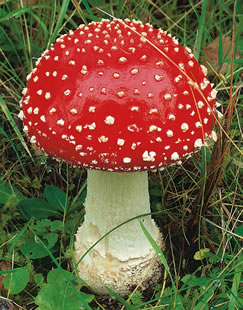
  The mushroom pictured above is an amanita muscaria, also known as fly agaric.  The variety has an etomycorrhizal (a specific sort of symbiotic) relationship with conifers (of which  more later) and are hallucinogenic.  Some believe that they and their relatives played a role in the evolution of human consciousness.  

  At the end of the last ice age our ancestors left the jungle for grasslands and began to pursue the animals they found grazing thereupon.  Growing on and around the animals’ dung were varieties of hallucinogenic mushrooms which great great (etc) grandpa also consumed.

  The presence of this fun stuff in the early human diet led to important neurological manifestations chief among which was synesthesia, a blurring of the boundaries of the senses.  This opened the door for the development of language and the flowering of humanity nature.

  About 10,000 or so years ago, the climate changed again, drastically reducing the geography upon which mind altering foodstuff could thrive.  The party over (but not lost to our collective unconscious), our ancestors reverted to the innate brutality of primate society.

  Why is this pertinent now?  As I mentioned above, certain sorts of mushrooms often grow near coniferous (Christmas!) trees and thus and otherwise have been linked to atavistic traditions of the holiday season.  Possibly, original catalyzing agents in fact.

   More recent of our forebears would watch reindeer find them by the trees, eat them, and then prance about euphorically.  Village shaman would enter a yurt dwelling at night through its smoke-hole and leave some of the fungi in stockings by the hearth for later employment in religious practices. 

  That the amanita natural design scheme is similar to Santa’s is obvious.  The white gilled, white spotted, and usually (but not always) deep red mushrooms appear widely throughout popular culture.  Including Christmas cards, Christmas tree ornaments, and, well, Disney’s version of the Nutcracker in Fantasia.

  Finally, “Rudolph the red nosed reindeer had a very shiny nose.  And if you ever saw him, you would even say it glows… [O]ne foggy Christmas Eve Santa came to say, Rudolf with your nose so bright won’t you guide my sleigh tonight?”. 

  Who could make this stuff up?  Rest my case.  On Prancer!

*Yule log.  A rolled holiday cake upon which are placed mushrooms made from meringue.

The Outdoor Cure

December 3, 2010


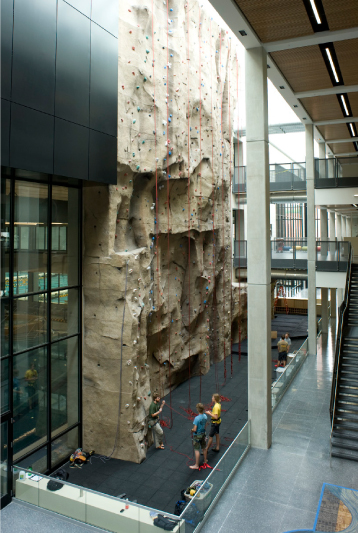
  There is an impressive new indoor climbing facility not far from where I live.  Visited it recently with youngest daughter and had a blast.  Vertical kinesthetics always provide their own special sort of joy.

  Daughter has been frequenting one in the Bay Area and was quite a bit more fit than her pencil pushing old man.  She cruised up and past the overhangs to the fifty foot summit with grace and ease.  Climbing is one physical endeavor that is gender neutral. 

  The sport’s most groundbreaking feat to date – the first free ascent of the Nose of El Capitan in Yosemite NP – was accomplished by a woman.  Lynn Hill.  Women know right off what it takes most men a long time to figure out, that finesse trumps brute strength.

  Anyway, the new wall incorporates a few hand sized cracks which up to this visit I’d seen in nature, but not plastic.  Either way, that sort of feature provides considerable security.  Slide your hand in, cup it, pressing fingers and hand heel to one side and knuckles to the other, and you have a multidirectional bomb proof purchase.

  Only trouble is that after a bit of upward progress thus effected the backs of your hands tell a tale of woe.  Especially if you’re out of practice and uncalloused.  (There’s a short such climb in Yosemite named “Meatgrinder”)  Oh well, I was visited by a waves of ouch and masochistic nostalgia as I slid my hands into my pockets later on.

  We had great fun, but it is not the same thing as being outside – somewhere between a video game and the real thing.  That thought occurred a few days ago when I came across an article in the 11-30-10 Science Tuesday section of the NYT titled “Head Out for a Daily Dose of Green Space”.

  Turns out that there is something called “outdoor deprivation disorder” and we learn that its “effects on physical and mental health are rising fast”.  The diminished importance given to physical activity and the natural environment has led to a diminished populace young to old.  Obesity, diabetes, high blood pressure, heart disease, vitamin D deficiency, osteoporosis, etc, etc.

  Not to mention the most important thing of all – the state of one’s mind and the experience of living.  Depression, stress, attention deficit disorder, are included in what one researcher called “diseases of indoor living”.

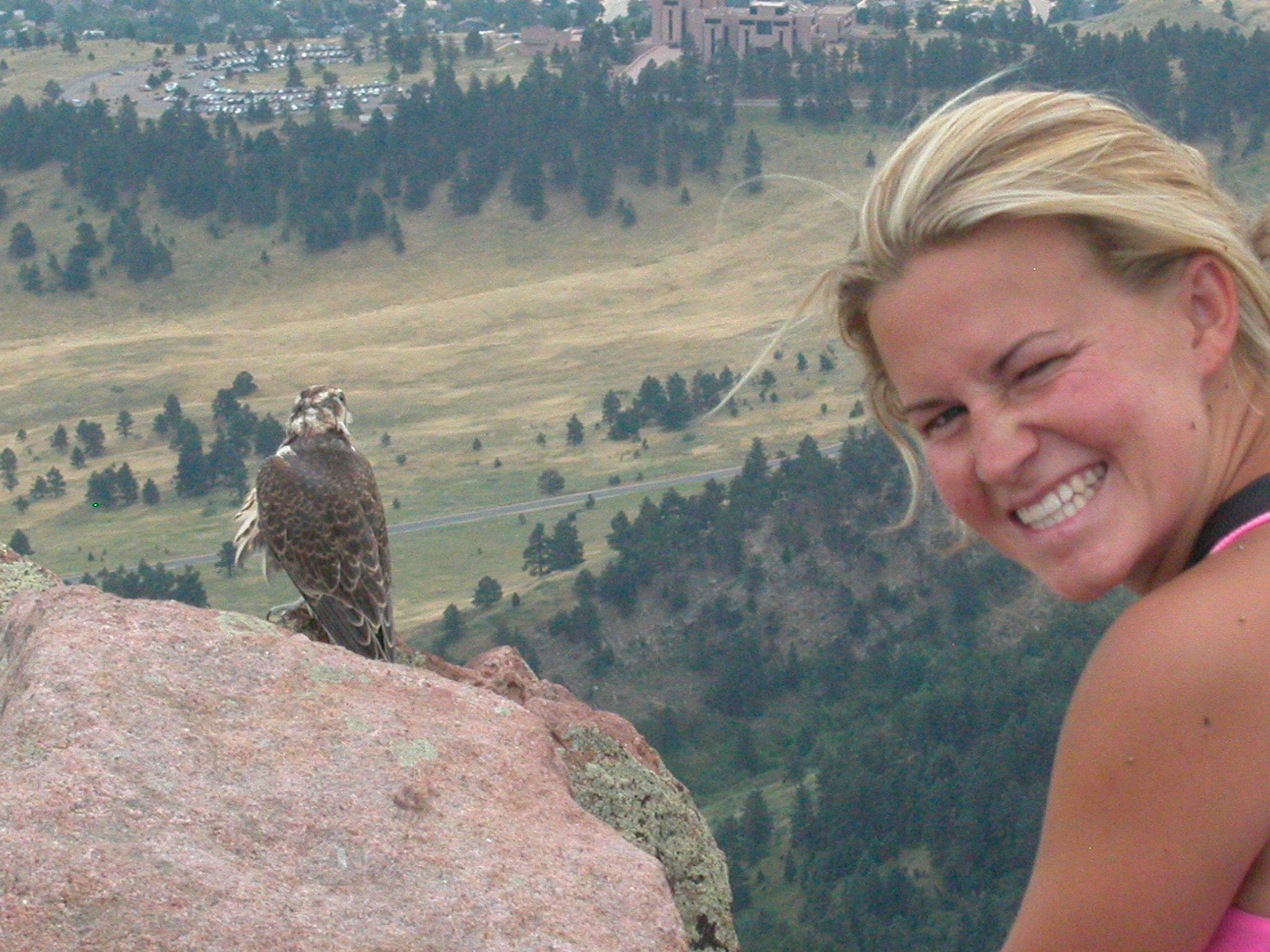
  Even regarding our present topic.  I’ve been repeatedly astounded to learn that gym rats visit other gyms within miles, within sight even, of world class natural outcrops completely unaware and uninterested.  You tell me which situation would constellate one’s neurons most spectacularly – the one above or the one below. 

 *The building in the background is IM Pei’s National Center for Atmospheric Research


How To Feel Good About Yourself

October 22, 2010

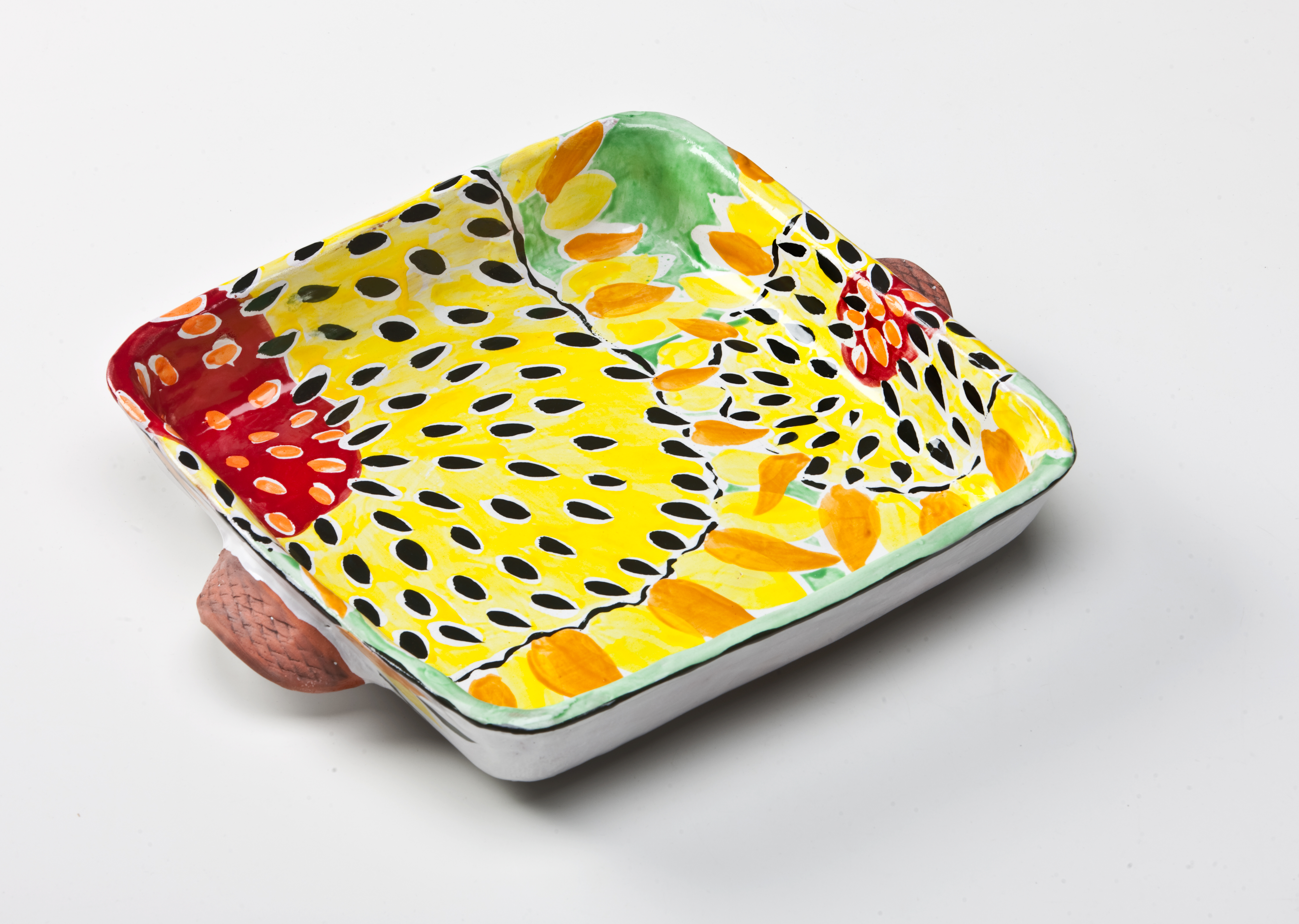
  Majolica is a type of earthenware ceramics characterized by rich design, broad and bright pallet, and glossy surface.  These attributes arise due to the presence of tin as the flux in the glaze.  The resulting relatively high viscosity restricts flow during firing and thus enables a sharpness of detail unusual in the surface treatment of fired clay.

  This ceramic style originated in the Middle East and accompanied the spread of Islam across Northern Africa and into Spain.  It got to Italy via the island of Majorca from whence the name.  Similarly Faenza, Italy was eponymized after sending examples to France where vessels of that nature to be called faience.  The Dutch waited for proficient differentiation and felt ok calling it Delftware.

  These centuries later, after mastering the requisite considerable skill, artists take the technique wherever their hearts might lead.  Well, my favorite artist has a huge heart and as you see here above and below, her work exudes joy and exuberance in uncommon measure. 

  The pieces are clearly functional and meant – no, yearn – to be used.  They engender the sort of feeling with which one finds him/herself imbued after a leisurely stroll through a fine farmer’s market lush with produce still sparkling with morning dew.

  That it is of a special nature I learned anew while reading an article* about, of all things, prosopagnosia – the impairment (slight to severe) of face perception.  Oliver Sacks wrote about an extreme case in his Man Who Mistook His Wife For A Hat.  While for that man the cause had to do with Alzheimer’s, in many it is simply a part of their neurological constitution.  

  I think my artist would agree that I have much greater facility with names and faces than does she though she can nonetheless quickly (and enthusiastically!) pick loved ones out of any crowd and that’s the point.  Observation and research suggests that emotion plays a large and discrete role in face recognition and in my artist emotion flows like the Amazon.

    Jane Goodall has the condition and is unable to put a name with a face (human or chimp) before some degree of a relationship has had a chance to evolve.  It’s no news flash that her heart and mind are well connected and it’s tough now not to speculate about the extraordinary manifestations of her particular constellation of synaptic connections.    

  Most interestingly, for the purpose herewith, is that well known portrait artist Chuck Close is severely prosopagnosic.  He believes that the condition “has played a crucial role in driving his unique artistic vision” which amplifies an initial visual impact into something just this side of a wonderful hallucination.

  I think that my artist is wired up in such a way that her manners of perception interweave with her ebullience to create a constantly evolving yet unmistakable body of work – from kids, to dogs, to food, and yes, to pots.  Look at her stuff, doesn’t it make you feel better about yourself?

*”Face-Blind”, by Oliver Sacks in the 8/30/10 New Yorker. 

The Endless Unknown

October 15, 2010


  In his work Lucian Freud conveys incredible emotional depth and complexity.  It should surprise no one that he is the grandson of Sigmund Freud and furthermore, for me, his oeuvre proves that the founder of psychoanalysis was on to something no matter what modern critics might say. 

  (L) Freud has said that: “Quality in art is inextricably bound up with emotional honesty”, which is not to say transparency.  He goes on: “The advantage of taking so long is that it allows me to include more than one expression”.  Ya  There’s a lot going on in the mind of the fellow above and it would take a lifetime of analysis or a lobotomy for any hope of eventual serenity.

  It is difficult to leave the gaze of a Freud subject such as the one above without, first, feeling the rumble of one’s own complexes.  The title of the picture above conveys this sense perfectly: “Reflection”.  Then, as you walk away, you realize that the frame of reference is much larger and you wonder about universal truths.

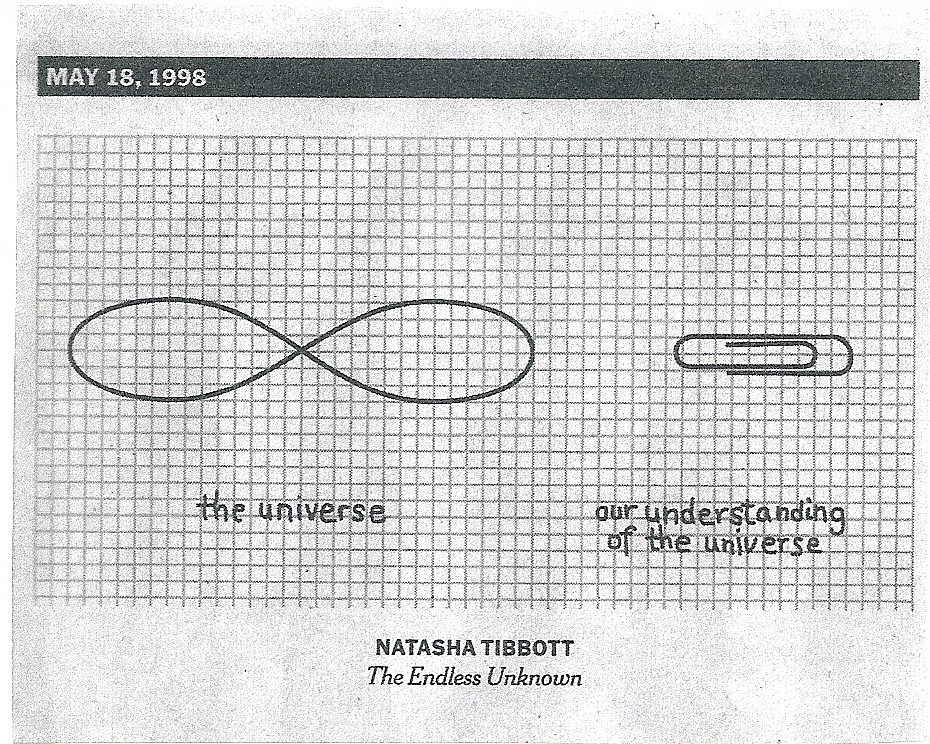
  Are there any?  I’ll bet that Freud would not be surprised to learn that recent research indicates that the laws of physics might not be consistent across the whole of our universe.  Or that some think that the human mind has reached its capacity for understanding the cosmos.  For the time being anyway.

  Juxtaposed with cave paintings or ancient petroglyphs carved into rock, Freud’s art embodies a sense of the degree to which consciousness has evolved thus far.  Oh, for a take some 10,000 years hence.  Try to imagine a state of mind holding an image of Freud in the same regard as we do not an ancient stick figure!

*The quotes have been drawn from an article in the 9/25/10 Economist.  Where else?

**The bit was a review of a new book I can’t wait to read: Man with a Blue Scarf: On Sitting for a Portrait by Lucian Freud.  The author, Martin Gayford calls Freud “omnivorous” in his search for “weight, texture and irreducible uniqueness of what he sees”.  I know the feeling.  See 1/31/09 and 4/10/09 below.

***Interestingly, just as a face or the representation of one can project outwardly with great force, so can inwardly a simple facial tactile experience.  The relative density of neuronal connections on a face is huge.  A recent experiment showed that continuous tweaking of just one whisker on the muzzle of rat stroke victim was enough to stimulate sufficient redirected blood flow to alleviate major damage.  WSJ 7/27/10

****Cartoon from the NYT


Headbone

September 24, 2010


     Sorry to break the news, but your erotic fantasies are but a collective by-product of more important machinations – those of the evolution of consciousness itself.  True, reproduction is the sine qua non of evolution in the first place. 

     It’s just that handcuffs, whips, etc. are not a necessary part thereof.  No prizes for guessing what is.  Furthermore, the sex life of most of earth’s creatures consists almost solely of an instinctual stimulus response arrangement operating strictly within certain biochemical parameters.*

      How did the human analogue of pollination come to be writ so large?  Air conditioning some think, in a manner of speaking.  When our anthropoid bipedal ancestors left the trees for the savanna they left behind shade – protection from the sun’s searing rays. 

Since a primary order of business for a warm blooded creature is temperature regulation, most importantly that of the brain, incremental improvements in an ability to radiate excess heat would be a distinct advantage.  Particularly in the sub-Saharan environment. 

       Thus, an incipient outer bit of tissue might have proven to be advantageous as first a radiator, later a tool designer, and much later “art” film producer.

      Much much later.  Some theorize that it was as recently as within the last several thousand years, citing the chastity of prehistoric murals and sculpture produced before 1000 BC. Soon thereafter an explosion of erotic representations appeared.

      Now, at this point of remove, many of the sensory receptors and inputs which heretofore have led to the horizontal have become vestigial.  Imagination may have become a key component of the reproductive system.

      Think about it.  What would your sex life be without the ability to reminisce, ruminate, and look forward?

*Watch an ‘unfixed’ male dog help sort the laundry of a mixed gender household. 

*cf post 9 3 10 re Hancher.  The U of I selected Pelli Clarke Pelli.  I’m sure they’ll do a fine job (and are thrilled to have my seal of approval) and I can’t wait to attend performances there (construction to start 2012).  Pelli is also the firm signed for an arts building (as yet unfunded) on the campus of Western Illinois University in Macomb…

Hey! Lose the ear buds!

August 27, 2010


  Furthermore, in an interview with Terri Gross on her NPR Fresh Air program Matt Richtel (the NYT reporter quoted in the previous post) drew an analogy between food and technology.  Too little of either can impair effectiveness and vitality.  Too much can lead to obesity, distraction, and actual neurological damage.

  Incredible as it may sound, the evolutionary precursor to this problem is the fight or flight syndrome.  Primitive man hears rustle in the bush, synapses fire, cortisol released, he runs or throws a spear.  Repeatedly induced by some signal to check your device or screen, same chain of events ensues all be they separately more diminutive.  Ill effects though are cumulative.

  Research on rats show that it is during downtime that memories form and creativity is enhanced.  “People need to take breaks.” Relatedly: multitaskers have more, not less, trouble filtering out irrelevance and staying focused.  The more often you switch from one screen or device to another the greater the negative impact upon your effectiveness.

  The reason you feel compelled to check is because of what’s called ‘intermittent reinforcement’.  Rats again.  If one in a cage knows that there will occasionally be a food pellet in its food dispenser, it will feel compelled to frequently check.  Similarly, while most of the stuff in your inbox is such junk it might as well be empty, sometimes there are gems.

  As mentioned in the previous post the researchers all felt a shift, if subtle, in their consciousness after the third day of their trip.  Ms. Gross commented that she noticed a difference in hers when a weekend extends from two to three days.

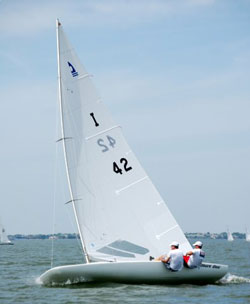
  I wonder if a similarly salubrious effect might be made possible in a shorter period by different conditions.  Extenuating, say… Wife and I were under sail last night in our twenty foot/216 sq ft sailcloth C Scow.  Breeze was way up and swells were big.  Barge and other boat traffic.  Last time we went over I broke ribs and wife’s eye was blackened. 

  Attention thus broadly drawn, there were no thoughts of Blackberry, office, bills, etc etc.  Matter of fact there was no thinking.  Way hiked out, minor adjustments in trim and body position were all that lay between full speed and swimming.  Back ashore, we felt renewed and refreshed.

*”Fresh Air” on NPR 8/24/10

**Research shows that it’s riskier to talk on a cell phone while driving – even hands free – than having a conversation with a passenger.  Passenger is even an asset: “they modulate their conversation – both topic and tone – based on what they see in front of them.”

***Sadly, Anne Franks’ tree went over last week.  Happily someone had the foresight to plant seeds and saplings have been distributed around the world.