Archive for the ‘consciousness/psychology’ Category

The Mind Around Us

August 20, 2010


   On the front page of Monday’s NYT (8/16/10) was an article entitled: “Outdoors and Out of Reach, Studying the Brain”.  Reporter Matt Richtel accompanied a group of five neuroscientists who left technology behind while floating down the San Juan River in remote southern Utah.  Their purpose was to study the effect of today’s digital barrage on one’s mind as well as what might be the ameliorative effects of nature’s embrace.

  The group was comprised of two sorts: several who employ digital technology with abandon and the rest a bit wary and more judicious.  Trip leader David Strayer, one of the latter, compared the research to the study of the consumption of too much meat or alcohol.

  Dang stuff is sort of addictive.  I know it is rude to check my blackberry in the middle of a conversation or meeting yet I do it anyway.  Find it difficult to resist in fact.  Even worse is texting while driving.

  “Attention is the holy grail” said Strayer.  “Everything that you’re conscious of, everything you let in, everything you remember and you forget, depends on it”.  “Too much digital stimulation can take people who would be functioning O.K. and put them in a range where they’re not psychologically healthy.”

  By the end of the trip, having fallen into the rhythm of the river, all had noticed a change in the nature of their cognition.  Even one of the skeptics said: “There’s a real mental freedom in knowing no one or nothing can interrupt you…time is slowing down…”

  “…even the more skeptical of the scientists say something is happening to their brains that reinforces their scientific discussions – something that could be important to helping people cope in a world of constant electronic noise.”

  And other stuff even worse.  Here’s Anne Frank: “The best remedy for those who are afraid, lonely or unhappy is to go outside, somewhere where they can be quiet, alone with the heavens, nature and God.  Because only then does one feel that all is as it should be.”

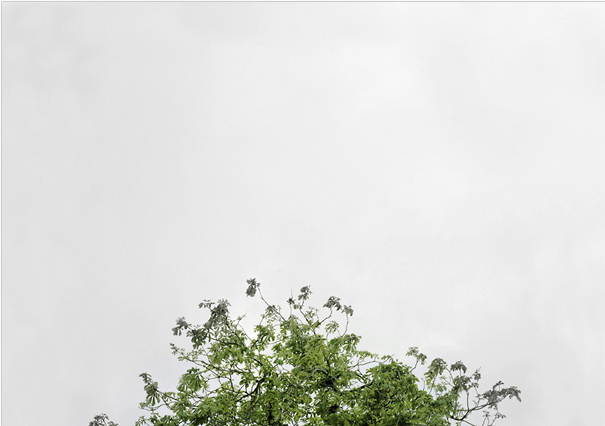
  The photo above is of the top of the tree she could see from her attic window and about which she wrote: “From my favorite spot on the floor I look up at the blue sky and the bare chestnut tree, on whose branches little raindrops shine, appearing like silver, and at the seagulls and other birds as they glide on the wind…As long as this exists, and it certainly always will, I know that then there will always be comfort for every sorrow, whatever the circumstances may be.”

  The scientists hope to develop strategies to identify the related specific neurological mechanisms surrounding attentional disorders wherefrom to enable curative therapies.  Jeesh.  Just turn it all off and go outside.  Or at least look out the window… 

*The photo and quotes came from the video installation by Jason Lazarus “The top of the tree gazed upon by Anne Frank while in hiding, Amsterdam, 2008”.  It can be seen at the Des Moines Art Center through 9/5/10

**In case you don’t get the allusion in the title, The Sea Around Us it the title of a best selling and prize winning book by Rachel Carson.

*** Relatedly (to me anyway) was the recent study showing accelerated hearing loss among the IPod generation.

Unfinished Business

July 23, 2010


  Whenever I get bewildered or stuck, I like to look through Jung.  He once wrote: “Life is a luminous pause between two great mysteries which yet are one”.  And he spent most of his career assisting those in the second half of life figuring out how to incandesce.

Uh, perfect timing.

  “The more a man’s life is shaped by the collective norm, the greater is his individual immorality.”  Easy for him to say.  How does one dig deep, take risks, and still be a responsible member of this species?  I understand him to say that’s just it.  One has to will a way to be comfortable living in those questions.  “What work then, needs to be done?”

  Or put another way, Jung defined neurosis as “suffering in search of meaning”.  Or “it’s not so much that one has a complex, it’s that the complex has him.”  And should one, a parent, not feel like taking up this great challenge he/she “should be conscious of the fact that they themselves are the principal causes of neurosis in their children”.

  And it goes way back:  “Together the patient and I address ourselves to the 2,000,000-year-old man that is in all of us.  In the last analysis, most of our difficulties come from losing contact with our instincts, with the age-old unforgotten wisdom stored up in us.  And where do we make contact with this old man in us?  In our dreams.”

   Furthermore, I’m obviously interested in all aspects of neuroscience, its explication and promise.  But I don’t think that science alone will ever completely demystify the living of a life.      

  “Scientific materialism has merely introduced a new hypostasis…It has give another name to the supreme principle of reality and has assumed that this created a new thing and destroyed an old thing.  Whether you call the principle of existence “God”, “matter”, or anything else you like, you have created nothing; you have simply changed s symbol.”

  “The danger that faces us today is that the whole of reality will be replaced by words.  This accounts for a terrible lack of instinct in modern man, particularly the city dweller.  He lacks all contact with the life and breadth of nature.”

  I’m going outside.  Be right back.  Well,  maybe Monday…

Yep, She’s Out Of Town Again…

July 2, 2010

   In his Once And Future King, T. H. White wrote: “Don’t ever let anybody teach you to think, Lance, it is the curse of the world”.  Ever feel like that?  Analysis paralysis.  Think too much and you invariably come up with the wrong answer.  Unfortunately my usual M.O..

  I’m not talking about working a problem – more like when the problem is working you.  The opposite of being in the ‘zone’, or in ‘flow’ – the term coined by researcher Mihaly Csikszentmihalyi*.  So absorbed in a task or activity that there is no extraneous cerebration. 

  Take last week’s England v Germany game in the Bloemfontein-Free State Stadium.  It was clear that the lads were thinking too much.  The Germans floated through them like Luke Skywalker and the rebels through the forests on the moon of Endor at 500 kilometers per hour.  It was as if the English (and the trees) weren’t even there.

  Or take metaphysics.  How much mental energy has been spent, pain wrought, and lives lost trying to know the unknowable.  A famous Zen mondo illustrates another approach.  A samurai once asked Zen Master Hakuin what happened after death.  “How should I know” was his answer. The astounded samurai responded: “How should you know? You’re a Zen Master!!”  “Yes, but not a dead one” Hakuin replied.

  A personal example?  Well, thirty three years ago on this date I was at the start of a several day funk.  My heart told me that I should ask this one really cute girl to be my permanent roommate.  My head was certain that I ought to analyze every possible sequence of events from the hoped for positive response through to the end of time.  Finally, on July 4, in the rustic spot** pictured above, before that cold St Pauli Girl touched my lips, I went with the flow of my emotions.

  Fireworks ever since.  Sometimes you just have to get out of your own way.

* Flow – The Psychology of Optimal Experience, NY, Harper and Row, 1990.  Csikszentmihaly has written many interesting books.  Read my post of March 21, 2008 to hear about Talented Teens,  his study of what lead some identified as gifted to continue making the most of their talents throughout high school while many do not.

**Millsite Inn.  Ward, Colorado.

Yes

June 11, 2010


  In the June 10, 2010 New York Review of Books noted British American physicist and mathematician Freeman Dyson reviewed a new book by Nobel Prize winner physicist Steven Weinberg.  The tone is largely positive, but toward the end Dyson makes an interesting observation.

  He says that Weinberg juxtaposes “militant atheism” on the one hand and absolute faith in the ability of science to explain everything on the other.  He tells us that Weinberg believes that science will soon have developed a “Final Theory” with a set of mathematical rules precisely describing every aspect of our universe.

      Dyson: “I distrust his judgment about philosophical questions because I think he overrates the capacity of the human mind to comprehend the totality of nature.”  I couldn’t agree more.  I think that our understanding of the universe has grown and will continue to grow at the exact pace of the evolution of our consciousness.

  A hope that absolute truth exists is misguided and a belief that one does often gets sublimated, cathected, and comes out as arrogance at best and fundamentalism at the extreme.  To make a contribution to the common consciousness and enjoy the experience, one need only find a way to be comfortable living in the question of it all.

  And next Wednesday being Bloomsday, of what better example might one think than Ulysses?  June 16 was the day of Leopold Bloom’s perambulations about Dublin in James Joyce’s great novel.  It is long, complex, and of beautiful erudtion.  One of its themes is the concept of parallax which in this case can be defined as the enhancement of an observation by the integration of differing perspectives.

  The three main characters provide this in great measure.  Molly Bloom’s famous final almost unpunctuated forty plus page stream of consciousness reconsiders many aspects of her life and relationships and concludes with joy and affirmation:

“…as a girl where I was a Flower of the mountain yes when I put the rose in my hair like the Andalusian girls used or shall I wear a red yes and how he kissed me under the Moorish wall and I thought well as well him as another and then I asked him with my eyes to ask again yes and then he asked me would I yes to say yes my mountain flower and first I put my arms around him yes and drew him down to me so he could feel my breasts all perfume yes and his heart was going like mad and yes I said yes I will Yes.”

*Joyce picked June 16 because that was the day of his first date with the woman who would be his wife.      

**There is beauty in the video clip, but it is no match for a reading of the prose.  Yes?

Judd Viburnum

April 16, 2010


  Marie Winn wrote The Plug in Drug in 1977 examining the effects of television on the developing minds of young people.  In the 25th anniversary edition she put the range of new electronic media under her scrutiny and, among other stuff, gave it all as the cause of a significant decline in average SAT scores of US high school seniors.

  Remember how I’ve described many times how the brain wires itself up through interaction with its own particular sensory environment?  A new book, iBrain* explores the effects of “growing up digital” on neuronal development.  The authors tell us that “Because of the current technological revolution, our brains are evolving right now – at a speed like never before”. 

  They demonstrate how addictive technology can be and that even just intent perusal leads to a diminution in social skills.  “With the weakening of the brain’s neural circuitry controlling human contact, our social interactions may become awkward, and we tend to misinterpret, and even miss subtle, nonverbal messages.” 

  The apparent purpose of the book is to identify this and other ramifications of modern media along with ameliorative suggestions.  It describes a “brain gap” between older and younger minds – ‘digital immigrants’ and ‘digital natives’ –  and how to narrow it.  The tone is not dire, but optimistic and hopeful.  Still… 

  It is well known that the average American spends far more time in front of some sort of screen than engaged in any sort of physical activity.  In this book a study at the University of Illinois is recounted that correlates the development of digital leisure technologies and a significant decline in visits to our national parks.

  How can this not bring to mind the middle (dark) ages of Europe in which the educated preferred to read Aristotle’s description of something rather than endeavor to undertake a real experience of it?  Alchemy – the attempt to turn common elements such as lead into gold – was big.  Doesn’t that remind you of the incredible profusion of gambling/lottery venues?

  Jeesh.  These days of spring, wife and I fight over who will take our dog on his evening constitutional.  Around the corner is a shrub that, as it comes into bloom, gives olfactory intimations of heaven. Especially in the dark when vision is reduced to monochromy and smell symmetrically amplified.

  Recently I ‘borrowed’ a cutting to take to a green thumb and identify.  “Oh my God” she said “let me have another whiff”.  Exact quote.  “Maybe mock orange, but I’m not sure, let’s go ask Ned.  I have to know too”.  I followed her to the shrubbery section where stood gnome Ned.      

  As we approached, he smiled broadly.  “Judd Viburnum” he said when he saw what I held.  “Wonderful, isn’t it?  We have one outside our bedroom window that we trim to keep the top just above the sill.  Oh Lord if doesn’t it make for a few of the most enchanting nights of the year.   We never leave town during the middle of April.”

   I wouldn’t either.

*iBrain, Surviving the technological alteration of the modern mind; Small, Gary and Vorgan, Gigi; Harper; 2009.

How To Wire Up A Beauty Or A Beast

March 26, 2010

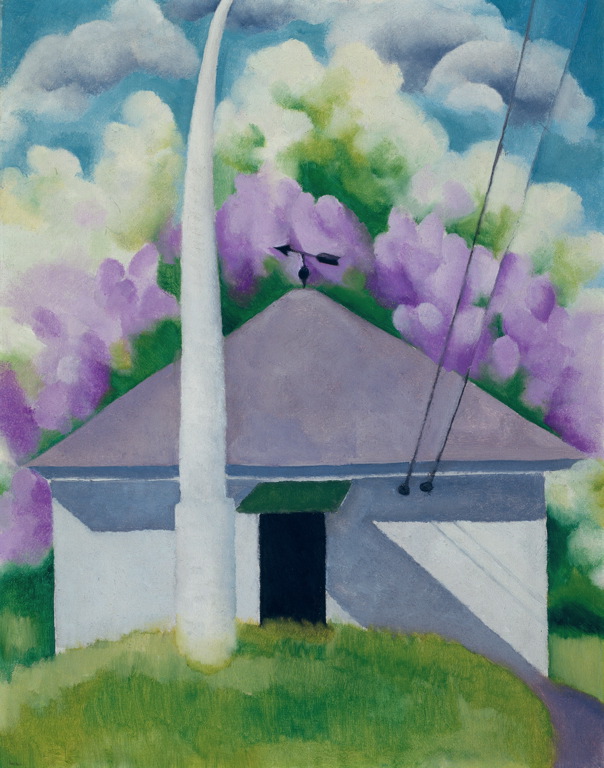
  In the house on her parent’s farm, Georgia O’Keefe was born November 15, 1887 near Sun Prairie, Wisconsin.  She was not taken outside during the cold, dark, and long upper Midwestern winter.  Spring did arrive and with it, verdancy, warmth, and the color of the sun.      

  Georgia was carried out and “placed on a handmade patchwork quilt spread on the new grass and propped up by pillows.  Those very first moments of seeing in the brilliant sunlight became indelibly etched in her memory: She precisely remembered the quilt’s patterns of flowers on black and tiny red stars…*

  I remembered that while reading a review of a new book: The Philosophical Baby: What Children’s Minds Tell Us about Truth, Love and the Meaning of Life by Alison Gopnik**.  O’Keefe was exceptional (duh!) in that virtually no memories form in most babies’ minds until about age 5.

  Their brains are different.  The part (prefrontal lobe) that filters out distractions and thus enables ‘internally driven attention’ is not yet fully formed.  “What rouses them is what is in front of their eyes, the first burst of information about cause and effect in the physical world”.

  Open to all stimuli and unable to shut any out, they are in a sense more conscious than are adults.  Gopnik compares “the lantern consciousness of childhood to the spotlight consciousness of ordinary adult attention”.  Very young brains require such copious amounts of neurotransmitters to process this inundation that they require relatively higher doses of anesthesia before surgery.

  As I know I’ve mentioned many times in this space, at birth the human brain has more connections among its 100 billion neurons as there are stars in the universe.  Some strengthen and some wither in a process labeled neural Darwinism by Gerald Edelman***.  Those connections in receipt of stimuli flourish and those that don’t disappear. 

  So in a very real sense what one does not see, hear, feel, etc as a baby one never will.  If, for some reason there is a patch on an eye over a crucial brief period neural connections will degenerate rendering it irreversibly blind.  Buckminster Fuller had poor vision, but a grand capacity for spatial visualization that he believed arose from early manipulation of blocks and other solid shapes.

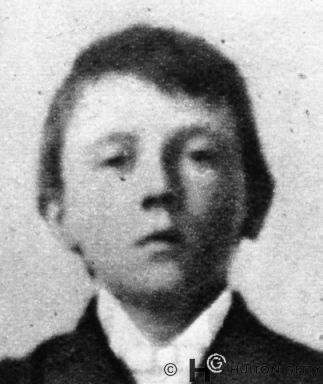
  Similarly, “although empathy does seem to be innate… the flourishing of empathy is not guaranteed”.  Which brings me to Swiss child psychologist Alice Miller.  In her book For Your Own Good, Hidden Cruelty in Child-Rearing and the Roots of Violence we read her take on the provenance of Hitler’s depravity.  She wrote “I have no doubt that behind every crime a personal tragedy lies hidden… every persecutor was once a victim”. 

  Ten years or so before Edelman developed his theory of neuronal selection Miller described the structure of the constellated narrative.  And it had nothing to do with innate drives.  Hitler’s youth was itself unmitigated horror.  He was beaten, humiliated, and demeaned by his parents while being commanded to love and respect those who might treat him thus.

  “My pedagogy is hard.  What is weak must be hammered away…I want the young to be violent and cruel… They must be able to bear pain… There must be nothing weak or gentle about them… The free, splendid beast of prey must once again flash from their eyes…”  Adolf Hitler.

  Most of Miller’s work addresses life after age five and actually gives us hope.  She holds that if a youth has an opportunity for just one positive connection, whatever might have characterized those first years, a good life is possible.  “The human soul is virtually indestructible, and its ability to rise from the ashes remains as long as the body draws breath.” 

*Portrait of an Artist by Laurie Lisle
**What Babies Know and We Don’t by Michael Greenberg; New York Review of Books March 11, 2010
***Edelman won the Medicine Nobel in 1972 for his description of the
immune system.  His theory of neuronal development remarkably, but I guess logically, parallels his earlier work.  
****Painting on top is “Spring by Georgia O’Keefe from the Art Institute in Chicago.
*****Photo is of a young Adolf Hitler
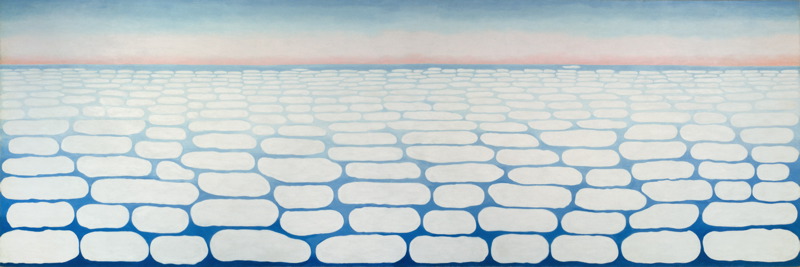
******Painting at bottom is “Sky Above Clouds IV by Georgia O’Keefe from the Art Institute in Chicago. 
 

Drug Free, I Promise!

March 5, 2010

  At about dusk one night not long ago, I was closing the gate at my office and had a hallucination that took over my consciousness completely – if only for a moment.  It was of my wife at home in the kitchen.

  She was wrestling a rarely used vessel and an associated implement from the dusty far reaches of a deep cupboard.  It had been a wedding present and I don’t think it’d seen the light of day since the birth of our first child nearly thirty years ago.  It soon dissolved, I secured the gate, and drove home.

  Just inside the back door of our house, I gasped when I saw that wife was using the vessel from my vision and had to have gone through those exact motions at the moment I saw them.  I asked what in the world had induced her to procure that setup to which she responded that she had been looking for something else, came upon it, and decided to use it instead. 

  Holy dogs, it wasn’t like I’d flashed a winning lottery number or been visited by divine guidance (or retribution for that matter) but, whatever, it was beyond coincidence.  Tha occurrence and others similar came to mind when reading the “Best Ideas of the Year” bit in the last issue of the New York Times Magazine that year.  It was about a forthcoming book entitled Extraordinary Knowing by Elizabeth Lloyd Mayer.

  Ms. Mayer was a psychologist and professor at UC Berkley.  Her eleven year old daughter’s harp had been stolen and they were desperate for its return.  Weeks went by with no leads when a friend suggested they avail themselves of the services of a dowser.

  Skeptical, but, “well why not?”, she contacted the American Society of Dowsers who referred her to one in Arkansas.  She called and after a pause the gentlemen told her that the harp was still in the area and asked her to send him a map of it.  The map was soon returned with a location marked upon it.  “Not good enough for a search warrant” said the police so Ms. Mayer decided to post photos of the harp on telephone poles around that neighborhood.

  Days later a phone call led to the return of the instrument and a changed Elizabeth Lloyd Mayer.  She began an exploration of the “inexplicable powers of the human mind” and first found, to her amazement, that several eminent colleagues at Berkeley had had related experiences, but were loathe to discuss for fear of possible harm to their professional reputations.

  Her investigation is filled with fascinating anecdotes, history, psychology, neuroscience, and quantum physics.  She suggests that extraordinary intuition is “quintessentially characterized by its random non repeatable quality and its absolute dependence on its highly idiosyncratic deeply personal capacities and dispositions of the knower…”. 

  An adept told her that: “Our minds resist intuitive knowing.  Once you learn to relax that resistance, you can start to reclaim intuition from its suppression by the rational mind.  The more you work with it, the more remarkable your knowing becomes.  You free the receptive state from it armoring by the ego.  You learn to live closer to receptivity.”

  If there was ever a reason to clear up neuroses, this had got to be it.  Could maybe tune into something really cool.

Psychic Rewilding

February 12, 2010

  In last Sunday’s New York Times Magazine there was an article by Daniel Smith entitled “Is there an Ecological Unconscious?” which addressed the stress and discomfort visited upon the psyche of those subjected to forced dislocation (eg Trail of Tears) or environmental degradation (eg exploitation of newly discovered nearby coal deposits).

  Researcher Glenn Albrecht coined the term solastalgia to describe this condition of “place pathology” leading to the diminution of “one’s heart’s ease”.  The article reminds us that Freud attributed just about everything to sex and how modern psychology is primarily concerned with urban interpersonal interaction, largely ignoring the primal bond between humankind and the rest of nature.

  The premise of echopsychology is that “an imperiled environment creates an imperiled mind” and that there might be a relationship between a resilient environment and a resilient mind.  Research shows that natural settings are far more effective than urban for the enhancement of cognition.  Researcher Peter Kahn calls for a ‘rewilding’ of the psyche.

   Well, yippee ki-yay, I quite agree.  “More and more”, he writes, “the human experience of nature will be mediated by technological systems.  We will, as a matter of mere survival adapt to these changes.  The question is whether our new, nature-reduced lives will be impoverished from the standpoint of human functioning and flourishing.”

  How much of a stretch is it then to ask about the degree to which TV, digital social networking, video games, etc are responsible for global warming?   Well a lot I guess, but you get my point.  How can one have a meaningful sense of self and surroundings without a vigorous dose of the environment from time to time?

  Paradoxically, it dawned on me that an emerging departure from rectiliniarity in architecture enabled by technology might be relatedly salubrious.  I have long been interested in the emotional generosity inherent in good design and wonder if this will prove to be an unexpected and fecund vector.

  Japanese architect Toyo Ito has said that: “I sometimes feel that we are losing an intuitive sense of our own bodies.  Children don’t run around outside as much as they did.  They sit in front of computer games.  Some architects have been trying to find a language for this new generation, with very minimalist spaces.  I am looking for something more primitive, a kind of abstraction that still has a sense of the body.”     

  I have only read about and seen photos of Ito’s built work and am eager to one day experience a product of his line of thinking.  New York Times critic Nicolai Ouroussoff calls him an “urban poet”, “someone who has been able to crystallize, through architecture, the tensions that lie buried in the heart of contemporary society.”*

  No two of his projects are alike, maybe not even remotely similar.  Ouroussoff: “By embracing ambiguity, his work forces us to look a the world through a wider lens.  It asks us to choose the slowly unfolding narrative over the instant fix…  A building that seems to have been frozen in a state of metamorphosis”

  The photos are of his stadium in Kaohsiung, Taiwan.  Ouroussoff tells us that it is “a space that manages to maintain the intensity and focus of a grand stadium without that intensity becoming oppressive.”  As opposed to other stadiums, “it seeks to maximize our awareness of (the outside world) while still creating a sense of enclosure.”

  Might such places help relieve solastalgia?  Help rewild a psyche, even?

*NYT 6 12 09

Buttons

January 22, 2010


  The only thing I remember, well the first thing that comes to mind I guess, about Mrs. Nichol’s sixth grade music class is the way she’d draw a circle on the blackboard and make me stand there with my nose in it for most of the period.  I mean who cared about Saint Saens, whole notes, or the fact that Anton Dvorak had actually been in Iowa?

  The only interesting thing I recall was listening to her describe her husband’s malaria.  He’d been in the Navy during WWII.  I never’d heard of anything you couldn’t shake. Anyway, I didn’t like music, the circle didn’t work, and I became intimately familiar with every corner of the principal’s office. 

  The sounds of the sixties perked up my ears, but being a-political and an emotional nitwit nothing found more than passing resonance.  I began to wake up in college – I’m probably not alone in having had an epiphany in front of Disney’s Fantasia.  The Beethoven’s Sixth segment was to my mind what Kool-Aid was for the Dead. 

  All of a sudden I had an incredibly eclectic taste in music and an incipient thirst for understanding.  What is it?  It’s got to be more than epiphenomenal…  Everybody has at least a little rhythm.  Why is it so great to hear Gene Kelly “Singing in the Rain” by the produce at the grocery store when the mini-sprinklers go on?  Wasn’t that a wonderful movie?  Can’t you just see him twirling about the lamppost, drenched?

  Long determined to launch a serious investigation, I didn’t have a clue about how to begin until wife fixed me up with guitar lessons recently.  Month into it now and I’m fascinated.  I can read a few notes, make annoyingly recognizable sounds, and am amazed at the mind state that’s induced.

  The first lessons were a bit awkward for sure.  I’m easily three times as old as most of the students in the facility.  Years older than most of the parents reading People Magazine in the lobby as a matter of fact.  But after practicing a little bit every day I have begun to feel like I did the first time fiddling with buttons on a shirt that was not my own…

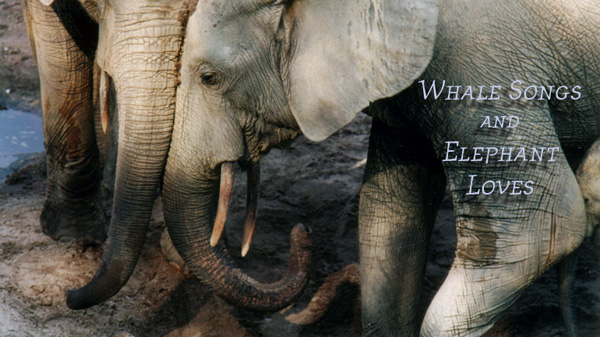
   What’s up with the elephants?  In February of 2007 on the radio program “Speaking of Faith” was a segment with acoustic biologist Katy Payne.  It is going to be rebroadcast Sunday.  You should listen.  Or visit the site: http://speakingoffaith.publicradio.org/  Her descriptions of whales composing complex songs are incredible.  Her stories of emotional networks maintained between and among elephants miles apart are enthralling. 

  She’s a Quaker working at the Bioacoustics Research Program at Cornell.  “I see my responsibility as being to listen.  My church is outdoors.  And I must say that if I could ask these animals that I like so much if there’s anything equivalent to what we speak of as being faith, I would love to do that.  We just don’t know.”

  “Many animals make sounds, everything from crickets to humans to whales.  Birds, of course.  Frogs.  And these sounds, in the case of animals, are thought of in relation to reproduction and courtship.  In humans, although they may serve exactly the same function, they’re thought of in relation to aesthetics.  And one of the aspects of my work has been to say, ‘Look, we don’t have to have two languages for this.’

Big Wow

December 18, 2009


   Ok kids, if you’ve been paying attention, you realize that I (and others) think that there’s more going on in one’s mind than can be described by any process identified thus far.  That I (and others) disagree with many scientists and probably most neurobiologists who believe that consciousness will one day be understood as a biological process albeit one quite complex.

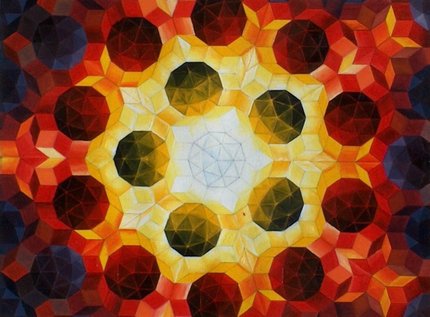
  I once read a complicated book, The Emperor’s New Mind by British polymath Roger Penrose.  He’s a respected scientist who thinks like I do.  I guess I should say thinks like I would if I had an IQ of 220 or so and didn’t have to use a calculator to do simple math.  Simply put, he believes that consciousness is the result of quantum processes that occur in structures far smaller than atoms (Planck scale) called microtubules in the brain.

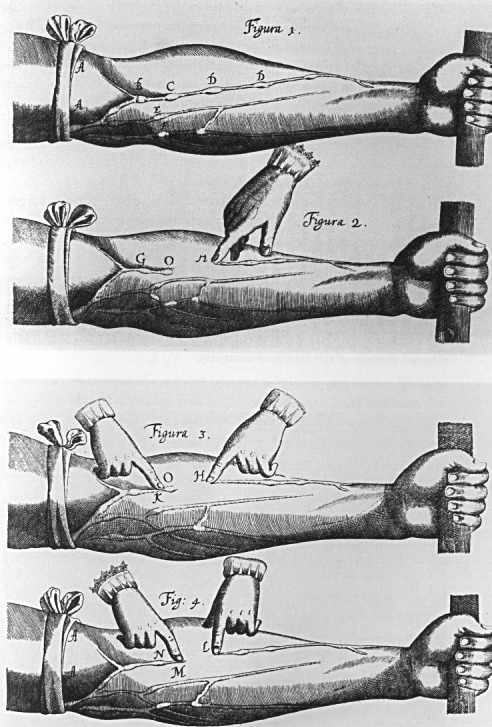
  Furthermore he says, “It doesn’t even act according to conventional quantum mechanics.  It acts according to a theory we don’t yet have.”  He then goes on again to draw an analogy with the research of William Harvey who was the first (westerner anyway) to describe the circulation of blood in the body circa 1616.  Prior to this it was thought that darker blood originated in the liver and lighter in the heart; that the two types had different purposes; and were consumed throughout the body.     

  Harvey figured out that arteries carried blood away from the heart and veins back to it and was certain that the two types of vessels had to connect, but couldn’t prove it without a microscope powerful enough to see things the size of capillaries. 

  Penrose is a widely respected physicist and has won many awards and though some might disagree, most take him seriously.  He theorizes that at that very small scale there is an abstract realm of Platonic ideals/mathematical reality that influences the quantum processes and thus the biochemistry, and thus the drama of our lives. 

  A rich connection with this dimension allows gifted mathematicians, musicians, artists, etc to make discoveries.  Given the spectacular ability of mathematics to describe our universe, this sort of makes sense even if it is difficult to fathom – if you know what I mean. 

  Where did this all come from?  Penrose says that consciousness, all consciousness arose with the big bang.  An Italian astrophysicist calls it the “Big Wow”.  Where will this take us as understanding grows?  Hold on to your chairs, truth is always stranger than fiction.  Suffice it to say that, though they have evolved at different speeds, religion and science will converge.

  “Half the people in the world think that the metaphors of their religious traditions, for example, are facts.  And the other half contends that they are not fact at all.  As a result we have people who consider themselves believers because they accept metaphors as facts, and we have others who classify themselves as atheists because they think religious metaphors are lies”.  Joseph Campbell.

  Nothing like a closed mind to screw stuff up.  Here is an exchange between two open ones:* Penrose’s partner in the development of their theory (Orch OR – Orchestrated Objective Reduction) Stuart Hameroff and Sam Hamil neurobiologist and author of The End of Faith;

Hamil: I do not rule out the possibility of our finding some sound, scientific reasons to believe in things that appear very spooky to most scientists at present – from telepathy to mathematical idealism.  And the fact that I do not rule such things out has made many atheists uncomfortable.  I do not foresee however, our finding good reasons to believe that the Bible was dictated by an omniscient being who disapproves of sodomy, but occasionally fancies human sacrifice.  These claims really do strike me as being “without intellectual merit.”

Hameroff: I agree with you.  My take is that there exists a fundamental Platonic wisdom embedded in the Planck scale (along with qualia, spin, charge, etc) which has inspired mankind to write the great books and act “in the name of God”… but man being man, many such efforts are misdirected, co-opted and perverted.

*http://AndrewSullivan.theatlantic.com/the_daily_dish/2007/03/

** Image at top is an oil painting by Urs Schmid of a Penrose tiling.  Look it up…

***Interesting to note that “anesthetic gases selectively erase consciousness soley through very weak quantum forces.”