Archive for the ‘consciousness/psychology’ Category

Joy

October 30, 2009

  While driving across our beautiful state earlier this week, obsessing about problems and desperate for creative insight, I turned on the radio.  Iowa Public Radio, to be precise, and a program about lucid dreaming.  That’s when you’re in a dream and know it.  There is even such a thing as dream yoga in which adepts reportedly develop remarkable facility.

  The discussion also recounted a wide range of dream research and anecdotes.  Abraham Lincoln had a dream premonition of his assassination shortly before the tragic event.  Sting and Johnny Cash, to name but two, have had songs come to them in dreams.

  Solutions to important math problems have appeared in dreams.  Or moments after a sunrise awakening.  (Which brings to mind the incredible underpinning mathematics seems to provide our universe.  Hmm, brains certainly aren’t rectilinear…)

  One of the cofounders of Google had his flash of insight appear to him in a dream.  A Nobel winning chemist whose work had to do with the chemical transmission of nerve impulses in the brain owes his prize to a dream.

  “Sleeping on it” works.  A study was done in which a problem requiring a creative approach was presented to two test groups.  One group got the problem early in the morning and allowed half a day to solve.  The problem was given to the second group shortly before bedtime with the answer due by noon the next day.  Second group was far more successful.

  Brought to mind two of the most incredible dreams I’ve had.  Both occurred during visits to my terminally ill brother.

The first was when I joined him at a beautiful secluded meditation retreat in the mountains of Oregon.  He had been diagnosed just weeks prior.  He looked fine and acted fine, but wasn’t.

Tashi Choling

  We arrived at night in a blizzard.  My emotions were roiling and after meeting his friends, both enrobed monks and lay people, I slept in my clothes it was so cold.  Wood heat.  My dreams were of such utter tranquility that I awoke with a smile certain that all would be ok.  And he was during the next seventeen months during which I visited him several times.

  When I arrived for what proved to be my last visit though, his condition had worsened dramatically over the short interim since my previous appearance.  I was so shaken that upon first seeing him I called the nearby Golden Gate Bridge something other than that.  Clearly the end was near.  Couple weeks.  He could see that I was shocked and joked about my mistake.  I was nearly overwhelmed.

  Several of his fellow Tibetan Buddhists were there with us.  That night I dreamt that my wife was giving birth to another child, another girl and I was in the next room waiting for the announcement.  There was some sort of muffled commotion and I went in.  

  Those about me were sobbing. The baby had been born, but wasn’t yet breathing.  It looked healthy and was clean of all birth fluids and blood etc.  I held her and talked softly to her.  She smiled and began to cry.  We were all overcome with joy and so that was what we decided to name her – Joy.

  Next morning, amazed at the tone and nature of that dream given the situation and my mental state, I recounted it to my brother.  He said “I’m tellin’ ya man, there’s somethin’ to this stuff…”

*Interviewee was Robert Waggoner/International Association for the Study of Dreaming.

Dunes

October 17, 2009

PA110378 

The huge dunes in the foreground were formed by the interaction of wind, water, and stone over the course of many eons.  They are the largest and most extensive (330 square miles) in North American and comprise the Great Sand Dunes National Park in south central Colorado.

PA050284 

  Most of the sand came from the San Juan Mountains to the west, but the larger grains were shed from the Sangre de Christos on the east such as Kit Carson and Crestone (pictured below) – two of Colorado’s fourteeners.

PA130413

  The dunes loom some 700 feet above the sand sheet and sabkha just to their west.  The visual effect of the afternoon sun upon them is unforgettable.  Why should the sun on a big pile of sand have such an impact?  Well, not long (in cosmic terms) after life evolved beyond a simple unicellular state, as ability to discern between light and less so developed.

PA120405

  Billions of years later we see in 3-D and Technicolor, but the pre-primal legacy still influences our perceptions.  The incredible lights and shadows of the dunes mediated by the undulating ridges transfix one’s gaze.

  All visitors thus moved, if only for a moment, what better place for an artist to imbue and convey?  Wife is artist-in-residence here and as usual has made the most of the situation.  Observations from many points of vantage have inflected her current work while observers, young and old alike, have added tactile impressions to their experience of this unique bit of terra firma NA.

PA110368

PA100346

  Bonus for this here strong back is that the location of the park, far far removed from the nearest town makes for a similarly prehistoric level of noise and light pollution.  Have seen more falling stars than I’ve fingers and toes.  Me lucky boy.

C=BT2

October 2, 2009

  Ever I hear folks arguing vociferously about the ascent of man I think about fathers coming out of the bleachers at little league games.  Ridiculous irrationality.  Give me a break.

  On the one hand you have folks who believe that an old dude of their own race awaits them in the hereafter.  A scary throwback to Old Testament literalism.  On the other, well, scientist Stephen Jay Gould once wrote: “Most important scientific revolutions involve the dethronement of human arrogance”.  How many times have thinkers of one stripe or another claimed to have reached the end?

  Myself?  I think that the middle ground, if you want to call it that, will be found in relation to consciousness.  Significantly, it’s origin and nature have not yet been discovered.  Sure, correlates of mental phenomena have been observed through brain imaging, but there is no consensus about how thoughts actually arise or what constitutes mind (as opposed to a brain).

  Some respected thinkers believe that consciousness might be another force – like gravity say – and similarly permeate all existence.  As I’ve mentioned before, approximately 75% of the universe, that has been calculated to exist, has not yet been found.  I think it works out something like this: Consciousness x Bell’s Theorem* = that 75%.

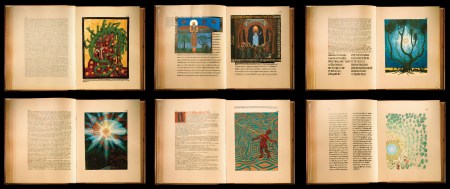
  Dial in the richness of Jung’s observations and there you have it.  In the September 20, 2009 New York Times Magazine there was an article about his long hidden “Red Book” titled The Holy Grail Of The Unconscious.  The book is said to stem from his mid-career “confrontation with his unconscious” during which lucid and florid dreams and visions came in “incessant streams”.  It is spectacularly illustrated by his own hand.

Jung Red Book

  He believed that we are all linked by a collective unconscious holding the whole of our history pretty much all the way back to stardust.  It manifests in each of us through the myths and archetypes that are made to constellate differently in an individual life by the forces borne upon them. 

  “Together, the patient and I address ourselves to the 2,000,000 year old man that is in all of us.  In the last analysis most of our difficulties come from losing contact with our instincts, with the age-old unforgotten wisdom stored up in us.  And where do we make contact with this old man?  In our dreams.”***

  There are many today skeptical, to say the least, of the utility of dream interpretation or any aspect of the “talking cure” for that matter.  I’d first refer them to the Gould’s words above and then simply say that once aware of Jung’s perspective it is incredible to follow him through a particular set of memories, dreams, and reflections – especially his own. 

  Herefrom echos my approach (only offered nearly seventy-five years ago). “I have been convinced that at least a part of our psychic existence is characterized by a relativity of space and time.  This relativity seems to increase, in proportion to the distance from consciousness, to an absolute condition of timelessness and spacelessness”.***

  Read some of his stuff, I’ll bet you’ll find resonance.

* Bell’s Theorem proves the non-local nature of reality.  cf July 18, 2008 below.

** From his autobiography, Memories, Dreams, and Reflections.

***NYT October 4, 1936

Rescuing Power

September 25, 2009

  Knee hurts, so instead of running early AM I’ve been riding my bike lately.  Trouble is it’s now fall and dark.  Oh well – the better…  Upon the razor’s edge once again.  More juice.  Might coast from time to time, but better not drift mentally till sunup.

  Right turn and fifty yards out of my drive I drop down a steep hill.  Feel like Batman falling off a lofty ledge Gotham dead of night.  Shirt flutters, cool air streams by my face, I use my night vision to search for potholes.

  Zoom through intersections and by homes asleep to another steep hill the climbing of which has me off the seat, pounds my heart, and puts me into oxygen debt. Just near the top, a light goes on in house on left.  Kitchen.  Lady.  Uh, sweet!

  Roll down other side a short way turn right and up beneath trees spread both sides touching middle.  Blocks the little starlight not already filtered out by clouds.  Hit puddle, sprayed from behind feel wet line up back must look like skunk.  Then nearly toppled by an acorn, but it crunches.

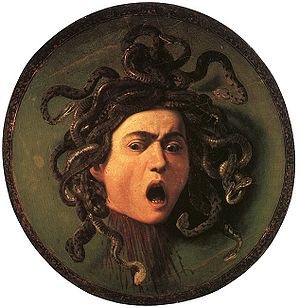
  Level out, cool down, cross a busy road against the light.  Down longest hill yet into a park and a cloud.  Thought of last time through  and a gorgeous field of daisy-like flowers stretched toward dawn.  Now though, dream dark, came to mind Piazza Campo Di Fiori* in Rome upon which a tennis match played 1606 ended with the brutal murder of one opponent by the other – great painter (and brawler) Caravaggio.

caravaggio medusa

  Funny, vigorous exercise almost always exorcises my demons. Or at least quiets them for a while.  Especially if hair on the back of my neck is up.  Quoting Holderlin Jung wrote: “Danger itself fosters the rescuing power”** 

  Out of the cloud mine sleep as I climb another hill then glide down the far side sharp turn right under bridge along swift creek.  Best Chinese restaurant in town on far side.  Ducks float in eddy to avoid Peking.

  Up last hill by kids’ elementary school (man, that was a long time ago…) turn left & coast to driveway. Twenty mile loop complete.  Stow bike  hose off French roast pat dog KISS WIFE ok. 

*”Field Of Flowers” in Italian.

**Carl Jung, Modern Man In Search of a Soul

***Painting is Caravaggio’s Head of Medusa which hangs in the Uffizi in Florence

Cuckoo

September 18, 2009

  Here is Eakins’ Agnew Clinic.  Similar to his picture above, this honors a retiring surgeon also emphasizing his service as an educator.  The roiling factor here though is more subversive.

Agnew Clinic

  Eakins thought that there was nothing more beautiful than the human body and went to great lengths to provide his students with the benefits of his talents.  Including once disrobing for a young coed to show a real male body in motion.

  On several occasions he allowed mixed gender life drawing classes.  Such disregard for the mores of the time brought trouble upon him and he was released from his position.  His choice of subject matter in the Agnew Clinic – a partially nude woman undergoing a mastectomy – was his retort.

  Eakins was born in Philadelphia in 1844 and thus lived his early years hearing whispers of war, was sixteen when the Civil War broke out, and twenty-one when it ended.   The mood in the birthplace of our nation must have been especially dark and turbulent through those developmentally crucial years.  The ramifications upon his fertile cortex must have been like that of acid rain on a forest.

  Jump forward a hundred years.  World War II had been won, factories were busy, and our democratic engine of capitalism had a full head of steam.  Everything was great – as long as one was white, straight, male, and in conformity.  Unbeknownst to the “Fathers Who Knew Best” there grew an undercurrent of disquiet and seething.

  The wake left on the leading edge of American consciousness shaped the art of the 1950s.  Its profile is just as impossible to capture in one work or one artist as during the 1850s, but a glimpse of an inflection might be had just as with Eakins.

  Robert Rauschenberg has been called a Neo-Dadaist which as defined by Oxford is “a movement characterized by anarchic revolt against traditional values”.  Here’s one of his pieces.  I’m not going to say that it foreshadows the incredible tumult of the sixties, but it sure does raise a few questions.  It’s called Monogram and was completed in 1959

rauschenburg

  The 1960s did come and saw foment and ferment of historic proportions.  Cuban Missile Crisis.  The Vietnam War brought response in all sorts of protest art.  Pop Art mocked the rise of our Consumer Society.  In One Flew Over the Cuckoo’s Nest  (1962), the sane and savvy, if sketchy, McMurphy was lobotomized for trying to help.

cuckoo

  “One flew east and one flew west and one flew over the cuckoo’s nest”.

Gross

September 11, 2009

  From the early days of the republic through the antebellum years, the American zeitgeist had been ebullient, dynamic, and filled with ambition and wanderlust.  Lewis and Clark, The Oregon Trail, Santa Fe, etc. The War Between the States however, catalyzed a wrenching change in its trajectory.

  600,000 lives were lost during the horrible conflict that followed our nation’s youthful exuberance – over 1% of the population. That’d translate into an incomprehensible 3,000,000 today.  Impossible for that not to be transformational, but the nature of the impact was not reserved to society’s human fabric.  As Lewis Menand wrote in his The Metaphysical Club: “… the United States became a different country.  The war alone did not make America modern, but the war marks the birth of modern America.”

  The secession of the south allowed what was left of congress to be a venue of action not seen since.  Progress.  It created the first system of national taxation; first national currency; public universities; completion of the transcontinental railway; and set the Republican Party up to promote industrial capitalism for years to come.

  The impact upon the common consciousness was darkly profound.  Democracy was supposed to progress with ayes and nays not blood and gore.  A proud American culture had given way to astonishing horror and irrationality.  “To some the war seemed not just a failure of democracy, but a failure of culture, a failure of ideas.”

  This came to mind the other day when I was thinking about a picture I’d seen in Philadelphia Museum of Art a few months ago while paging through a tome on American Art at home the other day.  In the book I saw an image of the picture below, Fur Traders Descending the Missouri painted by George Caleb Bingham twenty years before the Civil War.  I know nothing of the history of that work, but can imagine the take of contemporaneous urban viewers. 

Fur Traders

  “Wow.  Wish I was there instead of behind this desk headed for idle conversation with friends this evening.  That.  That’s living.  Trap a few beaver.  Fish.  Float down the river.  I want to be part of the wild west.  See stuff not seen before (Well, except for by Indians)”  In actual fact, thousands of people paid to view such pictures and get their only taste of the frontier.

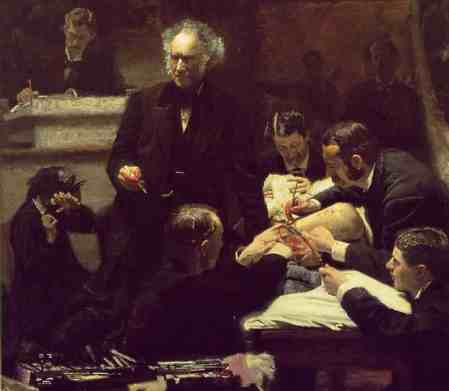
  Now look at the picture from Philadelphia painted by Thomas Eakins ten years after the war’s end.  Gross*.  The title is The Gross Clinic.  “This is what our guts look like folks.  Get used to it.  Shit happens.  We obviously can not predict the outcome of this case just yet.  He might die.  Whatever.  We’re learning from our mistakes.”  Eakins thought this the best of his work.  He submitted it to the 1876 Centennial Exhibition in Philadelphia only to see it rejected.  He sold it to Jefferson Medical College for $200. 

gross clinic

  The above is hardly scholarly, but it is impossible for me to imagine either picture to have been executed at the time of the other.  The spirit of a time is also a great reality.

*I heard somewhere that usage of the word “gross” to mean disgusting dates from this work.  A perusal of the OED yields nothing that would hold to the contrary.

**The Metaphysical Club, Louis Menand, Farrar Straus Giroux, 2001

Non-Ergodic

May 1, 2009

mandelbrot

Read that word in an absolutely fascinating excerpt from the new book Reinventing the Sacred by Stuart Kauffman.  Didn’t know what it meant either and it wasn’t in my dictionary.  Tried to look it up in my digital OED but it locked up.

Courtesy of Google found that non-ergodic refers to a set or group or system, the universe say, that is incomprehensible by study of a single aspect or earlier state.  Ever since the Big Bang, the universe has been expanding and evolving.  One could not extrapolate its current state based upon its early arrangement any more than examination of a slice now would tell us much about the whole a billion years hence.

Kauffman is an atheist who wants to understand the nature of the universe.  At its earliest why did the atoms combine as they did?  Darwin’s theory of evolution tells us a lot about our biosphere, but what about before there was anything to evolve? How did the first reproducing cell form?

Framing the question with an example, he tells us that there are twenty different amino acids and 20 to the power of 200 possible combinations thereof to make a length 200 protein.  It would have taken ten to the power of thirty-nine times the age of our universe to make each of them once. Why did the ones that formed come into being and not any of the other possible combinations?

Kauffman began his quest with genes.  He earned his MD at UCSF and undertook research into genetic expression.  He found that they exist “on the edge of chaos” and that “the proper functioning of an organism depends upon its self organization and regulation”.  A trait does not come fully formed from a single gene, but from their interaction.  “Health is just a moment of stability in a very uncertain cellular world.”

The principles of self-organization found in complexity theory play an important creative role in the evolution of the universe, our biosphere, our genome, and our existence. It describes the behavior of systems that are sensitive to initial conditions, but evolve unpredictably over time.

The above Mandlebrot fractal is an example of a complicated structure arising from a simple set of points, a formula, and repeated iterations.  A slight difference in the points and formula would have led to significantly different evolution.  (cf the butterfly effect)

“Thus a radical and I will say, partially lawless creativity enters the universe.  The radical implication is that we live in an emergent universe in which ceaseless unforeseeable creativity arises and surrounds us.  And since we can neither prestate, let alone predict all that will happen, reason alone is an insufficient guide to living our lives forward.  This emergent universe, the ceaseless creativity in this universe, is the bedrock of the sacred that I believe we must reinvent.”

“What about all the aspects of the universe we hold sacred – agency, meaning, values, purpose, all life and the planet?…One response is that if the natural world has no room for these things, and yet we are unshakably convinced of their reality, then they must be outside of nature – supernatural…”

“The ground of our existence, then is not to be found in physics alone, but also in the partially lawless becoming of the biosphere, econosphere, culture that we self-consistenly co-construct.”

A universe not understandable by reductionism? Nor by a grand patron in robe and slippers?  Kauffman gives us a radical appreciation of an unpredictable creativity that underpins and leavens our cosmos.

*Interesting (to me anyway) Kauffman was president (in 1961) of the same mountaineering club as was I (1974).  Makes me wonder anew about the field of embodied cognition to which I referred  in “Let’s Dance” 1/24/08 below.  Kinesthetics, adventure, and cerebration  can combine to powerful effect.

**Dang if he didn’t figure out how to get paid to sit around staring off into space while I still need my day job.   Teaching at Harvard this spring,  he heads the Institute for Biocomplexity and Informatics at the University of Calgary.

Heh, heh, heh…

February 20, 2009

  p4080042

  Not long ago (well I guess you can see when), I was seated at a table with a bunch of crusty old (and not so old) farts discussing an important community development project.  A lot of money was involved and so were therefore complexities, hidden agendas, and outright misguided prejudices.

  Sometimes during such meetings I work on needlepoint or origami as sorts of insurance policies.  They ensure that the time spent is not a total waste.  To be fair though – the measure is usually not necessary and often my own contribution amounts to little more than a stupid joke.

  Both needlepoint and origami bear certain similarities with an arcane subset of mountaineering called ‘bouldering’ which consists of short routes of extreme difficulty.  All demand intensely personal – essentially solitary – commitment and creativity to engender any hope of real success. 

  They also help sharpen ontological acuity.  Paradoxically, acts of concentration such as these awaken a broad and deep sense of awareness.  I actually did most of the bit you see above while visiting my brother for a week some months before he died of cancer.  I remember every stitch I made, breath he took, and drip from the roof during that uncharacteristically wet Marin February.   

  Anyway, during the above referenced meeting I could tell by their furtive glances that several of my colleagues were discomfited by my silent activity. 

  Several times Mr. Curmudgeon fired a question at me to check for my attention.  Reminded me of grade school when I was the best day dreamer in class and loved to look out the window while we were taking turns reading aloud.

  The teacher would break order and call on me because she figured my mind was elsewhere.  She was right of course, but alas for her wrong too.  I’d pick right up where the last had left off without losing a beat.  Heh, heh, heh. 

  I nailed Mr. C’s questions, but nonetheless later was asked, anonymously, to leave my “stitchery” at home or the office or wherever.  In the end, the series of meetings wound up with nothing solved and no real purpose served, but the above project found its first incarnation as the cover of a graduation present/address book.

  Heh, heh, heh. 

* Above L-R: Sun over surf; an Iowa farm; and mountains.

Expecto Patronum*

January 23, 2009

  The headline of a recent Daily Mail from London tells us that: “Richard Dawkins warns Harry Potter could have ‘negative effects’ on children”.  Dawkins is a recently retired professor from Oxford, scientist, and author of best seller The Selfish Gene.  The book first came out in 1976 and has sold over a million copies in twenty-five different languages.

  It is a very interesting look at evolution holding that the theory is best explained or understood from the point of view of a gene.  They function alone or in combination with others with the sole purpose of ensuring their own replication.  This usually, but not always, works to the benefit of the particular organism in which a gene exits. 

  An example of a case in which it does not is that of a male praying mantis in search of a mate.  You probably know that the female usually eats the male after they’ve done the dirty.  Too bad for him fer sure, but his genes made it to the pool whatever his consort might have had for lunch.

  So why in the world would he worry about Harry Potter?  As I’ve said (way) above, there are fundamentalists of all sorts of stripes.  Indeed, Dawkins has been accused of attempting to establish a religion built around evolution.  Being a prominent and very public atheist, he makes a very odd bedfellow for those mustering the clerical assault on Hogwarts.

  Book bannings and burnings are nothing new of course.  In fact those ashen pages make quite an august group.  Leaves of Grass, Huckleberry Finn, Ulysses, and Civil Disobedience (!) just to name a few in English.  Why not Cinderella, Snow White, and the Wizard of Oz?  Hey, what about the witches in Macbeth?  “Double, double, toil and trouble; fire burn and cauldron bubble…”  Hmmm. I’m gonna guess that those who get worked up about Harry Potter haven’t made it to Shakespeare.

  Kids learn valuable lessons from fairy tales and other fiction.  And are OK at reality testing.  In his National Book Award winning (1977) The Uses of Enchantment psychologist Bruno Bettelheim wrote: “a child needs to understand what is going on within his conscious self so that he can also cope with that which goes on in his unconscious… It is here that fairy tales have unequaled value, because they offer new dimensions to the child’s imagination which would be impossible for him to discover as truly on his own.” 

  The problem with fundamentalist adults, it has long seemed to me, is that the words that leave their lips express desperate attempts to convince themselves that the doubts lurking deep in their unconscious are unfounded.  And as Bettelheim continues: “When the unconscious material is repressed and its content denied entrance into awareness, then eventually the person’s conscious mind will be partially overwhelmed by derivatives of these unconscious elements, or else he is forced to keep such rigid, compulsive control over them that his personality may become severely crippled.”

  They get stuck and never take up such important tomes as the one my thoughtful (and well yes perceptive) brother gave me for Christmas: The Encyclopedia Of Immaturity.  There are approximately 240 entries.  I’m already to page 18 which helps me brush up on “How to Make Noises Under Your Arm”.  I’m trying to get each lesson down before turning the page, but I couldn’t help noticing that “The Case Against Chores”, “Here are Your Lifetime Goals”, “Be a Stapler Artiste”, “Do the Bubblegum Nose Bubble”, and “The Cas Aginst Gud Spelg” lie ahead.

  My wife said it was the perfect gift for me.  Also that my brother is better looking than am I as well as much handier.  She hasn’t laughed at my new facility with the brachial noisemaker. Jeesh. I’ll get even once I master “How to Be A Rubber Band Ninja Warrior” and “How to Make an Air Puff Annoyer”.       

*Expecto Patronum is a spell first used in the Harry Potter book Prisoner of Azkaban.  According to Wikipedia it “Conjures an incarnation of the caster’s innermost positive feelings such as joy and hope…”

Here’s Hopin’ for a Draw

January 2, 2009

  Talk about a battle for resources.  A new theory asserts that mental disorders such as schizophrenia and autism result from competition between genes from the sperm and egg.  They vie in utero over management of available nutrients.  The mother fights for moderation so she might live to bear another day while, given the opportunity, the father would empty the refrigerator to enhance the chance that each seed grows to maturity.

  A gene called IGF2 is inherited from both parents and promotes growth.  Usually the mother chemically muffles it so that demands for sustenance do not become voracious.  If the gene is fully active growth can becomes excessive.  As much as 50% above normal.

  The implications for brain development arise in the same region on chromosome 15.  There dominance can lead to conditions associated with autism on the father’s end of the spectrum and mood problems and psychosis on the mother’s.

  “Emotional problems like depression, anxiety and bipolar disorder, seen through this lens, appear on Mom’s side of the teeter-totter, with schizophrenia, while Asperger’s syndrome and other social deficits are on Dad’s. 

  One of the researchers, Christopher Badcock of the London School of Economics noticed that: “some problems associated with autism…are direct contrasts to those found in people with schizophrenia.  Where children with autism appear blind to other’ thinking and intentions, people with schizophrenia see intention and meaning everywhere.”

  My roommate tells me that I am rude, crude, unattractive, and am extremely symptomatic of all sorts of social deficit disorders.   I love it.  I is fine.  Thanks Dad!

  AMF

* I learned about all of this in an article in the 11/11/08 NYT by Benedict Carey.