Archive for the ‘consciousness/psychology’ Category

Er, hadn’t thought about the milkman…

December 19, 2008

 brainy-sperm

  Yet again, the Economist comes through. A bit in the December 4, 2008 edition basically sets forth how healthy, intelligent, and sexy I am. 

  I’ve long known that all the hot chicks can’t take their eyes off of me, but my wife and kids never believe it. I’m certain they won’t now disagree.  The thought of their chagrin is delicious beyond words.

  In a piece titled: “Balls and brains” we learn of recent research testing a thesis attempting to explain a newly discovered interrelationship between intelligence and health.  (As you will see, the thesis also tests political correctness).

  One view would hold that smart people, on average, make smart choices about such things as tobacco and exercise.  In other words, their intelligence would translate into good health. 

  In stark contrast however, some evolutionary biologists think that intelligence signals underlying genetic fitness and has thus forever been a source of attraction for potential mates.  (No bright woman would choose a dumb husband, right honey?*)

  Rosalind Arden of King’s College, London sought to test this idea through the analysis of semen.  Using samples from and interviews with 425 men she found that there is indeed a direct relationship between its quality**  and a standard measure of general intelligence called Spearman’s g.

  So sports fans, “The quality of a man’s sperm depends on how intelligent he is, and vice versa”. 

*This is the truth: Once asked why she agreed to marry me, my wife responded that she needed an encyclopedia.

**Comparative measures of concentration, count, and motility

November 21, 2008

sauger-on-bed 

  I once had a wilderness experience in which I was all by my lonesome for four days.  It is amazing how thought patterns change in the absence of human interaction.  For me at least ‘monkey mind’ – jumping from one thought to the next haphazardly – disappears and is replaced with much longer cycle time.

  The days were filled with physical intensity and focus.  The nights were filled with stars and cerebration.  (“Stars, stars, stars!”  I wrote in my journal.*)  I can still recall the seeds of a cucumber sliding over my tongue down my parched throat and somehow making a connection between them and Orion’s belt.  I dunno.

  When I made it back to the Mirror Lake bus stop the only others there were a mother and young son.  Son looked at me and moved closer to his mother.  She looked at me and held him tightly.

  I said hello and hoped that they’d ask what I’d been up to so I could regale them with my tale of glory.  No response.  I suppose the Mom subscribed to a corollary of the theory I frequently repeat to my daughters: the only decent boy they’ll ever meet is their brother, myself included.

  Wife’s gone again and all this was running through my head last night.   Certainly, it is not the same at all just to be at home alone for several evenings in a row complete with any number of phone conversations.  But, still, one’s mind finds a different gear. 

  I agree with the French philosopher Pascal: “All men’s miseries derive from not being able to sit in a quiet room alone.”  If one cannot be comfortable alone with one’s own thoughts, how can he/she possibly have honest interaction with another?

  Even a dog. Know how you can talk to someone and be thinking about something completely different? Staring into the eyes of mine last night it dawned on me that a dog, at least a smart one, knows if you’re day dreaming or not.  With a dog you must commit.  They wait for engagement.

  How’s that for deep thinking?

  I also agree with Donne that “No man is an island”, but one is unable to really deeply understand that without an experience of real solitude. 

*While looking back in my journal I saw that I had been wondering how I measured up to others my girlfriend/future wife had been dating.   I was pretty much of a bum at the time.  In retrospect it is funny to have been concerned.  The ones I saw were all weasels.

Last One I Caught Was A Yellow Swallowtail, I Think…

September 26, 2008

  While out in Maine I went into a really neat gallery/used book store.  There were many volumes I tried to convince myself to buy, but in the end walked away with only two:  A Rorschach Workbook and Child Rorschach Responses – both published in the early ‘50s.

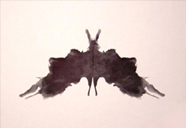
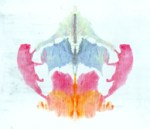
  Yep the images above are five of the ten official Rorschach Ink Blots. Aren’t they beautiful?  Luscious I’d have to say.  Whoops, did I just reveal something about the depths of my psyche?

  A brief investigation courtesy of Google showed that the Test is still given though probably not nearly as frequently as fifty years ago.  And that there is no dearth of skeptics.  I remember discussing Rorschach with an elderly psychologist a few years ago and found him to be defensive, but yet still an advocate.  He held that so much data had been amassed over the years that the normative boundaries could reasonably and clearly be defined.

  No matter what, administration of the test must be interesting, especially after the accumulation of considerable experience.  The subject’s response is called a “Performance” because “The Rorschach test is based upon the assumption that behavior is meaningful and that when a person is presented with unfamiliar, nonstructured material, he will behave in his own individual way”.  

  A subject is initially given a vague instruction such as: “People see all sorts of things in these ink blot pictures; now tell me what you see, what it might be for you, what it makes you think of.”  The examiner then begins to present the ten cards from a deck which is always stacked in exactly the same order.

  Once the subject begins (hopefully ) to expound, the examiner takes careful, precise, and detailed notes.  How long it takes to react to each card is recorded as well as how long it takes to complete a response. 

  Then, “An inquiry, following the performance proper, is conducted to obtain sufficient information so that a response can be scored correctly.”  The examiner asks just enough questions to determine: where on a particular blot something was seen; essential info regarding form, movement, color, and/or shading of each discrete perception per card; content clarification if needed.

  All of the above is scored using a complex system of annotation to “facilitate the analysis of the record as a whole”.  A bar graph is created with the ‘determinant’ categories – movement, color, shading etc.  across the x axis and frequency of related responses on the y axis.  The result is called a Psychograph.

  Location categories are tabulated by percentage: location responses of a specific sort, (whole card, large detail, small detail) are divided by total number of responses.  So if thirty total responses were given of which eight were takes on the whole image on a particular card, then that score would be 8/30 or 27%.  These figures are compared to the “expected” percentages.

  “Normal expectancy” is that 20-30% involve the whole card; 45-55% large details; 5-15% small details; and less than 10% a combination of large details, small details, and some portion of the white space.

  Content is given one of three denotations.  ‘Popular’ if typical; ‘Original’ if rare, but good with respect to form and content; and ‘Bizarre’ if very rare, nebulous, and conceptually deficient.

  The Handbook includes many sample responses for every category.  As one might expect, there is incredible range – soup to, uhm, nuts.  My favorite thus far (with consideration to the maintenance of a certain decorum in this space…) is from the ‘Content’ category for card #8 which is the upper right most above: “The pink is the evil which is slowly destroying the good in the World.  Evil is triumphing and destroying the good”.  Whoa.

  Child Responses covers ages two to ten with age group specific observations made in six month increments up to the age of six.  It is filled with an incredible amount of detail.

  For example at age five: the total number of responses is slightly fewer than the two preceding ages; 58% of responses include the whole card; “content categories shift again to a more mature group… animals, objects, humans.  First age plants and trees are not an outstanding category.”  Sex difference not marked at this age.  Colored cards are much preferred. “All the dark ones don’t look so good.”

  What’s a typical response to card #8 from a five year old girl?  “I don’t know what this is.  Another butterfly.  Or a piece of candy.”

  How could this not be fun with kids? “Results of the present investigation point clearly and unmistakably to the conclusion that many types of response which are considered pathological or at least suggestive of disturbance in the adult occur quite normatively and characteristically at certain ages in the child”.

  Yes, I suppose that one’s early, florid imagination is usually trimmed (like that dang lawn) by the demands of life.  First half of one anyhow.  Well to recall Shunryu Suzuki’s observation in Zen Mind Beginner’s Mind: “In the beginner’s mind there are many possibilities, in the expert’s there are few”.

  I don’t know about you, but I’m fixin’ to break out my butterfly net again pretty soon…
Flirtatious Attempts at Self Selection

September 11, 2008

  Clear and very cool this morning when I took the dog for a run along the frayed edges of the fog blanketing the river.  I wondered if the commercial fisherman usually there was out in his 20′ jon boat.  I’d never noticed him to have a light and certainly no foghorn.  He’s been there regularly for years and I concluded that he must know how to be safe.

  Dog shot about like a bullet which caused me some angst.  Every year for the past few, at about this time, I come to realize that his sluggishness just days or weeks prior was not due to age but heat.  What a jerk am I sometimes.  Awful when I repeat.

  Previous few weeks it’d been us three boys.  Son took off for London yesterday and so now it’s down to Sauger dogger and me.  Current nature of our crib belies that fact.  We had fun.  Ah well, I’ll get after it and no one will be the wiser.

  Turning away from the river back toward home thought shifted to the concept of ‘no self’.  No self in the sense that one doesn’t have an immutable center, that what you are is largely the evocation of your own evolving particular interpersonal milieu. 

  Andrew had his elaborate DJ setup in our living room and took it all out for a number of gigs while home.  Watching him perform and seeing how the crowd drew enjoyment and naturally fell into its rhythms and beats made me realize that our “own personal interpersonal milieus” are just like bits of music – improvisational jazz.  We’re all instruments playing off each other and the environment.

  Your particular array of pets has inflected your personality in a particular if subtle way.  The sense of your place probably had a greater impact.  You’d be profoundly different had your family been constituted other than it was.  So What?  Take Five.

  Music has always been part of our nature.  “Darwin suggested that human ancestors, before acquiring the power of speech, endeavored to charm each other with musical notes and rhythm.  It is because of music’s origin in courtship that it is firmly associated with some of the strongest passions an animal is capable of feeling.”

  (In that regard, this dad watching his son perform couldn’t help but notice a steady stream of alluring young women approach in what sure seemed like flirtatious attempts at self selection.  OMG)

  A “Dr Miller sees music as an excellent indicator of fitness in the Darwinian struggle for survival.  Since music draws on so many of the brain’s faculties, it vouches for the health of the organ as a whole.  And since music in ancient cultures seems often to have been linked with dancing, a good fitness indicator for the rest of the body, anyone who could sing and dance well was advertising the general excellence of their mental and physical genes to a potential mate.” 

  Guess I better work on my moves so that I can bust a really good one some few days hence. 

Note: Quotes above came from my trove of clippings:  9/16/03 NYT

Where’s the Clearasil? Or, uh, Proactiv?

September 5, 2008

  Like just about everybody, I wish I had a whole lot more lettuce than I do, but, hey, life is good.  That’s why, I guess, I wonder about how big of an issue it really should be that the mega rich have become richer at a faster pace than the rest of us.

  Why care?  Most agree, from shrinks, to sociologists, to rock stars that after you reach a relatively modest threshold, the correlation between net worth and happiness rapidly weakens. (Besides, every redistributive effort thus far has failed miserably.  Just ask Gorbachev.  Or even better – Deng Xiaoping.)

  Think how ecstatic you’d be if all of a sudden your desire for more ‘stuff’ evaporated.  And you care less about the Jones.  Think how full your house is of junk that has long not seen the light of day.  Things that still fit and/or are far from the end of their useful lives.

  You’d be able to relax a bit more and enjoy the company of your roommate.  Which reminds me that mine is still away.  And the funny thing is that my friends at the Economist found out and included a bit in the 8/30 issue to help keep my mind on the subject.  (And off of the magazine covers son has left strewn about.) 

  It is a review of a book titled September Songs: The Good News about Marriage in the Later Years.  The author “turns her attention to couples in their 50’s and 60’s and finds older marriage is full of unexpected pleasures”.

  “Older couples expressed lower levels of anger, disgust, belligerence and whining and higher levels of one important emotion, namely affection.”

  “The nest empties.  Retirement approaches… As in late adolescence people once again have to forge an individual identity.  Without a growing family or a career to provide self-definition, older people must answer anew the teenage question, ‘who am I?'” 

  What fun!  Hope I don’t get pimples again.  Wife never had any.

  We’ll have to look in the mirror and see what we see…

Scratch That Thought

August 22, 2008

  OK, I’ve always told my kids to listen to the little voice in their heads to keep them out of trouble and on the right path etc.  Maybe that’s been bad advice.

  Last weekend I was listening to the “Speaking of Faith” radio program on NPR during which host Krista Tippitt listened to best selling author Eckhart Tolle recount a seminal experience.  While riding public transportation to his university he often was seated near a certain schizophrenic who was always engaged in animated two-part conversations with herself.

  His realization was that he was frequently, though more quietly (but not silently!), similarly engaged.  Aren’t we all? You know: “I’m a dope.  What should I do now? No, that’s never worked. He’s an idiot. She’s hot.  Get out of my way moron.  Oh, sorry, I didn’t realize you were blind”…

  Furthermore, as I’ve mentioned (way )above , Julian Jaynes, one time head of the psychology department at Princeton wrote an unbelievably well wrought and erudite argument to the effect that the human preconscious mind was characterized by what we’d now classify as (mostly) auditory hallucinations. 

  And that today, while we’ve added the layer of consciousness, there is still plenty of evidence – vestigial and otherwise – of our ancestral selves.  In fact, it is exactly those vestiges that must be left behind to make way for behavior of a higher order. 

  “… athletic trainers… urge their trainees not to think so much about what they are doing. The Zen exercise of learning archery is extremely explicit on this, advising the archer not to think of himself as drawing the bow and releasing the arrow, but releasing himself from the bow and releasing the arrow, but releasing himself from the consciousness of what he is doing by letting the bow stretch itself and the arrow release itself from the fingers at the proper time.”

  Just think of the number of times you’ve gotten yourself in a stew and made it worse by continuing to stir.  Your mind takes over and you find yourself its captive.  You identify its interpretation of an event based upon sketchy sensory input.  Often later to have been found faulty or incomplete. 

  Michael A. Singer gives this advice: “The best way to free yourself from this incessant chatter is to step back and view it objectively… If you’re hearing it talk, it’s obviously not you.  You are the one who hears the voice.  You are the one who notices that it’s talking.”

  So, uh, notice what’s going on in your head.  Wait for it to go away.

  (And write home from time to time)

Before Shit Happened…

August 8, 2008

  If you buy the idea that developments in the arts of a time or  civilization are due to tremors in its underpinnings, then get this: the cave paintings of Paleolithic artists were largely unchanged for some twenty five thousand years! Must not have been any neurotic cavemen.  Or angst.  Or civil displeasure.  I read this in an interesting article by Judith Thurman in the 6/23 New Yorker.

  Isn’t that amazing?  Just think of all of the different movements of art that rode tumultuous waves of change in the twentieth century alone: Fauvism, Die Brucke, Cubism, Futurism, Orphism, Der Blaue Reiter, Constructivism, Suprematism, Dada, De Stijl, Art Deco, Bauhaus, Surrealism, Regionalism, Abstract Expressionism, Op, Pop, Minimalism, Conceptualism, Performance, Earth, Post Modernism, etc, etc. 

  She writes: “Paleolithic artists transmit[ed] their techniques from generation to generation for twenty-five millennia with almost no innovation or revolt.  A profound conservatism in art is one the hallmarks of a classical civilization.  For conventions of cave painting to have endured four times as long as recorded history, the culture it served… must have been deeply satisfying – and stable to a degree it is hard for modern humans to imagine.”  In addition, she points out that there has not been found any depiction of human conflict in cave art.

  Thurman tells us that the life expectancy way back then was about eighteen.  The brevity of the average was due to high infant mortality.  However, those making it through could expect to live for another thirty or so years due “to the rarity of infectious diseases and abundance of protein… considerably longer than the Greeks, the Romans, or the medieval peasants who built Chartres”.

  The zeitgeist way back then – for all of those centuries and all those generations – must have been characterized by an overwhelming sense of natural rhythm.    

  Must have been sweet.  But then we invented agriculture and began to try to remake the world according to an endless variety of parochial visions.  Shit happened and the rest is, well, history.

  As I have asked before, and will again, now that we are all elbow to elbow and our existence is at the very least wildly syncopated:  whither now that zeitgeist?

Can You Hear Me?

July 11, 2008

  Ever see The Perfect Storm?  Remember near the end when it’s clear the end is near and the character played by Mark Wahlberg screams into the storm over the raging sea:  “Christina? Christina, can you hear me?  I don’t know if you can, but I’m talking to ya, baby.  Do you know how much I love you?  I loved you the moment I saw you.  I love you now, and I’ll love you forever.  No goodbye.  There’s only love, Christina.  Only love.”

  And then after the storm, after Bobby (Wahlberg’s character) and his colleagues have all perished, and after the memorial service, Christina recounts a recurring dream in which “all of a sudden there he is.  That big smile…” And he repeats the above word for word.  “And then he’s gone.  But he’s always happy when he goes.  So I know he’s gotta be okay.  Absolutely okay.”

  Sebastian Junger writes in the introduction to the book that “No dialogue was made up”.  So while the film is largely true to the book the last words to leave Bobby’s mouth in the movie are fiction, but Christina’s dream not.  No matter what, cool bit of antiphony, right? 

  The day after the last time I saw the movie, I read a note in Outside magazine about a book by Maria Coffey: Explorers of The Infinite which asked: “What is it with extreme athletes and paranormal experiences?”

  Had to buy the book.  Found it fascinating.  Coffey punctuates her work with views and explanation of mainstream science, but it is clear that she believe that there is indeed something else going on.

  During the course of reviewing historical accounts of and numerous interviews with folks living life on the edge: “I became increasingly convinced that extreme adventurers break the boundaries of what is deemed physically possible by pushing beyond human consciousness into another realm.”  

  She quotes Krishnamurti:  “A complex mind cannot find out the truth of anything, it cannot find out what is real – and that is our difficulty.  From childhood we are trained to conform, and we do not know how to reduce complexity to simplicity.  It is only the very simple and direct mind that can find the real, the true”. 

  Coffey tells the story of a couple who followed, on foot, a caribou herd for months and hundreds of miles way up in the Yukon.  Alone and vulnerable, they fell into rhythm with the pace of the life of the animals.  Some weeks in, they both began having dreams.  The dreams began coming true.  “Heuer and Allison believe it was the rigors of the journey that led to their dreams and the other inexplicable events that began to unfold.”

  The identical twin British mountaineer brothers, Adrian and Allan Burgess provide several fascinating anecdotes.  In one, Adrian, who didn’t often remember dreams and hadn’t thought about a certain dead alpinist friend for quite some time was visited by her in his sleep during early stages of an attempt on Nanga Parbat.  “Adrian, you’re with the wrong people, get the fuck out of there” she told him.  He was shaken and did leave.  Shortly thereafter the team was hit by an avalanche.

  It’s not all dreams.  There’s intuition.  “Jung described intuition as the perception of realities that are unknown to the conscious mind.”  Marlene Smith says: “Intuition is about our body translating the energy it picks up, animals listen to those physical messages, but most humans reason them away”.  Among other examples, Coffey cites evidence of unusual activities of some animals and primal people that spared them death from the Asian tsunami in December 2007. 

  In 1985 a mixed Spanish-Polish team of alpinists attempted Nanga Parbat.  They communicated in English over their two way radios.  During the descent there was a terrible storm and all “felt near death”.  After safely reaching base camp, they listened to the recordings of their conversations and were amazed that they were all speaking in their native languages – unintelligible to each other.  Yet during the actual event they understood one other perfectly.

  There are many more stories and much hypothesizing, but it’s hard at the very least to disagree with British climber John Porter who said: “I think the starting point for any sort of weirdness is life itself.  If we’re here, then it seems to me that anything is possible.” 

  After all, without even having to wade through the several bewildering mainstream explanations of the origin (or lack thereof) of our universe, it interesting to note that physicists do agree that the universe is made up of: 4% matter as we know it; 22% dark matter that we maybe know something about; and 74% something else yet to be determined. 

  Now that’s weird.

A robot couldn’t use a Ouiji Board, much less dream one up.

July 5, 2008

  In the Science Times section of the Jun 3, 2008 NYT there was an interesting series of predictions given by futurist Ray Kurzweil.  He has a decent track record and now posits that: solar power will be economical in ten years; soon there will be a drug that will let you eat whatever you want, and by 2050 “humans and/or machines [will] start evolving into immortal beings with ever-improving software”.

  Most interestingly, he predicts that by 2020 or so, with new tools including nanotechnology, gene sequencing, and brain scans etc, we will be “adding computers to our brains and building machines as smart as ourselves”.

  Another interesting fellow, V. S. Ramachandran does not agree.  He is a neuroscientist with impressive range having done research and written fascinating books about phantom limbs and consciousness; is (or was) on the board of directors of the San Diego Museum of Art in La Jolla; and lectured widely about art, perception, and the brain.  (Including at the National Council for Education of Ceramic Arts!)

  Ramachandran allows that a thinking feeling machine might one day be possible, but not a reverse engineered brain.  “My colleague Francis Crick used to say that God is a hacker, not an engineer.  You can do reverse engineering, but you can’t do reverse hacking.”

  I agree with Dr. Ramachandran. Think about it.  An immortal man/robot hybrid would not have thoughts about sex or death and since the primordial soup, evolution of life on the planet has been guided by pursuit of the former and avoidance of the latter.  Still is: look at any billboard.

  Furthermore, it’s the incredibly inscrutable array of connections and cross connections that has led to the invention of the wheel, penicillin, thermos bottles, crepes suzette, the push-up bra, and everything else.  Even experts can’t account for all the stuff they come up with. 

  For example, Irvin Yalom begins his book Existential Psychotherapy with an anecdote about a cooking class in which he and several friends had enrolled.  After repeated failures at home, he went back to the school to watch again. 

  He hadn’t originally noticed that the chef did more than simply follow a recipe.  She would taste, readjust, and even incorporate afterthoughts.  Thus, before even beginning to really convey his thoughts about existential psychodynamics, he admitted that while “Formal texts, journal articles, and lectures portray therapy as precise and systematic, … and a careful rational program… I believe deeply that when no one is looking, the therapist throws in the “real thing”.

  (BTW, the book is really interesting and his selection of cookware provocative:   “The existential position emphasizes a different kind of basic conflict: neither a conflict with suppressed instinctual strivings nor one with internalized significant adults, but instead a conflict that flows from the individual’s confrontation with the givens of existence… Death – Freedom – Existential Isolation – Meaninglessness. )

  Or to come at it from an entirely different perspective: in the June 21 edition of the Wall Street Journal, billionaire financier George Soros credited his success to his backaches.  “I would say that I basically have survived by recognizing my mistakes.  I very often used to get backaches due to the fact that I was wrong.  When I make the right decision, the backache goes away.

  As a final example of the irreplicability  of the gray matter in our skull I’m reminded of an issue of the New Yorker a few years back.  In it were an interview with Bill Gates and an article by Oliver Sacks about Temple Grandin, the autistic veterinarian who says she feels like an “anthropologist on Mars”.  It was impossible to read the two pieces and not recognize characteristics and mannerisms of each in the other.

  Like it or not, we’re dang complex.  Maybe unfigureoutable.

And I thought it was because I am a Gemini…

June 20, 2008

  Awesome!  The Economist is such a great magazine!  I just learned from reading the current issue (June 14 – 20 ) why my attention span is so short.  Ahem.  Among other things.

  It’s about attention-deficit hyperactivity disorder.  Those with ADHD are impulsive.  They “have trouble concentrating on any task…they flit from activity to activity… tend to perform poorly in society [and] are prone to addictive and compulsive behavior”.  C’est moi!  Yo comprendo!

  Turns out I owe my restlessness to nomadic ancestors.

  Testing has shown that ADHD is a genetic condition. “It is associated with particular variants of receptor molecules for neurotransmitters in the brain”.  Variant 7R of protein DRD4 has been shown to be associated with “novelty seeking, food and drug craving, and ADHD”.

  The neurotransmitter here is dopamine which, as you may know, is associated with reward and pleasure.  The thought is that people with ADHD are getting hits of dopamine (aka positive feedback) for behavior that seems inappropriate in today’s society.

  How could this have come to be?  Well, we’ve not long been desk jockeys and the sorts of things associated with ADHD might have well served our nomad and hunter-gatherer ancestors.  Couch potatoes would not have fared well, would they?

  Recent research in Kenya supports this hypothesis.  The Ariaal people are historically nomadic.  Those now among them with the variant receptor and who continue to wander were found to be “better nourished” than those without.  By interesting contrast, those members of the group that had the variant but had settled down were worse than those without.

  A further question is why, if important, the variant is found only amongst 20% of the population.  Could be that the “effects are beneficial only when they are not universal”. 

  I buy that.  Somebody’s got to poke sticks at snakes and do the peyote ceremonies etc while the rest keep the fire burning. And the latter would tolerate the presence of the former for only the briefest of intervals – eg long enough to drop off the day’s catch.

  I’ve always felt like the odd one out.  Now I understand.  Everybody else is missing a gear. 

(For some reason, this reminds me of something that Patagonia founder Yvon Chouinard said in an interview that appears in the June/July issue of Businessweek Small Biz:  “My favorite quote about entrepreneurship is that to understand an entrepreneur, you should study a juvenile delinquent”.)