Archive for the ‘couch potato’ Category

D’oh

December 17, 2010

     Whether or not you buy the notion that magic mushrooms played an important role in the evolution of human consciousness, you must agree that the density of interconnections in our neural circuitry underpins the richness of our thinking.

  OK.  What could cause a reversal, a diminution, a loss of ‘stars’ in our cerebral constellation, a trend backwards toward the synesthetic threshold?   Television.  And it won’t take generations for evidentiary manifestation.  Just as DDT decimated avian populations within a generation, so is the boob tube laying waste to a wide swath of our individual and collective brainpower.

   US students were “mediocre”, faired poorly in a just released assessment of fifteen year olds across the planet.  Another recent report showed that Americans’ scores on a commonly used creativity test fell steadily from 1990 to 2008, particularly among our youth.  Time spent in front of screens was given as a primary cause.

  Not only do couch potatoes’ muscles wither and minds lose dimension while bellies grow, the attendant self isolation wreaks wider havoc.  Society’s collective consciousness attenuates along with the density of its interactions. 

  An article in the May 22 WSJ posited that: “Where population falls or is fragmented, cultural evolution may actually regress”.  For example, 10,000 years ago the 4,000 residents of Tasmania became isolated by rising sea levels.  They then “constituted too small a collective brain to sustain let alone improve the existing technology” and apparently lost the ability to fashion tools, clothing and fishing equipment.

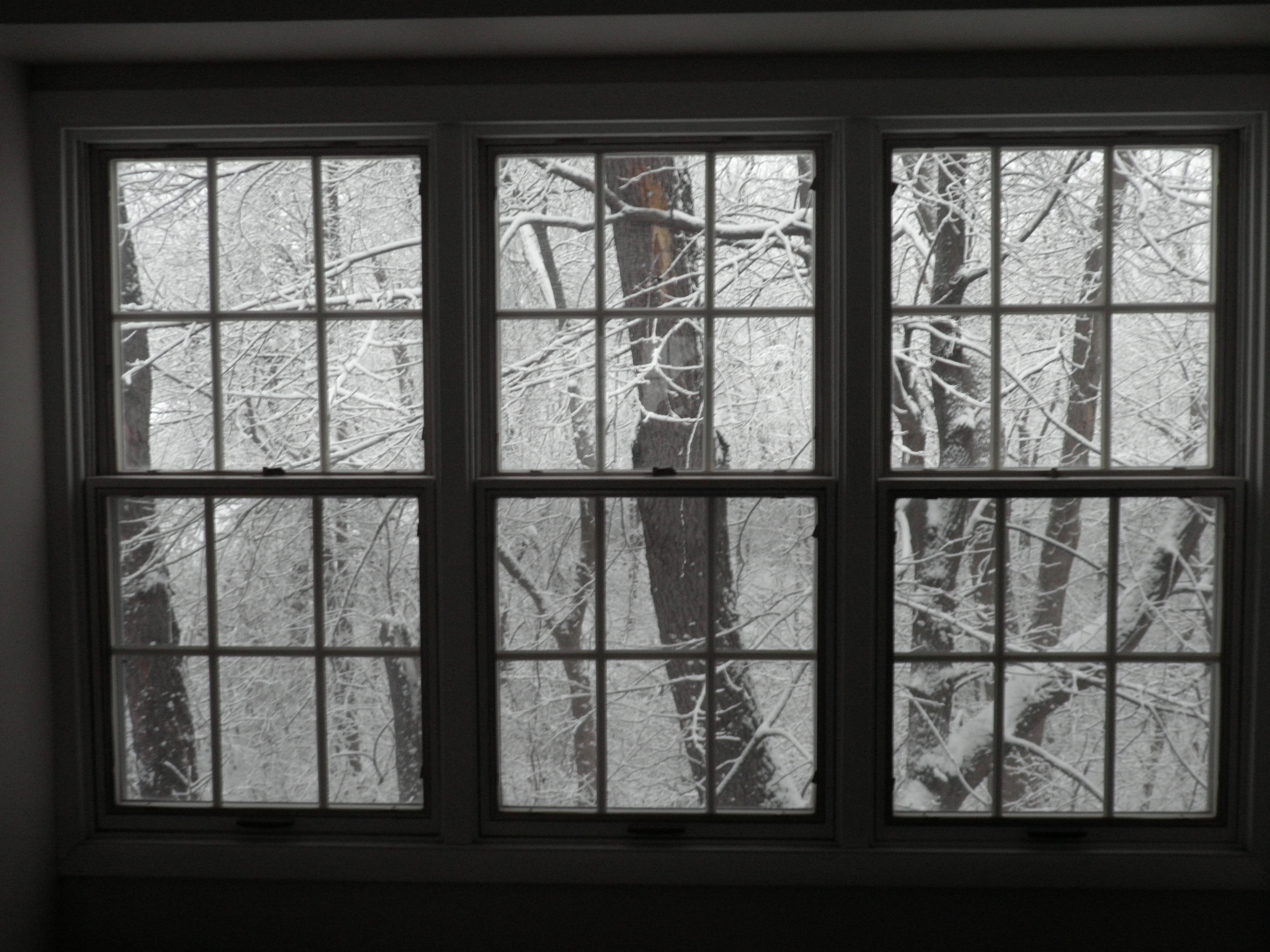
  Reflect upon this the next time driving through a neighborhood and you notice that nearly every large window is illuminated by that familiar glare.  Or the next time in a big box store the walls of which are filled with incredibly expensive and huge television sets.  With $500.00 alters upon which to rest them available nearby.

  Most TV programs are either inane or pandering.  Not great art. Reminds me of what Iris Murdoch wrote about bad art: It’s “the soft, messy self-indulgent work of an enslaved fantasy.” 

  The other evening there was a prime time network program about losing weight.  How can there be viewership sufficient to satisfy advertisers?  We should feel insulted.  Newsflash – there is one and only one way: EAT FEWER CALORIES THAN YOU BURN!

  Jeesh. Who is going to fix stuff here in the States some years hence, let alone invent it? 

  D’oh!


Hey! Lose the ear buds!

August 27, 2010


  Furthermore, in an interview with Terri Gross on her NPR Fresh Air program Matt Richtel (the NYT reporter quoted in the previous post) drew an analogy between food and technology.  Too little of either can impair effectiveness and vitality.  Too much can lead to obesity, distraction, and actual neurological damage.

  Incredible as it may sound, the evolutionary precursor to this problem is the fight or flight syndrome.  Primitive man hears rustle in the bush, synapses fire, cortisol released, he runs or throws a spear.  Repeatedly induced by some signal to check your device or screen, same chain of events ensues all be they separately more diminutive.  Ill effects though are cumulative.

  Research on rats show that it is during downtime that memories form and creativity is enhanced.  “People need to take breaks.” Relatedly: multitaskers have more, not less, trouble filtering out irrelevance and staying focused.  The more often you switch from one screen or device to another the greater the negative impact upon your effectiveness.

  The reason you feel compelled to check is because of what’s called ‘intermittent reinforcement’.  Rats again.  If one in a cage knows that there will occasionally be a food pellet in its food dispenser, it will feel compelled to frequently check.  Similarly, while most of the stuff in your inbox is such junk it might as well be empty, sometimes there are gems.

  As mentioned in the previous post the researchers all felt a shift, if subtle, in their consciousness after the third day of their trip.  Ms. Gross commented that she noticed a difference in hers when a weekend extends from two to three days.

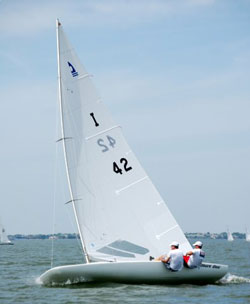
  I wonder if a similarly salubrious effect might be made possible in a shorter period by different conditions.  Extenuating, say… Wife and I were under sail last night in our twenty foot/216 sq ft sailcloth C Scow.  Breeze was way up and swells were big.  Barge and other boat traffic.  Last time we went over I broke ribs and wife’s eye was blackened. 

  Attention thus broadly drawn, there were no thoughts of Blackberry, office, bills, etc etc.  Matter of fact there was no thinking.  Way hiked out, minor adjustments in trim and body position were all that lay between full speed and swimming.  Back ashore, we felt renewed and refreshed.

*”Fresh Air” on NPR 8/24/10

**Research shows that it’s riskier to talk on a cell phone while driving – even hands free – than having a conversation with a passenger.  Passenger is even an asset: “they modulate their conversation – both topic and tone – based on what they see in front of them.”

***Sadly, Anne Franks’ tree went over last week.  Happily someone had the foresight to plant seeds and saplings have been distributed around the world.

The Mind Around Us

August 20, 2010


   On the front page of Monday’s NYT (8/16/10) was an article entitled: “Outdoors and Out of Reach, Studying the Brain”.  Reporter Matt Richtel accompanied a group of five neuroscientists who left technology behind while floating down the San Juan River in remote southern Utah.  Their purpose was to study the effect of today’s digital barrage on one’s mind as well as what might be the ameliorative effects of nature’s embrace.

  The group was comprised of two sorts: several who employ digital technology with abandon and the rest a bit wary and more judicious.  Trip leader David Strayer, one of the latter, compared the research to the study of the consumption of too much meat or alcohol.

  Dang stuff is sort of addictive.  I know it is rude to check my blackberry in the middle of a conversation or meeting yet I do it anyway.  Find it difficult to resist in fact.  Even worse is texting while driving.

  “Attention is the holy grail” said Strayer.  “Everything that you’re conscious of, everything you let in, everything you remember and you forget, depends on it”.  “Too much digital stimulation can take people who would be functioning O.K. and put them in a range where they’re not psychologically healthy.”

  By the end of the trip, having fallen into the rhythm of the river, all had noticed a change in the nature of their cognition.  Even one of the skeptics said: “There’s a real mental freedom in knowing no one or nothing can interrupt you…time is slowing down…”

  “…even the more skeptical of the scientists say something is happening to their brains that reinforces their scientific discussions – something that could be important to helping people cope in a world of constant electronic noise.”

  And other stuff even worse.  Here’s Anne Frank: “The best remedy for those who are afraid, lonely or unhappy is to go outside, somewhere where they can be quiet, alone with the heavens, nature and God.  Because only then does one feel that all is as it should be.”

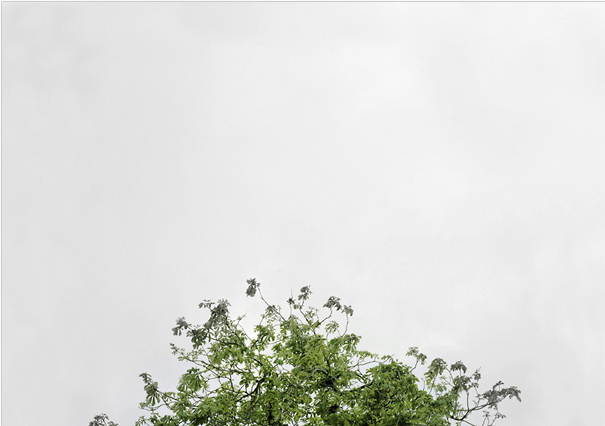
  The photo above is of the top of the tree she could see from her attic window and about which she wrote: “From my favorite spot on the floor I look up at the blue sky and the bare chestnut tree, on whose branches little raindrops shine, appearing like silver, and at the seagulls and other birds as they glide on the wind…As long as this exists, and it certainly always will, I know that then there will always be comfort for every sorrow, whatever the circumstances may be.”

  The scientists hope to develop strategies to identify the related specific neurological mechanisms surrounding attentional disorders wherefrom to enable curative therapies.  Jeesh.  Just turn it all off and go outside.  Or at least look out the window… 

*The photo and quotes came from the video installation by Jason Lazarus “The top of the tree gazed upon by Anne Frank while in hiding, Amsterdam, 2008”.  It can be seen at the Des Moines Art Center through 9/5/10

**In case you don’t get the allusion in the title, The Sea Around Us it the title of a best selling and prize winning book by Rachel Carson.

*** Relatedly (to me anyway) was the recent study showing accelerated hearing loss among the IPod generation.

Unfinished Business

July 23, 2010


  Whenever I get bewildered or stuck, I like to look through Jung.  He once wrote: “Life is a luminous pause between two great mysteries which yet are one”.  And he spent most of his career assisting those in the second half of life figuring out how to incandesce.

Uh, perfect timing.

  “The more a man’s life is shaped by the collective norm, the greater is his individual immorality.”  Easy for him to say.  How does one dig deep, take risks, and still be a responsible member of this species?  I understand him to say that’s just it.  One has to will a way to be comfortable living in those questions.  “What work then, needs to be done?”

  Or put another way, Jung defined neurosis as “suffering in search of meaning”.  Or “it’s not so much that one has a complex, it’s that the complex has him.”  And should one, a parent, not feel like taking up this great challenge he/she “should be conscious of the fact that they themselves are the principal causes of neurosis in their children”.

  And it goes way back:  “Together the patient and I address ourselves to the 2,000,000-year-old man that is in all of us.  In the last analysis, most of our difficulties come from losing contact with our instincts, with the age-old unforgotten wisdom stored up in us.  And where do we make contact with this old man in us?  In our dreams.”

   Furthermore, I’m obviously interested in all aspects of neuroscience, its explication and promise.  But I don’t think that science alone will ever completely demystify the living of a life.      

  “Scientific materialism has merely introduced a new hypostasis…It has give another name to the supreme principle of reality and has assumed that this created a new thing and destroyed an old thing.  Whether you call the principle of existence “God”, “matter”, or anything else you like, you have created nothing; you have simply changed s symbol.”

  “The danger that faces us today is that the whole of reality will be replaced by words.  This accounts for a terrible lack of instinct in modern man, particularly the city dweller.  He lacks all contact with the life and breadth of nature.”

  I’m going outside.  Be right back.  Well,  maybe Monday…

Judd Viburnum

April 16, 2010


  Marie Winn wrote The Plug in Drug in 1977 examining the effects of television on the developing minds of young people.  In the 25th anniversary edition she put the range of new electronic media under her scrutiny and, among other stuff, gave it all as the cause of a significant decline in average SAT scores of US high school seniors.

  Remember how I’ve described many times how the brain wires itself up through interaction with its own particular sensory environment?  A new book, iBrain* explores the effects of “growing up digital” on neuronal development.  The authors tell us that “Because of the current technological revolution, our brains are evolving right now – at a speed like never before”. 

  They demonstrate how addictive technology can be and that even just intent perusal leads to a diminution in social skills.  “With the weakening of the brain’s neural circuitry controlling human contact, our social interactions may become awkward, and we tend to misinterpret, and even miss subtle, nonverbal messages.” 

  The apparent purpose of the book is to identify this and other ramifications of modern media along with ameliorative suggestions.  It describes a “brain gap” between older and younger minds – ‘digital immigrants’ and ‘digital natives’ –  and how to narrow it.  The tone is not dire, but optimistic and hopeful.  Still… 

  It is well known that the average American spends far more time in front of some sort of screen than engaged in any sort of physical activity.  In this book a study at the University of Illinois is recounted that correlates the development of digital leisure technologies and a significant decline in visits to our national parks.

  How can this not bring to mind the middle (dark) ages of Europe in which the educated preferred to read Aristotle’s description of something rather than endeavor to undertake a real experience of it?  Alchemy – the attempt to turn common elements such as lead into gold – was big.  Doesn’t that remind you of the incredible profusion of gambling/lottery venues?

  Jeesh.  These days of spring, wife and I fight over who will take our dog on his evening constitutional.  Around the corner is a shrub that, as it comes into bloom, gives olfactory intimations of heaven. Especially in the dark when vision is reduced to monochromy and smell symmetrically amplified.

  Recently I ‘borrowed’ a cutting to take to a green thumb and identify.  “Oh my God” she said “let me have another whiff”.  Exact quote.  “Maybe mock orange, but I’m not sure, let’s go ask Ned.  I have to know too”.  I followed her to the shrubbery section where stood gnome Ned.      

  As we approached, he smiled broadly.  “Judd Viburnum” he said when he saw what I held.  “Wonderful, isn’t it?  We have one outside our bedroom window that we trim to keep the top just above the sill.  Oh Lord if doesn’t it make for a few of the most enchanting nights of the year.   We never leave town during the middle of April.”

   I wouldn’t either.

*iBrain, Surviving the technological alteration of the modern mind; Small, Gary and Vorgan, Gigi; Harper; 2009.

Psychic Rewilding

February 12, 2010

  In last Sunday’s New York Times Magazine there was an article by Daniel Smith entitled “Is there an Ecological Unconscious?” which addressed the stress and discomfort visited upon the psyche of those subjected to forced dislocation (eg Trail of Tears) or environmental degradation (eg exploitation of newly discovered nearby coal deposits).

  Researcher Glenn Albrecht coined the term solastalgia to describe this condition of “place pathology” leading to the diminution of “one’s heart’s ease”.  The article reminds us that Freud attributed just about everything to sex and how modern psychology is primarily concerned with urban interpersonal interaction, largely ignoring the primal bond between humankind and the rest of nature.

  The premise of echopsychology is that “an imperiled environment creates an imperiled mind” and that there might be a relationship between a resilient environment and a resilient mind.  Research shows that natural settings are far more effective than urban for the enhancement of cognition.  Researcher Peter Kahn calls for a ‘rewilding’ of the psyche.

   Well, yippee ki-yay, I quite agree.  “More and more”, he writes, “the human experience of nature will be mediated by technological systems.  We will, as a matter of mere survival adapt to these changes.  The question is whether our new, nature-reduced lives will be impoverished from the standpoint of human functioning and flourishing.”

  How much of a stretch is it then to ask about the degree to which TV, digital social networking, video games, etc are responsible for global warming?   Well a lot I guess, but you get my point.  How can one have a meaningful sense of self and surroundings without a vigorous dose of the environment from time to time?

  Paradoxically, it dawned on me that an emerging departure from rectiliniarity in architecture enabled by technology might be relatedly salubrious.  I have long been interested in the emotional generosity inherent in good design and wonder if this will prove to be an unexpected and fecund vector.

  Japanese architect Toyo Ito has said that: “I sometimes feel that we are losing an intuitive sense of our own bodies.  Children don’t run around outside as much as they did.  They sit in front of computer games.  Some architects have been trying to find a language for this new generation, with very minimalist spaces.  I am looking for something more primitive, a kind of abstraction that still has a sense of the body.”     

  I have only read about and seen photos of Ito’s built work and am eager to one day experience a product of his line of thinking.  New York Times critic Nicolai Ouroussoff calls him an “urban poet”, “someone who has been able to crystallize, through architecture, the tensions that lie buried in the heart of contemporary society.”*

  No two of his projects are alike, maybe not even remotely similar.  Ouroussoff: “By embracing ambiguity, his work forces us to look a the world through a wider lens.  It asks us to choose the slowly unfolding narrative over the instant fix…  A building that seems to have been frozen in a state of metamorphosis”

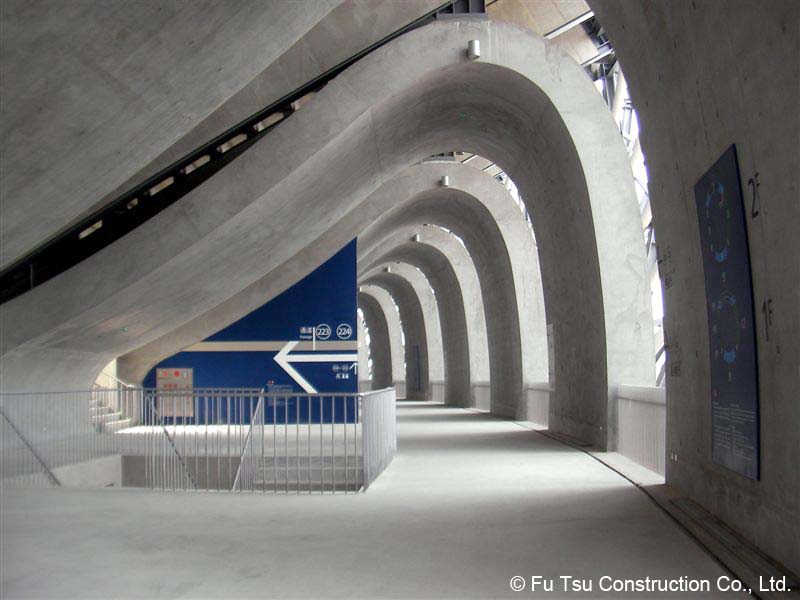
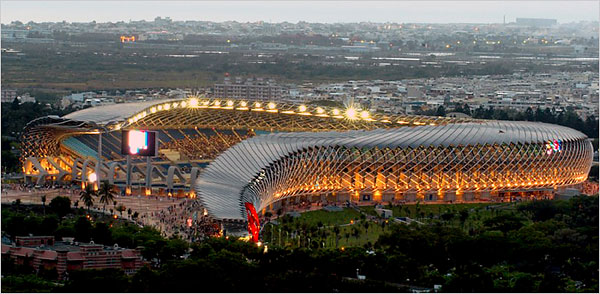
  The photos are of his stadium in Kaohsiung, Taiwan.  Ouroussoff tells us that it is “a space that manages to maintain the intensity and focus of a grand stadium without that intensity becoming oppressive.”  As opposed to other stadiums, “it seeks to maximize our awareness of (the outside world) while still creating a sense of enclosure.”

  Might such places help relieve solastalgia?  Help rewild a psyche, even?

*NYT 6 12 09

Snow

December 11, 2009


  I remember hearing years ago in school something to the effect that Eskimos have more than a hundred different names for snow.  Recent investigation of that thought took me to a ponderous discussion of linguistic relativism.  Whatever the number, it seems obvious to me that a people living in an environment so dominated by a substance would develop a very nuanced relationship with it.

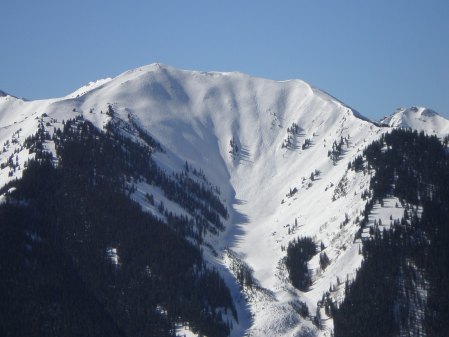
  Consider recreational users of backcountry in winter.  Skiers, hikers, climbers etc.  With experience, they’ll develop acute sensitivity to the nature of the snow through which they tramp, slide, andor ascend and not only because it governs the nature of their progress.  The evolution of a particular season’s snowpack determines its proclivity to avalanche.

Neve is granular snow on the upper part of a glacier
Sastrugi is snow sculpted and packed by wind erosion
Graupel is that type of snow that looks like little Styrofoam balls
Hoar is frozen dew
Depth Hoar is made of cup shaped large grained faceted crystals near to the ground in a larger snowpack formed by temperature gradients.
Surface Hoar is a dangerously slippery layer of frost formed upon an existing snowpack.  Little to impede succeeding layers from sliding off…

  Those are just a few.**  None would enter the consciousness of one bereft of experience.  Couch potato or equatorial vision of snow would suffer from what New Yorker art critic Peter Schjeldahl calls the “pandering ghosts” of a reproduction.  An image of snow on a mountain would reflect their preconceived notions – would show them what they wanted to see.  Like an un-defrosted freezer in the case of the former and an air conditioned heaven maybe in the latter.

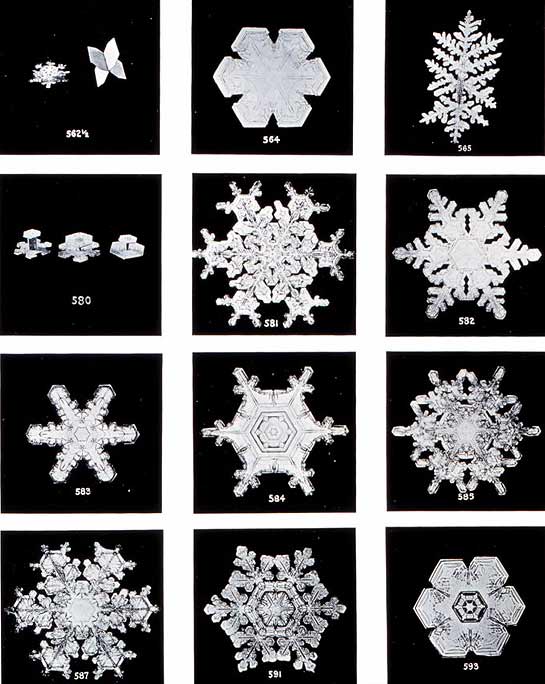
  Wilson “Snowflake” Bentley was a New England farmer who found endless joy in, you guessed it, snowflakes.  He was born in 1865 and never lost the magic that all but the grim and grisly find in a season’s first snow.  “When a snowflake melted that design was forever lost.  Just that much beauty was gone, without leaving any record behind” he wrote.

  He spent a lifetime photographing snow crystals.  Some 5,000 separate images he recorded.  Imagine how difficult it must have been!  Cold obviously, but how to get individual crystals onto a slide without breathing on them or causing them to fracture.  In an accompanying narrative, he’d then wax exuberantly about their beauty. 

  In a paper written in 1902 he used the words beauty or beautiful nearly fifty times.  Snow crystals Nos 716 and 718 were “very choice and beautiful”.  Nos 722 and 723 were “charming patterns in snow architecture.”  They were “gems from God’s own laboratory”.  No 781 is “wonderfully beautiful…”.

  What a great way to go through life, eh?  

  Finally, here’s a somewhat less tranquil manner by which to get up close and personal with a whole lot of snowflakes:

*cf photo with that of post 11-7-08

**http://www.avalanche.org/~uac/encyclopedia/

***I learned of Bentley in a wonderful book: Exuberance – The Passion for Life by Kay Redfield Jamison.

****While reading about snowflakes, I also learned that it is an incredible experience to listen to them hitting the surface of a body of water from a position beneath it.  Have to remember to check that out.

High Lands

February 6, 2009

0052 

  Daughter and I took lifts to the top of the ski area where we boarded a snow cat which took us up the ridge to a point where it narrowed and steepened.  We got off.

  After the drop off we began the hike up the ridge as it narrowed to a knife edge.  A sign read: “Hazards of back country skiing include death”.  Though wife and I had made this hike and ski descent before and though it is a far sight from the leading edge of this day’s temerity,  I had been sleepless the night before.

  To voluntarily enter a challenging environment with one of one’s progeny can only hope to be a healthy endeavor if accompanied by some degree of expertise, experience, and humility. And voluntary participation.  Kids are all adults now…

  Hiking in ski boots is not natural.  Hiking up a steep trail – actually only a succession of small slots kicked in the ice and frozen snow – focuses one’s attention.  Drop your skis and you’d never seen them again.  Slip, well, you get the picture.  The wind was blowing so fiercely that the contrails from my runny nose froze solid on the left lens of my shades. 

   We reached the top.  Rested a bit and considered best route of descent.  Couldn’t  see over the corniced ridge so to be safe skied down the shoulder a bit and then dropped in.  It was steep and cruddy.  Had to be athletic and assertive.  Perfect for #3.  She knew she’d be back to drop in from point zero.

   From the bottom of the bowl a short trip down a tortured trail to a cat walk and the lift took us to the summit lodge, her mother/my wife  (the real skier) and lunch.

  It is not hard to imagine how humans began to slide down frozen inclines and even began to perfect the activity.  Just watch kids in winter upon the most modest of slopes.  Thinking of kids, hundreds of years ago in Norway a child prince was spirited away from danger upon skis for some fifty kilometers.   Name of biggest cross country ski race in the states – Birkebiener – came therefrom.

  What is difficult for me to understand is how our evolution equipped us to seek, survive, and thrive in the steep cold environment.  Well maybe I can understand the seek part.   Without a thirst for adventure in at least part of the population we’d all still be starring into Olduvai Gorge.

  But the kinesthetic part I don’t get.  Such prowess must be an epiphenomenon related to swinging through a forest canopy.  Now to think of it, that does sound like fun.

  Clearly the huge ski industry is built upon a very wide range of athleticism.  Weighted toward the heavy end.  The fact that couch potatoes enjoy it is interesting.  The fact that a few seek out the steep quick and cold is fascinating. 

  Whatever.  The conviviality on top is a fine reward.  Humans are weird and I’m glad to be one.

004

Las Animas

August 15, 2008

  In the 8/10/08 NYT there was an article about the recent tragedy on K2 titled: “Does Climbing Matter Anymore”?  Tragedy it certainly would have been if just one had perished let alone eleven, but only a couch potato would ask that question.  It is actually more of a koan and the answer is the Louis Armstrong response to the ‘what is jazz’ question:  “if you have to ask, you’ll never know”.

  Commercial endeavors (a big and growing) aside, adventurers know what they’re getting into and do so with purpose and resolve.  No matter if it’s the Himalaya or an unnamed wood, they understand that there is grave existential peril in a comfy slouch.  

  For some reason, the piece brought to mind a trip taken many years ago…

  We were headed, by narrow gauge rail, toward the Chicago Basin at the head of Needle Creek in Colorado’s San Juan Mountains.  Our car was several back from the engine, but even so, its spewing plume made me feel like an erstwhile citizen of Herculaneum.  I could not understand how my wife and kids were not bothered and instead hopped from side to side describing the scenery with ebullience.

  The angular bits of coal dust soon floating across my cornea triggered not exactly a pain response, nor diverting anticipatory thoughts of the wilderness that we had barely entered, but instead memories of recent car troubles, problems at the office back home, and dinner the last night in Aspen.  Why had we left?

  El Rio de Las Animas Perditas, the river along which the rails mostly traveled, was far below yet beckoned hypnotically.  I sank into my seat resignedly to obsess and await what might lay before.

  Just as I entered the state between wakefulness and sleep, the train stopped at the ghost town of Needleton which lies approximately midway between the railroad’s eponymous northern and southern terminuses; Silverton and Durango.  We jumped out, hustled back to the boxcar to retrieve our backpacks, and watched the train depart and disappear.

  The steep ten mile hike up along Needle Creek was in a word, brutal, but at least my thought pattern began to make sense.  I was again in the wilderness with my family.  Did we have the right stuff?  Would we be safe?  Would we have fun?

  Well not right off. First, cartographic aphasia led to several wrong turns, a trip to the top of a pile of rubble some distance from the day’s goal, and hours lost.  Then the water pump/purifier performed poorly and during attempted remediation an o-ring popped into the stream.  Finally, it rained intermittently during the hike up and through the night.  One of our tents leaked and all five of us spent the first night huddled together in the other – a few with pre-oedemic headaches.   

  Nonetheless next morning the pervasive beauty began at least to inflect my cortical cramping.  We set out to hike yet higher and reached a pair of lakes at about 12,000 feet.  There were of course no trees, little vegetation, and the water virtually sterile due to its hibernal solidity.

  The surface upon which our vibram almost squeaked had been polished smooth by the icy meniscus’ expansive ancestors and was ensconced high up in and surrounded by the castellated rim of the cirque.  The air was still, though laden with the smell of brimstone and the sounds of the neophyte creek.  Sally and I watched our three children silently stepping from rock to rock as if in performance of some Shinto rite.

  It is amazing – the grandeur of the infinite – that with which one becomes suffused in an area so devoid of life’s layers.  Wondering about how that sort of stark emptiness could be so fulfilling, so sort of spiritually tumescent, I recalled a proposition of physics which as written by one Alan Wallace has it that: “there is more energy in a cubic yard of empty space than in all the matter of the known universe”.  It must be that energy which has led native peoples around the globe to impute magic and divinity to such purlieus.

  After further exploration and a bit of rest we decided to move our camp down valley from whence to find a seldom visited lake about which we’d somehow heard.  Why it held allure I’ll never be certain.  There was no trail marked on the map and our guidebook described its approach as steep, indistinct, discontinuous, and treacherous.

  Indeed, though we were amazed at the myriad flora, fauna, and signs of men long gone that we had missed on the way in, we could not even determine which drainage would lead up to the darn place.

  Frustrated my group became as we covered the same steep mile several times in search of both some sort of indication of previous trail bifurcation as well as simply a way to cross the now adolescent torrent.  Our only encouragement was an animated description of hidden beauty by some wild eyed sacerdote.

  Our persistence was soon rewarded when another stranger offered assistance.  This one, a local fishing guide, showed us where to cross and described in general (the nature of the mountainside did not lend itself to detail) the way to the lake which was several thousand feet up and over a subtle ridge replete with turrets, hidden streams, and it was true – no real trail.

  “Purty well hid” he said looking upwardly as he twirled his mustache.  “Awful purty though; awful purty.”  In parting, he blew a wad of tobacco juice across the trail in front of us.

  The next morning we started up through the trees as directed.  They were dripping wet and seemed more like a forest of kelp.  After an hour or so of bushwhacking and log hopping, vestiges of the old miner’s trail did appear.  It was discontinuous – segments averaged about 100 yards in length – but we soon found ourselves able to follow it quite well by naturally filling in the blanks and being aware of the degree of arc and slope of a stretch, interpolating, and allowing reawakened internal guidance to lead us to the next short section.

  Occasionally, the way disappeared completely for quite some distance having been wiped out by landslide or avalanche and overgrown.  We would then build a little cairn at the breakpoint as we dropped into each new bit of destruction we had to cross to reach more virgin wood.

  More serious were the hazards created a bit past the more or less halfway point as the ridge’s rocky ossature began to protrude.  Mossy cliff edges were hard to identify due to the soft lighting and surrounding mist.  Fortunately, their position had been fixed in our minds while scanning the terrain the previous afternoon.

  As we rose, clouds obscured our view of the valley below and Mt. Eolus and subsidiary peaks to the north.  Once though, during a brief respite and snack, a hole appeared through which we watched massive disembodied blocks of orange granite seem to float in space.

  By the middle of the afternoon, light could be seen through the trees above.  Negotiation of a broken dark cliff band led to the top of the ridge, but not yet quite to our destination.  An old path led first to a absolutely still shallow tarn by which we sat briefly to watch trout dart back and forth with their dorsal fins protruding above the surface.  The glistening triangles were interesting counterpoint to the similar shapes on the far horizon.

  Our lake rested in a peneplain one hundred yards to the south and was larger than we had expected; several acres or so.  Behind and around it sloped a meadow resplendent in yellow and green which itself was collared by a rolling monadnock.  Its highest point looked like a turtle’s head beginning to emerge from the folds of its neck.

  As we approached, the clouds parted allowing the sun to set our wet garb steaming and reveal the lake’s luminescence as well as transmute the meadow into its almost iridescent apprentice.  It is in such a place, upon such a surface that Tibetan Lamas trek to read the names of the future.

  We looked in and saw ourselves.  Needed sunglasses.  The kids scurried around the edge for about half an hour while Sally and I watched and wrung out.  They first clambered around bone bleached piles of tailings and then continued around the lake, in birth order, toward a position opposite us.

  Their animations were uncharacteristically subdued and we speculated about the nature of their conversation.  I will forever hear the soft tones of their voices lilting across the invisible surface barely discernible from the sound of the gently falling water nearer to us.

  The clouds eventually drew back together reminding us that we were ill prepared for a night at 12,000 feet and serving effective notice that one must not long tarry in such a place lest the right of return be forsaken.

  Our descent was pure, clean, and mostly silent.  We had little trouble finding our way even though, if anything, the air grew more murky.  The cairns led us across the desolation zones and in between those we discovered keloid scars left by miners on the uphill sides of trees for unenlightened colleagues.

  Needleton was thriving the next afternoon with others in wait of a ride back to Durango.  Abigail flagged down the beast as it approached puffing and belching.

  We threw our gear into the boxcar and slowly climbed on board without a look back.  Pilgrims.

Let’s Dance

January 24, 2008

In a letter to Oliver Sacks (unanswered, but oh well) I referred to fascinating artilcle he wrote in the New York Review of Books in 1990 – “Neurology and the Soul”.  I asked about his statement that “This evoluton of self…is made possible…by the strengthening of connections within neuronal groups in accordance with the individual’s experiences and needs and beliefs and desires.  This process “cannot arise, cannot even start, unless there is movement.  It is movement that makes possible all perceptual categorizations.”

Recent articles in the Boston Globe [1-13-08] and the WSJ [1-15-08] describe new research in “the emerging field of embodied cognition”.  Investigators do indeed believe that movement and gesticulation enhance cerebration.  “People think with their bodies, not just with their brains…arm movements can affect language comprehension…children are more likely to solve mathmatics problems if they are told to gesture with their hands…”

Makes me wonder first about related ramifications to couch (or computer) potatoism.  Would those most lethargic among us somehow be diminished by more than just the time lost?  Furthermore, would those at the other extreme be operating on some sort of an elevated plane?  One of a state of kinesthetic omniscience like, say, Gene Kelly in American in Paris, or Tiger Woods, or Mia Hamm dribbling through a line of Amazons and getting off a shot?

Finally,  what then is going on mind/bodywise with those in “flow” in situations of great personal risk – in battle or on a lonely tightrope high above the ground or a ski racer rounding a turn at 75mph?