Archive for the ‘Family’ Category

Grace Under Pressure

January 16, 2009

 Once heard Lorne Michaels, the producer of Saturday Night Live being interviewed.  Questioned about what made for the best guest hosts he responded “athletes” without missing a beat.  He said that people like Michael Jordan were used to being in front of a demanding audience and performing under pressure.

  He didn’t mention the tremendous work ethic that great athletes must also have.  Or the ability to take mistakes in stride or worse – how to deal with “the agony of defeat”.

  Youngest daughter played D1 soccer for four seasons.  Team made it to the Big 10 championships her last season.  Lost by one point to the eventual #1.  They worked out from 7:00 AM to 10:00 AM and several hours late in the PM six days a week.  And that was the off season.  Seniors all graduated with honors.

  She’s now in Aspen working at an exclusive club.  Waitress/sommelier.  Her first time in Colorado was during the summer before she was born.  I remember being concerned for her prenatal wellbeing when we all hiked above the upper lift at Aspen Highlands.  +12,000 ft.  I worried that the thin air might somehow attenuate her potential to, well, smile.

  Needn’t have worried.  On her Facebook wall her brother’s post read: “Why is it that in every picture you look like you are having more fun than everyone else in the room?”  In Sydney, Australia she and a friend won the grand prize at a karaoke contest singing “Born in the USA” along with the Boss.  Who else could get away with something like that?  In June of 2008?  Her name comes from a Hebrew word meaning “source of joy” so maybe that’s it.

  Lorne Michaels’ thoughts came to mind when we heard that senior staff at the club were favorably impressed with her performance.  Maneuvering trays and bottles through a room crowded with demanding folks has to be easier than doing the same with a ball through a bunch of Amazons intent upon inflicting bodily harm.

  These months have been a great opportunity for her to sift through her thoughts of the year she spent working at a fine winery in New Zealand.  She’s just now begun evaluating graduate programs in viticulture and oenology.  I was quite taken by her response to my question of what drew her interest thereto.

  She said “Dad, you can’t cheat or lie.  You can only do the best you can do with the soil and the grapes.  The fact that a crucial ingredient, the weather, is completely beyond the vintner’s control only makes the work more interesting”.

  Her first comment evoked a vision of the current scoundrels of Wall Street.  I thought about how all of the ugly headlines must reverberate across the cerebrations of those with career choices not yet hardwired in.

  Then it dawned on me that she was talking about farming and how, in any of its permutations, agriculture is the archetype for an honest living.  For exactly the reasons she mentioned. 

  A few years ago some urbanite asked Pulitzer Prize winning poet Jorie Graham why she lived in Iowa:

  “Iowans respect work.  When one comes to live and work here, from whatever corner of the globe, one realizes after a while that one is working amidst people who work hard, who work with their hands, who stand between land and sky, corn prices and weather, with determination and faith and courage and an uncluttered understanding of the value of work.  When you sit down to work in their midst – you have a deep sense of their being at work in your midst.  Whether it’s the farmland that surrounds us, or the small businesses struggling around us, writers in Iowa are encircled – and instructed – by all kinds of other real work being done… One can feel the rightness of a well-planted thing, the incredible hard work it takes to make it come to fruition, the miracles and the sweat and the patience and the technique – both literal and imaginary – are in fact poems or stories that carry in their marrow the values and the beliefs of that community…” 

  Yup, can take the girl out of Iowa, but can’t take Iowa out of the girl.

abby-stomping-grapes-1

The grapes of my body can only become wine
After the winemaker tramples me.
I surrender my spirit like grapes to his trampling
So my inmost heart can blaze and dance with joy.
although the grapes go on weeping blood and sobbing
“I cannot bear any more anguish, and more cruelty”
The trampler stuffs cotton in his ears: “I am not working in ignorance
You can deny me if you want, you have every excuse,
But it is I who am the Master of this Work.
And when through my Passion you reach Perfection
You will never be done praising my name.”


Persian mystic Jelaluddin Rumi  1207-1273
January 9, 2009

 grandpa 

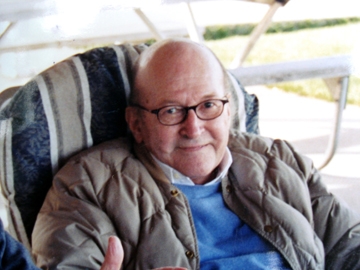
 It’s been nearly two years since my father passed away, but his office (adjacent to mine) has remained more or less the way he left it.  Only real work undertaken in there over the last twenty months has been the administration of his estate.  I used his desk for that effort and all sorts of statements, letters, appraisals, and other assorted documents have lain strewn atop it.

  Several weeks ago the notice came from Uncle Sam that everything seemed to be in order and I decided it was time to straighten things up.  I first looked through the old roll top desk (that was first my grandfather’s) behind his main work space.  Found two bank books from erstwhile institutions that didn’t make it through the thirties.   The last entry in the American Commercial and Savings Bank book was for a deposit of $883.36 on September 22, 1931.  I checked and that bank failed before the end of that year.  Hope Grandpa got his money out.

  Then I came across several of Dad’s report cards.  Grades 4,5, and 7.  Back then E was excellent, G very satisfactory, A average, F below average, and P “not sufficient for passing”.  Dad’s were all E and G in grade school, but dropped a bit in junior high.  I thought back to the horror that I found 7th grade to be and tried to picture him there.  I remember a few of his stories from grade school and all sorts of his exploits from high school on, but nothing in between.  Hmmm, I’ll have to ask my brother if he remembers anything.

  I decided to try to make space in a wide standing file cabinet just to the left.  I pulled the door of the second shelf out, up, and back and began to sort through the sheaves.  Estates.  My father’s parents and paternal grandparents.  Took me quite – way – aback.

  Dad’s passing, even though it was not sudden, left me feeling half exposed to the cosmos.  It was as if a hole in the ozone opened just over my head allowing a powerful new force to pour down upon me.  It was searing.  Sitting there behind Dad’s desk looking through generations of funeral bills I realized more fully than ever before that one day I’d find myself in that filing cabinet or one like it.

Chicago          March 3, 1914               
David D Mee & Co Undertakers:
1 Casket                $65
Embalming              $10.00
Auto Hearse             $13.50
4 6 passenger autos     $54.00
1 Auto Flowers          $ 9.00
Total                   $151.50

  After meditating upon this for quite some time, I was able to throw enough stuff away (old power bills, laundry statements etc with which even I have no problem dispensing) to find a place for a new estate file.  Dad’s.

  I pulled the file door closed and sat back in his chair and thought about all of the times I’d entered in search of his advice.  It was always better to seek it out than wait for it to arrive.  “Son…” he would begin.  Experience taught that I had to figure out some things for myself, but that for others Dad always had answers.  I asked him about an electrical problem the day before he died.

  I was awakened from this new sort of reverie by my own son who rolled in for some financial advice.  “Dad, would you co-sign on this lease and Fed Ex it out today?”  It was a bit after 4:00 PM.

  “Sure” I said listening to Dad chuckle in the background.

Er, hadn’t thought about the milkman…

December 19, 2008

 brainy-sperm

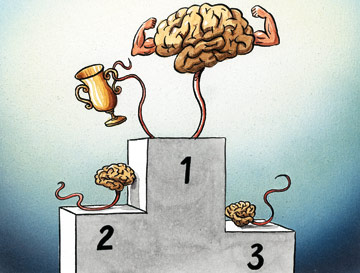
  Yet again, the Economist comes through. A bit in the December 4, 2008 edition basically sets forth how healthy, intelligent, and sexy I am. 

  I’ve long known that all the hot chicks can’t take their eyes off of me, but my wife and kids never believe it. I’m certain they won’t now disagree.  The thought of their chagrin is delicious beyond words.

  In a piece titled: “Balls and brains” we learn of recent research testing a thesis attempting to explain a newly discovered interrelationship between intelligence and health.  (As you will see, the thesis also tests political correctness).

  One view would hold that smart people, on average, make smart choices about such things as tobacco and exercise.  In other words, their intelligence would translate into good health. 

  In stark contrast however, some evolutionary biologists think that intelligence signals underlying genetic fitness and has thus forever been a source of attraction for potential mates.  (No bright woman would choose a dumb husband, right honey?*)

  Rosalind Arden of King’s College, London sought to test this idea through the analysis of semen.  Using samples from and interviews with 425 men she found that there is indeed a direct relationship between its quality**  and a standard measure of general intelligence called Spearman’s g.

  So sports fans, “The quality of a man’s sperm depends on how intelligent he is, and vice versa”. 

*This is the truth: Once asked why she agreed to marry me, my wife responded that she needed an encyclopedia.

**Comparative measures of concentration, count, and motility

Hair City

December 5, 2008

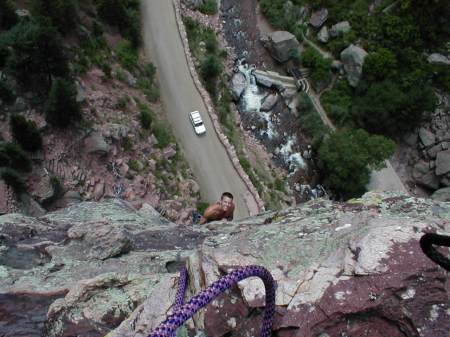
  I started taking all of my children rock-climbing at a very early age and have enjoyed the experiences more than I ever could have imagined.  Usually.  Upon a few occasions terror and/or minor injury was/were unwelcome companions.  Matter of fact I probably did visit both upon each repeatedly.  Has made me realize that child abuse is not as easy to define as I’d thought.  And that perhaps it is sometimes inflicted without intent.

  Early one morning many, many years ago son Andrew and I made our way to the base of a cliff overlooking the river.  As we hiked beneath its lush deciduous canopy that was yet spring green, Andrew gestured toward a broad soaring bird that we could only sporadically glimpse.

  “Look at the hawk!” he exclaimed.

  “Vulture” I corrected without really looking.

  Our goal was the Sentinel, a free standing pinnacle 120 feet tall on the river side and about half that on the other due to eons of rock fall and other organic detritus fallen from the top of the main wall thirty feet to the east.

  We first climbed the easy east face.  It is solid gray limestone with many large solution pockets, natural handholds, and fossils so that route finding is not a problem and the experience pleasant.  The fact that a discrete summit is gained makes it all the more fulfilling.

  Then in the fifth grade (I think) Andrew was strong and kinesthetically adept.  He could do the most pull ups in his class and had no problem with the tight-wire in our front yard.  Thus, it seemed to make sense to search for greater challenge.

  I remembered a climb on the west face that could be done in three pitches, had wide ledges, and great views out across the river which is over a mile wide there and dotted with islands and lots of boat traffic.  As I recalled, the climbing was all chimneys with a traverse across a wide flat ledge halfway up.  Perfect.

  At its base, I tied Andrew into a tree and began the first short pitch.  The chimney was much dirtier than I’d remembered – filthy actually.  I quickly reached the small ledge and set up a belay.

  Andrew was up in a flash ever excited and unconcerned about the dirt.  I tied him to the belay anchor and took the step right and up to begin the traverse into the main chimney.  Andrew was less than thrilled as I disappeared from view and his side of the banter grew a bit tremulous.

  Indeed, I did move more slowly than I’d anticipated.  The ledge was not wide, but rather narrow.  And difficult to protect.  If Andrew slipped, he would take quite a swing.  Oh well, I thought, I’ll get to the bolts at the base of the main chimney, bring him over, and then cruise to the top.

  Only there were no fixed anchors, the rock was rotten, and the chimney wasn’t as I’d remembered either.  It’s walls were sharp, jagged, friable and constricted to a bulge a few yards up making for tricky passage. 

  It even thought momentarily about spitting me out and thus unleash the ravages of gravity upon us both.  I corralled such thoughts and relegated them to the place the Dalai Lama sends thoughts of women.

  Andrew called several times after my slow progress wondering what every second does when the leader’s progress is slower than expected: what sort of terror might lie ahead.

  He made it across the traverse slowly calling up “Dad I’m scared”.

  “You’re doing fine Andrew” I croaked.  We both knew that the choices were few and that the difficulties, for him, had just begun.

   He started up the crack.  Up, down, up, down, up down.

   Shit.  How do you holler technical advice to a little guy you can’t see, who’s never heard the terms, and you know is fighting back fear so that he can please his dumb old man?  I gave him a bit of tension from time to time, but knew that a tight rope would not help him through the bulge.

  He came to it and began to wrestle with the crux.  A flake broke off and crashed loudly below sending a flock of starlings into the wind.  The air then filled with the sounds of utter and complete despair.  I felt like Judas.

  He did though surmount the difficulties and soon I watched his little hand slap the top of the block upon which I sat.  He clambered toward me and came into my arms.  After a bit he turned and took in the view.  Without looking at me, he asked if we had to go on.

  No way off but up.  “Soon we’ll be in the sun” I said.

  “Ok”

  As it happened, the leading arc of the solar disc edged over the top just as I began the last pitch – cascading rays down upon us and illuminating the zillion motes of dust that theretofore had been invisible. We were like exhausted pilgrims in a nave.

  I reached the top quickly and Andrew followed smoothly with a surprising return of confidence – quiet though he did remain.  Upon the small summit platform, he sat serenely gazing toward the distant rolling hills.

  As I bent over the rappel anchors a broad shadow stroked the loose coils of rope, the surrounding rock, and my back.  I raised my eyes to watch Andrew track the winged dihedral floating just above our heads.

  We exchanged no words for many minutes until he said matter-of-factly “Dad, it is a hawk, a red tail”.

  As the raptor then rose effortlessly on a thermal up into the sun, its backlit tail feathers twitched in fine manipulation of pitch and roll and shone rust red.

   *NB As you can see below, many more adventures did ensue.  And thankfully yet another of my father’s aphorisms has held true (so far): “Son by the time you can take me on you won’t want to”…

hair-city1

yellow-spur-ledge1

atop-wind-tower

Very, Very, Very Fine House

November 28, 2008
nikon-transfer-497
Our house, is a very, very, very fine house
With two cats in the yard
Life used to be so hard,
Now everything is easy ’cause of you. 

      Graham Nash wrote “Our House” in 1969 when Sally and I were in high school dating (though she in Massachusetts and I in Iowa).  While certainly a CSN fan, I was not particularly fond of that song. It thus came as quite a surprise when its lyrics began to run through my mind some thirty-five years later.

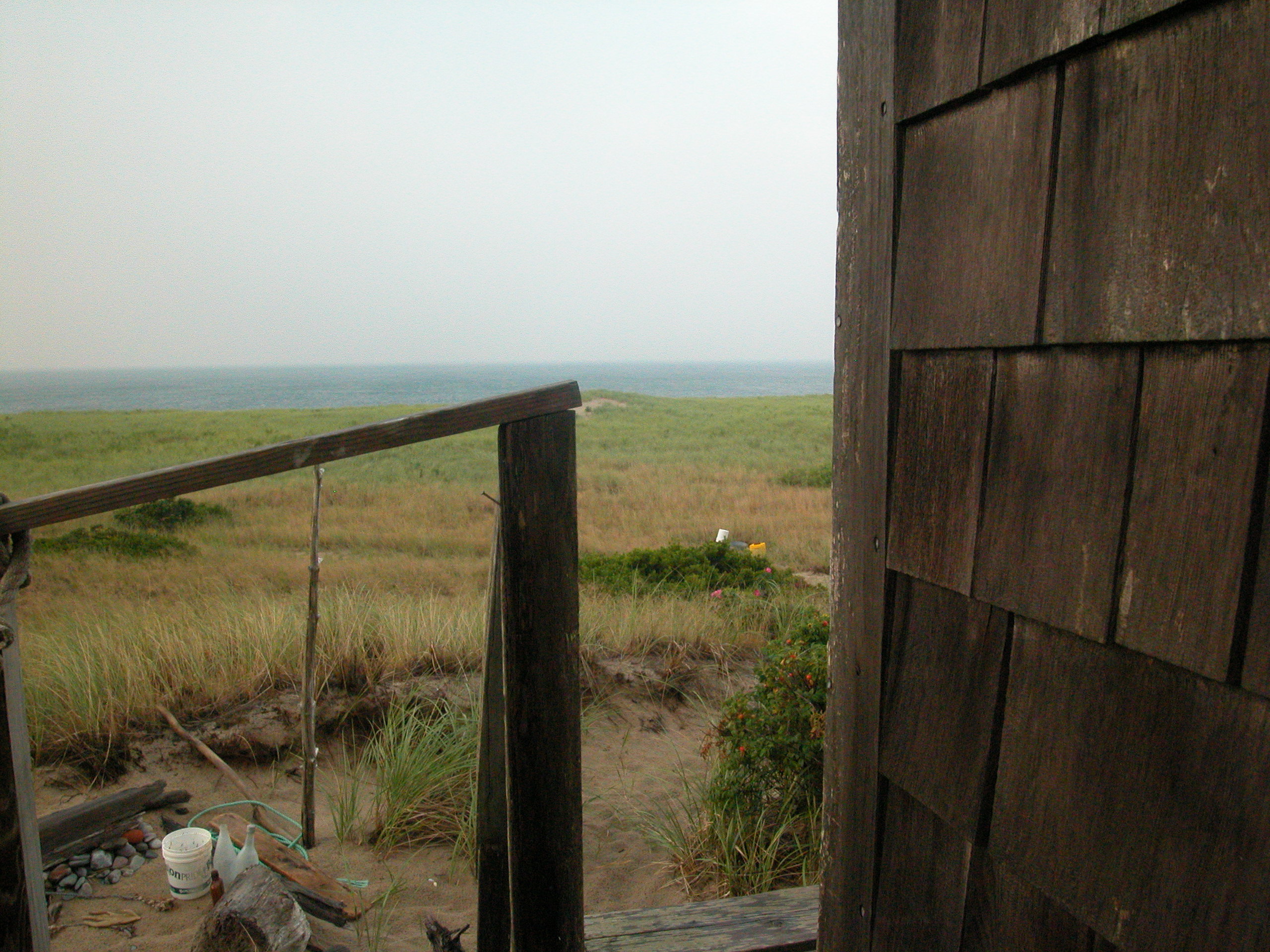
      We were on Cape Cod in an isolated one-room shack that was perched upon a sand dune.  It looked as in and out of place as a piece of driftwood – one that had been part of a tree, gone through the hands of man, and back to those of nature over the course of many many years.

      While not exactly alone, it was hundreds of yards from its closest neighbor, which was similarly bereft of electricity or running water.

      My wife was one of several, out of hundreds of artist applicants, to have an opportunity to live in the cabin for two weeks alone (or almost) with their thoughts and work.  I was only able to visit for three days, but even so they were several of the best of my life.

      The shacks were originally built in the 1800s to serve as life saving stations offering aid to the victims of shipwrecks just off the coast.  Thousands have occurred since the Mayflower first furled her sails nearby.  They fell into disuse after 1914 with the construction of a strategic canal that obviated the dangerous passage.

      The then empty gray boxes were discovered by those who had already made nearby Provincetown a dynamic and vibrant artists community.  Maybe America’s first.  Thoreau spent time there.  Eugene O’Neil was living in one when he learned of his first Pulitzer Prize.  Kurt Vonnegut wrote Player Piano there. Norman Mailer had a place.  Painters such as Hans Hoffman, Mark Rothko, and Helen Frankenthaler have lived and worked in these parts.

      Jackson Pollack visited the area several times and apparently had even stayed in the shack in which we found ourselves. He was thereabouts heard to have said that “he fucked Mrs Benton” (Mrs Thomas Hart…) which episode though must have taken place in town – not in the shack.  It’s too far from anywhere for an illicit tryst.  Not the place for a quickie.  Wrong juju.

      The hike in sets the tone emotionally and otherwise.  You park your car just outside of Ptown at the intersection of Snail Road and US Highway 6, pack your things and enter a natural archway through a thick wood. 

The trees end suddenly though, leaving one to face the steep slope of a fifty-foot sand dune.  A one-hour trudge up down over and across hot sand leads to the north coast. The two steps forward and one back routine make it much tougher going than most mountain trails. 

      And a horse of a different color at night.  Once, after a wild time in Ptown we made it back to a quiet fogbound trailhead at 10:00 PM.  We nonchalantly chattered about the evening for an hour or so until we realized that we’d lost our way.  Fortunately, as I’ve mentioned before, I always carry a compass and with a few course corrections soon found ourselves home.

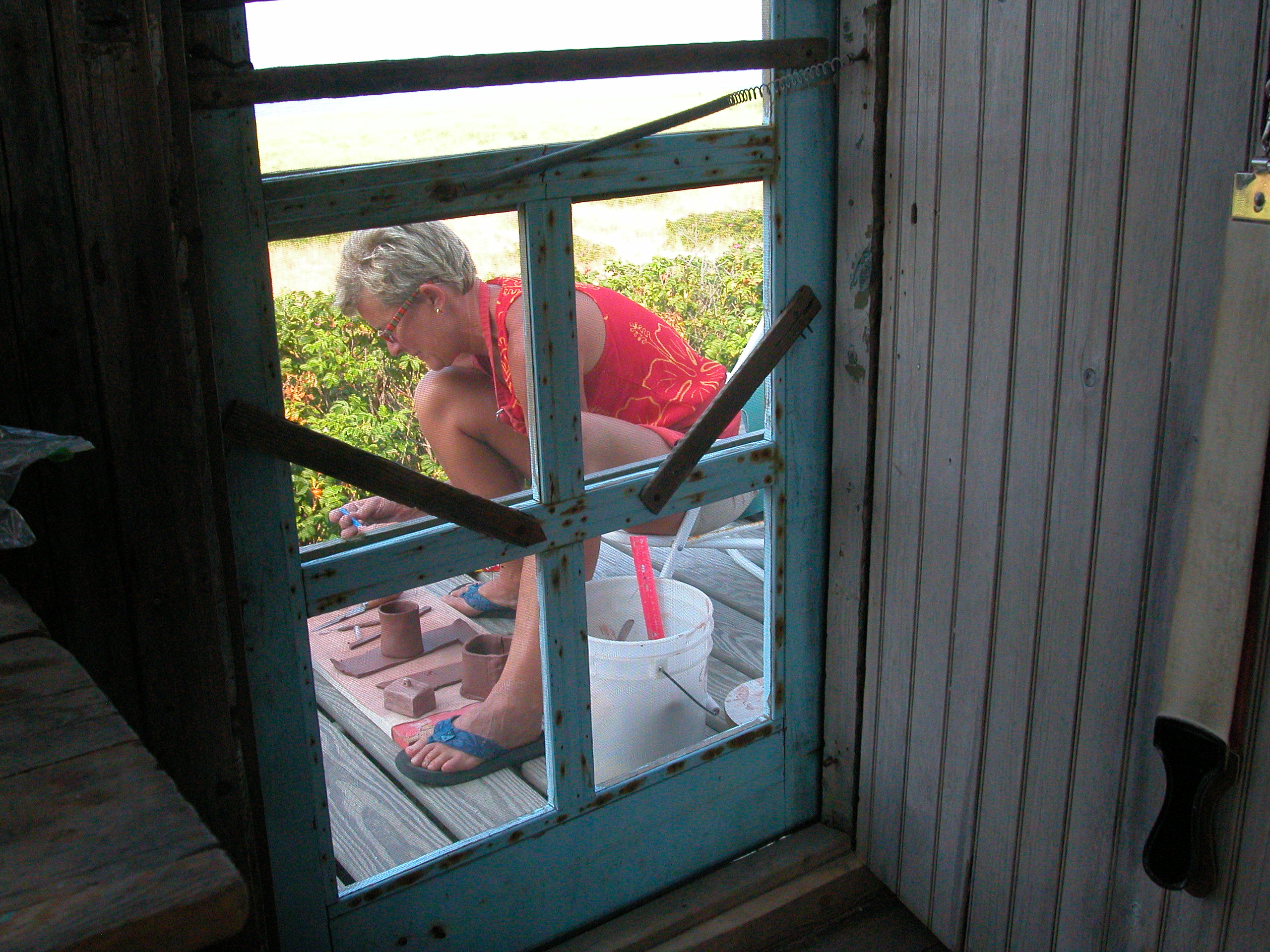
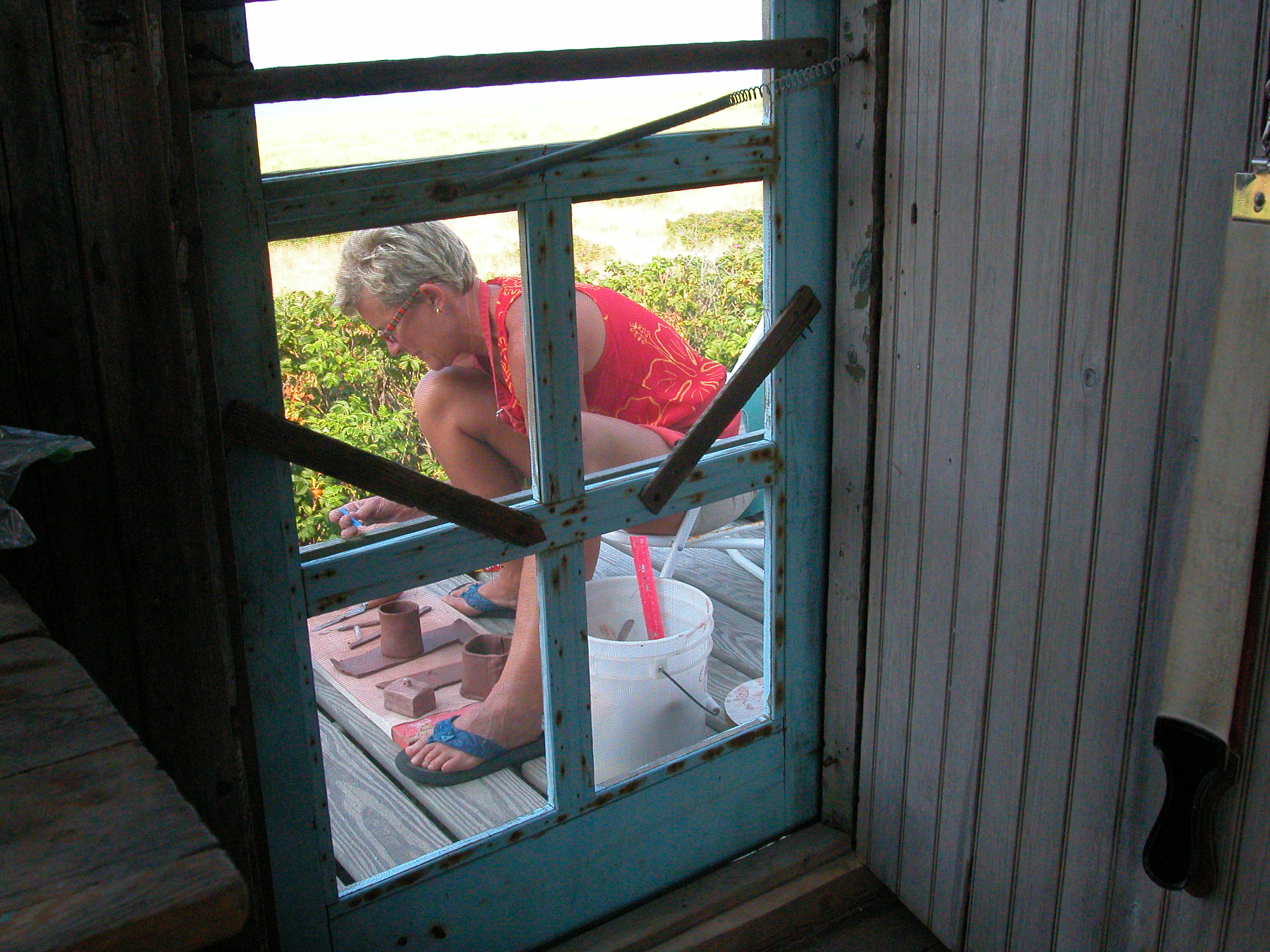
      Upon awakening the first morning there, I turned slightly to look through the screen door to watch Sally on the deck intent upon her clay.  The ocean rolled in the distance and fishing vessels bobbed about.  She hadn’t always worn glasses, but looked great in them.  Her long honed mode of concentration was at its peak. 

nikon-transfer-4791

      Other mornings were similar.  After watching her work a bit, I’d make a pot of filtered coffee, we’d eat a bit of breakfast, and then walk on the beach.  Sometimes for hours without seeing another soul.  Only twenty miles from Boston and the whole eastern seaboard! 

     We were lucky though.  During most of the year vehicular traffic is apparently allowed on the shore, but through the course of our sojourn the endangered piping plovers were breeding.  The National Park Service makes certain that their relationships are allowed to flower.

      Ya, during our walks over those few days we did talk about our kids, folks, work, world events, etc, but they somehow seemed far away and ok.  Life used to be so hard.

      Upon conclusion of our strolls we’d disrobe and swim.  Not an original thought. Thomas Hart Benton wrote in 1937 “once or twice I’ve seen a young Venus come naked out of the Martha’s Vineyard sea, but generally it’s something to make you wish you hadn’t lived so long.”  Well, I’m still aiming for 100.

      Then lunch, after which Sally would put in several more hours of work at her clay or watercolors.  I’d usually take a well-deserved nap.  Just before dinner we’d bathe in water we’d drawn from the well several hours before and allowed to warm in a galvanized tub out front.

      Once home – without her – the song continued to play in my head and I was somehow compelled to locate and read letters that Sally had written to me back in high school.  The nature of the relationship manifest therein was, well, syncopated, but the tone, the sparkle of their author was clearly recognizable and fresh.

      Déjà vu.

November 21, 2008

sauger-on-bed 

  I once had a wilderness experience in which I was all by my lonesome for four days.  It is amazing how thought patterns change in the absence of human interaction.  For me at least ‘monkey mind’ – jumping from one thought to the next haphazardly – disappears and is replaced with much longer cycle time.

  The days were filled with physical intensity and focus.  The nights were filled with stars and cerebration.  (“Stars, stars, stars!”  I wrote in my journal.*)  I can still recall the seeds of a cucumber sliding over my tongue down my parched throat and somehow making a connection between them and Orion’s belt.  I dunno.

  When I made it back to the Mirror Lake bus stop the only others there were a mother and young son.  Son looked at me and moved closer to his mother.  She looked at me and held him tightly.

  I said hello and hoped that they’d ask what I’d been up to so I could regale them with my tale of glory.  No response.  I suppose the Mom subscribed to a corollary of the theory I frequently repeat to my daughters: the only decent boy they’ll ever meet is their brother, myself included.

  Wife’s gone again and all this was running through my head last night.   Certainly, it is not the same at all just to be at home alone for several evenings in a row complete with any number of phone conversations.  But, still, one’s mind finds a different gear. 

  I agree with the French philosopher Pascal: “All men’s miseries derive from not being able to sit in a quiet room alone.”  If one cannot be comfortable alone with one’s own thoughts, how can he/she possibly have honest interaction with another?

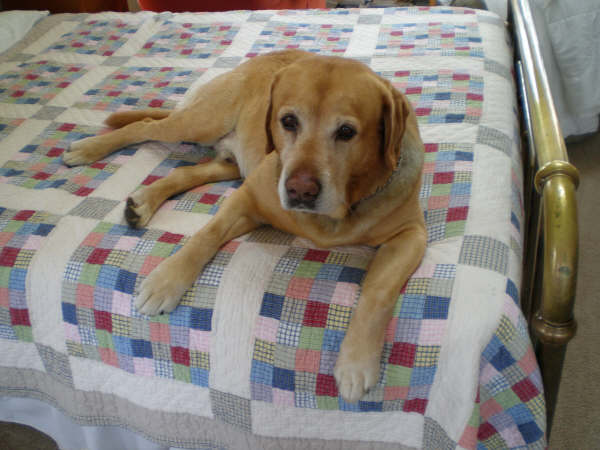
  Even a dog. Know how you can talk to someone and be thinking about something completely different? Staring into the eyes of mine last night it dawned on me that a dog, at least a smart one, knows if you’re day dreaming or not.  With a dog you must commit.  They wait for engagement.

  How’s that for deep thinking?

  I also agree with Donne that “No man is an island”, but one is unable to really deeply understand that without an experience of real solitude. 

*While looking back in my journal I saw that I had been wondering how I measured up to others my girlfriend/future wife had been dating.   I was pretty much of a bum at the time.  In retrospect it is funny to have been concerned.  The ones I saw were all weasels.

October 17, 2008


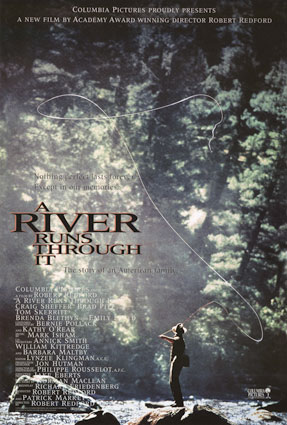
  Ever read or see A River Runs Through it?  Rare case of a wonderful book and movie both of which came to mind when I noticed that a new Norman Maclean Reader just came out.  River Runs Through It is the achingly beautiful autobiographical story of a Scottish Presbyterian minister father, two sons – one turbulent and one well grounded, and fly fishing on the Blackfoot River in Montana.  “In our family there was no clear line between religion and fly fishing.”

  Mr. Maclean wrote that his purpose was to explore the “topography of certain exposed portions of the surface of the soul”.  It is the soul of the tumultuous one, Paul, which lacks the sheltering layers most humans are able to maintain.  The exposure causes him to fall in with the rhythms of nature both harmonious and discordant.  He is a masterful fisherman, but also drawn to gambling and drinking and fighting.   

    “A river, though, has so many things to say that it is hard to know what it says to each of us.”  Norman listens attentively.  At one the two brothers are fishing together and a big one gets away.  “Poets talk about ‘spots of time’, but it is really fishermen who experience eternity compressed into a moment.  No one can tell what a spot of time is until suddenly the whole world is a fish and the fish is gone.  I shall remember that son of a bitch forever.”

  The ‘poet’ Maclean invoked was Wordsworth:

There are in our existence spots of time,
That with distinct pre-eminence retain
A renovating virtue, whence-depressed
By false opinion and contentious thought,
Or aught of heavier or more deadly weight,
In trivial occupations, and the round
Of ordinary intercourse-our minds
Are nourished and invisibly repaired;
A virtue, by which pleasure is enhanced,
That penetrates, enables us to mount,
When high, more high, and lifts us up when fallen.

  Paul (played by Brad Pitt in the flic) had no capacity for reflection or introspection.  The river carries him wherever it goes.  At the end, after he is found beaten to death, there is an exchange between the father and Norman.  Father: “Do you think I could have helped him?”  Son: “Do you think I could have helped him?”  “How could a question be answered that asks a lifetime of questions?”  Maclean asks the reader.  He concludes: “I am haunted by waters.”

  Paul reminded me of Meriwether Lewis who, like he, apparently reveled and managed well in the dangers and difficulties that filled the expedition he led with William Clark, but once back in civilization and society floundered.  Easy street was his most difficult traverse.  He was found dead of gunshot wounds two years later.  It’s disputed, but most thought it suicide.

  Huck Finn bore some resemblance to both Lewis and Paul Maclean, but knew himself well enough to say: “But I reckon I got to light out for the territory ahead of the rest because Aunt Sally she’s going to adopt me and sivilize me, and I can’t stand it.  I been there before.”

  I can’t stand it either.  I’ve been there before too. 

Note 1: At the movie’s end, at the last light of day while we watch a now nearly ancient Maclean cast his fly towards a cliff on the far side of a rushing river, the reading of the final lines by director/narrator Robert Redford is a coda more perfect than any other I can recall:  “Eventually all things merge into one, and a river runs through it.  The river was cut by the world’s great flood and runs over rocks from the basement of time.  On some of the rocks are timeless raindrops.  Under the rocks are the words.  And some of the words are theirs.  I am haunted by waters.” 

Note 2:  Perhaps I’m in luck.  Maclean didn’t start writing until his “biblical allotment of three score years and ten” after being prodded/encouraged by his children who had long listened to his story telling.  I remember driving a blue Ford pick up with a manual transmission talking about the Genius (aka Genii) in the bottle while one kid or another would shift when I’d push in the clutch…  And it was they who organized this space for me…

Lobstah

September 19, 2008

  The persistence of vision is an interesting phenomenon.  It’s a conjunction of physics and biochemistry that allows our visual stream of consciousness to be seamless.  Like how the scene behind a picket fence looks essentially unbroken if you ride by quickly.  Or how a movie appears continuous rather than a succession of cells.

  It’s all because the biochemical transmission of nerve responses from retina to the back of your brain is much slower than the transmission of light.

  I’ve long wondered if there is some sort of analogue in our memory banks.  Long periods of separation from friends or loved ones often seem to disappear into some sort of synaptic negligibility.  You pick up where you left off almost as if it had been in mid-conversation.

  Recently however, I’ve begun to believe Heisenberg’s Uncertainty Principle is what is operative.  It basically holds that all pertinent facts about something unseen cannot be known with precision – only probabilities.  And that actual observation can yield surprise.

  A week or so ago for example I hadn’t seen oldest daughter for quite some time and stood not far from Casco Bay in wait.  Saw something catch the sun in the distance and lost my balance.  She had the lines of a really sweet sloop, fine sailcloth trimmed tight, on a run, heading towards me at speed.

  I swear last time I saw her she gripped my index finger to steady herself in the surf on the warm gulf shore of Florida.  

  But now, what with Maine’s rugged coast, it was critical that I quickly regain an even keel.  I wasn’t sure whether to tack or jibe or heave to and only at the last minute was, thankfully, after all these weeks, rescued by my navigator. 

  I looked into her compass and found my sea legs again.  We listened together about a candle burning at both ends, briefs, pro bono, and the state supreme court.  First part of her passage may have been tough, but we could tell that her grip on the tiller was firm and her ability to read the wind solid. 

  Soon it was time to shove off.  We sheeted in and  made for  points north.

Flirtatious Attempts at Self Selection

September 11, 2008

  Clear and very cool this morning when I took the dog for a run along the frayed edges of the fog blanketing the river.  I wondered if the commercial fisherman usually there was out in his 20′ jon boat.  I’d never noticed him to have a light and certainly no foghorn.  He’s been there regularly for years and I concluded that he must know how to be safe.

  Dog shot about like a bullet which caused me some angst.  Every year for the past few, at about this time, I come to realize that his sluggishness just days or weeks prior was not due to age but heat.  What a jerk am I sometimes.  Awful when I repeat.

  Previous few weeks it’d been us three boys.  Son took off for London yesterday and so now it’s down to Sauger dogger and me.  Current nature of our crib belies that fact.  We had fun.  Ah well, I’ll get after it and no one will be the wiser.

  Turning away from the river back toward home thought shifted to the concept of ‘no self’.  No self in the sense that one doesn’t have an immutable center, that what you are is largely the evocation of your own evolving particular interpersonal milieu. 

  Andrew had his elaborate DJ setup in our living room and took it all out for a number of gigs while home.  Watching him perform and seeing how the crowd drew enjoyment and naturally fell into its rhythms and beats made me realize that our “own personal interpersonal milieus” are just like bits of music – improvisational jazz.  We’re all instruments playing off each other and the environment.

  Your particular array of pets has inflected your personality in a particular if subtle way.  The sense of your place probably had a greater impact.  You’d be profoundly different had your family been constituted other than it was.  So What?  Take Five.

  Music has always been part of our nature.  “Darwin suggested that human ancestors, before acquiring the power of speech, endeavored to charm each other with musical notes and rhythm.  It is because of music’s origin in courtship that it is firmly associated with some of the strongest passions an animal is capable of feeling.”

  (In that regard, this dad watching his son perform couldn’t help but notice a steady stream of alluring young women approach in what sure seemed like flirtatious attempts at self selection.  OMG)

  A “Dr Miller sees music as an excellent indicator of fitness in the Darwinian struggle for survival.  Since music draws on so many of the brain’s faculties, it vouches for the health of the organ as a whole.  And since music in ancient cultures seems often to have been linked with dancing, a good fitness indicator for the rest of the body, anyone who could sing and dance well was advertising the general excellence of their mental and physical genes to a potential mate.” 

  Guess I better work on my moves so that I can bust a really good one some few days hence. 

Note: Quotes above came from my trove of clippings:  9/16/03 NYT

Where’s the Clearasil? Or, uh, Proactiv?

September 5, 2008

  Like just about everybody, I wish I had a whole lot more lettuce than I do, but, hey, life is good.  That’s why, I guess, I wonder about how big of an issue it really should be that the mega rich have become richer at a faster pace than the rest of us.

  Why care?  Most agree, from shrinks, to sociologists, to rock stars that after you reach a relatively modest threshold, the correlation between net worth and happiness rapidly weakens. (Besides, every redistributive effort thus far has failed miserably.  Just ask Gorbachev.  Or even better – Deng Xiaoping.)

  Think how ecstatic you’d be if all of a sudden your desire for more ‘stuff’ evaporated.  And you care less about the Jones.  Think how full your house is of junk that has long not seen the light of day.  Things that still fit and/or are far from the end of their useful lives.

  You’d be able to relax a bit more and enjoy the company of your roommate.  Which reminds me that mine is still away.  And the funny thing is that my friends at the Economist found out and included a bit in the 8/30 issue to help keep my mind on the subject.  (And off of the magazine covers son has left strewn about.) 

  It is a review of a book titled September Songs: The Good News about Marriage in the Later Years.  The author “turns her attention to couples in their 50’s and 60’s and finds older marriage is full of unexpected pleasures”.

  “Older couples expressed lower levels of anger, disgust, belligerence and whining and higher levels of one important emotion, namely affection.”

  “The nest empties.  Retirement approaches… As in late adolescence people once again have to forge an individual identity.  Without a growing family or a career to provide self-definition, older people must answer anew the teenage question, ‘who am I?'” 

  What fun!  Hope I don’t get pimples again.  Wife never had any.

  We’ll have to look in the mirror and see what we see…