Archive for the ‘Film’ Category

From The Heart

November 14, 2008

  The clip is the opening spectacular from the Bollywood flic Dil Se.  It neatly launches the story about an All-India radio reporter who becomes so infatuated with a mysterious and beautiful woman that he doesn’t realize that she’s a terrorist until it is too late.  Way too late.

  The film is dark, foreboding, and does not attempt to  convey optimism about the potential for peaceful coexistence between and among India’s many ethnic and religious groups.  The interwoven bits of romance lighten up the political part of the narrative in the same way that the fantasy of Tralfamadore does the story of the WWII firebombing of Dresden in Vonnegut’s Slaughterhouse 5.

  Dil Se was controversial when it came out in 1998 because it had only been a few years since a female suicide bomber had taken the life of Rajiv Ghandi.  It failed at the box office in India.  Since then it has been shown at many international film festivals and has drawn praise and a following. 

  I’m sure you’ll agree that the video is incredible on many levels.  The music alone is wonderful and has become wildly popular around the world.  It was employed by Spike Lee – to provocative effect – on the soundtrack of his Inside Man. 

  The music combined with the position of its performance – atop a train moving through rugged topography – makes what could be a dream sequence for a lyrical thrill seeker as well a poetic look at love.

He whose head is in the shadow of love
will have heaven beneath his feet.
Whose head is in the shadow of love..
Walk in the shadow.
Walk in heaven, walk in the shadow. 

  Culturally, it brings several things to mind.  First, it would not seem odd or staged or maybe not even dangerous to Indians or people in much of the third world that passengers would be allowed to ride on the top of a train.  Makes one aware of the existence of a spectrum of personal responsibility with abdication on one (our) end and self reliance on the other.

  Secondly, it interesting to know that while Richard Gere was threatened with jail for kissing an Indian actress on the lips on stage at an AIDs awareness rally, it is apparently not there found unacceptably erotic that the dancer at the beginning of this movie initially lends her chest to the surrounding landscape and then sets her hips to swaying like, well, uh, if I went into the kitchen at home and my wife was moving thus I’d know what was on the menu.  And my silverware would be ready.
    

October 17, 2008


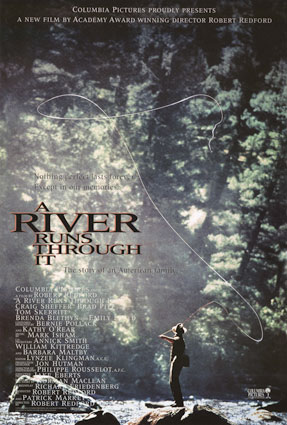
  Ever read or see A River Runs Through it?  Rare case of a wonderful book and movie both of which came to mind when I noticed that a new Norman Maclean Reader just came out.  River Runs Through It is the achingly beautiful autobiographical story of a Scottish Presbyterian minister father, two sons – one turbulent and one well grounded, and fly fishing on the Blackfoot River in Montana.  “In our family there was no clear line between religion and fly fishing.”

  Mr. Maclean wrote that his purpose was to explore the “topography of certain exposed portions of the surface of the soul”.  It is the soul of the tumultuous one, Paul, which lacks the sheltering layers most humans are able to maintain.  The exposure causes him to fall in with the rhythms of nature both harmonious and discordant.  He is a masterful fisherman, but also drawn to gambling and drinking and fighting.   

    “A river, though, has so many things to say that it is hard to know what it says to each of us.”  Norman listens attentively.  At one the two brothers are fishing together and a big one gets away.  “Poets talk about ‘spots of time’, but it is really fishermen who experience eternity compressed into a moment.  No one can tell what a spot of time is until suddenly the whole world is a fish and the fish is gone.  I shall remember that son of a bitch forever.”

  The ‘poet’ Maclean invoked was Wordsworth:

There are in our existence spots of time,
That with distinct pre-eminence retain
A renovating virtue, whence-depressed
By false opinion and contentious thought,
Or aught of heavier or more deadly weight,
In trivial occupations, and the round
Of ordinary intercourse-our minds
Are nourished and invisibly repaired;
A virtue, by which pleasure is enhanced,
That penetrates, enables us to mount,
When high, more high, and lifts us up when fallen.

  Paul (played by Brad Pitt in the flic) had no capacity for reflection or introspection.  The river carries him wherever it goes.  At the end, after he is found beaten to death, there is an exchange between the father and Norman.  Father: “Do you think I could have helped him?”  Son: “Do you think I could have helped him?”  “How could a question be answered that asks a lifetime of questions?”  Maclean asks the reader.  He concludes: “I am haunted by waters.”

  Paul reminded me of Meriwether Lewis who, like he, apparently reveled and managed well in the dangers and difficulties that filled the expedition he led with William Clark, but once back in civilization and society floundered.  Easy street was his most difficult traverse.  He was found dead of gunshot wounds two years later.  It’s disputed, but most thought it suicide.

  Huck Finn bore some resemblance to both Lewis and Paul Maclean, but knew himself well enough to say: “But I reckon I got to light out for the territory ahead of the rest because Aunt Sally she’s going to adopt me and sivilize me, and I can’t stand it.  I been there before.”

  I can’t stand it either.  I’ve been there before too. 

Note 1: At the movie’s end, at the last light of day while we watch a now nearly ancient Maclean cast his fly towards a cliff on the far side of a rushing river, the reading of the final lines by director/narrator Robert Redford is a coda more perfect than any other I can recall:  “Eventually all things merge into one, and a river runs through it.  The river was cut by the world’s great flood and runs over rocks from the basement of time.  On some of the rocks are timeless raindrops.  Under the rocks are the words.  And some of the words are theirs.  I am haunted by waters.” 

Note 2:  Perhaps I’m in luck.  Maclean didn’t start writing until his “biblical allotment of three score years and ten” after being prodded/encouraged by his children who had long listened to his story telling.  I remember driving a blue Ford pick up with a manual transmission talking about the Genius (aka Genii) in the bottle while one kid or another would shift when I’d push in the clutch…  And it was they who organized this space for me…

Can You Hear Me?

July 11, 2008

  Ever see The Perfect Storm?  Remember near the end when it’s clear the end is near and the character played by Mark Wahlberg screams into the storm over the raging sea:  “Christina? Christina, can you hear me?  I don’t know if you can, but I’m talking to ya, baby.  Do you know how much I love you?  I loved you the moment I saw you.  I love you now, and I’ll love you forever.  No goodbye.  There’s only love, Christina.  Only love.”

  And then after the storm, after Bobby (Wahlberg’s character) and his colleagues have all perished, and after the memorial service, Christina recounts a recurring dream in which “all of a sudden there he is.  That big smile…” And he repeats the above word for word.  “And then he’s gone.  But he’s always happy when he goes.  So I know he’s gotta be okay.  Absolutely okay.”

  Sebastian Junger writes in the introduction to the book that “No dialogue was made up”.  So while the film is largely true to the book the last words to leave Bobby’s mouth in the movie are fiction, but Christina’s dream not.  No matter what, cool bit of antiphony, right? 

  The day after the last time I saw the movie, I read a note in Outside magazine about a book by Maria Coffey: Explorers of The Infinite which asked: “What is it with extreme athletes and paranormal experiences?”

  Had to buy the book.  Found it fascinating.  Coffey punctuates her work with views and explanation of mainstream science, but it is clear that she believe that there is indeed something else going on.

  During the course of reviewing historical accounts of and numerous interviews with folks living life on the edge: “I became increasingly convinced that extreme adventurers break the boundaries of what is deemed physically possible by pushing beyond human consciousness into another realm.”  

  She quotes Krishnamurti:  “A complex mind cannot find out the truth of anything, it cannot find out what is real – and that is our difficulty.  From childhood we are trained to conform, and we do not know how to reduce complexity to simplicity.  It is only the very simple and direct mind that can find the real, the true”. 

  Coffey tells the story of a couple who followed, on foot, a caribou herd for months and hundreds of miles way up in the Yukon.  Alone and vulnerable, they fell into rhythm with the pace of the life of the animals.  Some weeks in, they both began having dreams.  The dreams began coming true.  “Heuer and Allison believe it was the rigors of the journey that led to their dreams and the other inexplicable events that began to unfold.”

  The identical twin British mountaineer brothers, Adrian and Allan Burgess provide several fascinating anecdotes.  In one, Adrian, who didn’t often remember dreams and hadn’t thought about a certain dead alpinist friend for quite some time was visited by her in his sleep during early stages of an attempt on Nanga Parbat.  “Adrian, you’re with the wrong people, get the fuck out of there” she told him.  He was shaken and did leave.  Shortly thereafter the team was hit by an avalanche.

  It’s not all dreams.  There’s intuition.  “Jung described intuition as the perception of realities that are unknown to the conscious mind.”  Marlene Smith says: “Intuition is about our body translating the energy it picks up, animals listen to those physical messages, but most humans reason them away”.  Among other examples, Coffey cites evidence of unusual activities of some animals and primal people that spared them death from the Asian tsunami in December 2007. 

  In 1985 a mixed Spanish-Polish team of alpinists attempted Nanga Parbat.  They communicated in English over their two way radios.  During the descent there was a terrible storm and all “felt near death”.  After safely reaching base camp, they listened to the recordings of their conversations and were amazed that they were all speaking in their native languages – unintelligible to each other.  Yet during the actual event they understood one other perfectly.

  There are many more stories and much hypothesizing, but it’s hard at the very least to disagree with British climber John Porter who said: “I think the starting point for any sort of weirdness is life itself.  If we’re here, then it seems to me that anything is possible.” 

  After all, without even having to wade through the several bewildering mainstream explanations of the origin (or lack thereof) of our universe, it interesting to note that physicists do agree that the universe is made up of: 4% matter as we know it; 22% dark matter that we maybe know something about; and 74% something else yet to be determined. 

  Now that’s weird.