Archive for the ‘Literature’ Category

October 17, 2008


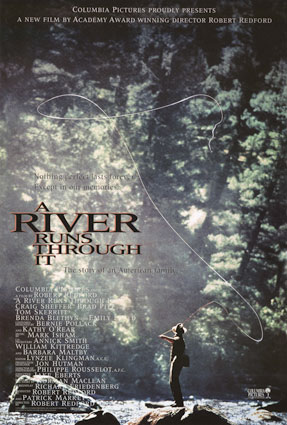
  Ever read or see A River Runs Through it?  Rare case of a wonderful book and movie both of which came to mind when I noticed that a new Norman Maclean Reader just came out.  River Runs Through It is the achingly beautiful autobiographical story of a Scottish Presbyterian minister father, two sons – one turbulent and one well grounded, and fly fishing on the Blackfoot River in Montana.  “In our family there was no clear line between religion and fly fishing.”

  Mr. Maclean wrote that his purpose was to explore the “topography of certain exposed portions of the surface of the soul”.  It is the soul of the tumultuous one, Paul, which lacks the sheltering layers most humans are able to maintain.  The exposure causes him to fall in with the rhythms of nature both harmonious and discordant.  He is a masterful fisherman, but also drawn to gambling and drinking and fighting.   

    “A river, though, has so many things to say that it is hard to know what it says to each of us.”  Norman listens attentively.  At one the two brothers are fishing together and a big one gets away.  “Poets talk about ‘spots of time’, but it is really fishermen who experience eternity compressed into a moment.  No one can tell what a spot of time is until suddenly the whole world is a fish and the fish is gone.  I shall remember that son of a bitch forever.”

  The ‘poet’ Maclean invoked was Wordsworth:

There are in our existence spots of time,
That with distinct pre-eminence retain
A renovating virtue, whence-depressed
By false opinion and contentious thought,
Or aught of heavier or more deadly weight,
In trivial occupations, and the round
Of ordinary intercourse-our minds
Are nourished and invisibly repaired;
A virtue, by which pleasure is enhanced,
That penetrates, enables us to mount,
When high, more high, and lifts us up when fallen.

  Paul (played by Brad Pitt in the flic) had no capacity for reflection or introspection.  The river carries him wherever it goes.  At the end, after he is found beaten to death, there is an exchange between the father and Norman.  Father: “Do you think I could have helped him?”  Son: “Do you think I could have helped him?”  “How could a question be answered that asks a lifetime of questions?”  Maclean asks the reader.  He concludes: “I am haunted by waters.”

  Paul reminded me of Meriwether Lewis who, like he, apparently reveled and managed well in the dangers and difficulties that filled the expedition he led with William Clark, but once back in civilization and society floundered.  Easy street was his most difficult traverse.  He was found dead of gunshot wounds two years later.  It’s disputed, but most thought it suicide.

  Huck Finn bore some resemblance to both Lewis and Paul Maclean, but knew himself well enough to say: “But I reckon I got to light out for the territory ahead of the rest because Aunt Sally she’s going to adopt me and sivilize me, and I can’t stand it.  I been there before.”

  I can’t stand it either.  I’ve been there before too. 

Note 1: At the movie’s end, at the last light of day while we watch a now nearly ancient Maclean cast his fly towards a cliff on the far side of a rushing river, the reading of the final lines by director/narrator Robert Redford is a coda more perfect than any other I can recall:  “Eventually all things merge into one, and a river runs through it.  The river was cut by the world’s great flood and runs over rocks from the basement of time.  On some of the rocks are timeless raindrops.  Under the rocks are the words.  And some of the words are theirs.  I am haunted by waters.” 

Note 2:  Perhaps I’m in luck.  Maclean didn’t start writing until his “biblical allotment of three score years and ten” after being prodded/encouraged by his children who had long listened to his story telling.  I remember driving a blue Ford pick up with a manual transmission talking about the Genius (aka Genii) in the bottle while one kid or another would shift when I’d push in the clutch…  And it was they who organized this space for me…

October 3, 2008


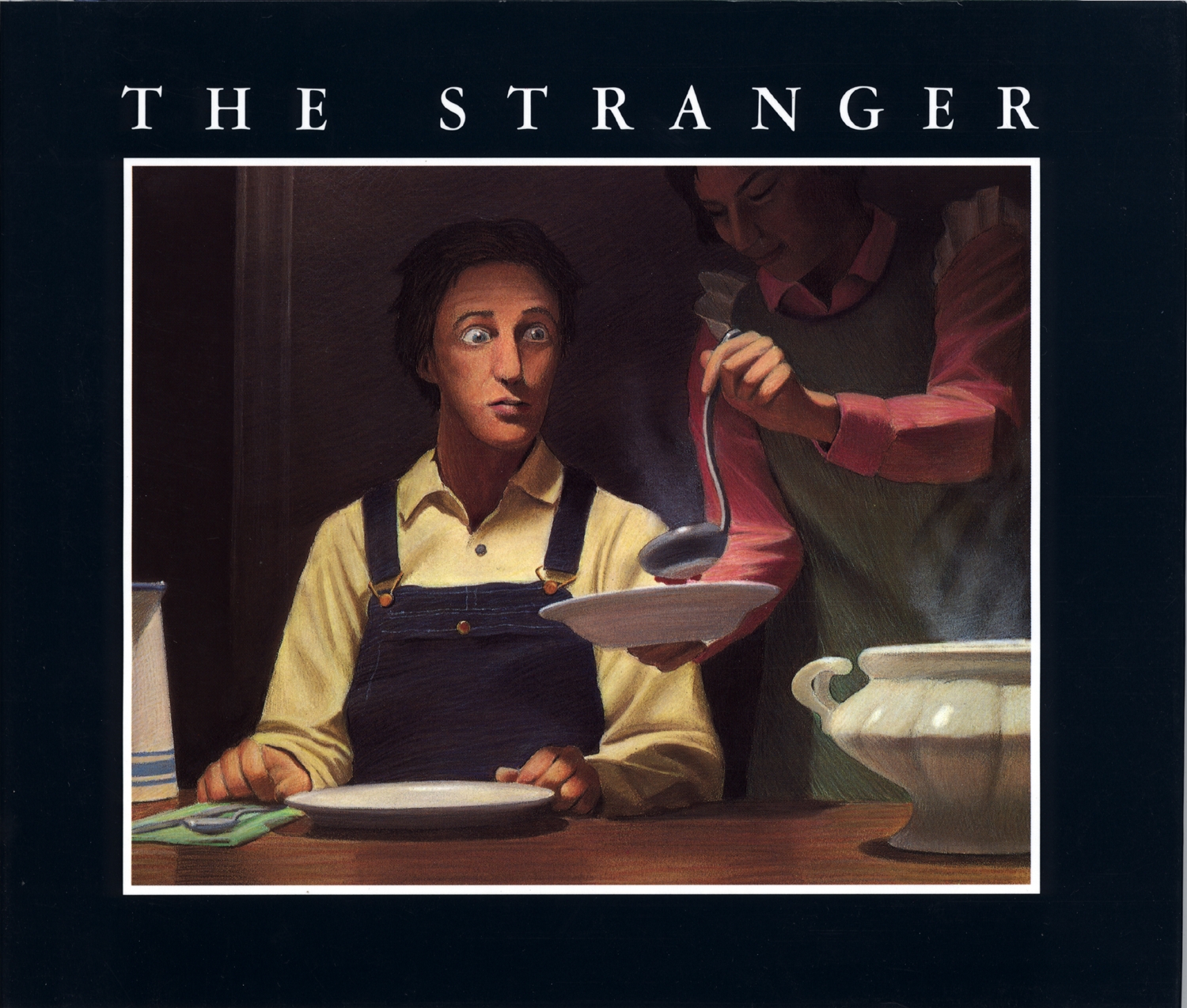
  The Stranger by Christopher Van Allsburg is a book I wanted badly to buy, but did not.  Why not?  Sticker shock.  It was autographed and priced at $250.  Our well worn copy at home will have to do.

  It came out in 1986 and ranked right up there with the Polar Express for at least two of our kids and perhaps even a bit ahead with the one born in 1985.  It is, for me, the ne plus ultra of children’s picture books.  Perfect combination of colorful, compelling artwork, spare yet fruitful prose, and prescient allegory woven discreetly into the fabric of the narrative.

  To a kid it reads as the story of an enigmatic stranger knocked temporarily into amnesia by an auto on a dark country road.  By this adult, now some twenty years after publication, on its pages can be seen hopeful resolution of careless interaction of man and nature.

  “It was the time farmer Bailey liked best, when summer turned to fall”.  Driving home, thinking he’d hit a deer, Farmer Bailey finds a strangely clad itinerant lying in front of his vehicle.  Taken to the Bailey home he is doctored and fed.  This is the caption to the cover picture above:

  – Mr. Bailey lent the stranger some clean clothes.  The fellow seemed confused about buttonholes and buttons.  In the evening he joined the Baileys for dinner.  The steam that rose from the food fascinated him.  He watched Katy take a spoonful of soup and blow gently across it.  Then he did exactly the same.  Mrs. Bailey shivered.  “Brr” she said.  “There’s a draft in here tonight”. –

  The stranger seems able to communicate non-verbally with the wildlife and stays with the Baileys for a while working tirelessly in the fields.  Until, that is, he notices that the autumn hues in the distance are not shared with the still verdant deciduous trees of the Bailey farm.

  After putting back on his own clothes, off he hurries leaving fresh frost and fall colors not far behind.  In the frost on the Bailey’s window is written “see you next fall”.

  It’d be terrible if fall didn’t come.  I can’t imagine living in a place where the seasons do not change.  Whether it be the luxuriant transformation of bean fields from green to golden or maples from green to orange to red, one can hardly not be filled with wonder or reverence as witness. It’s like the slap in the face by a zen master to make sure you’re paying attention.

  It’s an amazing process.

  The green energy producing chemical chlorophyll is unstable and rapidly decomposes in sunlight.  Thus, obviously, plants must continuously synthesize it.  Come shorter days and cooler nights a corky membrane grows between stems and leaves constricting the flow of nutrients and the chlorophyll disintegrates.  Green gone.

  Other more stable compounds are left behind.  Carotene (which helped transfer light energy to the chlorophyll) absorbs blue-green and blue light thus appearing yellow.  Leaves containing it, (aspen, soybeans) will thus turn bright yellow as the chlorophyll disappears. 

  Some leaves contain anthocyanins which absorb blue, blue-green, and green light thus reflecting red.   Unlike chlorophyll and carotone this is a component of cell sap and not part of the cell membranes.  As the concentration of sugar in the sap increases the yellowing leaves turn red.  The more sugar, the brighter the red.  Maple syrup.  Forty gallons of sap = one gallon of syrup.

  Best colors come with dry sun filled days coupled with dry cool but not freezing nights. 

Autumn morning sun
Hallows the dirt and stuble
Noble shades of brown

Bell’s Theorem

July 18, 2008

  An old guide with features as sharp and chiseled as the rock ledge upon which he sat stared into the void.  His much younger companion ministered his smooth hands with tape and tincture of benzoin.

  Higher up, the youth, a “guide aspirant”, allowed as how the elder moved rather well for his age.  Indeed, he had so far been impressed.  There was no retort or response but for the crunch of rice cakes and gurgle of water from the canteen – water which had been scooped from the clear cold stream far below.

  Long before sunset the guide had prevailed upon the youth to take advantage of the broad ledge traversing both walls of the huge dihedral they were ascending.  Protestations as to the waste of yet available light were left echoing alone.

  Moreover, though the ledge on one side was flat and smooth, the other was roughly castellated.  The youth had remarked upon this fact and the related possibilities for a comfortable night.  To his then further dismay, the old guide insisted that they both watch the moon from amongst the blocks.

  Just after dawn, there was a terrible sound from high above.  Covering his head and face with his hands, the youth pressed himself to the back of the ledge and behind the now welcome hunks of orange granite.

  Thick with the smell of damnation, the dust cloud slowly cleared as the young man peered between his fingers to see the old man unmoved and beyond him unweathered rock where the opposite ledge had for millennia been.

Can You Hear Me?

July 11, 2008

  Ever see The Perfect Storm?  Remember near the end when it’s clear the end is near and the character played by Mark Wahlberg screams into the storm over the raging sea:  “Christina? Christina, can you hear me?  I don’t know if you can, but I’m talking to ya, baby.  Do you know how much I love you?  I loved you the moment I saw you.  I love you now, and I’ll love you forever.  No goodbye.  There’s only love, Christina.  Only love.”

  And then after the storm, after Bobby (Wahlberg’s character) and his colleagues have all perished, and after the memorial service, Christina recounts a recurring dream in which “all of a sudden there he is.  That big smile…” And he repeats the above word for word.  “And then he’s gone.  But he’s always happy when he goes.  So I know he’s gotta be okay.  Absolutely okay.”

  Sebastian Junger writes in the introduction to the book that “No dialogue was made up”.  So while the film is largely true to the book the last words to leave Bobby’s mouth in the movie are fiction, but Christina’s dream not.  No matter what, cool bit of antiphony, right? 

  The day after the last time I saw the movie, I read a note in Outside magazine about a book by Maria Coffey: Explorers of The Infinite which asked: “What is it with extreme athletes and paranormal experiences?”

  Had to buy the book.  Found it fascinating.  Coffey punctuates her work with views and explanation of mainstream science, but it is clear that she believe that there is indeed something else going on.

  During the course of reviewing historical accounts of and numerous interviews with folks living life on the edge: “I became increasingly convinced that extreme adventurers break the boundaries of what is deemed physically possible by pushing beyond human consciousness into another realm.”  

  She quotes Krishnamurti:  “A complex mind cannot find out the truth of anything, it cannot find out what is real – and that is our difficulty.  From childhood we are trained to conform, and we do not know how to reduce complexity to simplicity.  It is only the very simple and direct mind that can find the real, the true”. 

  Coffey tells the story of a couple who followed, on foot, a caribou herd for months and hundreds of miles way up in the Yukon.  Alone and vulnerable, they fell into rhythm with the pace of the life of the animals.  Some weeks in, they both began having dreams.  The dreams began coming true.  “Heuer and Allison believe it was the rigors of the journey that led to their dreams and the other inexplicable events that began to unfold.”

  The identical twin British mountaineer brothers, Adrian and Allan Burgess provide several fascinating anecdotes.  In one, Adrian, who didn’t often remember dreams and hadn’t thought about a certain dead alpinist friend for quite some time was visited by her in his sleep during early stages of an attempt on Nanga Parbat.  “Adrian, you’re with the wrong people, get the fuck out of there” she told him.  He was shaken and did leave.  Shortly thereafter the team was hit by an avalanche.

  It’s not all dreams.  There’s intuition.  “Jung described intuition as the perception of realities that are unknown to the conscious mind.”  Marlene Smith says: “Intuition is about our body translating the energy it picks up, animals listen to those physical messages, but most humans reason them away”.  Among other examples, Coffey cites evidence of unusual activities of some animals and primal people that spared them death from the Asian tsunami in December 2007. 

  In 1985 a mixed Spanish-Polish team of alpinists attempted Nanga Parbat.  They communicated in English over their two way radios.  During the descent there was a terrible storm and all “felt near death”.  After safely reaching base camp, they listened to the recordings of their conversations and were amazed that they were all speaking in their native languages – unintelligible to each other.  Yet during the actual event they understood one other perfectly.

  There are many more stories and much hypothesizing, but it’s hard at the very least to disagree with British climber John Porter who said: “I think the starting point for any sort of weirdness is life itself.  If we’re here, then it seems to me that anything is possible.” 

  After all, without even having to wade through the several bewildering mainstream explanations of the origin (or lack thereof) of our universe, it interesting to note that physicists do agree that the universe is made up of: 4% matter as we know it; 22% dark matter that we maybe know something about; and 74% something else yet to be determined. 

  Now that’s weird.

Razor’s Edge

February 20, 2008

  Somerset Maugham ended his book The Razor’s Edge with an epigram taken from the Katha Upanishad:  “The sharp edge of a razor is difficult to pass over, thus the wise say the path to salvation is hard”. 

  Those few words are a clean distillation of his story of a fighter pilot returning from the horrors of WWI.  The flyer decides not to resume the mode of his previous existence.  Instead, he will seek transcendence while his old friends and acquaintances tootle on in neutral.  

  Perhaps the pilot was cruelly fortunate to have had the devil hold his face over the abyss.  The line between good and bad is not always so clearly drawn.  It can prove hauntingly easy to start down a dark path when everything is gray.  

  Even a somewhat voluntary encounter with the grim reaper can provide new perspective.  Stuck in a storm far at sea, or frozen and hungry on a ledge high up on the side of a big mountain, or lost with a young family camping in the wilderness will have been an extra-ethical experience.  The burn from the searingly intense ontological lens does not soon fade.  

  Back in a modern urban embrace of course, the mundane resurfaces and temptations and distractions reconvene.  Still, the lesson in values won’t easily be forgotten.  Only at one’s peril will it be drugged or drowned into submission.  

  Bill Murray was in the second Hollywood take on the Maugham novel and the thought of him choosing that role makes one realize what a positive important purpose celebrities can serve.  Why not Ghostbusters $Umpteen$?  

  At the pinnacle of popular culture with nowhere left to go, some few see what the pilot saw and return determined to tell us about it.  As Iris Murdock wrote: “There’s a truthfulness to great art…  pornography is at one end of the scale and great art at the other…”             

What, Me Worry?

January 25, 2008

  “Everything great in the world comes from neurotics.  They alone have founded our religions and composed our masterpieces.  Never will the world know all it owes to them nor all that they have suffered to enrich us.”     

  Agree with Proust?  Or rather his character Boulbon speaking from the depths of Remembrance of Things Past?  The words are often quoted, but not always to the same end.     

  There are some who apparently believe that Proust had his character speak thus to highlight his idiocy and prove himself a fool.     

  Others, including healers of various stripes, would wholeheartedly accept face value.  What else, they would ask,  could catalyze breakthroughs, innovations, or even personal growth other than some sort of inner conflict conscious or un?     

  Picture a starving artist in his or her garret.  Powerful forces would have to conspire to thwart pursuit of goals more toward the center of the range of possibilities.         

  Furthermore, individual neurosis (let’s just define it as mental conflict, interior pain, questioning) may well have been (and be) the elemental unit of the evolution of consciousness and society and civilization.     

  In an interview [WSJ 1/23/08] Daniel Day-Lewis said: “Perhaps I’m particularly serious because I’m not unaware of the potential absurdity of what I’m doing…. There’s the potential for a certain kind of nobility in the work.  Because, after all, if you’re not exploring human experience in one form or another, it seems that maybe there’s something missing in one’s life.”        

  What’s the opposite?  McMurphy in One Flew Over the Cuckoo’s Nest after his lobotomy – and Chief Broom before?