Archive for the ‘Science’ Category

Wahoo

December 12, 2008

 Several days ago I listened to the husband/wife team of Dorothy Cheney and Robert Seyfarth discuss their book Baboon Metaphysics on NPR’s Fresh Air.  (Terry Gross is the interviewer nonpareil!)  It was a fascinating discussion of the incredibly complex fabric of baboon society. 

  The title was taken from words of Charles Darwin: “Origin of man now proved.  Metaphysic must flourish.  He who understands baboon would do more toward metaphysics than Locke.”  Darwin therewith asserts a greater complexity to the mind than Locke’s (and later BF Skinner et al’s) tabla rasa.

  From the book: “Darwin disagreed – both with the conclusion that animals’ thoughts and behavior are entirely based on instinct and with the view that human thought and behavior are governed entirely by reason”.

  For example, brains scans of two day old humans show that they pay more attention to faces than other visual stimuli and focus more intently on speech than other auditory stimuli.  Had to have been in the recipe.

  On the program Ms. Gross played recordings of a variety of baboon vocalizations described as “grunts, screams, and wahoos”.  It was interesting to listen to several different ‘speakers’ in succession.  The voices are distinctly each their own. 

  The information transmitted by the grunts and other utterings is complex and structured.  There is a matriarchic hierarchy to baboon society which can be divined by careful observation of the patterns of the vocalizations. 

  To test their theory the researchers recorded the grunt of a higher ranking female followed by the scream of a subordinate and then played them back in reverse order.  The whole troop was dumbfounded.  Apparently there is no place for an uppity baboon.

  Another interesting aspect of their research was based scatological evidence.  Collecting poop was easier and less intrusive than drawing blood as a means to obtain and evaluate glucocorticoid levels which rise and fall with stress.  When a particular baboon falls victim to a predator those hormone levels rise in each member of the group, but more greatly the closer the relation.  Stress is also evidenced in the friendless.  And furthermore the hormone levels fell when estranged family members were observed to be reintegrated as apparent acts of compassion.

  From their research, Cheney and Seyfarth extrapolated two conclusions regarding baboon metaphysics, brains, and evolution.  “First, natural selection often creates brains that are highly specialized.  Arctic terns migrate each year from one end of the earth to another, ants navigate across the Sahara, bees dance to signal the location of food….Yet… there is no evidence that [they] are generally more intelligent than other species…. they are more like nature’s idiots savants…”

  Secondly that “The domain of expertise for baboons – and indeed all monkeys and apes – is social life”.  And it sure sounds like the grunts, screams, and wahoos hold it together.

  Which, uh, brings me to Robert Frost.  In the December 4 New York Review of Books an article about Frost shows that he too thought that: “the brute noises of our human throat…were all our meaning before words stole in”.

  In fact, his theory was that the essence of effective poetry is to be found in “sentence sounds”. * “It is everything in the sound of poetry; but not as inventor or creator – simply as summoner”.**

  The author of one of the reviewed books, Mark Richardson, “notes the Darwinian drift” of Frost’s thinking.  He also mentioned that Frost had been influenced by Herbert Spencer’s observation: “variations of voice are the physiological results of variations in feeling”. 

  My wife knows just what is going on (and what course of action to take) by noticing if I’m grunting, or screaming, or wahooing.  Heck, so did my dog.  She would hide whenever she heard me grab my tool belt.

  Baboons are very distant relatives.  We humans took the path less traveled by – left the jungle long ago.  Lived in caves for a while.  Learned how to emote in many different languages.  Still are social creatures.  Sure will be interesting to see how, having added nuance to our grunting and howling, our “sentence sounds” will evolve through keyboards, flat screens, and emoticons.

NB It dawned on me that I had hidden (well, lost) somewhere at home a recording of Robert Frost reading some of his own poetry.  Took me a while to find it.  Longer still (and a few grunts) to coax the turntable into cooperation.   Compelling to listen to his intonation of Fire and Ice.  And to remember Kennedy’s inauguration while listening to Frost read his The Gift Outright: 

The land was ours before we were the land’s
She was our land more than a hundred years
Before we were her people.  She was ours
In Massachusetts, in Virginia
But we were England’s, still colonials,
Possessing what we still were unpossessed by,
Possessed by what we now no more possessed.
Something we were withholding made us weak
Until we found out that it was ourselves
We were withholding from our land of living,
And forthwith found salvation in surrender.
Such as we were we gave ourselves outright.
(The deed of gift was many deeds of war)
To the land vaguely realizing westward.
But still unstoried, artless, unenhanced,
Such as she was, such as she would become. 

* In the 12/11 Economist Nobel laureate Seamus Heaney describes his own speech patterns as “Phonetic grunting”.

**cf “The repetitive pattern of his picking seems to procure the rasp of his voice like hot firing synapses do obsessive thought” in Freewheelin’ above: 6-6-08


Poetry for Physicists

October 24, 2008

  I don’t like to revisit the same issue – at least not directly – but, well, in an entry level undergraduate physics course I read a book entitled: Physics for Poets  and I’ve thought ever since that there should also be something called Poetry for Physicists

  This came to mind recently while reading reviews of a new production of the opera Doctor Atomic which follows events leading up to the explosion of the first nuclear weapon in 1945.  The libretto was assembled from historical documents by Peter Sellars.  The end of the opening chorus goes like this:

A weapon has been developed
that is potentially destructive
beyond the wildest nightmares
of the imagination;
a weapon so ideally suited
to sudden attack
that a country’s major cities
might be destroyed overnight
by an ostensibly friendly power.
This weapon has been created
not by the devilish inspiration
of some warped genius
but by the arduous labor
of thousands of normal men and women
working for the safety of their country.

  Certainly I am glad Hitler didn’t cook it up before we did and the several hundred thousand Japanese who perished probably did substitute for many thousands of Allied deaths.  Somebody was going to figure it out and we’re lucky it was us.

  What did take me aback though was that during a recent dress rehearsal the composer, John Adams, met with one of original scientists who told him: “I didn’t know a single person at Los Alamos who wasn’t enthusiastic about using it.  Not a single person.”

  I’m no military strategist and won’t attempt to suggest what better course of action might have been taken, but will state the obvious: with such terrible power must come responsibility and perspective.  I wonder how that responsibility would have been managed if those with even the vaguest notions of what the ramifications of E = MC2 might be were versed in, say, ancient Greek literature.

  For example, in Sophocles’ Oedipus the King the title character meets King Laius on the road to Thebes and kills him due to a prideful perception of disrespect.  Only later does he find that Laius was his biological father.  Or the Odyssey in which that title character lands himself a ten year detour by haughtily mocking the Cyclops who was able to use information contained in the taunt to exact revenge.

  It isn’t a lack of knowledge or information that got those fellows into trouble, it was arrogance and a lack of humility.  There is actually a name for the concept – hubris – and it is well to keep in mind.  (Like every time I open my mouth!)

  Perhaps those scientists would have been chastened by knowledge of the myth of Prometheus.  He was the Greek god who gave fire to our ancestors and was punished by Zeus for having done so.  Chained to a rock, his liver was torn out and eaten by eagles, only to have it grow back and torn out again day after day. 

  Or how about something more recent:

Some say the world will end in fire,
Some say in ice.
From what I’ve tasted of desire
I hold with those who favor fire.
But if it had to perish twice,
I think I know enough of hate
To say that for destruction ice
Is also great
And would suffice.   Robert Frost

  As the pace of change ever increases discerning vision will only become more critical and as Nathalie Sarraute wrote: “Poetry is what makes the invisible appear”.

October 3, 2008


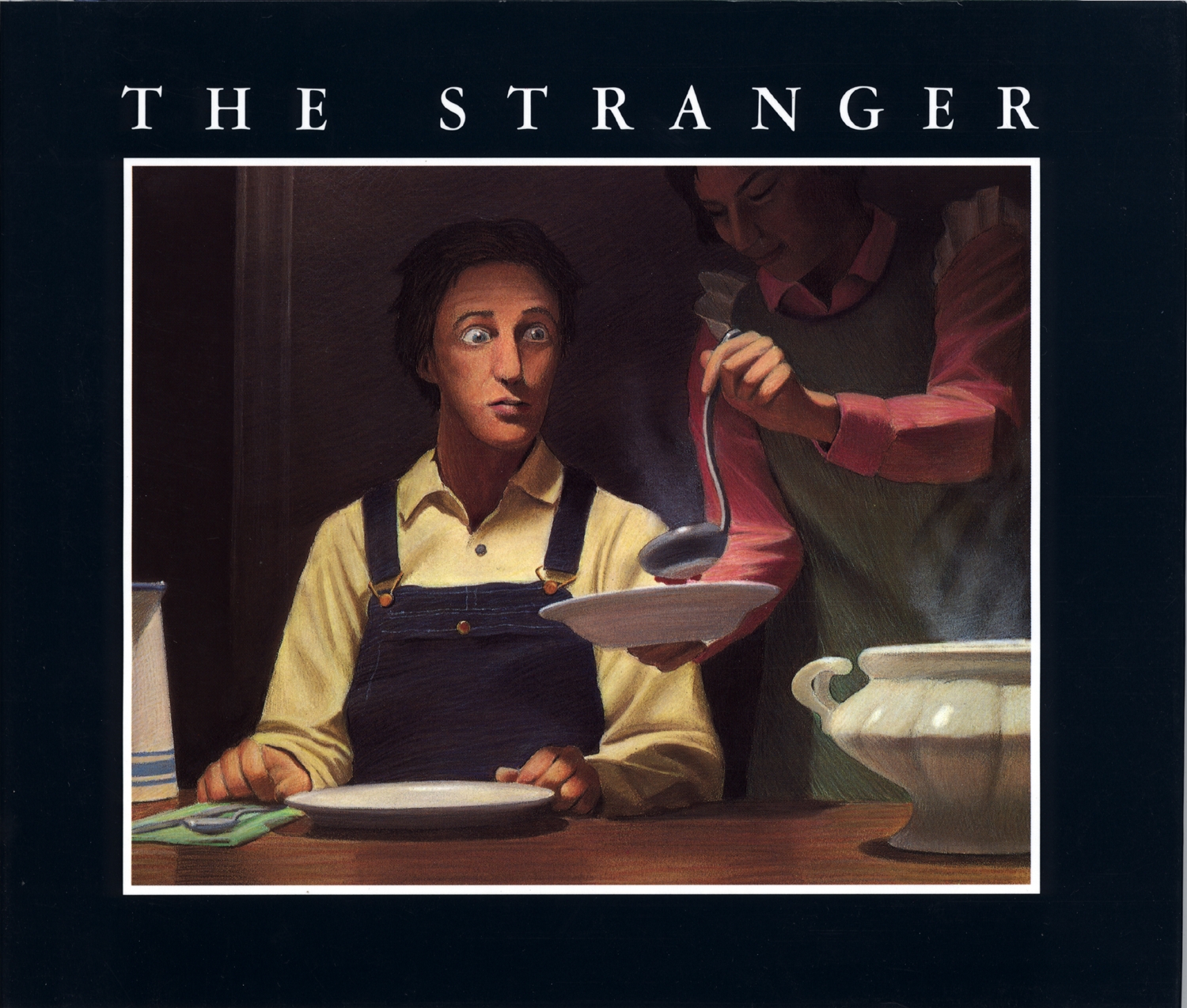
  The Stranger by Christopher Van Allsburg is a book I wanted badly to buy, but did not.  Why not?  Sticker shock.  It was autographed and priced at $250.  Our well worn copy at home will have to do.

  It came out in 1986 and ranked right up there with the Polar Express for at least two of our kids and perhaps even a bit ahead with the one born in 1985.  It is, for me, the ne plus ultra of children’s picture books.  Perfect combination of colorful, compelling artwork, spare yet fruitful prose, and prescient allegory woven discreetly into the fabric of the narrative.

  To a kid it reads as the story of an enigmatic stranger knocked temporarily into amnesia by an auto on a dark country road.  By this adult, now some twenty years after publication, on its pages can be seen hopeful resolution of careless interaction of man and nature.

  “It was the time farmer Bailey liked best, when summer turned to fall”.  Driving home, thinking he’d hit a deer, Farmer Bailey finds a strangely clad itinerant lying in front of his vehicle.  Taken to the Bailey home he is doctored and fed.  This is the caption to the cover picture above:

  – Mr. Bailey lent the stranger some clean clothes.  The fellow seemed confused about buttonholes and buttons.  In the evening he joined the Baileys for dinner.  The steam that rose from the food fascinated him.  He watched Katy take a spoonful of soup and blow gently across it.  Then he did exactly the same.  Mrs. Bailey shivered.  “Brr” she said.  “There’s a draft in here tonight”. –

  The stranger seems able to communicate non-verbally with the wildlife and stays with the Baileys for a while working tirelessly in the fields.  Until, that is, he notices that the autumn hues in the distance are not shared with the still verdant deciduous trees of the Bailey farm.

  After putting back on his own clothes, off he hurries leaving fresh frost and fall colors not far behind.  In the frost on the Bailey’s window is written “see you next fall”.

  It’d be terrible if fall didn’t come.  I can’t imagine living in a place where the seasons do not change.  Whether it be the luxuriant transformation of bean fields from green to golden or maples from green to orange to red, one can hardly not be filled with wonder or reverence as witness. It’s like the slap in the face by a zen master to make sure you’re paying attention.

  It’s an amazing process.

  The green energy producing chemical chlorophyll is unstable and rapidly decomposes in sunlight.  Thus, obviously, plants must continuously synthesize it.  Come shorter days and cooler nights a corky membrane grows between stems and leaves constricting the flow of nutrients and the chlorophyll disintegrates.  Green gone.

  Other more stable compounds are left behind.  Carotene (which helped transfer light energy to the chlorophyll) absorbs blue-green and blue light thus appearing yellow.  Leaves containing it, (aspen, soybeans) will thus turn bright yellow as the chlorophyll disappears. 

  Some leaves contain anthocyanins which absorb blue, blue-green, and green light thus reflecting red.   Unlike chlorophyll and carotone this is a component of cell sap and not part of the cell membranes.  As the concentration of sugar in the sap increases the yellowing leaves turn red.  The more sugar, the brighter the red.  Maple syrup.  Forty gallons of sap = one gallon of syrup.

  Best colors come with dry sun filled days coupled with dry cool but not freezing nights. 

Autumn morning sun
Hallows the dirt and stuble
Noble shades of brown

Feed Your Head

May 23, 2008

  Picasso once said that “Computers are useless – they can only give you answers”.  True, they have enabled incredible productivity and played a large role in tremendous economic expansion.  But Bill Gates would still be a geek without game (or a college degree) if he hadn’t asked:  Software or hardware?  Steve Jobs would still be a hippie if he hadn’t wondered “are these things just for nerds?”.

  Staring into one’s screen, it is now awfully easy to be drawn mindlessly along. And spew out report after report without getting ‘out of the box’.  You come up with the same garbage you would have without a computer – just faster or more frequently.

  America’s first billionaire, shipping magnate Daniel Ludwig, thought about that and asked himself: “paperless office?”.  He didn’t buy it and developed a massive project in Brazil to produce paper on a theretofore unheard of scale.  He foresaw the reams you’ve “borrowed” from your office to feed the machine at home.

  Artificial intelligence has a long way to go. It has no counterpart to the older parts of our brain – those controlling respiration, fight or flight, and lust for example.  That neat stuff complete with its incredible cortical wrapper make quite the cosmic organ.

  A tool kit comprised of only 1s and 0s, or circles and rectilinearity will be no help in discerning between cheese and mold or making lemonade from lemons or evaluating risk or associating truth and beauty.  Or painting Les Demoiselles d’Avignon. (Or being a misogynist for that matter I quess.)

  Gonna have to keep on thinkin’ – daydreaming at the very least…

Monkey See…

May 16, 2008

  In the May 12, 2008 issue of the New Yorker Malcolm Gladwell (author of bestsellers The Tipping Point and Blink) has an interesting article about the simultaneous spontaneous generation of scientific insights.  We associate the invention of the telephone with Alexander Graham Bell and evolution with Darwin.  But an Elisha Gray filed a patent for his version of the telephone on the same day as Graham.  The two had never met.  Alfred Russel Wallace developed a theory of evolution without any knowledge of Darwin or the Beagle.  Turns out that the “phenomenon of simultaneous discovery [is] extremely common.”  The other examples he goes on to cite amaze.

  The essay reminded me of French Jesuit Philosopher Teilhard de Chardin (1881-1955) and the monkeys.  In the 1950s scientists on the island of Koshima gave food treats to its simian inhabitants.  Treats were much appreciated, but problematic to eat because dirt would stick to them.   After a while, one monkey figured out how to rinse and clean the potato bits in water and others soon learned by observation.  Incredible thing was that after a critical mass figured out the trick, all of a sudden they all did.  All.  Even those on nearby islands.

    Teilhard believed that all things were on a path of increasing complexity and convergence. First monkeys get on the same wavelength and then cogito ergo sum.  “For the observers of the Future, the greatest event will be the sudden appearance of a collective humane conscience and a human work to make.”

  Although he got sideways with the church, Teilhard believed that the nature of our universe was characterized by orthogenesis.  That evolution and its direction are purposeful.  “Evolution is an ascent toward consciousness…evolution is nothing but matter become conscious of itself.”

  Teilhard wove together all aspects of his vast body of knowledge to describe an ever increasing interconnected universe.  “The powers that we have released, could not possibly be absorbed by the narrow system of individual or national units which the architects of human Earth have hitherto used.  The age of nations has passed.  Now unless we wish to perish we must shake off our old prejudices and build the Earth”.

  “… these perspectives will appear absurd to those who don’t see that life is, from its origins, groping, adventurous, and dangerous.  But these perspectives will grow, like an irresistible idea on the horizon of new generations.” 

                                 ***********

    Interesting to note that Teilhard was, at least in part, launched on his quest for understanding by the horrors of WWI: “…the war was a meeting…with the Absolute.”  (Remember the Razor’s Edge?)

Better Take Off Your Shoes And Socks

May 2, 2008

  It has long been posited that the fabric of our universe can elegantly be described mathematically.  I’ve always sort of bought this intellectually, but without a gut level embrace because of all the, well, numbers.  All of those sliding blackboards in superposition – covered with chalk numbers, parentheses, and strange symbols – seem hopelessly unintelligible.

  Fortunately (for my daydreaming), recent research in neuroscience has provided another point of entry.  In the March 3, 2008 issue of the New Yorker, Jim Holt wrote about “Numbers Guy” Stanislas Dehaene. 

  “Over the decades, evidence concerning cognitive deficits in brain damaged patients has accumulated, and researchers have concluded that we have a sense of number that is independent of language, memory, and reasoning in general… In Dehaene’s view, we are all born with an evolutionarily ancient mathematical instinct… [and so are salamanders, pigeons, raccoons, dolphins, parrots, and monkeys] The number area lies deep within a fold in the parietal lobe called the intraparietal sulcus.”*

  “Our number sense endows us with a crude feel for addition … But multiplication is another matter.  It is an ‘unnatural practice’… Give a calculator to a five-year-old, and you will teach him how to make friends with numbers instead of despising them…”  Tell me if this last bit doesn’t ring true.

  OK, if time-space is the macro and one’s brain micro what are examples in between? Or is there a disconnect like between quantum physics and the theory of relativity? One occurred to me while reading about a concept known as the Golden Section.  It is the proportion resulting from the division of a straight line into two parts so that the ratio of the whole to the larger is the same as that of the larger to the smaller: 1: (√5+1)2. 

  Gwyn Headley writes: “The inexplicably satisfying proportions of the Golden Section have been appreciated since before Euclid”.   Google the term and you will find it neatly describing stuff ranging from the Pyramids at Giza to the Parthenon to Leonardo’s Annunciation in the Uffizi, to an endless array of elements of modern design.

  Furthermore, the closely related Fibonacci sequence can be used to describe such disparate things as the elegant spiral of the shell of the Nautilus to a smooth golf swing.

  The more this connectedness sinks in, the more I’m nearly overtaken by, well, The Marvelous.

  Holy dogs, if I had been on this scent earlier I would have made Mr. Gates wish he’d finished Harvard.  But shoot, now I know my attention will soon drift. 

*  Interesting thing here is that Holt goes on to say that “Brain imaging, for all the sophistication of its technology, yields a fairly crude picture of what’s going on inside the skull, and the same spot in the brain might light up for two tasks even though different neurons are involved. Quoting Dehaene: Some people believe that psychology is just being replaced by brain imaging, but I don’t think that’s the case at all”. 

  There are physicists and other thinkers who use this fact to hold that while consciousness may be present in a brain, it is not a product of it.  See, I’m getting off track.  More later.

The Marvelous

March 13, 2008

   But, shoot, look where Galileo got us: “There is a straight line from the physics of Bacon and Galileo to the atom bomb” (German physicist Carl Friedrich von Weizacker).  Funny thing about science – just like religion – it’s yielded some really bad shit.

  Several interesting books (the exhortatory End of Religion by Sam Hamill and God Is Not Great, How Religion Spoils Everything by Christopher Hitchens) have been published recently about the terrors of religion.  Gotta remember that there is also the continuing tragic paradox of the Enlightenment.  Without the miracles of modern technology, the nuts and crackpots and despots about would be little more than babbling idiots – you know, sans WMD.

  Several years ago author Michael Frayn wrote a play called Copenhagen. It centered on his fictional account of the wartime discussions between Werner Heisenberg and Niels Bohr which may or may not have helped stop a Nazi bomb.  The morality of any atomic research in all of its historical permutations is the larger background issue.

  During a discussion of the play on NPR, a physicist savored the “sweet technological problems” that were and are attendant to nuclear weapon research. He even giggled in so doing.  Later, on the same program, Werner von Braun was quoted: “we were only charged with getting the rockets up in the air…”  

  Here though, is what went through Robert Oppenheimer’s mind while watching the first mushroom cloud at Los Alamos:

       I am become death, the shatterer of worlds;
      Waiting that hour that ripens to their doom. – Bhagavad-Gita     

  Nothing like a slap in the face, eh?

  Frayn ends his play talking about “that final core of uncertainty at the heart of things”. Can’t put the genie back in the bottle, but can Pascal* leave his room without sowing seeds of destruction?

  Perhaps best after first having found a way to be comfortable there.

  Here’s the koan, courtesy of Seamus Heaney:

The annals say: when the monks of Clonmacnoise
Were all at prayers inside the oratory
A ship appeared above them in the air. 
                                                                                       
The anchor dragged along behind so deep
It hooked itself into the altar rails
And then, as the big hull rocked to a standstill,
                                                                                
A crewman shinned and grappled down the rope
And struggled to release it.  But in vain.
“This man can’t bear our life here and will drown,”
                                                                                               
The abbot said, “unless we help him.” So
They did, the freed ship sailed, and the man climbed back
Out of the marvelous as he had known it.

*”All man’s miseries derive from not being able to sit quietly in a room alone”  Blaise Pascal 1623-1662

Headbang

January 29, 2008

    Much has been written recently about the development of the human brain.  Not that long ago, even Hillary and Bill hosted a colloquium on early neurological development.  Small wonder really – brains are us.   

  The development of a brain is a dynamic interactive process beginning shortly after conception.  Its ultimate configuration is an amalgam of the genetic raw material wired up in response to environmental inputs.  “The world develops the mind” writes researcher Robert Ornstein.   

  An example Ornstein cites is illustrative.  A two year old boy developed a small growth on his left eyelid.  Treatment involved covering that eye for two weeks.  Later, during his first grade eye test, it was determined that he was blind in that left eye.  Subsequent investigation found nothing at all wrong with the eye itself.   

  ‘Sup with that?  It was simply because the eye had been covered during a critical time in the development of the boy’s visual system.  At that point, certain neurons were looking for a live connection.  Finding no stimulation at the left eye, some withered and others connected with the right eye.  Sadly, that particular process rapidly becomes complete and immutable.    

  Neuronal selection is what it is called.  Neural Darwinism.  The sum total of a zillion similar interactions directly influences the wiring pattern of each brain.  The process yields a unique mind with its own collection of constellations.   

  A fertilized egg is thus an incipient cosmos; a big bang as it were.  Guess who guides its evolution.