Archive for the ‘Uncategorized’ Category

Oubilette

January 28, 2013

  oubilette 3

  Translating something from one language to another, it is impossible to convey the depth and richness of meaning of the original.  The essence with any luck, but not the full flavor.  Surprisingly perhaps, a good way to demonstrate this is by first examining a random passage in English.  The last page of, say, of the Economist, which is usually an obituary.

  Indeed, the last page of the January 19, 2013 issue of the magazine is the obituary of computer programmer and activist Aaron Swartz.  In it will be found the following sentence: “He already had access to the library network; no need to hack into the system.”  Fairly simple and straightforward, right?  Well not so much as it might seem.  The word “hack” proves to be problematic.  In my pocket French/English dictionary there is no ‘hack’, but the translation of ‘hacker’ is given as “pirate informatique”.  “Pirate” is basically the same in both languages.  So “hacker” translates into French as “computer technology pirate”.

  Gets the point across, but not the etymological provenance and thus much is lost.    Look up “hack” in an American dictionary and you get: “To cut or chop with repeated and irregular blows; To break up the surface; To cut or mutilate as if by hacking; taxi driver”.  Only in new dictionaries do the final possible definitions refer to computers.  Thus with “technology pirate” one would not understand what we here do innately, that “to hack” is the infinitive form of a verb  adapted by Americans to describe the process of unauthorized entry into or usage of an information system through actions analogous to the cutting and chopping in days of yore. 

   This all came to mind while attempting to translate an article* from French to English about lessons for the French from the sexual harassment case of Dominque Strauss Kahn in New York City some months ago.  L’Affaire DSK caused quite a bit of discussion about “harcelement sexuel” in France where it has had a much lower profile and different tone than on this side of the Atlantic.  Hard for us to imagine, but a former French minister essentially said about the DSK incident: “what’s the big deal, it wasn’t a murder”. 

  As opposed to in the USA, the rare person accused and convicted of workplace sexual harassment in France may suffer minor punishment, but not the employer.  Thus, there is not in place a system of sensitivity training, reporting responsibility, and serious adjudication with the potential for severe penalties.  There has even been some snickering about American prudishness.

  The article concludes with the following: “… le subject ne risqué pas de tomber aux oubliettes”.  First part is easy: “the subject doesn’t risk falling into…”  The last word is the problem.  A quick glance at my dictionary has the whole phrase “tomber aux oubliettes” and translates it as “sink into oblivion”.  The word alone translates as jail cell.  So, now, in France, due to  all the publicity surrounding the affair DSK, a reexamination of sexual harassment doesn’t risk falling into oblivion. 

   Good thing certainly, but as above, richness of meaning is lost.  Knowing that the infinitive “oublier” means “to forget”, I was curious and got a bigger dictionary where I found that an “oubliette” is a particularly awful sort of medieval dungeon down into which prisoners were lowered through the only opening.  Native French speakers would have understood the emotion attendant to the use of that word and that all hope would have been lost for the occupant of the oubillette as well as any relatives, friends, and sympathizers.    

*Les lecons de l’affaire DSK, interview of Abigail Saguy by Anne Senges, France – Amerique, September 2011
Hope I Get Asked Back

December 8, 2012


  Yep, it was time again earlier this week.  I had put it off longer than the recommendation and had not been made fearful by a “you’re overdue and consequences may be severe” letter from the office.  Well, not fearful till I finally scheduled the dang thing.  Started to think about a friend who recently left this world because he’d put it off a bit too long.

  You know how your mind works.  As the appointment drew near, I began to consider rescheduling because our insurance will soon change and if it was to be that something nasty was lurking within, the transition could prove problematic and/or expensive.  Being a college grad I realized that was stupid.

  Night before, I opened the prep kit and read the instructions.  “Sulfate salts provide sulfate anions, which are poorly absorbed.  The osmotic effect of unabsorbed sulfate anions and the associated cations causes water to be retained within the gastrointestinal tract.”  You can say that again.  I was so squeaky clean that wife, little black angel, and I took a five mile run early in the AM before my 7:00 inspection.

  Was soon there, signed voluminous “hold harmless” sorts of documents, changed into one of those gowns that would only flatter a Reef model (www.reef.com/culture/miss-reef), had IV inserted, and was rolled into the chamber where several smiling faces looked down upon me.  Very strange sort of perspective.  And it got stranger.

  There was a big screen and pretty soon we were all watching something that looked exactly like when, in Star Wars, Han Solo piloted the Millennium Falcon through a deep cavern which turned out to be the bowel of a huge beast.  Remember that?  Anyway, Doc kept making comments in the manor of a geologist following a vein.

  He found nothing of interest.  Not even one bit to clip off and send to a lab.  I was under the influence of something certainly, but just as obviously had some level of awareness and so a quick feeling of relief gave way to a few jokes.  I’m not sure, but think that I told a favorite involving mice in a bar, a cat, sex, and the f-bomb.

  Doc said, “see you in five years”, but I guess I hope I didn’t offend anyone present, my file doesn’t get “lost”, and I do in fact get asked back. Everything considered, it wasn’t all that bad.


… he can’t be any worse.

November 16, 2012


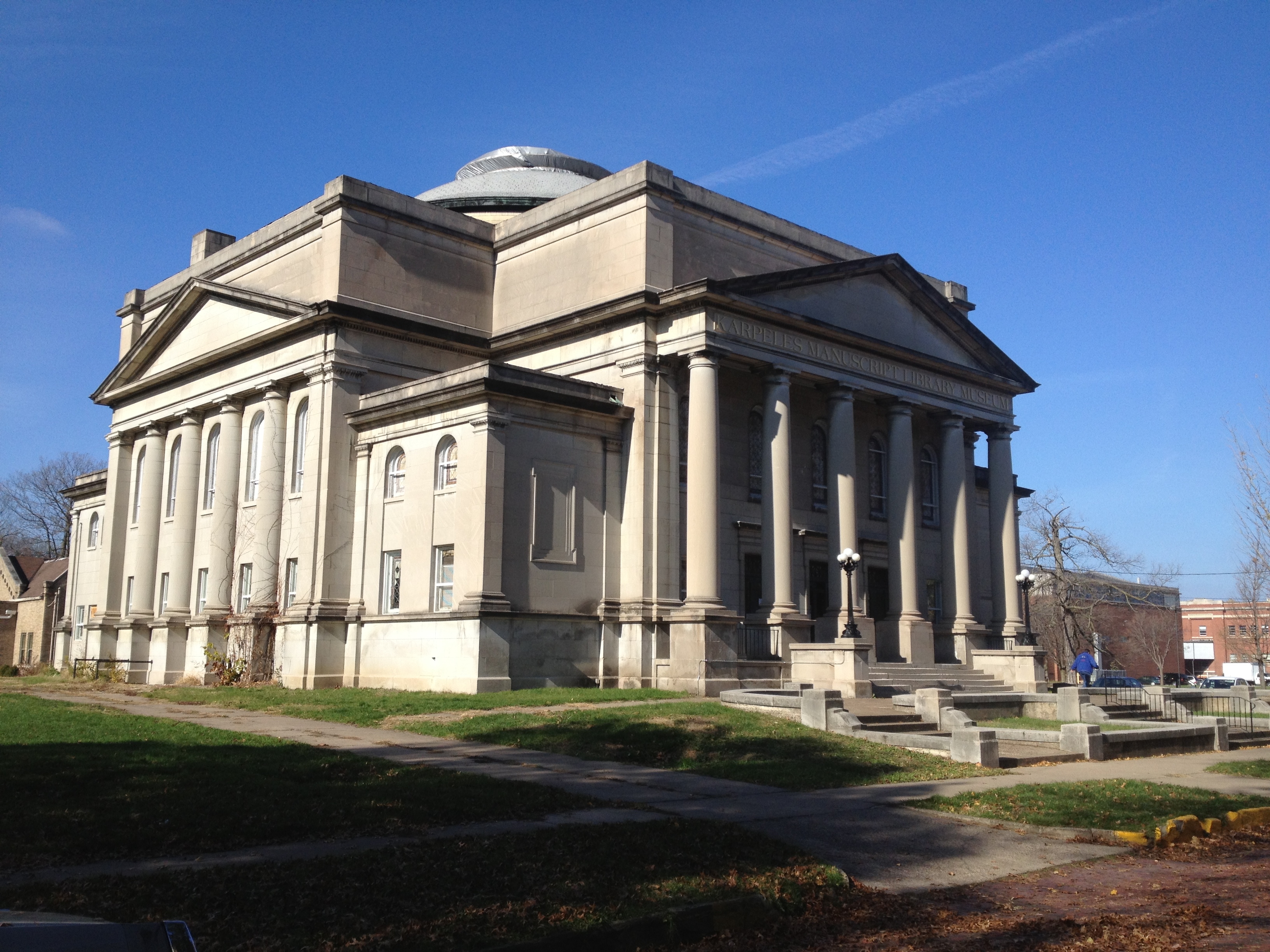
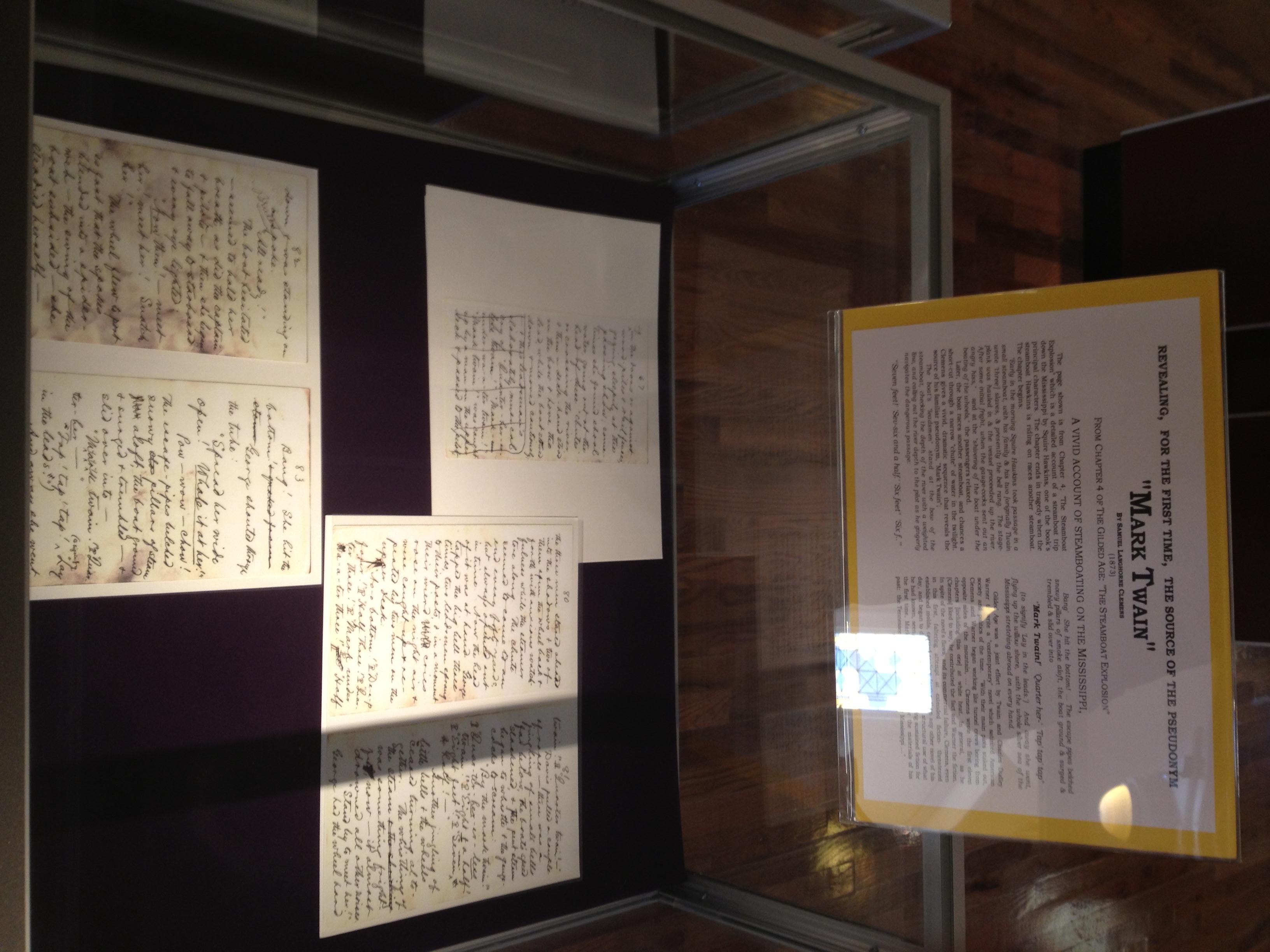
  The Palladian style building you see above was designed by Chicago architect William C Jones and built in Rock Island, Illinois in 1915.  Its original purpose was to serve as a Christian Science Church, but it now serves as the latest of the Karpeles Manuscript Library Museums scattered across the country.

  These museums, from Santa Barbara to Tacoma to Duluth to Buffalo to Charleston, to Jacksonville (and others – not to mention over 200 mini-museums), house an astounding array of historical drafts, letters, and documents.  The Museum brochure mentions stuff by Napoleon, Washington, Lincoln, Henry VIII, Pope Lucius III, Wagner, Martin Luther, and others and more.  Whew!

  Major restoration is underway on the building in Rock Island (though the main meeting room is closed off, it is interesting to stand in its center, beneath the dome, and imagine the presence of a congregation – especially if your notion of a place of worship is more of the cruciform sort), but the narthex holds a dozen or so fascinating pieces of history.

  There is a draft treaty between the USA and the people of Tripoli and the Barbary Coast which inspired the Marine Hymn and is sadly ironic to consider in light of what happened in Benghazi a few weeks ago.  Nearby is a model of Lord Nelson’s flagship the HMS Victory and his handwritten battle plan for the Battle of Trafalgar.  You know, the naval battle in which his outnumbered fleet defeated Napoleon’s and confirmed British Naval Supremacy.

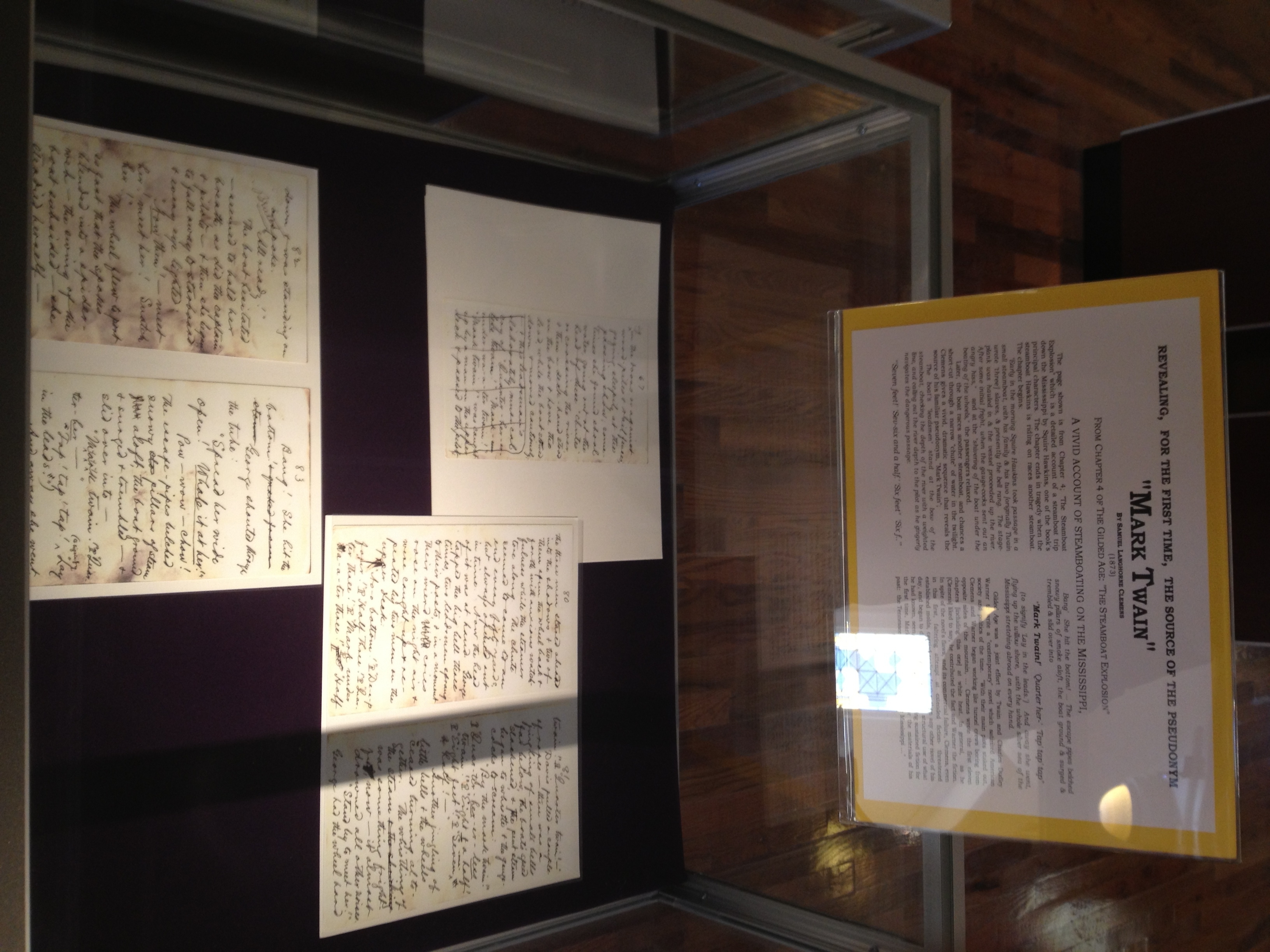
  Ya, pretty dang eclectic.  There is though a cohesive group of material by and/or related to Mark Twain including a draft of a document describing the origin of Samuel Clemens’ pseudonym.  Perfect.  I’d been thinking about Twain during the too many torrid months of the presidential campaign.  Can you imagine what he’d have had to say?

  Pretty sure I know who he’d have voted for, but am also confident Mr Clemens would have had choice words for him too.  “I have no color prejudices nor caste prejudices nor creed prejudices.  All I care to know is that a man is a human being and that is enough for me: he can’t be any worse.”

Can’t Wait To Try Their Pharmacy

July 27, 2012


  Know what bugs me?  Crappy generic store branded stuff.  Like the matches of which you see some on the right above next to proud green strike anywhere Diamonds on the left.  What makes a bad match?  Thanks for asking.  I’m gonna tell ya.

  Few days back, there was an, uh, odor I hoped to dispel with first the flame and then the smoke of a struck match.  I opened the box, pulled one out and across the abrasive panel when it broke.  Next one ignited and then broke, fell onto my shirt, and burned a hole.  Oh well, work shirt. 

  Next one ignited, broke, fell onto the carpet, and seemed to have gone out.  It was in a corner and the carpet is dark and wife didn’t see.  Almost ‘oh well’ again, but didn’t want to burn the house down so dumped a glass of water on it which I did have to explain later.  (“Uh, was watering plants”) I’d by then forgotten about the odor, but in retrospect I’m pretty sure it was long gone.

  What’s more is that the cheap ones hail from a poor country in which forests are rapidly being decimated by the indiscriminate use of wood as fuel for cooking.  On the back of the box of good ones is a statement of which the following is part: “…sourced from responsibly managed Aspen forests of Minnesota…”

  Store where we mostly shop stocks only those on the right.  As of recently I should say.  There used to be a choice.  I’m no genius, but I’m sure management figured that the process of match procurement for the average consumer involves negligible consideration of price or quality.  Thus, remove the good ones, sell the replacements at the same price, and double the profit.

  Matches were invented in China* in or around AD 577 when it was found that dry sticks coated with sulfur would facilitate the sharing of an established flame.  Robert Boyle (remember Boyle’s Law?) figured out that a stick coated with sulfur would ignite when dragged across a piece of paper coated with phosphorus. 

  As further refinement a John Walker in 1826 soaked small sticks with a mixture of potassium chlorate, antimony sulfide, starch, and gum, and allowed them to dry.  Move tip across a rough surface and voila – a flame.  This solution was poisonous however and sickened factory workers.  So after some experimentation, in 1910 the Diamond Match Co substituted sesquisulfide for the phosphorus and patented the modern match.

  And now some pencil neck has taken us a few steps back.  Can’t wait to test their pharmacy…

*cf post of July 2, 2011 to read about the invention of fireworks.

**Most of the history of matches above was drawn from an article by Lisa De Nike in the Fall/Winter issue of The Boss.

Almost Perfect

June 29, 2012


  If you keep your eyes open and wits receptive, it’s amazing the cool stuff you come across.  Just yesterday, for example, I was driving by the jobsite you see above and did a double take.  At first, I thought that a piece of concrete pipe had loosed its restraints and was rolling toward disaster.

  Then, lo, a pair of steel arms lowered it to the ground gently as a nursemaid.  Beautiful bit of industrial choreography.  Had to stay to watch the whole process and was amazed at its efficiency and the economies of movement and energy.  One person unloaded the whole truck without assistance or requirement for outside power.

  Learned that the thing is a Pipemaster 100 and was invented in 1956 by Hank Schmidgall not far from here and has become an industry standard for all of the obvious reasons.  Easy one person operation – driver does it all.  Don’t have to wait for a crane or backhoe.  Thus no delays and can haul more pipe in a day. 

  Then later, on my way home, I couldn’t believe my eyes.  The Weinermobile!  I’d been struck with great good fortune twice in one day.  This bit of only-in-America was designed by Oscar Mayer’s nephew Carl in 1936.  There are now eight on the road: six built on a GMC chassis and two on that of a Mini Cooper. 

  Their horns can play the jingle (I wish I were a…) in twenty-one different genres from Cajun to Rap to Bossa Nova.  After multiple circumperambulations I drove home quickly, determined to find my Weiner Whistle.  Well, it wasn’t to be a perfect day, but one could hardly complain.

Let There Be Light

June 22, 2012


  Having been in the ER several times during the past week or so due to the aforementioned incident, I took the opportunity to sort of Rosetta Stone the placard you see above.  It was prominently mounted on a wall in every patient room I’ve visited thus far.  (Just one more visit to go!)

  Even though I’ve never had to worry about being in labor (rest assured my roommate would agree with that statement – whatever meaning you might ascribe to the phrase) the translation of that bit is what interests me most.

  I know a little Spanish and enjoy watching Despierta America (Wake up America) on Univision in the early AM.  You should watch it.  It is interesting even with the sound off, for the wonderful cultural counterpoint it conveys vis The Today Show, Good Morning America, et al.

  Anyway, the title and first phrase up to the conjunction translate easily word for word.  But then in English it says “…or are in labor…” and in Spanish “O Esta Dando A Luz” which I knew didn’t say anything about work or labor – trabajo.  I knew that Luz meant light.

  Turned to one of my research assistants, daughter #1, who informed me that the phrase does indeed mean “in labor”/giving birth, but translates literally as “…or you are giving light”.  I think that is beautiful, interesting, and further provocation for my sodium ion exchange (that’s what moves stuff along in one’s neurons).

  Had I ever have had the prospect of being in labor, I wonder if the nature of my anticipation of such an event would have differed if I’d  known it described exclusively by one or other of the phrases.  I’ll go out on a limb and say that it would have.  

  On the one hand, whatever combination of excitement, nervousness, and trepidation one might feel, to view the penultimate stage of a pregnancy in terms of work would be way different than, say, as the dawn of a new universe.

  Furthermore, that metaphor, “dando a luz” would (in my mind anyway) evolve through a series of metaphiers from the initial “giving light”, to the newborn’s astonished visage, to the acquisition of literacy, to a college mortarboard, and to a bright eyed effort to make the world a better place.

  But then I’ll never be pregnant and in all honesty the process of giving birth does not look that much like any sort of serene experience.  I would never have chosen the word “labor”.  More reminds me of William Wallace’s last experience of life in Braveheart.  Torture. I’ve watched it three times.  Birth that is.  Braveheart many more.

*Interested in metaphors and their contribution to consciousness?  Go to post of February 4, 2011


It’s True Even If It Didn’t Happen*

February 3, 2012


 OK. It is probably either because I’m an insecure misfit or else am in search of an excuse for misanthropic behavior, but I’m again going to quote my bud Carl Jung: “The more a man’s life is shaped by the collective norm, the greater is his individual immorality”.

  Why now?  Well, because, as you may have heard, it is the fiftieth anniversary of the publication of One Flew Over The Cuckoo’s Nest.  On NPR I just heard the bit from the movie where Jack Nicholson playing McMurphy asks Nurse Ratched to modify the work schedule so the guys can watch the World Series.  “A little change never hurt, huh? A little variety?”

  She wouldn’t have it.  “What you’re asking is that we change a very carefully worked out schedule.”  Conform.  Hew to the baseline.  Don’t raise your hand, ask questions, or use your outside voice inside.  That was in 1962 and the tumult in western society was just getting started. 

  Thinking back upon all that, I find it incredible that in one sense popular culture is more misdirected than ever.  Globally now even.  As Irish poet John O’Donohue told Krista Tippett**, “One of the huge confusions of our time is to mistake glamour for beauty.”  It’s like the metaphor from The Cuckoo’s Nest that pervades is the lobotomy…

*A great line from the book.  And I guess it would apply to all great fiction…

**On Being 1/26/12

Thank God for Kutta-Joukowski

January 13, 2012


Know that a bird’s flight feathers are analogous to the blades on an airplane’s propeller?  It is actually the other way around of course, birds came before airplanes after all, but that is the manner in which the astonishment came to me.

And I’m not the Lone Ranger.  Long before Kitty Hawk there were attempts at manned flight designed around the avian wing.  The problem was propulsion.  Wright Brothers, or someone else, would have been aloft sooner had they understood how birds do more than just glide.

OK, you’ll remember that the mechanics of flight revolve around a curved surface – an airfoil.  As it moves through air (or water – think penguins) the molecules flowing over the curved top must move faster than those with the shorter path to travel below.  This creates a drop in air pressure above and lift*.

Well, the outermost part of a wing – the hand wing – is composed of stiff slightly pointed primaries which are longitudinally asymmetrical.  When a bird in flight flaps downward the narrower portion of the primaries curve creating airfoils and voila forward ‘lift’ occurs.

The several primaries on both wings of a bird combine into an analogue for a multi-blade propeller.  One on each wing.  Try it yourself next time you find a feather.  Hold it by the bare part of the shaft and move it through the air as had its original owner.  You won’t take off, but you’ll get the idea.

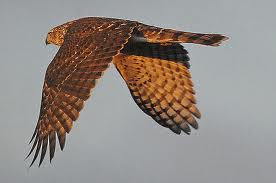
My favorite bird?  Cooper’s Hawk.  It is incredible to watch them Top Gun song birds.  Cuts bird seed budget line item way back.

*Bernoulli’s principle, developed in the eighteenth century, explains the ramifications of the pressure differential, but not why the air moves faster on top than underneath.  Explanations of flight and lift always bothered me because I was unable to get that part.  I’m happy to report that the Kutta-Joukowski theorem, developed in the twentieth century addresses that aspect.  It is complicated and I don’t completely understand, but feel better to know that I might one day.

I Need The Eggs

December 9, 2011


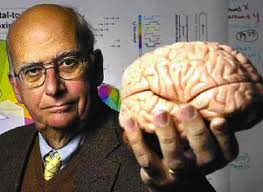
  Interestingly, in his new book Who’s In Charge* cognitive neuroscientist Michael Gazzaniga wrote: “…we are people, not brains” by which he means that, uh, the whole is more than the sum of the parts.  That though an emergent property of the bit of grey matter up top, a meeting of minds can not be understood as can, say, theIndianapolis 500 by the mechanics of an internal combustion engine.

  He holds that: “analyzing single brains in isolation cannot illuminate the capacity of responsibility”.  Rather, it is “an interaction between people – a social contract”.  One, crucially, able to be honored or broken.  And it’s irreducible.  A solitary test lap would be meaningless.

  Makes me think of the Buddhist imperative to “forget the self”, because there’s not one really there to begin with.  It’s (they say) a construct assembled by the brain from inputs internal and external to aid us in navigation through a daily routine.  If some combination of influences doesn’t make you feel trustworthy or un-, you will have no ability to feel either.

  Perhaps the example of feral children can provide a useful, if horrific, example. Romulusand Remus aside, there have indeed been cases of infants and children who survived early extreme neglect, sometimes actually with the nurturance of wild animals.  If protracted, a child’s mental and psychological development ends at a prehensile stage.

  Beyond hope and possibility of resurrection.  Should a one not be exposed to language – in any form – by puberty, the potential for later acquisition would have thus been rendered forever lost.  But, with luck and the agency of a “Good Enough Parent”**, a child grows to become part of a rich network with myriad relationships – some inchoate and fleeting some deep and long.

  Of the latter sort, I like the way Woody Allen put it in his film Annie Hall.   “I-I thought of that old joke, you know, this, this, this guy goes to a psychiatrist and says “Doc, uh, my brother’s crazy.  He thinks he’s a chicken.’  And uh, the doctor says ‘Well, why don’t you turn him in?’  And the guy says ‘I would but I need the eggs’.  Well, I guess that’s pretty much how I feel about relationships.  You know, they’re totally irrational and crazy and absurd and…but, uh, I guess we keep goin’ through it because, uh, most of us need the eggs.”

  I do.

*I read about this book in a review by Raymond Tallis in the 11/12-13 WSJ. Gazzaninga first gained prominence in the 50’s when he pioneered split brain research.  That is, brains in which the tissue connecting the halves – the corpus callosum – had been severed.  This lead to the knowledge of hemispherical specialization.  Interesting to note that the corpus callosum is more substantial in females.  I wonder what the ramifications of that are…

**I’ve heard this phrase a lot, but it’s capitalized in reference to the eponymous great book by Bruno Bettleheim.

***Perhaps the eggs come frequently to mind because Annie Hall came out – and won the Oscar – in 1977. The year I got my roommate.   

Wonder When The All Clear Will Come

November 25, 2011

Though it is not exactly the story he tells, in his new book The Bear History of a Fallen King, French cultural historian Michel Pastoureau shows how the coming of consciousness gave its bearers power which descendents have yet even now to effectively tame.

In prehistoric times bears were feared, perhaps deified as a result, and thus immortalized on cave walls.  Common in Europe they were more than a match for dimwitted pre-humans.  Once the light went on however, so was the hunt and the rest, well, history.

By the time of Charlemagne in the late eighth century it was mere sport.  He led forays that were responsible for incredible ursine carnage – thousands upon thousands.  By the 1200 sightings in the wild had become rare.  Bears did however make trifling appearances in zoos, circuses, and traveling minstrel shows.  They’re there now nearly extinct.

Reminds me of a roundtable discussion amongst nuclear weapon developers on NPR a decade or so ago.  Moderator asked about what had led to a particular cold war multiple level of magnitude increase in throw-weight.  Answer?  “It was a sweet technological problem.  Hee, hee, hee.”

Fortunately, we also are thus far this side of extinction.  But cf the ongoing decimation of species, climate change, and pressure of well armed hungry thirsty populations, the all clear is not yet out.

Funny thing though is that, with luck, the significant expansion of North American breeding bear populations might be an indicator of a new coming to conscience.  They are messy, destructive, and sometimes violent and deadly.  Yet, “The people [in their range] look at these bears as members of the community”.*

If a friend was killed or your kitchen destroyed by Yogi or Boo Boo the incident would not be something of which to make light.  However, yesterday was Thanksgiving and maybe we should look with favor upon the fact that these days the response to an initial minor incursion might not be to whack.  That there’s maybe an incipient wonder about the cosmic distribution of sentience and consciousness.

*WSJ; 11/21/11; As Bears Multiply, Human Clashes Rise.

**Photo on top of Cro-Magnon painting in Chauvet cave from Smithsonian 12/10