Pas Timide

June 17, 2011


  Can you believe the news of men of late?  Deeds done that you’d call inane if not for collateral damage, ramifications, and victims?  A presidential candidate with a love child.  A governor with one too.  A congressman broadcasting his ‘package’.  The French president of the International Monetary Fund accused of violent sexual abuse.  Jeesh.  Brings to mind the first line of a Neruda poem: “It so happens I am sick of being a man”.

  Well, I don’t wish I played for another team and understand those actions to be, like, mutations in the drive without which none of us would be here.  Still, what’s up?  Take the last incident cited above.  How could one of the most prominent men on the planet undertake such horror?  From whence could he have come?

  First reports from France conveyed a sense of outrage for the fact that a front runner for their next presidential campaign was seen across all media doing a perp walk.  Soon though came reports of other unwanted encounters with DSK and then, amazingly, of a broader related permeation of French society.

  It was incredible to listen to a female editor of the prominent French newspaper, Le Monde, describe conditions for women, though not perfect, as much better here in the USA than en France.  This from a culture in which the employment of idiomatic Americanisms can be illegal and American taste and popular culture vilified. 

  Made me break out de Tocqueville.  “In France… women commonly receive a reserved, retired, and almost conventual education… then they are suddenly abandoned, without a guide and without assistance, in the midst of all the irregularities inseparable from democratic society.”

  Yikes!

  “Long before an American girl arrives at the marriageable age, her emancipation from maternal control begins: she has scarcely ceased to be a child, when she already thinks for herself, speaks with freedom, and acts on her own impulse.  It is rare that an American woman, at any age, displays childish timidity or ignorance.”

  Democracy in America was first published in France en Francais in 1835.  Perhaps “plus ca change plus ca meme chose” – More things change the more they remain the same.  The American women with whom I’m most familiar would most definitely not be taken for ignorant or timid.  Toward one should an uninvited paw be extended, a bloody stump would be what was pulled back. 

*Walking Around

**cf post of 10/9/09 for more examples of neat stuff us guys think up

Be Careful With What It Thinks

June 10, 2011


  Stepped the mast of our sailboat last night and then saw this summer’s first lightening bug while walking dog.  Was reminded, again, of the subtle interjection of dynamism the seasons’ change provides.  Always something new to think about.

  Most of the ones you see flashing are males.  All of the ones flying and flashing.  With their fireworks, they’re trying to impress the females in the grass below. The success rate is low because competition is high – the m/f ratio can be as high as thirty to one.  The girls each flirt with up to ten different suitors simultaneously, by signaling back, before choosing one with which to bed.

   How does she choose?  Well, sometimes a female equates a male’s flashing sequence with the size of his package.  Seriously.  It goes like this:  Firefly larva spend the first two years of their lives underground.  They don’t eat for their two week adulthood above ground. 

  Along with sperm the successful male passes a protein rich ‘nuptial gift’ to his mate enabling her to produce more eggs while she slowly starves.  The ecstatic coupling ordeal can last from dusk to dawn.

  There are some 2,000 firefly species on the planet of which a handful will be found in North America.  You might encounter several in your yard this evening.  You can differentiate by the pulse pattern – sort of like Morse code.  Pulse pulse, three second pause, pulse pulse = Photinus greeni.  Pulse, five second pause, pulse = Photinus ignitus.

  It’s thought that the ability to thus show off began in larvae eons ago as a means to convey a warning to would be predators.  Bitter taste.  Evolution coursed the luminance up the ontogeny to where we see it today.  Still though tastes bad to most other creatures which led to another bifurcation in these insects’ family tree.

  Firefly Photuris will sit in the grass feigning femininity by returning the flash of a male on wing.  Said male approaches hoping to do the dirty but gets eaten instead.  Photuris is thus even more repellent to potential predators. 

  Photuris seems to go for a rapid flash rate, just like the females.  So if a bug hopes to avoid trouble and get lucky instead it should probably try to be more suave than debonair.  And like Dad said, it should be careful with what it thinks.

*I read most of this stuff in the June 30, 2009 NYT    

Florence Shore – End of the World as We Know It

June 3, 2011


  An interesting article in the current Economist (5/24-6/3) reminds us that before Copernicus, it was thought that the earth was at the center of the universe and that we upon it were all thus imbued with God’s grace.  As the sciences evolved the perception of our position devolved to the point where, well, that “we are stardust”.

  Yep, old news.  The point of view now gaining traction though is that humankind has assumed the central role debunked long ago – at least insofar as our planet is concerned. Clear cut forestry, strip mining, large scale farming, carbon based energy etc and all the related ramifications are “bringing about an age of planetary change”.

  Geologists call the more or less discrete (geologically, meteorologically, etc) epoch in which we’ve been for the last 10,000 years the Holocene.  Scientist Paul Crutzen came to the belief that the wake the coming of man left behind has begun to shape something new.    He’s suggested we call the new age the “Anthropocene”.

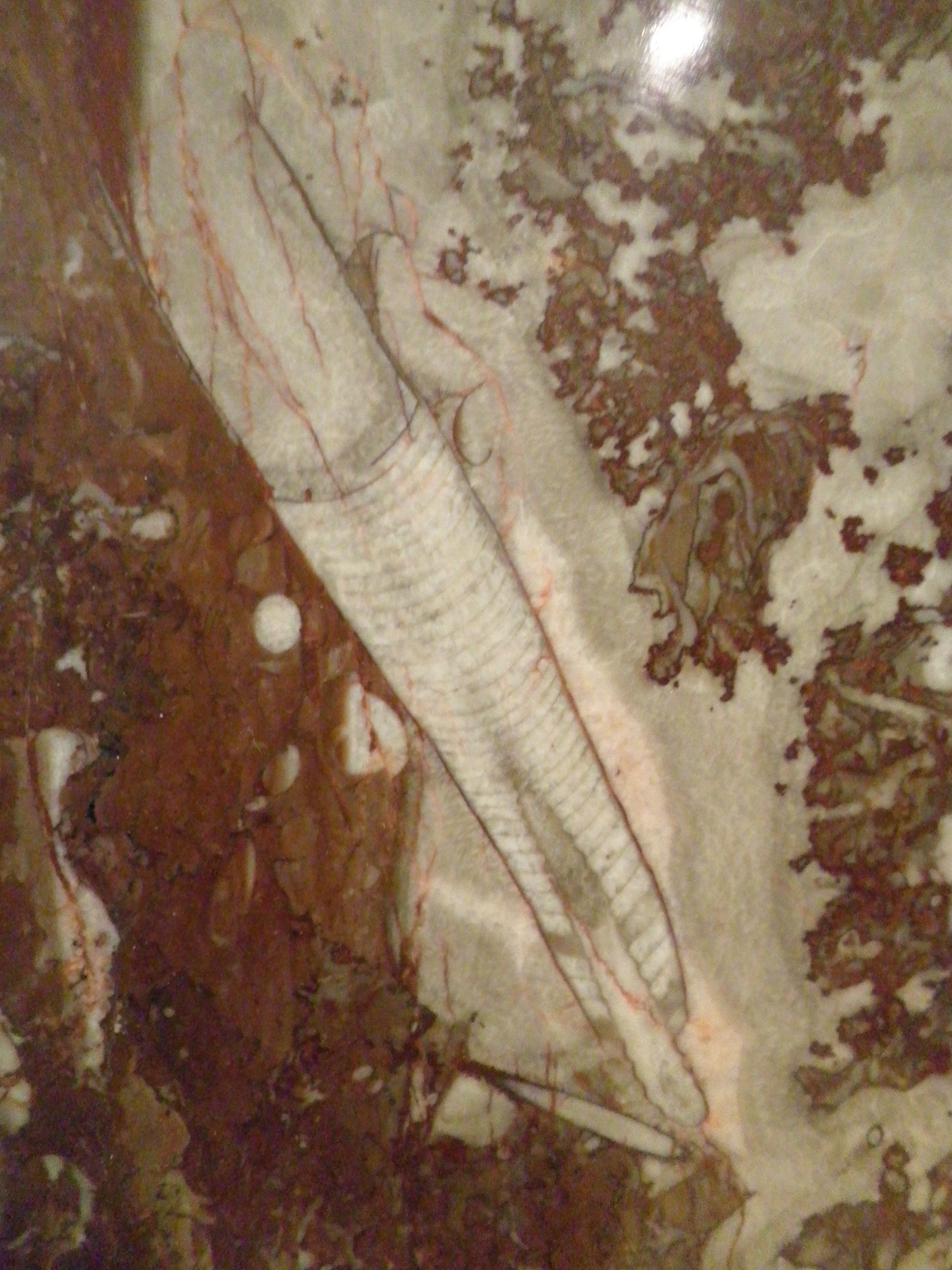
  I was thinking about this the other day while in the bank with MD erstwhile geologist brother when he pointed out the ‘captured’ fossil pictured above on an interior wall.  He said it was a “cephalosomething” embedded in metamorphic limestone aka marble. He went on to say that some buildings and groups of buildings (college campuses e.g.) have maps and guidebooks locating and describing incredible arrays of such stuff.  The Burgess Shale as interior decoration!

  I realized that at some distant point in the future these buildings will have collapsed into the ground, archaeology will sort of transmute into paleontology, and given the trajectory of the average level of intelligence worry that whoever is doing the research be really confused. “How did this cephalosomething get here?  They went extinct eons before the other stuff in this layer…”

  I follow the logic above, but hesitate to adopt the new perspective.  There are too many dopes around who will get the wrong idea.  Might even think the changes we’ve wrought are something of which to be proud.  In 2005 Patagonia founder and environmentalist Yvon Chouinard said: “Forty-eight percent of people in America still don’t believe in evolution… don’t believe in global warming because it relies on scientific interpretations of core samples that are hundreds of thousands of years old, and they think the earth is only six to ten thousand years old”*.

  Some of us are even dimmer.  Jersey Shore is in its fourth season.  They’re in Florence!  People watch.  Rest my case.**

*Alpinist 12 Autumn 2005

**OMG It gets worse.  On NPR with Terri Gross Newsweek journalist Maziar Bahari describes being beaten in Teheran’s notorious Evin prison while his torturer asked about New Jersey – his interest having been piqued by the show.

And I Thought It Was My Appendix

May 27, 2011


  In about the seventh grade I went to a church youth group meeting led by a dapper dude named Oliver something.  He told us he was forty years old and that his “way of thinking hadn’t changed much since I turned thirty-five”.  I was thrilled.  I hated junior high and though that birthday was some distance ahead, it was great to know one day the path ahead would be clear!

  No such luck.  Dude must have been lobotomized.  Or fundamentalized maybe.  That Christmas I watched William F Buckley interview Malcolm Muggeridge.  Even though they were both Catholics (Muggeridge one of great zeal) I found comfort in the overlap of our metaphysical perspectives.  Muggeridge:

  “It is only possible to succeed at second rate pursuits – like becoming a millionaire or a prime minister, winning a war, seducing beautiful women, flying through the stratosphere or landing on the moon.  First-rate pursuits – involving, as they must, trying to understand what life is about and trying to convey that understanding – inevitably result in a sense of failure.  A Napoleon, a Churchill, a Roosevelt can feel themselves to be successful, but never a Socrates, a Pascal, a Blake.  Understanding is for ever unattainable.  Therein lies the inevitability of failure in embarking upon its quest, which is none the less the only one worthy of serious attention.”

  Well, Blake framed his take as the apocalyptic “fearful symmetry” of tyger and lamb.  As I’ve said before* I prefer Jung’s: “Life is a luminous pause between two great mysteries which yet are one” with its intimation of meaning and perhaps even numinosity.  Both would probably agree that courage and will are necessary to emerge from problematic phases of the ‘pause’.

  In his book The Middle Passage, Jungian analyst James Hollis quotes Jesus from the Gospel of Thomas**: “If you bring forth what is within you, what you bring forth will save you.  If you do not bring forth what is within you, what you do not bring forth will destroy you”**.

Hmm.  Just what is it that’s eatin’ at me…?

*7/23/10

**The Gospel of St Thomas?  It’s one of the Gnostic Gospels as described by Elaine Pagels in her book The Gnostic Gospels.  They were discovered by farmers in Egypt in 1945.  The Gospel of Thomas dates to the second century.  Gnostics held that salvation will come from within.  Without need for clerical intercession.

***The pictures above are drawings from Jung’s Red Book.  They are his representations of self induced hallucinations undergone in a midlife effort to figure out what was inside him trying to get out.

I (Sorta) Wonder What It’d Be Like…

May 20, 2011


  Brother was riding his bike recently, came upon an unexpected obstruction, went over the handlebars, and fractured his wrist.  His recollection of the event was interesting.  “It was all in slow motion.  I remember the sound pattern made by my helmet on the sidewalk.”

  Perfect timing.  Maybe not for him, but for us.  In the April 25 edition of the New Yorker, there’s an article about scientist David Eaglemen whose research seeks to understand our perception of time.  He was drawn to that study by the experience of falling off a roof as a child.  “In life threatening situations, time seems to slow down.  It’s a moment of absolute calm and eerie mental acuity.”

  Why?  Well, it seems that it’s a matter of how much information is on the way to the brain and how it coordinates.  By way of example, light travels faster than sound, but they use a starting pistol in the Olympics instead of a light flash because the brain reacts more quickly to sound.  Cavemen would have been well advised to flee a rustling of the brush long before a predator presented itself visually.

  The more stimulating and/or serious a situation, the more input sent to our accreted cerebral “hodgepodge of systems”.  One component, the amygdala, is sort of an emotional node and seems to become hyperactive when scared and records far more detail than when bored. 

  As a result, one’s experience of the passage of time is vivid and slows significantly.  During an experiment, subjects terrified by a uniquely “plausibly deadly” amusement park ride overestimated the passage of time by thirty-six percent.

  Ok.  What event would put one most in extremis… would push the phenomena the furthest?  Having your head cut off comes most immediately to my mind, but to be honest I have to admit that not an original thought.    

  From the perspective first of a caveman finding his neck in the jaws of a saber toothed tiger, through the likes of John the Baptist, Anne Boleyn, and Marie Antoinette, writer Robert Olin Butler wrote a book entitled Severance in which he presents sixty-two different takes of what the experience of decapitation might be like.

  He begins with these two epigrams to set tone and style:  “After careful study and due deliberation it is my opinion the head remains conscious for one minute and a half after decapitation.” (Attributed to a Dr. Dassy D’Estaing 1883) And: “In heightened state of emotion people speak at the rate of 160 words a minute.”  The math works out to about 240 words for that ninety seconds and is thus the length of each of the stories.

  Sweet précis, eh?  Mull that around a bit.  Would you be dizzy if your head rolled? Would it feel claustrophobic if your noggin fell into a basket?  Would you be able to close your eyelids?  Would you if you could?

  Courtesy of Mr. Butler, here’re the last 240 words that came to the mind of Ta Chin, a Chinese wife beheaded by her husband in 1838:

“straight and whole are my feet I would rise and run as I have loved for many winkings of the moon to run with my brothers but I press my feet side by side and wiggle my toes this last time and whisper to them goodbye I know what is before me my mother in the courtyard singing prayers to Kuan Yin the goddess of mercy, not to spare me a life of pain but to wither my feet to perfection, the mercy of the golden lotus, the mercy of a wealthy man to keep me, I tremble I am ready to weep but for these tiny stones of anger Kuan Yin has placed in the corners of my eyes even as the footbinder puts the soaking tub before me that first night even as my husband trembles before me in the torch light trembling always from the opium but this night he trembles from what he believes about the brushing of my sleeve by a man he himself brought to our house and my mother sings and my toes are seized and folded hard under and the wrappings wind and wind and squeeze and my arch cracks and I see Buddha in heaven sitting on his lotus but it is my naked foot the golden lotus he sits upon and hands push me down my neck made bare and I cry please, before my head cut off my feet

  Think I’d try to think of the Marx Brothers.  Or maybe Mel Brooks.  Ya, that’s it – Young Frankenstein.

*New Yorker, April 25, 2011, “The Possibilian” by Burkhard Bilger

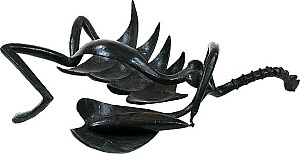
**Sculpture above?  It’s Woman With Her Throat Cut by Alberto Giacometti.

I’m Glad I Don’t Have A Tail

May 13, 2011


  Please, please, please don’t repeat this to anyone.  Last Friday wife and I rode our bikes along the river to a brew pub for dinner.  On way home via a different route just before dusk she (up ahead) exclaimed: “Is that what I think it is!?  Let me have your knife!”

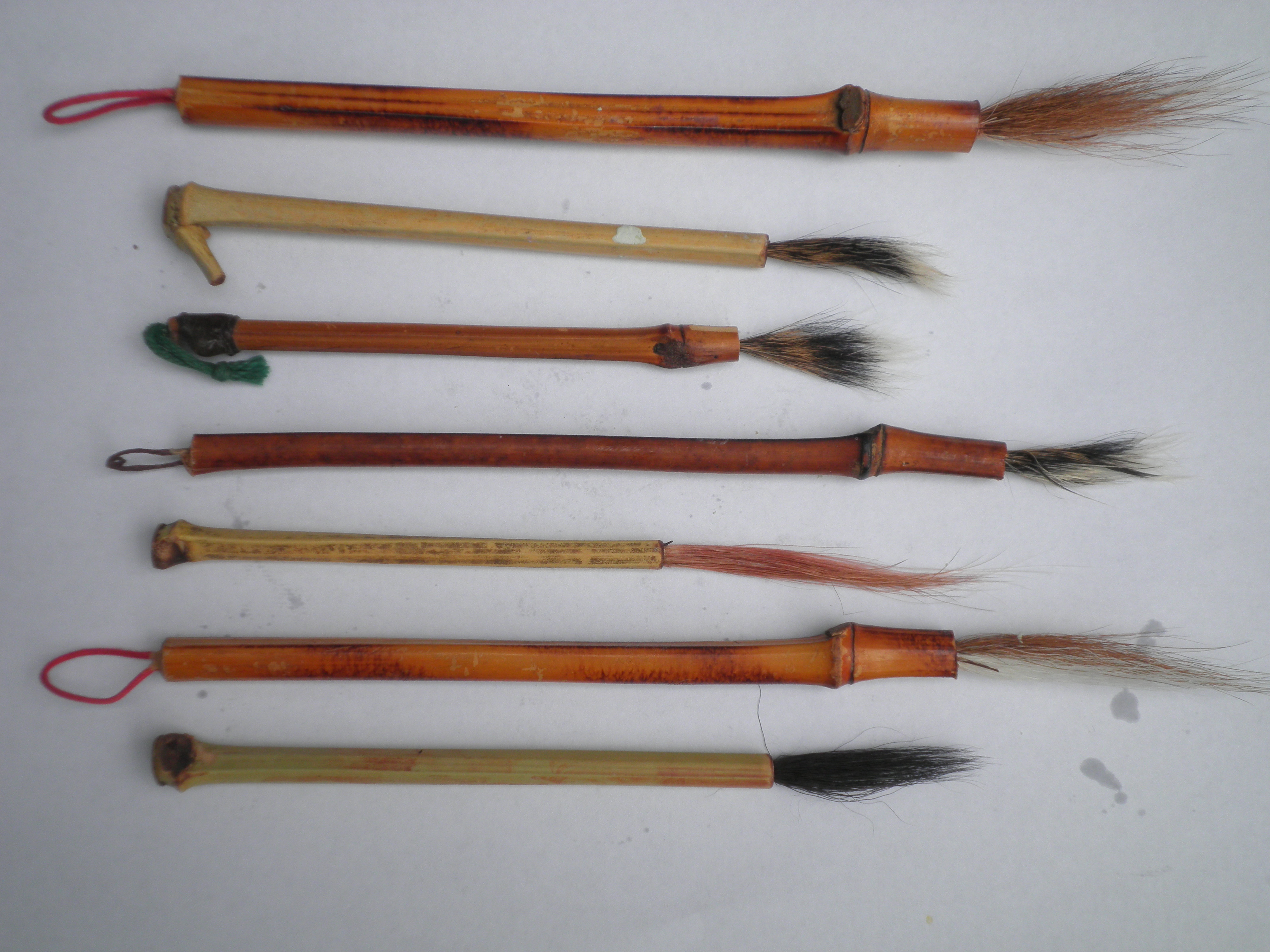
  I did so and then watched as she cut the tail off of a dead black squirrel.  Jeesh.  Unfortunately I’ve many times found myself part of that peculiar sort of excision separating tail from torso of skunk, deer, raccoons, and more.  All in service to art.  She makes fine brushes with the hair.

  Jung wrote some interesting stuff about artists: “The artist’s life cannot be otherwise than full of conflicts for two forces are at war within him (her) – on the one hand the common human longing for happiness, satisfaction and security in life, and on the other a ruthless passion for creation which may go so far as to override every personal desire”.

  Furthermore: “The artist is not a person endowed with free will who seeks his (her) own ends, but one who allows art to realize its purposes through him (her)”.*  Mission for god as the Blues Brothers put it.

  Demanding a muse might be, but a grand thing which to follow should an audience later manifest.  What a way to live if people would cathect emotion and fork over dinero in response to what might express from the depths of one’s soul through a trained and tamed skill set.  Two examples:

  Mick Jagger arranged for Lucien Freud to paint his then wife Jerry Hall and baby.  Sitting for Sigmund’s grandson is an arduous process and Mrs. Jagger spent many many hours in his studio over the course of four months. 

  One day Freud called his dealer William Acquavella: “I want you to be the first to know, the painting’s had a sex change.”  “What!” Acquavella responeded.  “Well, Jerry didn’t show up for two sittings so I changed her into a man”.  Jagger rang up Acquavella but there was nothing that could be done.** 

  Similarly, if not quite as obstinately, architect Peter Zumthor picks his clients not visa versa.  “Normally architects render a service.  They implement what other people want.  This is not what I do.”  What he does is to take the measure of a site and client from which to distill his vision.  Not theirs.

  Actor Toby Maguire hoped for a Zumthor house in the LA hills.  The architect said he’d look at the site if Maguire’d educate himself by visiting several projects in Europe such as his spa in Vals Switzerland and museum in Bregenz Austria.  House went ahead.  Maguire asked for a basketball court, but apparently got a garden instead.***

  Uhm, I’m glad I don’t have a tail.

*Both Jung quotes are from his book Modern Man in Search of a Soul

**WSJ Weekend April 2011 by Tom Vandrbilt

***New York Times Magazine by Michael Kimmelman


Beyond the Blare of the News

May 6, 2011


  There are small minds everywhere, but fortunately there are about big ones too.  Above you see the Museum of Islamic Art in Doha, Qatar.  It was designed by IM Pei who went to very great effort – wide peregrination and deep cultural immersion – to find the heart of Islamic architecture.  “Might it not lie in the desert, severe and simple in its design, where sunlight brings form to life?”*

  Most collections of Islamic art are in the west, minded by non Muslims.  The original vision of The Emir and his wife Sheikha Moza was not only to emplace fine objects in the region of their origin, but also to provide a center of culture and education.  “Here is a museum in the Muslim world capable of bridging the gap between tradition and modernity” said the original curator Sabiha Al-Khemir.

  As you may know, pictorial representation contravenes a precept of Islam.  There is thus no tradition of landscape or portraiture.  Think then about how it must currently be for visitors to that museum to look upon the likes of Rembrandt, Hals, and Vermeer for the first time in an exhibition of the Dutch golden age.

  For an article in the May 2011 Art Newspaper editor Anna Somers Cocks toured the show with a young volunteer.  The responses of the latter to Ms Cocks’ “just tell me what you see” were fresh and felt and fascinating.  About Church Interior by Emanuel de Witte (below) she said:

  “I like this very much; if you stand back you feel like you can go inside it.  I like that he drew if very well; you can see the small things like the details of the column.  They told me that they put dead people under the floor and I said how can you prey with dead people beneath you? I am told that when a woman got married the only thing she could do for fun was to go to church.”

  Above you see Jan Steen’s The Very Merry Family: “Because everybody is happy about something, everyone is doing a different thing, but because they are ignoring each other, the small child is on its own, drinking.  So this is a troubled family and very dirty and things are falling down.”

  She liked Rembrandt’s Self Portrait: “I love this person because he has been painting himself since he was young.  Maybe this is his last portrait.  I have heard that he painted himself all through his life, how his face, how his body changed.  It’s a very nice idea.  You can feel he is very old, even from how he is drowning his hair.  He does not put in many details so that you can focus on the face”.

  Hmm.  There is so much behind and beyond the blare of the 24/7 news cycle…

*I.M. Pei Complete Works by Jodido and Strong, Rizzoli, 2008

Tornado in a Lumberyard

April 29, 2011


  The 1913 Armory Show was arguably the most important exhibition of art ever organized on this continent.  It introduced cubism, futurism, Cezanne, Duchamp, Picasso, and much more to audiences on this side of the pond and inflected the NA zeitgeist like nothing else before or since.    

  It was up in NYC from February 17 to March 15 of that year and then traveled to Chicago where it hung in the Art Institute March 24 to April 16.  From there it went back east to Boston.

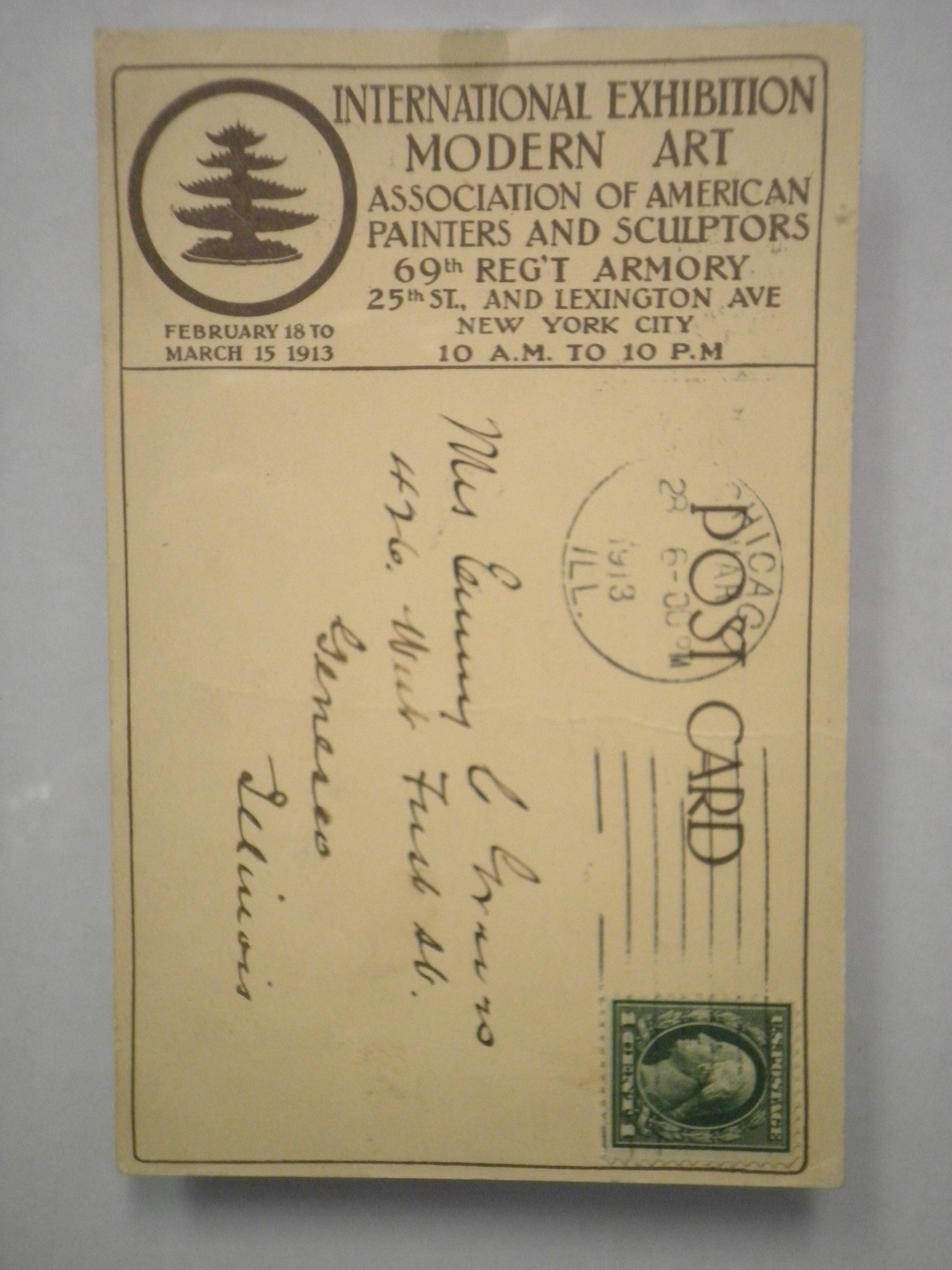
  The postcard image above is, of course, Duchamp’s Nude Descending a Staircase.  My great-grandfather sent it to my great-grandmother from the Chicago venue.  His handwriting encircling the picture reads:

 “This is a photo of one of the cubist pictures.  It is said to be a picture of a nude woman walking down stairs.  I don’t think any of the postal authorities will object to it as improper as it goes through the mails.  I have one more I will bring home with me.” 

  “There is no news.  I went to see this exhibit and must say it is a fright.  Yet I heard one or two fools raving over the beauty of these daubs.  It was worth going to see however just to see what some will praise.  Lorado Taft* says it reminds him of nothing so much as a lumber yard after a tornado.  Home as usual tomorrow at 6.  Yours, EC”

  My great-grandfather was a judge who frequently traveled between Geneseo, Illinois and Chicago.  He died young and left my grandmother, one of five offspring to survive, and great grandmother to fend for themselves.  Grandma adored her father and held dear precious memories and memorabilia through to the end.  Interesting now to allow them to take one back…

   Compare the image on top with the one just above and you will get an idea of an experience none of us will ever again have.  An in-person audience with a work of art will always be different than one with a reproduction**, but any potential for shock and awe has been removed by the quality and ubiquity of virtual experience.

  On second thought, I retract that observation.  Or qualify it I guess with the addition of the following phrase:  given current knowledge of our universe…

*Lorado Taft (1860-1936) was a prominent American sculptor and teacher.  His studio was in Chicago and he taught at the Art Institute.

**I’m pretty sure I’ve used this in a previous post, but in case you’ve forgotten, New Yorker critic Peter Schjeldal wrote: “Reproductions are like pandering ghosts, they show us what we want to see”. 


Pocket of the Groove

April 22, 2011

  Ok.  I’m continuing with my attempt to learn how to play the guitar and enjoy it immensely even though I’ve yet to play anything through without a fat fingered mistake.  It’s amazing how absorbing practice can be.  Just a few notes in, and even the most acute of the day’s existential crises have dissolved.

  Just now trying to find my way through “Scarborough Fair” familiar to me (and you maybe) courtesy of the Simon And Garfunkel cover on their 1966 album Parsley, Sage, Rosemary, and Thyme.  For me, their rendition was even more important to the 1968 film The Graduate than their “Mrs. Robinson” for the former’s telling of a wonderfully mysterious tale of courtship. 

  It is an old English ballad.  Some say it arose in the time of the plague and that the refrain: “Parsley, sage, rosemary, and thyme” refers to an herb bundle used to mask the then pervasive odor of death. 

  Of also Mrs. Robinson perhaps.  It would take something pretty powerful to gain the willing hand of a fair young maiden with the mother of whom the suitor had also slept.  And indeed that collection of herbs held ancient pagan esteem for their power to arouse and attract. 

Love imposes impossible tasks,
Parsley, sage, rosemary, and thyme,
Though not more than any heart asks,
And I must know she’s a true love of mine.

  The music itself is interesting for this here novice to play around with.  The first two notes are the same, but the first is a half note and the second a quarter note which means that the first is held twice as long as the second. 

  One obviously doesn’t watch a clock so what is interesting is the different emotional impact of even slight variations in duration.  As luck would have it, Paul Simon was quoted in an article about working with just that in this week’s NYT Tuesday Science section:

  “The stopping of sounds and rhythms, it’s really important, because, you know, how can I miss you unless you’re gone?  If you just keep the thing going like a loop, eventually it loses its power.”

  “My brain is working that way – it’s dividing up everything.  I really have a certain sense of where the pocket of the groove is, and I know when you have to reinforce it and I know when you want to leave it.”

  Well, his is a sensibility to which one can only aspire.

*Interesting to note that Mike Nichols, director of The Graduate, originally wanted Robert Redford for the role that launched Dustin Hoffman’s career.  Shortly into a screen test with Redford he realized that he needed someone else.  “The Graduate only works if it’s a 21-year-old going on 16, who’s sexually insecure.  Well, Redford is this… classic sexual matinee idol…”  From NPR’s Morning Edition Broadcast 12/9/02

Feminization of AIDS in Africa

April 16, 2011


  While back oldest daughter was an intern at an affiliate of the United Nations Development Program (UNDP).  Her work took her to a conference in Nairobi “Integrating programming to address gender-based violence and engage men and boys to challenge gender inequality in national AIDS strategies and plans”.

  On her day off, she explored Kibera, the second largest (after Soweto) slum in east Africa.  There, she came upon a group of women selling hand made crafts, such as the pin above, to help defray the expense of their AIDS related medicine.  The women had organized themselves because “no one was helping them”.

  “The women I met had been ostracized because their husbands (and their husbands’ families) threw them out of their house/family when they disclosed their status.  Odds are, they got HIV from their husbands (who are more likely to have been promiscuous outside of the marriage).”

  Three-quarters of those 15-24 living with HIV in Africa are female.  The grim reaper follows with AIDs being the leading cause of death for African women 25 to 34.  Aspects of biology and physiology make females more likely to contract HIV during even consensual sex. 

  Furthermore, “heightened female HIV susceptibility is rooted in gender inequality, which leads to sexual assault and women’s limited ability to negotiate safe sex”.*  Forced sex can lead to tissue tears and abrasions thus facilitating disease transmission. 

  The relative few women able to fund an IV drug habit are similarly disadvantaged because they are usually the last to share a needle. Some HIV positive women have been reinfected by a mutated version of the virus thus complicating treatment programs.

  These are acts of individual violence and discrimination, yet an emerging aspect of the human rights paradigm holds that states are responsible for amelioration. Due diligence principles are being developed with potential to “transform patriarchal gender structures and values that perpetuate and entrench violence against women” and the closely related feminization of AIDS in Africa. 

*These are very few words describing a complex and terrible state of affairs.  Read ”Due Diligence in the Context of Gender Inequality and HIV”, by Tiana O’Konek for more information