Wright’s Gingkos

November 12, 2010


  Until it gave up in 1992 there was a ginkgo tree in front of Frank Lloyd Wright’s first home in Oak Park, Illinois.  The one pictured above still thrives behind the home and to the side of the studio addition.  The historic site book shop is named for it.

  At first sight, Wright had been attracted to that lot on the corner of Chicago and Forest streets which was owned and profusely planted with native and exotic species by Scottish landscaper John Blair.  “I remember well that I came to Oak Park to live for no other reason than… the remarkable character of the foliage on the old Blair lot.”

   A few days ago while watching the gingko in our backyard drop nearly all of the green jewels of its crown in the span of just a few hours, I began to wonder what role gingko might have played in the evolution of Wright’s Prairie Style.  They are beautiful, but idiosyncratic, and though once widespread, the extant species has not naturally existed outside a small part of China since the Pliocene.

    They stand out.  They look like their progenitor must have been an initial sincere attempt at arboreal architecture by a divine novice – one with only a schematic set of instructions from his/her master.  The branches all stick out and up from the trunk in a more or less regular fashion and at a more or less forty-five degree angle.  Though plentiful, they are too brittle to make for good climbing.  (Look at ours and you’ll see how I figured that out.)

  They are dioecious which means that there are separate male and female plants.  A seed is an inch or so long, light yellow brown, soft, and stinks.  Smells so bad, in fact, that upon the odiferous encounter many look about and step with care thereafter.
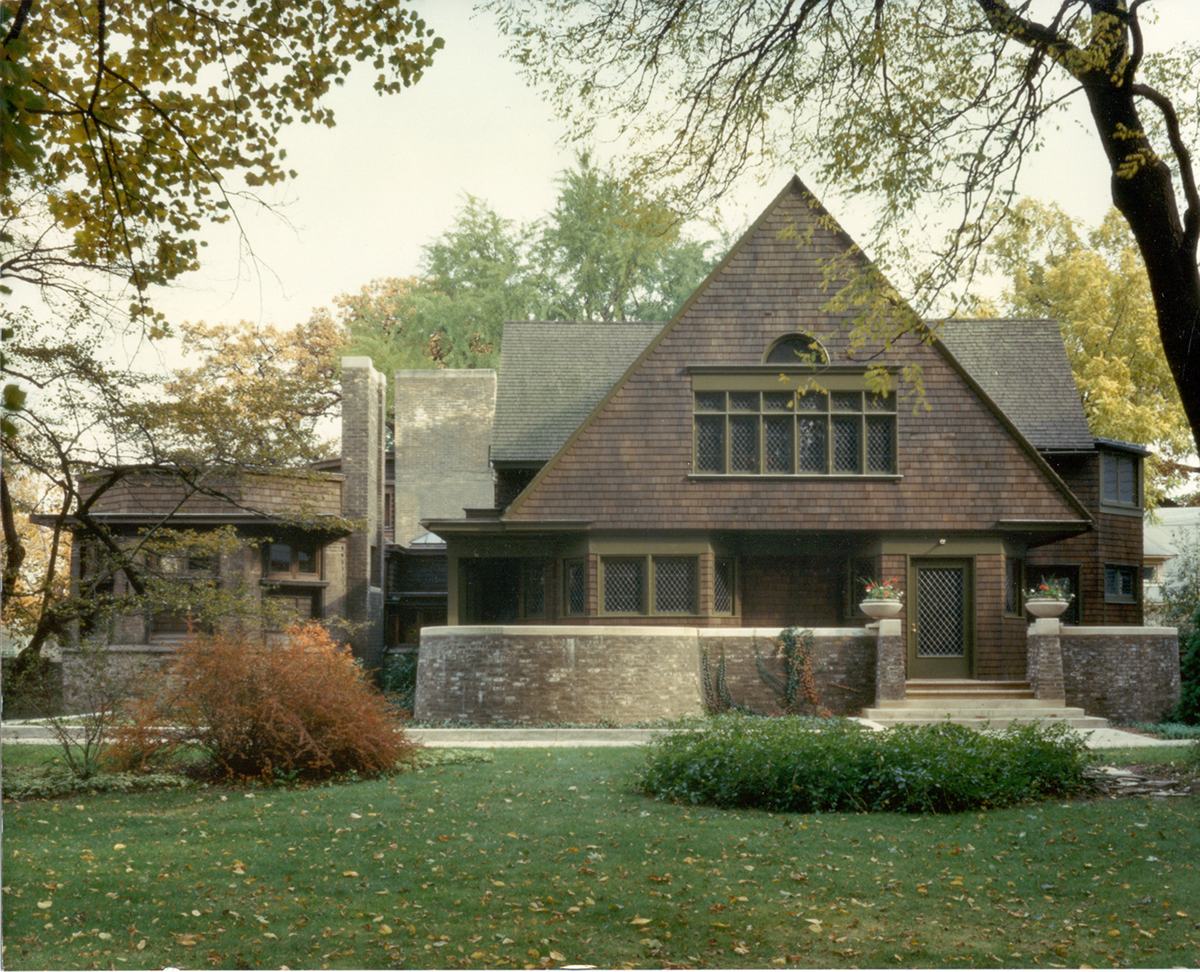
  The steep gables of the Platonic triangular west façade of the Wright home vaguely parallel the gingko vectors.  The lines of Wright homes 1895 – 1898 do to a lesser degree.  The lines of his studio, built in 1898 do not at all, nor does any part of the Prairie aesthetic.

  It’s probably my over active imagination again, but I wonder if at some point in the mid 1890s the alien acute angularity and proclivities of the gingko catalyzed the transmutation of shapes and shadows of local species into the leitmotif of his Prairie Style.  Hmmm…

 *Wright’s home was designed in 1889.  The  Frank Thomas home (above) just a block down  Forest Ave was built in 1901. 
 

Wake Up!

November 5, 2010


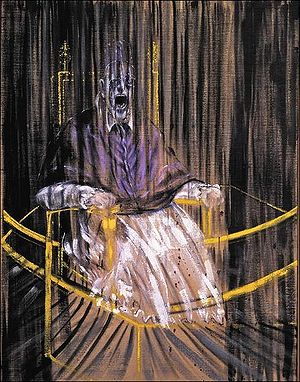
  The picture above is Study After Velasquez’ Pope Innocent X by Francis Bacon.  The one just below* is a shot of lead character Hannibal Lecter from the film Silence of the Lambs directed by Jonathan Demme.  I think that the similarity of the two images is striking. 

  Demme’s an art collector (though most well known for his Haitian stuff) and had to have been aware of Bacon’s oeuvre.  The cell in the Memphis courthouse is certainly not an exact transcription of the painting’s motif and could have been done subliminally or even completely by accident.  But, as someone once said “ mediocre artists borrow, great artists steal”.

  The arrangement of the prominent vertical brushstrokes in the Bacon work has the same visual impact and conveys a similar carnal apprehension as do the bars of the cell in the flic.  Both characters pervade beyond any limitation.  Like nightmares.

  Bacon said that he “had nothing against popes” and simply found their garb to be uniquely suitable for the colors with which he was then working.  Sure seems disingenuous to me.  He painted forty some in the series and the power of the images suggest otherwise.  Even though screaming heads appear throughout his body of work, they’re a fungible conceit.  It would be easy to impute certain recent horrific revelations and wonder about the possibility of the cathexis of earlier manifestations through Bacon’s brush.

  At any rate, the two images project – to me at least – horror from nearly opposite perspectives.  Bacon’s pope nearly empties himself in sanctimonious rage while Dr. Lecter speaks with the quiet confidence only available to a psychopath.  The former just barely obscures the abyss with his robes and incantations while the latter revels from its depths.  Bacon’s pope is like an exploding star while in Lecter Demme and Hopkins conjure up a black hole.

*Unfortunately, this is the scene, but not the shot I had in mind when I cobbled these thoughts together.  Those who’ve seen the film will remember the shinning cupola shaped cell assembled in a Tennessee courthouse for the sole purpose of containing Dr. Lecter.  There is drapery, furniture, and a comfortable chair.  Next time notice how it recalls the Bacon picture.

Dirt

October 29, 2010


  Sometimes while passing through the entryway to my grocery store I watch pasty sorts of folks assiduously scrubbing down shopping carts before touching them.  No foolin’.  A little exercise would boost their immune systems far more than the deficit a few germs might cause and would put a bit of color in their cheeks to boot.

   You can be too clean.  When I was a kid my MD grandfather would say that the healthiest babies were those nursed from coke bottles to which plastic nipples had been attached.  Recent research would uphold his observation.  As recounted in (among other places) a fine article by Melinda Beck in the 5-18-10 WSJ, the “hygiene hypothesis” holds that “exposure to a variety of bacteria, viruses, and parasitic worms early in life helps prime a child’s immune system much like sensory experiences program his brain”.

  The simile is made even more interesting by the fact that Gerald Edelman, awarded the medicine Nobel for his elucidation of immune system mechanics, was the one who later drew the analogy between it and neuronal development.  He coined the term “Neural Darwinism”.

  Allergies and autoimmune diseases were rare before the advent of modern sanitation and still are in the third world.  Furthermore, there are clinical trials underway (re)introducing bugs such as pig whipworm to the gut as treatment for those “modern” ailments.

  The article also points out that “children who grow up on farms have low rates of allergies and asthma”; “children who attend day care during the first six months of life have lower incidence of eczema and asthma”; “Having one or more older siblings also protects against hay fever, asthma, multiple sclerosis and Type 1 diabetes” (you’re welcome bro); and more.

  Very obviously however, one does not wish a return to the unsanitary conditions of yore.  The ultimate ramifications of poor water quality are even more pernicious than the obvious tragedy of an elevated infant mortality rate.  The energy drained by endemic diarrhea during impoverished youth will irreversibly attenuate cerebral potential and thus that of an eventual ruling class.

  But, still, here we are.  I once asked MD brother how dogs could drink from questionable puddles and not get sick.  He said “a better question is why we would”.  In the 10-15-10 Men’s Journal, Yvon Chouinard gave as his best survival tip that one should drink out of every stream one might fish.  Gave him a good gut.  “I can go to any country and eat out of the bazaars and don’t get sick.”

  Hmm.  Never seen catfish in a Patagonia catalogue…

*Top photo from the WSJ article

**Kid who rolled in paint went then to a mud hole.  Dad got in trouble.

***Bottom photo shows that we count on her for everything.      

How To Feel Good About Yourself

October 22, 2010

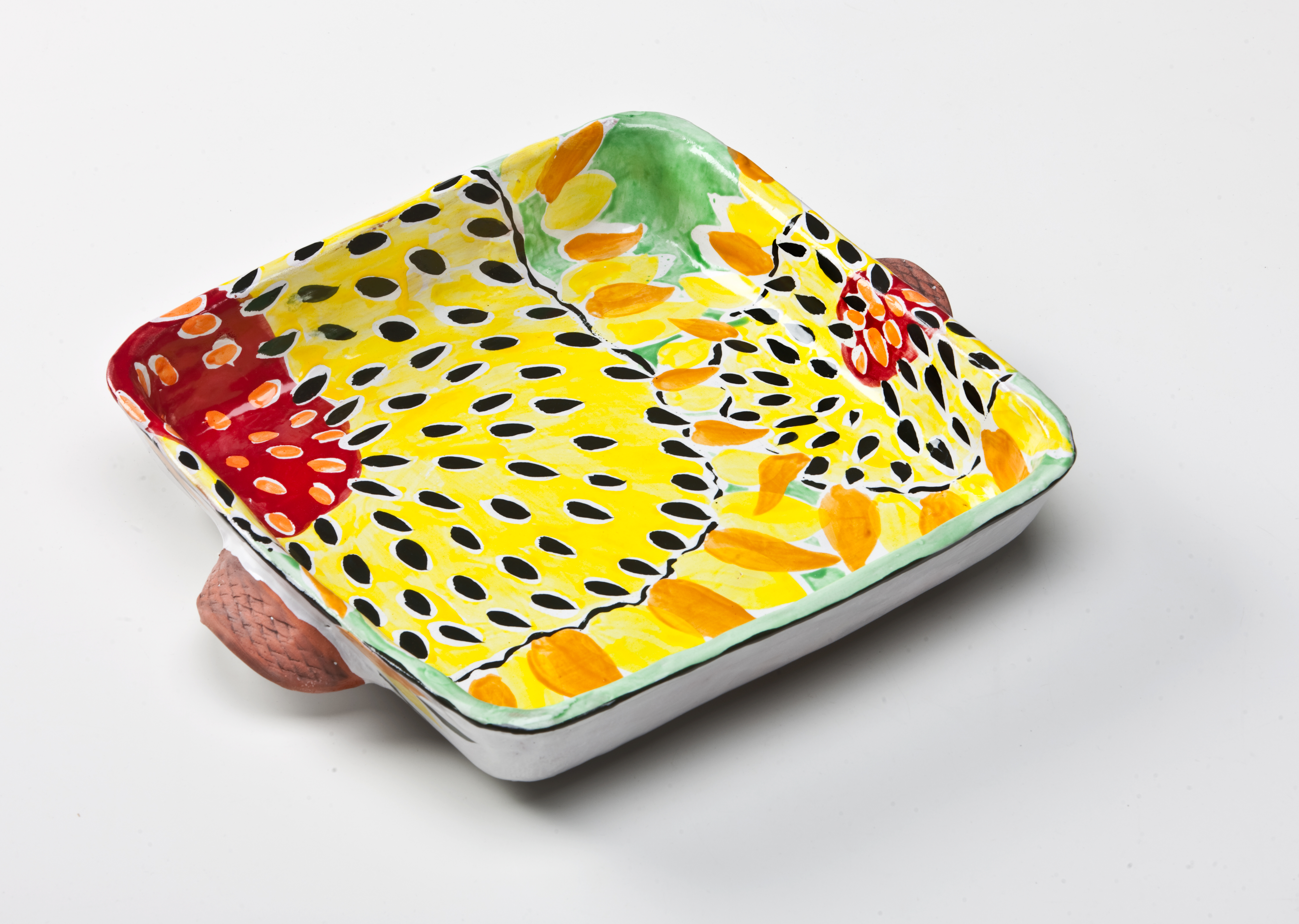
  Majolica is a type of earthenware ceramics characterized by rich design, broad and bright pallet, and glossy surface.  These attributes arise due to the presence of tin as the flux in the glaze.  The resulting relatively high viscosity restricts flow during firing and thus enables a sharpness of detail unusual in the surface treatment of fired clay.

  This ceramic style originated in the Middle East and accompanied the spread of Islam across Northern Africa and into Spain.  It got to Italy via the island of Majorca from whence the name.  Similarly Faenza, Italy was eponymized after sending examples to France where vessels of that nature to be called faience.  The Dutch waited for proficient differentiation and felt ok calling it Delftware.

  These centuries later, after mastering the requisite considerable skill, artists take the technique wherever their hearts might lead.  Well, my favorite artist has a huge heart and as you see here above and below, her work exudes joy and exuberance in uncommon measure. 

  The pieces are clearly functional and meant – no, yearn – to be used.  They engender the sort of feeling with which one finds him/herself imbued after a leisurely stroll through a fine farmer’s market lush with produce still sparkling with morning dew.

  That it is of a special nature I learned anew while reading an article* about, of all things, prosopagnosia – the impairment (slight to severe) of face perception.  Oliver Sacks wrote about an extreme case in his Man Who Mistook His Wife For A Hat.  While for that man the cause had to do with Alzheimer’s, in many it is simply a part of their neurological constitution.  

  I think my artist would agree that I have much greater facility with names and faces than does she though she can nonetheless quickly (and enthusiastically!) pick loved ones out of any crowd and that’s the point.  Observation and research suggests that emotion plays a large and discrete role in face recognition and in my artist emotion flows like the Amazon.

    Jane Goodall has the condition and is unable to put a name with a face (human or chimp) before some degree of a relationship has had a chance to evolve.  It’s no news flash that her heart and mind are well connected and it’s tough now not to speculate about the extraordinary manifestations of her particular constellation of synaptic connections.    

  Most interestingly, for the purpose herewith, is that well known portrait artist Chuck Close is severely prosopagnosic.  He believes that the condition “has played a crucial role in driving his unique artistic vision” which amplifies an initial visual impact into something just this side of a wonderful hallucination.

  I think that my artist is wired up in such a way that her manners of perception interweave with her ebullience to create a constantly evolving yet unmistakable body of work – from kids, to dogs, to food, and yes, to pots.  Look at her stuff, doesn’t it make you feel better about yourself?

*”Face-Blind”, by Oliver Sacks in the 8/30/10 New Yorker. 

The Endless Unknown

October 15, 2010


  In his work Lucian Freud conveys incredible emotional depth and complexity.  It should surprise no one that he is the grandson of Sigmund Freud and furthermore, for me, his oeuvre proves that the founder of psychoanalysis was on to something no matter what modern critics might say. 

  (L) Freud has said that: “Quality in art is inextricably bound up with emotional honesty”, which is not to say transparency.  He goes on: “The advantage of taking so long is that it allows me to include more than one expression”.  Ya  There’s a lot going on in the mind of the fellow above and it would take a lifetime of analysis or a lobotomy for any hope of eventual serenity.

  It is difficult to leave the gaze of a Freud subject such as the one above without, first, feeling the rumble of one’s own complexes.  The title of the picture above conveys this sense perfectly: “Reflection”.  Then, as you walk away, you realize that the frame of reference is much larger and you wonder about universal truths.

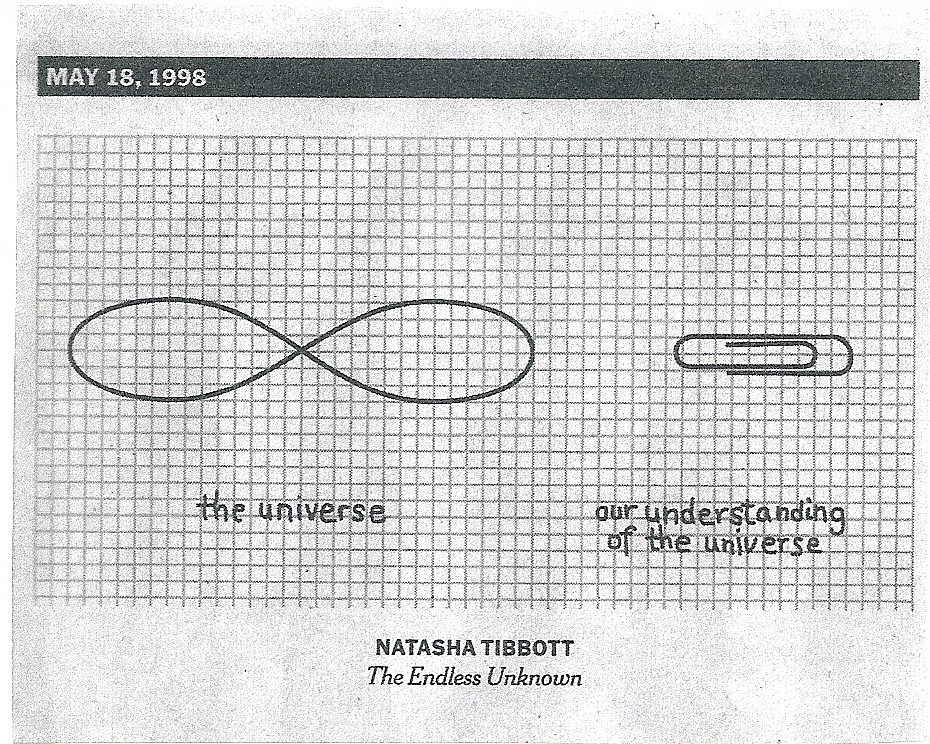
  Are there any?  I’ll bet that Freud would not be surprised to learn that recent research indicates that the laws of physics might not be consistent across the whole of our universe.  Or that some think that the human mind has reached its capacity for understanding the cosmos.  For the time being anyway.

  Juxtaposed with cave paintings or ancient petroglyphs carved into rock, Freud’s art embodies a sense of the degree to which consciousness has evolved thus far.  Oh, for a take some 10,000 years hence.  Try to imagine a state of mind holding an image of Freud in the same regard as we do not an ancient stick figure!

*The quotes have been drawn from an article in the 9/25/10 Economist.  Where else?

**The bit was a review of a new book I can’t wait to read: Man with a Blue Scarf: On Sitting for a Portrait by Lucian Freud.  The author, Martin Gayford calls Freud “omnivorous” in his search for “weight, texture and irreducible uniqueness of what he sees”.  I know the feeling.  See 1/31/09 and 4/10/09 below.

***Interestingly, just as a face or the representation of one can project outwardly with great force, so can inwardly a simple facial tactile experience.  The relative density of neuronal connections on a face is huge.  A recent experiment showed that continuous tweaking of just one whisker on the muzzle of rat stroke victim was enough to stimulate sufficient redirected blood flow to alleviate major damage.  WSJ 7/27/10

****Cartoon from the NYT


…All Sounds Are Music

October 8, 2010


  Just after putting up last post I turned on TV and there was the opening of August Rush.  No foolin’.  What adds to the amazement, given this particular turn of events, is that Sting wrote the music and lyrics for “Synchronicity”.  That’s the term coined by Carl Jung which has been defined as a combination of events that do not obey rules of time, space, and/or causality*.

  The film is the incredible story of the first eleven years in the life of the orphaned musical prodigy to whom you just listened.  He was the product of a chance, but seemingly meant to be, encounter between a classical cellist and an Irish rock musician. 

  Here’s a transcription of the opening lines: 

Listen. 
Can you hear it? 
The music. 
I can hear it everywhere. 
In the wind… 
… in the air… 
… in the light. 
It’s all around us. 
All you have to do is open yourself up. 
All you have to do… 
… is listen. 

  Several things interest me about those words.  First of all, they relate truth.  Music is sound and sound is vibration and as Daniel Levitin wrote in his This Is Your Brain On Music:  “… it would be difficult to imagine an advanced species that had no ability whatsoever to sense vibrating objects”.  Earthbound or otherworldly.  The science is quite convincing.

  In humans, music is wired into a brain more tightly than the perception of color.  If a particular note, say an A at 440 Hz, is played into an ear, certain neurons would fire at exactly that frequency.  Electrodes attached to those neurons would send out a 440Hz signal.  Nothing similar happens with vision and color.

  Secondly, the essential concept buried deep in that soliloquy goes way back.  All the way to Pythagoras.  It’s called ‘music of the spheres’ or ‘harmony of the spheres’.  It states that “heavenly bodies, being large bodies in motion must produce music… It is hidden from our ears only because it is always present…”**

  Thirdly, in between came American radical musician/composer John Cage whose work “4’33’’” debuted on August 29, 1952.  It consisted of him sitting before his piano for four and one half minutes without making a sound.  “There is no such thing as silence” he said.  “You could hear the wind stirring outside during the first movement.  During the second, raindrops began pattering the roof”.

  In a recent profile of Cage in the New Yorker*** scholar Kyle Gann calls the “4’33’’” “an act of framing, of enclosing environmental and unintended sounds in a moment of attention in order to open the mind to the fact that all sounds are music.”

  Below you will see the prodigy during his first encounter with a guitar in which he doesn’t exactly play it, but he’s not just sitting there either.   And it certainly is music.

*Critical Dictionary of Jungian Analysis

**Oxford Dictionary of Philosophy

***The New Yorker October 4, 2010

When the West Wind Moves

October 1, 2010


  That’s obviously Sting’s “Field’s of Gold”.  The piece is an incredible combination of emotive music and powerful poetic narrative.  It is said that the notion for the piece came to him as he walked through a barley field near his home not far from Stonehenge.

  Wind moving through that field catalyzed the thought of a young couple making love upon it – “See the west wind move like a lover so upon the fields of barley”.   From there the story of a relationship unfolds, develops, and matures.

  The song came out in 1993 on his “Ten Summoner’s Tales” album and I remember listening to it then.  It became one of two bits of music I set up as goals eight months ago when I began my relationship with a guitar.  I bought an “Easy Pop Melodies” songbook in June and turned to the page, but couldn’t even get started.

  Several days ago, I thought I’d give it a try again.  A few pickup notes and a single measure later I was almost overcome with surprise by having figured it out and with emotion at the power of the sound being made by my clumsy fingers.  I was shocked.  I felt like an apprentice wizard with a magic wand and spell book.

  Perfect timing for several reasons.  First of all is that the mostly corn and bean fields around here are ripening to gold just now and it is beautiful to move among them*.  It is at this turn of seasons – summer to fall – that one’s mind casts back a bit to consider lives lived thus far: 

Many years have passed since those summer days
Among the Fields of barley
See the children run as the sun goes down
Among the fields of gold. 

  Secondly, roommate’s out of town again and dang if that doesn’t heighten the impact of such music and rumination.  We have for the most part been able to “forget the sun in his jealous sky” but, pushing sixty, the pace of reminders has begun to quicken. 

*Of a sudden the opening of August Rush came to mind.  See it if you haven’t.

Headbone

September 24, 2010


     Sorry to break the news, but your erotic fantasies are but a collective by-product of more important machinations – those of the evolution of consciousness itself.  True, reproduction is the sine qua non of evolution in the first place. 

     It’s just that handcuffs, whips, etc. are not a necessary part thereof.  No prizes for guessing what is.  Furthermore, the sex life of most of earth’s creatures consists almost solely of an instinctual stimulus response arrangement operating strictly within certain biochemical parameters.*

      How did the human analogue of pollination come to be writ so large?  Air conditioning some think, in a manner of speaking.  When our anthropoid bipedal ancestors left the trees for the savanna they left behind shade – protection from the sun’s searing rays. 

Since a primary order of business for a warm blooded creature is temperature regulation, most importantly that of the brain, incremental improvements in an ability to radiate excess heat would be a distinct advantage.  Particularly in the sub-Saharan environment. 

       Thus, an incipient outer bit of tissue might have proven to be advantageous as first a radiator, later a tool designer, and much later “art” film producer.

      Much much later.  Some theorize that it was as recently as within the last several thousand years, citing the chastity of prehistoric murals and sculpture produced before 1000 BC. Soon thereafter an explosion of erotic representations appeared.

      Now, at this point of remove, many of the sensory receptors and inputs which heretofore have led to the horizontal have become vestigial.  Imagination may have become a key component of the reproductive system.

      Think about it.  What would your sex life be without the ability to reminisce, ruminate, and look forward?

*Watch an ‘unfixed’ male dog help sort the laundry of a mixed gender household. 

*cf post 9 3 10 re Hancher.  The U of I selected Pelli Clarke Pelli.  I’m sure they’ll do a fine job (and are thrilled to have my seal of approval) and I can’t wait to attend performances there (construction to start 2012).  Pelli is also the firm signed for an arts building (as yet unfunded) on the campus of Western Illinois University in Macomb…

We’ll Always Have Paris…

September 17, 2010


     That’s Manet’s Olympia and it came to mind for several reasons.  First, while following an Economist online debate* over the legal status of prostitution, the tone and argument of some of the sex workers who weighed in made me realize that the range of their experience is extreme.  For some (like those I wrote about below 5/21/10) it’s a living hell while for others (like lady above) it’s a hell of a living.  Fulfilling even.

  Seventy-seven percent of respondents were in favor of legalization.  The moderator cited the following main reasons: “governments should not … legislate for morals; …part of human nature; …decriminalization would make it easier to apply laws against sexual violence; criminalization distracts from real problems – trafficking, abuse, disease etc; and people become prostitutes for a variety of reasons, including voluntarily.”

  Manet presented the painting to the Salon in 1865**.  There was some praise, but much scorn.  Why? Paternalism.  Nudity has been part of art since stick figures were first scratched in the dirt.  Issue with Ms Olympia was her exudation of confidence and self assurance.  Comfortable in her birthday suit, further familiarity would be by her choice and hers alone.

  I first saw a representation of this picture during a lecture in college.  Beautiful I certainly thought she was.  However, that experience couldn’t have prepared me for an in-person take during a 1972 term abroad.  The picture hung by itself on a wall at the end of a rectangular room in the Jeu de Paume on the grounds of the Louvre.  Pulse way quickened, I returned many times.

  A decade or so later, I was in the neighborhood with my father who I knew would enjoy an introduction.  That painting and the rest of the Louvre’s Impressionist stuff by then had moved to a remodeled train station now called the Musee d’Orsay.  Initially overcome by the scale and expanse of the new space I used a map to hurriedly escort Dad to Manet’s masterpiece. 

  We rounded the corner and – I’ll never forget it – she looked like a pole dancer on break. I found myself apologizing for the big build up.  What could have happened?  It was obviously not the painting that had changed and I’m here to tell ya neither had my, uh, joie de vivre.    

  It was a whack in the side of the head.  I began to realize just how critical are placement and context.  My inchoate understanding was greatly aided by Victoria Newhouse in her Art and the Power of Placement.  Casually looking through that book I was shocked to find a chapter that began with that exact experience: “Forced out of what was to a generation of viewers Olympia’s flattering ‘dress’, the painting was suddenly thrust into something hideously unbecoming”.

  Simply put, the soft and intimate conditions of the Jeu de Paume had made for a transcendent experience.  At the d’Orsay paintings are hung on the walls of brightly lit masonry rooms like decorations on those of a columbarium.  Oh well, we’ll always have Paris – err, The Jeu de Paume.****  

*http://www.economist.com/debate/overview/182 There were more than 300 comments; some instructive and some very interesting.  The effective difference between decriminalization and legalization for example.

**The same year the Civil War ended and the Matterhorn was first climbed.

***If you don’t get the allusion, you should.

Salutations!

September 10, 2010


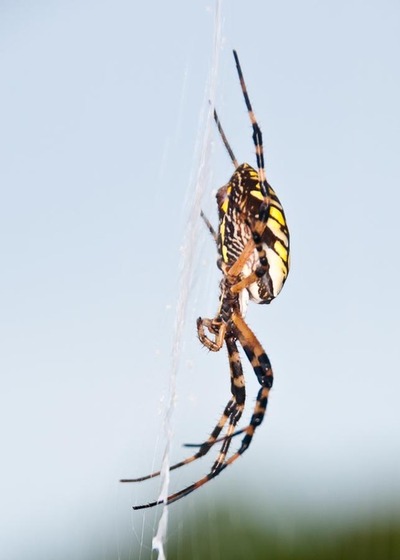
  Ever watch a garden spider spin her web (yes, only the girls make the big ones)?  It’s an amazing process requisite of a highly evolved bit of anatomy.  There are six different glands nearly filling a spider’s abdomen each producing different sorts of silk.  Ductwork connects the glands to spinnerets, which are in fact repurposed vestigial legs.

  When ready to set up her redoubt our little friend secures a perch some distance above the ground or any other more or less horizontal feature.  She then simultaneously secretes silk from several of her spinnerets divergently aimed.  Light wafts of air will thus cause the threads to loosely combine and form a sort of kite.  With luck, said waft will carry said kite downwind TO sticks to some solid surface.

  She will then grab the secured line with her hind legs and begin to roll it up while simultaneously attaching a new one behind her by which to let herself across – still aloft.  Once to the middle, she connects the two ends and lets herself down.  Critically, she then moves a few paces perpendicularly one way or another before affixing that end thus ensuring that the plane of the finished product will be inclined.

  Complex, but similar steps create the rest of the web’s framework.  Last but not least is the sticky part – the only sticky part.  Working from the outside toward the middle she winds a spiral of thread beaded with a glue like substance.  Guess the reason for the inclined orientation of the web plane?  Ms. Spider moves about her orb by grasping the nonstick  framework from its underside.  Neat huh?

  Even though she has eight eyes, she doesn’t use them to locate entrapped quarry.  Instead, she employs a remarkable sense of touch.  The impact of, say, a fly would of course be very apparent due to the reverberation.  To find and dispatch fly before it dispatches itself, spider plucks the threads like an angel of death with a guitar strumming a chord in a minor key. Specific vibration pattern pinpoints next meal.

  Now even if you’re an arachnophobe (and I’m related to at least one with a real problem*) that is pretty amazing.  No matter what your metaphysics, you have to agree with the preacher in E.B. White’s Charlotte’s Web: “…human beings must always be on the watch for the coming of wonders”.        

  Remember Charlotte?  A great book.  Eudora Welty called it “just about perfect… about friendship on earth, affection and protection, adventure and miracle, life and death, trust and treachery, pleasure and pain, and the passing of time.”**

  Here’s Charlotte telling spring pig friend Wilbur how to construct a web: “Take a deep breath.  Now climb to the highest place you can get to.  Then make an attachment with your spinnerets.  Throw yourself into space and let out a drag-line as you go down.”  A plenty good description for a naïve little pig.

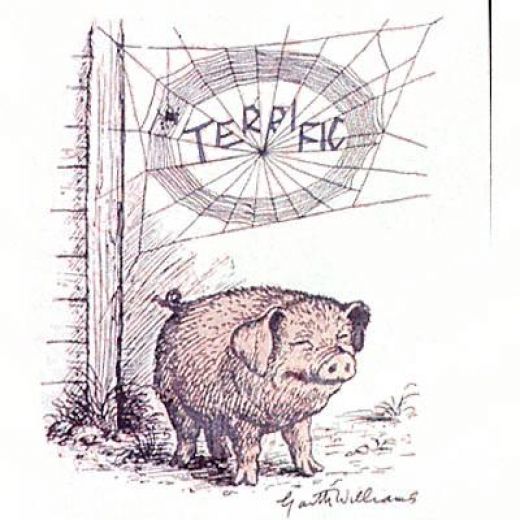
  As I’m sure you’ll recall, Charlotte soon uses her skills to save Wilbur from getting turned “into smoked bacon and ham”.  Farmer Zuckerman and soon neighbors from near and far marvel over patterns in Charlotte’s web that first read” “SOME PIG”, then when people seem to get bored with that “TERRIFIC”, then “RADIANT, and finally “HUMBLE”. 

  At one point rat friend Templeton suggested “crunchy” to which Charlotte responded “Just the wrong idea” for obvious reasons.  Asked about all that effort in his behalf she responds: “You’re my friend, Wilbur.  That in itself is a tremendous thing.”

  Wilbur returns her vital favors by ensuring the safety of her egg sack and its 514 occupants.  As we leave the scene, Wilbur regales several progeny, Joy among them, with tales of their mother.  You should maybe reread the book.  Besides the simple vocabulary, it’s easy because as Ms Welty also wrote: it is “a book for children, which is nice for us older ones as it calls for big type.”

*One time oldest daughter awoke in a small room to see a web wove just above her – plane parallel to floor – and affixed to all four walls.   She not same since.

**NYT 10/15/52

***”Salutations” was the first word Charlotte was heard to utter as well as that of daughter Joy both in address to Wilbur.