On Y Va – Let’s Go

June 25, 2010


   See the US v Slovenia soccer game June 18?  That’s the one during which ref Koman Coulibaly called back a US would have been game winning goal.  Big deal certainly in a contest of such importance, but shit happens and the US ended up playing through anyway.

  Interesting thing is that the ref’s last name brought to mind a favorite track on a great CD.  Coulibaly is a common surname in the Bambara language spoken in part of West Africa.  (ref Coulibaly is Malian).  Biton Coulibably (1689 – 1755) was a pre-colonial empire builder of whom there is great regional pride.  Below is a photo of his grave near Segou Mali.

  A track eponymously entitled on Dimanche a Bamako (Sunday in Bamako) laments “Where is Coulou against whom one can lean?”.  It’s a great album by two known as the “Blind Couple from Mali” – Amadou and Mariam – with a lot of help from the guru of world music Manu Chao.

  The record starts almost sweetly, conversationally, with expressions of love.  Tone changes and momentum builds quickly with ‘Coulibaly’ sweeping one up and along.  Dang tough thereafter to disengage. 

  A broad range of subjects are addressed including: the stark reality of daily life in Africa; difficulty of being an artist; sorrows wrought by politics; the fundamental beauty of weddings; first person pleas for fidelity; and more.

  ‘Taxi Bamako’ is another favorite of mine.  The phrasing and easy pace induce a vision of just what a cab ride in the capital city might be like.  Earnest, but not too.  Neatly anthropocentric.  Would have been perfect in the flic Cars.  On y va.  Come on let’s go.

  The lyrics are in French, but relatively easy to translate, although those sung don’t exactly match the accompanying hard copy.  Doesn’t matter if you chose not to try though for the music, voices, and wealth of ambient sounds combine for a hypnotic experience.  Don’t attenuate its potential by downloading just one bit.  That’d be like reading one chapter of a book or watching one act of an opera.

TAXI BAMAKO

Taxi Bamako
Ou tu veux, je t’emmene
Taxi Bamako
Tu m’appelle je suis la
Taxi Bamako
Je suis le plus rapide
Taxi Bamako
Tu est ma seule cliente
Tu t’assois, je conduis
On traverse le pont
Je fais ma course au ciel
J’evite tous les traffics, les problemes
Mecaniques
Je suis le pus rapide
On traverse le pont
Je fais ma course au ciel
Tu t’assois, je conduis 

TAXI BAMAKO

Taxi Bamako
Where you want, I take you
Taxi Bamako
You call me, I am there
Taxi Bamako
I’m the fastest
Taxi Bamako
Your’re my only fare
Sit down, I’ll drive
We’ll cross the bridge
I make my way by the sky
I avoid all the traffic
And mechanical problems
I’m the fastest
We’ll cross the bridge
I’ll make my way by the sky
Sit down, I’ll drive

*Ref in yellow shirt is Komar Coulibably
58

June 21, 2010


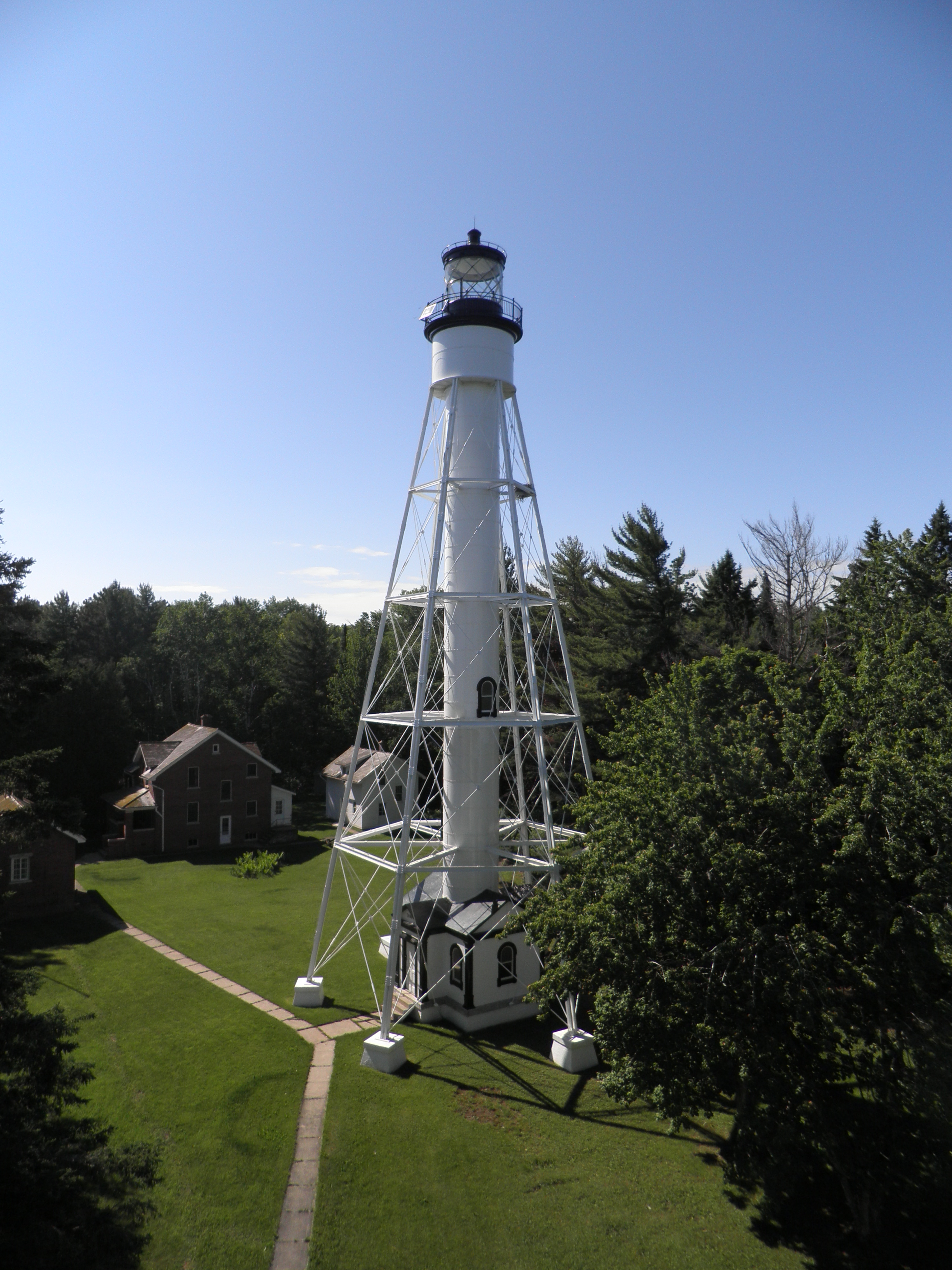
   That’s  the light tower on Michigan Island in the Apostle archipelago on Lake Superior.  This National Seashore area holds the highest concentration of light towers in North America.  They take a variety of forms and shapes, are in good condition, and all quite picturesque.  The day after this visit we sailed to Devil’s Island, the northernmost.  We’d hoped to go ashore there to, but the winds were shifting so we listened to the NOAA weather report.  Big storm coming.  Strong winds from the south.

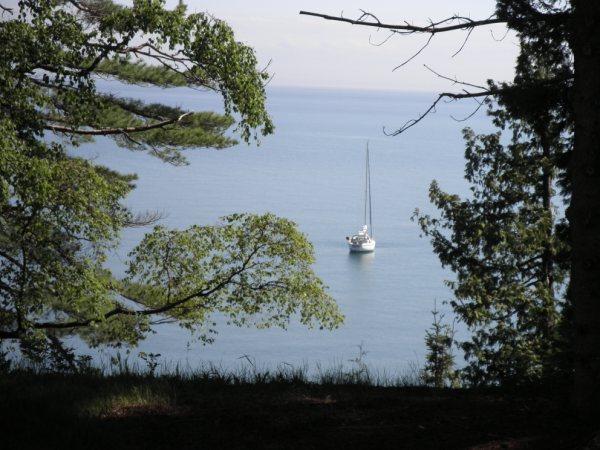
   Change of plans. Checked the chart and made for a bay approximately fifteen miles away that opened only to the north and set anchor.  Did then ‘batten down the hatches’, had a great chicken curry dinner, and slid into our sleeping bags to get what rest we could before the sound and fury.  It arrived at about 10:30PM.   We were obviously protected from the worst of the wind, but were still violently rocked by the waves.  They rolled us so severely that the mast nearly slapped the water repeatedly on both sides.

  Fortunately, it wore out before did we and a fitfull sleep ensued until about 8:00 AM.  It was our last day and we were anxious to set sail for our last stop – Madeline Island – the only inhabited one of the group.   We’d heard it was a neat/funky sort of place and a fine spot to celebrate my birthday.   After brewing the coffee I went forward to raise the anchor.  “Better hold off on that” said wife from the cockpit.  “Engine won’t start.”

  Thing turned over ruling out electrical issues.  We figured that the storm had either shaken up sediment in a fuel filter overdue for change or somehow introduced air into the system.  Having no spare filters or tools we going to have to do everything the old fashioned way.  Which we knew was going to be brutal because we were a long way from home and the wind was a steady twenty-five to thirty nm/h blow directly down our course.

  Wife at helm I pulled out the headsail a bit while son took anchor just off bottom ready to reset if necessary.  Breeze took the jib and bow with it around and to a downwind course.  Pulled the sail the rest off the way out and stowed the anchor.  Raised the main and into the channel we made it.   Unfortunately another problem soon presented itself.

   Sailing upwind requires one to beat back and forth as far toward the direction of the wind as sail design will allow, in this case about fifty degrees off.  In strong winds it is important that the main swing fully from one side to the other  so that some of its force is allowed to spill off and you’re not overpowered.  On the Marcie however, the apparatus that positions the boom (“traveler”) would be moved only with great difficulty.  Fearful of it getting stuck in the middle during a change of course we decided to furl the jib so that problems couldn’t compound during a tack.  This made the helm a bit heavier and forward progress slower.

  Though, as son pointed out, we were up there to sail and that we surely did.  The island’s rich red cliffs and dense green forest salved the chafe of the elements.  Wind seemed to calm a bit and we raised the jib.  Quite better progress until the problem we foresaw above did manifest.   Son put his considerable back into the traveler and we furled the jib for the rest of the day.

  Some ten hours later we were sunburned, wind whipped, exhausted, but portside.  We furled the sails, cleaned up, hosed off, and enjoyed a very fine birthday spaghetti dinner with billowing pink cumulus providing the pyrotechnics.  Drank a bit of wine and sat around philosophizing.

Ahh

Yes

June 11, 2010


  In the June 10, 2010 New York Review of Books noted British American physicist and mathematician Freeman Dyson reviewed a new book by Nobel Prize winner physicist Steven Weinberg.  The tone is largely positive, but toward the end Dyson makes an interesting observation.

  He says that Weinberg juxtaposes “militant atheism” on the one hand and absolute faith in the ability of science to explain everything on the other.  He tells us that Weinberg believes that science will soon have developed a “Final Theory” with a set of mathematical rules precisely describing every aspect of our universe.

      Dyson: “I distrust his judgment about philosophical questions because I think he overrates the capacity of the human mind to comprehend the totality of nature.”  I couldn’t agree more.  I think that our understanding of the universe has grown and will continue to grow at the exact pace of the evolution of our consciousness.

  A hope that absolute truth exists is misguided and a belief that one does often gets sublimated, cathected, and comes out as arrogance at best and fundamentalism at the extreme.  To make a contribution to the common consciousness and enjoy the experience, one need only find a way to be comfortable living in the question of it all.

  And next Wednesday being Bloomsday, of what better example might one think than Ulysses?  June 16 was the day of Leopold Bloom’s perambulations about Dublin in James Joyce’s great novel.  It is long, complex, and of beautiful erudtion.  One of its themes is the concept of parallax which in this case can be defined as the enhancement of an observation by the integration of differing perspectives.

  The three main characters provide this in great measure.  Molly Bloom’s famous final almost unpunctuated forty plus page stream of consciousness reconsiders many aspects of her life and relationships and concludes with joy and affirmation:

“…as a girl where I was a Flower of the mountain yes when I put the rose in my hair like the Andalusian girls used or shall I wear a red yes and how he kissed me under the Moorish wall and I thought well as well him as another and then I asked him with my eyes to ask again yes and then he asked me would I yes to say yes my mountain flower and first I put my arms around him yes and drew him down to me so he could feel my breasts all perfume yes and his heart was going like mad and yes I said yes I will Yes.”

*Joyce picked June 16 because that was the day of his first date with the woman who would be his wife.      

**There is beauty in the video clip, but it is no match for a reading of the prose.  Yes?

An Unplanned Allegory

June 4, 2010

  Smoking is nasty, dirty, and deadly.  I know that all too well.  I’ve tried it though and have been in the sway of its allure for many years.  In fact, I was in a cigar smoking club while in kindergarten.  We lived near a farm and a friend whose father always had a box of stogies on his desk would purloin a few and meet the rest of us in Farmer D’s apple orchard.

  I was the only one who could finish one.  Maybe that’s why I’m the shortest in the family.  I smoked a pipe for a while and tried cigarettes.  Thankfully, nothing stuck.  My favorite part was fidgeting with the paraphernalia – lighters and all.  I became quite proficient at rolling my own, but, uh, that’s another story.

  What is interesting to me now is how cigarette smoking is portrayed in modern cinema.  The actual act, I mean.  Next time you’re watching a movie and someone has a butt in hand notice carefully what happens when it gets to a mouth.  You will almost certainly witness a very poor bit of business no matter between whose even Oscar winning fingers it is held.

  Anyone can be cool, graceful, tremulous, or whatever’s appropriate to the role from pack through ignition.  However, lips once pursed, chest has to raise as lungs fill or it looks fake and taints the whole dang flic.  99% of the time you get the feeling that the actor either is worried about his/her own health or else is stealthily furthering his/her own antismoking campaign.   

 What would be the right thing to do?   Faithfully portray the character, as imagined by its creator, to the best of one’s ability or ask for a rewrite?  The solution I’ve just described is a compromise that I’m surprised to see condoned by today’s top talent.

  When this issue comes to mind, I’m drawn back to the opening sequence of The Client in which a young boy sneaks a couple cigarettes from his mother, goes into the woods with his brother, and they light up.  Looks real to me and the sequence conveys more about those two characters than dialogue ever could.

  The tragedy though is that Brad Renfro won awards for his portrayal of the older brother, but died of an overdose at age twenty-five.  Perhaps the bright lights were more than he could handle, but I wonder if instead that the long draw at age ten evidenced a naïve slipping of his skin to such a degree that it could not be made snug again once shooting stopped.      

In The Clover

May 28, 2010


  Another favorite constituent of my lawn, exterminated (+/or extirpated) from most others, is clover.  Like the bird’s foot trefoil mentioned above*, it is a member of the pea family – Fabaceae.  It is most widespread in North America, but can be found the world over.

  Much of the year (spring to fall) it but adds to the verdant carpet out front.  Just now however, the plants’ spiky flowers are making their presence known.  And not just by virtue of their small scale beauty.

  Stand before a field of clover in bloom on a warm day with a faint breeze wafting toward you and you’ll see what I mean.  Or, uh, smell what I mean.  It’s incredible.   You’ll be caught off guard and transfixed.  Instantly aware of its ephemerality you won’t move so to enhance and prolong the experience.     

  Now is the time to seek out this marvelous opportunity.  If it is windy or if you’re breathing heavily your olfactory will be numbed past its threshold for delicacy so take care.

  Fortunately for conformists surrounded by nothing but fescue, bluegrass, etc several varieties of clover are cultivated as fodder.  Put yourself downwind of an acre of the stuff and you’ll think of heaven for a moment until it dawns on you that you’ll be inhaling the flinty scent of fire and brimstone for a long time before the visit with St. Peter.

  The Wikipedia clover entry holds that the phrase “to be in clover” grew from the use of the plant by farmers to fix nitrogen in the soil after harvesting their primary crop.  They were done for the season and could relax.

  Could be, but I’ll wager that the person who wrote that had never had the pleasure I’ve just described. To me, “Being in clover” is a metaphor for a state less like relaxation and more like exaltation.

*July 17, 2009

**Ever after first such experience, each time you snap the cap on your honey bear the memory will flash back as you remember that most honey is made by bees from clover.

Mermaid Who’d Lost Her Way

May 21, 2010


  I’ve been driving from the same office to the same house for thirty plus years and have always enjoyed the opportunity to unwind a bit and look forward to getting home.  I do though like variety and thus frequently change my route.

  It’s long enough (+/- ten miles) that many alternatives present themselves and by now I’ve tried most.  Attendant cerebrations are the typical jumble of present past and future unless I take one certain very short industrial stretch connecting two busy streets with windowless rusty buildings on either side.         

  I first got the sense of the place years ago when a vehicle slowed down in front of me, passenger door opened, woman jumped out, and car sped away before door was properly shut.  Suspicions aroused I began to notice the demeanor and countenance of the disheveled females standing there all alone.

  Yep, sometimes, there stands a prostitute with her hook in the water and I’m forced to review my narrow take on reality.  None of them have ever reminded me of Julia Roberts (Pretty Woman) or Xaviera Hollander (“The Happy Hooker”) or even Ashley Dupre (Eliot Spitzer). They’re unkempt, furtive, wary, and certainly don’t evince a high level of job satisfaction.  In all of these years I have never seen one smile.

  What could have happened to these poor souls?  They had to have been once sweet and innocent.  What terrible journey led them to solicit all manner of horror here, in a small town, not far from a bend in the river?   

 Fable of the Mermaid and the Drunks

by Pablo Neruda

 All these fellows were there inside
when she entered utterly naked.
they had been drinking, and began to spit at her.
recently come from the river, she understood nothing.
she was a mermaid who had lost her way.
the taunts flowed over her glistening flesh.
obscenities drenched her golden breasts.
a stranger to tears, she did not weep.
a stranger to clothes, she did not dress.
the pocked her with cigarette ends and with burnt corks,
and rolled on the tavern floor in raucous laughter.
she did not speak since speech was unknown to her
her eyes were the colour of faraway love,
her arms were matching topazes.
her lips moved soundlessly in coral light,
and ultimately, she left by that door.
hardly had she entered the river than she was cleansed,
gleaming once more like a whitel stone in the rain;
and without a backward look, she swam once more,
swam toward nothingness, swam to her dying.

 Fabula de la Sirena Y los Borrachos

 Todos estos senores estaben dentro
cuandoella entro comletamente desnuda
ellos habian bebido y comenzaron a escupirla
ella no entendia nada reciensalia del rio
era una sirena que se habia extraviado
los insultos corrian sobre su carne lisa
la inmundicia cubrio sus pechos de oro
ella no sabial llorar pore so no llorba
no sabia vestirse pore so no se vestia
la tatuaron con cigarillos y con corchos quemados
y reian hasta caer al suelo de la taberna
ella no hablaba porque no sabia hablar
sus ojos eran color de amor distante
sus brazos construidos de topacios gemelos
sus labios se cortaron en la luz del coral
y de pronto salio por esa puerta
apenas entro al rio quedo limpia
relucio como una piedra Blanca en la lluvia
y sin mirar atras nado de Nuevo
nado hacia nunca mas hacio morir.

 *The image above is of a print from a series by Eric Avery.  An artist MD with a social conscience.  “His social content prints explore such issues as human rights abuses and social responses to disease, death, sexuality, and the body”.  Check out his stuff at www.docart.com His work can be found in the collections of (among others) The Fogg, The Library of Congress, The Philadelphia Museum of Art, and The Boston Museum of Art.

Ya Baby

May 14, 2010


   Ever see True Lies?  It’s an action-comedy flic in which, early on, main protagonist spy Arnold Schwartzenegger returns home after a few days of violence and intrigue in Switzerland.  Unknowing wife, played by Jamie Lee Curtis, asks “How’d it go at the trade show, you make all the other salesmen jealous?”

  That bit came to mind recently after perusal of both the digital and paper versions of the Economist.  First, in the “Executive Focus” section of the magazine, a posting asks: “Where else could you deliver intelligence to Whitehall, protect your country, and pretend you had a boring day at the office?”

  Then, online same day, an imperative popup: “Make a world of difference – Clandestine Service – The Ultimate International Career”.  The first (as I hope you guessed) was an advert for the British Intelligence service MI6/SIS.  The second was for our own CIA.  I had to check it out.  

  …”There are some fundamental qualities common to most successful officers, including a strong record of academic and professional achievement, good writing skills, problem-solving abilities and highly developed interpersonal skills.  Overseas experience and languages are important factors as well.  Officers must be perennial students…”

  Check.  So far so good.  “The CIA offers exciting career opportunities and a dynamic environment.  We’re on the forefront of world-altering events – as they happen.  So working here isn’t just a job, it’s a mindset and a lifestyle.”  Copy that.

  Ok, let’s try the personality quiz.  First question: “Which activity would you like your mission to include: a. Rock Climbing, b. Dining on haute cuisine, c. Surfing the waves, d. Shopping on Rodeo Drive, or e. Reading a best selling novel.  OMG!  I’m in!

  Uh, oh.  Maximum age is thirty-five without special dispensation.  Hmm.  How about if I tell them that I agree with John Le Carre in that “A desk is a dangerous place from which to view the world”?  And that I’m an oenophile like famed expert Frank Schoonmaker who was in the CIA’s predecessor, the OSS.  Or that I’m interested in art like Brit Poussin expert and spy Anthony Blunt?*

  Uhm, the application begins with this admonition:  “Friends, family, individuals, or organizations may be interested to learn that you are an applicant for the CIA, but widespread public knowledge of your Agency affiliation could limit your opportunities.  We therefore ask you to exercise discretion and good judgment in disclosing your interest in a position with the Agency.” 

  Guess I better just push delete, get my passport, pack my tuxedo, grab my rope, and go. Ya Baby!

*Well, Blunt was probably a poor choice here especially since there are other nonfictional examples of connoisseur spies.  He turned and provided information to the USSR.   But then again, late in his life he expressed regret and claimed to have been blinded by a personal crusade against fascism.

** Here’s the link if you’re a US citizen: https://www.cia.gov/careers/index.html and here if you’re British: http://www.mi6officers.co.uk/

Universe In A Grain Of Sand

May 7, 2010


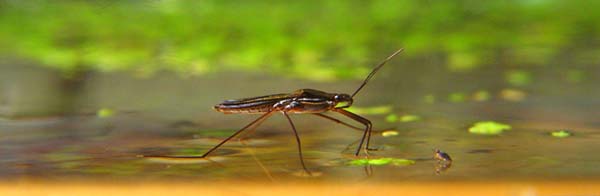
  The April 2010 issue of National Geographic recounts research undertaken by John Bush and David Hu into the locomotion of those bugs that stroke silently across the surfaces of ponds and lakes – water striders.  Until these MIT grad students* looked into it, the thinking was that the insects created tiny waves that propelled them forward.

  That theory was first compromised by “Denny’s Paradox” which showed that wave propagation could not account for the movement of baby water striders because legs of the newly hatched are too short to make waves.  Applying mathematical analysis to high speed photography Bush and Hu found the truth to be entirely different. 

  The surface tension of the water allows the bugs to stand upon it without poking through.  Essentially, each foot makes an indentation in the surface much as would a human foot upon a trampoline thus also similarly imparting energy thereto.  Their middle legs use this energy to make themselves sort of bounce forward. 

  This reminds me of Einstein’s Theory of Relativity.  It is the impression of matter, such as the earth, upon the fabric of space-time that makes for the motion of heavenly bodies.  In a sense, the moon rolls around the rim of the depression in the universe made by our little blue planet.  And us around the sun etc. 

  Just as the three dimensions of a pond develop energy by the actions of a bug upon it, so do the four of our universe by virtue of our presence in them.

  I think.

*Their work was first published in an MIT newsletter 8/6/03 and in the journal “Nature” the following day.

At Least It’s A Start

April 30, 2010


  Ever see “Un Chien Andalou”, the film Luis Bunuel and Salvador Dali released in 1929?  It epitomizes one sort of surrealism in that the scenes make no real sense and in fact seem like a hyper real dream sequence.  No meaning I guess but what might be given up to psychoanalysis which is a scary thought given what follows.

  The opening montage is one of the most disturbing in all of cinema.  I found it on YouTube, but chose not to import it here.  The photo above is from the first bit and I’ll tell you that the other hand holds a straight razor.  To also know in advance (if you chose to seek it out) that in the next few frames is a dead donkey stand-in will effect  no comfort.

  I thought of this yesterday when I read that a new music video by Sri Lankan M.I.A. was sensored from YouTube.  Son had taken me to it the previous evening.  It is by Romain Gavras, the son of the maker of award winning overtly politically themed films (“Z” most famously) Costa Gavras. 

  The video by Gavras fils employs graphic violence to convey it’s message, but you know you’re watching a movie.  The raw technique employed by the eighty years older segment bypasses your intellect.

You’ve been warned.  Me, I’d have allowed the former to continue to play and will forever try to repress my big screen memory of the latter.

  I shave with a straight razor.  Taking it against the strop (and occasionally a stone) somehow sets an early rhythm for the day.  But more important is the sort of early edge it puts on my consciousness.  Ya sorta gotta pay attention.  Dreams left behind and matinal ruminations bypassed, I’m reminded that the moment present is all there is.

  And forget soon after, but at least it’s a start.

*Un Chien Andalou translates from the French as “An Andalusian Dog”.  And if you don’t know what the Andalusian Peninsula is you had better figure it out before our paths next cross.

**Interesting that both leading actors from the Bunuel flic took their own lives.  The woman by self immolation…

***The obvious didacticism blunts the effect of the violence of the Gavras video which, upon reflection, is the case of at least several of his father’s films as well. 

****Didacticism aside, Gavras pere’s films get their point across.  His “Missing” (1982), which was about Les Disaparecidos in Pinochet’s Chile, led to a $150 million lawsuit by the real counterpart to the fictionalized US ambassador to that country.  It was dismissed.  And though Pinochet died without having been convicted, he was forced to weave in and out of legal processes for the last decades of his life.  And star of the movie Jack Lemmon died of natural causes.

*****The M.I.A. video can be found on her website: www.miauk.com

The Tyrant Next Door

April 23, 2010


 I don’t get lawns.  I mean, I’m glad I have one and I revel in its revivification each spring.  I’m just not particularly particular about its constitution.  Green is great, but green alone lacks drama and verve.  What is up with the incredible close cropped homogeneity that pervades most of suburbia? 

  Well (you read it here) it’s the outer manifestation of a sequestered  concern that there might not be order in our universe – which of course there is not.  At the beginning, for a moment, it was indeed highly organized.  Since, however, we’ve been hurtling toward ever greater disorder.  Entropy.  The universe is a mess, getting messier by the moment, and there’ll be no turning back the arrow of time.  Too bad, so sad.

  The more assiduous the lawn care, the more every blade in a lawn is identical and oriented just so, the more bottled up inner turmoil can logically be assumed to inhabit the owner determined to beat his little part of the planet into submission.  Just watch the reaction after a kid cuts a path and you’ll see what I mean.  Jeers and tears all out of proportion and to no good end.

  Makes me think of Thomas Hobbes.  His Leviathan, published in 1651, is perhaps the most important work of modern political theory.  In it Hobbes asserts the necessity of an iron fisted central authority strong enough to preclude civil disorder as well as to enable a credible defense. 

  It made certain sense back then, especially given the provenance of his thinking.  Told that the approach of the Spanish Armada jolted his mother into labor, he later said that “I was born the twin of fear.”  His point of perspective though didn’t allow him to foresee twentieth century totalitarianism and the associated agony and horror left in its wake.

  Sure, civil society must most certainly be.  But not to the point of heartlessness and cruelty.  As the Dalai Lama says, “The purpose of our lives is to be happy” and dandelions can help.  They are bits of beauty that arrive on their own, unannounced. If allowed, they can provide emotional counterpoint to Hobbes’ famous dictum that “life is nasty, brutish, and short”. 

  Walt Whitman, among others, would agree.  From Leaves of Grass:

Give me the splendid silent sun with all his beams full-dazzling,
Give me juicy autumnal fruit ripe and red from the orchard,
Give me a field where the unmow’d grass grows,
Give me an arbor, give me the trellis’d grape,
Give me fresh corn and wheat, give me serene-moving animals
  teaching content,
Give me nights perfectly quiet as on high plateaus west of
   the Mississippi, and I looking up at the stars,
Give me odorous at sunrise a garden of beautiful flowers where I
  can walk undisturbed.
Give me for marriage a sweet-breath’d woman of whom I should
  never tire,
Give me a perfect child, give me away aside from the noise of the
  world a rural domestic life,
Give me to warble spontaneous songs recluse by myself, for my own
  ears only,
Give me solitude, give me Nature, give me again O nature your
  primal sanities!

*Finally, I’m ecstatic to report that the January 2, 2010 Economist (what else?) tells us that dandelions “may yet make the big time”.  They might supplement or even replace Hevea brasiliensis which is the scientific name for the traditional rubber tree.  Can you imagine what a field of them would look like?