Judd Viburnum

April 16, 2010


  Marie Winn wrote The Plug in Drug in 1977 examining the effects of television on the developing minds of young people.  In the 25th anniversary edition she put the range of new electronic media under her scrutiny and, among other stuff, gave it all as the cause of a significant decline in average SAT scores of US high school seniors.

  Remember how I’ve described many times how the brain wires itself up through interaction with its own particular sensory environment?  A new book, iBrain* explores the effects of “growing up digital” on neuronal development.  The authors tell us that “Because of the current technological revolution, our brains are evolving right now – at a speed like never before”. 

  They demonstrate how addictive technology can be and that even just intent perusal leads to a diminution in social skills.  “With the weakening of the brain’s neural circuitry controlling human contact, our social interactions may become awkward, and we tend to misinterpret, and even miss subtle, nonverbal messages.” 

  The apparent purpose of the book is to identify this and other ramifications of modern media along with ameliorative suggestions.  It describes a “brain gap” between older and younger minds – ‘digital immigrants’ and ‘digital natives’ –  and how to narrow it.  The tone is not dire, but optimistic and hopeful.  Still… 

  It is well known that the average American spends far more time in front of some sort of screen than engaged in any sort of physical activity.  In this book a study at the University of Illinois is recounted that correlates the development of digital leisure technologies and a significant decline in visits to our national parks.

  How can this not bring to mind the middle (dark) ages of Europe in which the educated preferred to read Aristotle’s description of something rather than endeavor to undertake a real experience of it?  Alchemy – the attempt to turn common elements such as lead into gold – was big.  Doesn’t that remind you of the incredible profusion of gambling/lottery venues?

  Jeesh.  These days of spring, wife and I fight over who will take our dog on his evening constitutional.  Around the corner is a shrub that, as it comes into bloom, gives olfactory intimations of heaven. Especially in the dark when vision is reduced to monochromy and smell symmetrically amplified.

  Recently I ‘borrowed’ a cutting to take to a green thumb and identify.  “Oh my God” she said “let me have another whiff”.  Exact quote.  “Maybe mock orange, but I’m not sure, let’s go ask Ned.  I have to know too”.  I followed her to the shrubbery section where stood gnome Ned.      

  As we approached, he smiled broadly.  “Judd Viburnum” he said when he saw what I held.  “Wonderful, isn’t it?  We have one outside our bedroom window that we trim to keep the top just above the sill.  Oh Lord if doesn’t it make for a few of the most enchanting nights of the year.   We never leave town during the middle of April.”

   I wouldn’t either.

*iBrain, Surviving the technological alteration of the modern mind; Small, Gary and Vorgan, Gigi; Harper; 2009.

Take Heart!

April 9, 2010


  A “Notice of Annual Meeting Of Shareholders” aka proxy statement, is the bland accompaniment to large public corporations’ glossy annual reports.  Especially when economic tides rise high, the latter are filled with impressive graphs and color photos of beaming faces in far flung places.  The former are little more than ink on paper whatever the water level.

  The proxy statements carry much arcanity along with an aspect of a company’s operations under growing scrutiny – compensation.  With the nation’s unemployment well beyond 10%, bailouts, etc, it is interesting to read how pay packages in the millions and tens of millions are assembled.

  Take a big bank.  Out of the 100+ pages of one March 2010 proxy, nearly forty pages are devoted to graphs and articulation in intricate rationalization.  (The next largest section goes all the way to seven pages.)  We hear about the need for sustained leadership, peer data review, retention performance share awards, and of course TARP.

  Furthermore, generally speaking, salary plays a relatively small roll in these arrangements.  Bonuses are where the dessert is and it’s assembled from an assortment of goodies like stock and options to buy stock at a certain price.  Thus, the price of a share of a company’s stock is the determining factor in the generation of wealth for many CEOs.

  The problem is that share price performance is not necessarily directly related with the underlying trajectory of a business.  Short term actions do not necessarily accrue to long term benefit.  Conversely, in a difficult environment, a manager might execute brilliantly yet yield meager profit.

  Enter (who else) Warren Buffet.  The compensation part of the 2010 Berkshire Hathaway proxy covers but one of its eleven pages.  Buffet’s personal wealth has of course grown – but not at the expense of his shareholders.  He pays himself less than $200,000/yr.  But what is really interesting is his method for developing pay packages for his key people.

  “The Committee has established a policy that: neither the profitability nor the market value of its stock are to be considered. Factors considered … are typically subjective… he utilizes many different incentive arrangements with their terms dependent upon economic potential or capital intensity.  These prices are never related to measures over which [the person] has no control.”

  His well known results speak for themselves.  The overall gain of his company from the date of inception is 434,057% compared with the most familiar yardstick – the S&P 500 at 5,430%.  And what I’m sure he’d say was nearly as important in the evolution of his business has been the development of an incredibly strong and defensible position. 

  As he likes to say “you don’t know who is wearing swimming trunks until the tide goes out…”  Indeed, instead of being bailed out, he was in there with Uncle Sam tossing lifelines.  And taking advantage of the extremely depressed pricing of most financial instruments.  “I felt like an oversexed guy with a harem.”

   How did he get to be so smart?  He’d be the first to admit to being fortunate in having had both his brain wired up in a certain fashion as well as the unconditional love of his parents.  There was additional insight in the March 24, 2010 WSJ. 

  Buffet dearly wanted to matriculate at Harvard, but was denied admission.  “The truth is, everything that has happened in my life … that I thought was a crushing event at the time, has turned out for the better… [setbacks] carry you along.  You learn that a temporary defeat is not a permanent one.  In the end, it can be an opportunity.”*

  Take heart kids.

*WSJ 3/24/10

Ding Dong Ditch It

April 2, 2010

  Ok, it’s spring, and, uh, well, you’re not going to believe this, but though I’m at my office, my mind is not.  Wife knows where it is, or at least could relate the nature of the topography.  Somewhere on that divine razor’s edge.

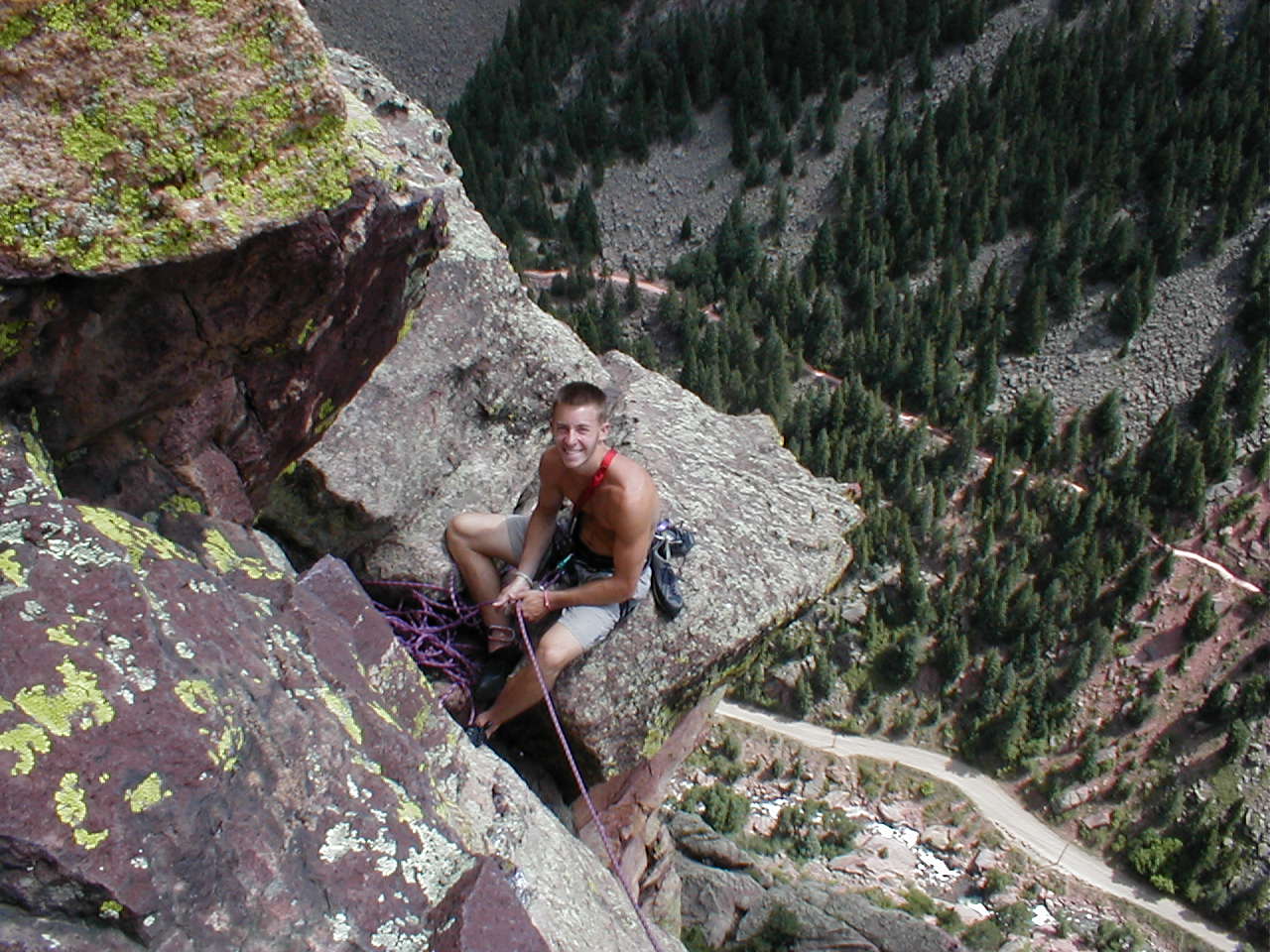
  Memory of an exhilarating perch on a narrow ledge high up something tall and steep has never left me.  It constellates sporadically, but early every spring without fail.  Dang.  Much has changed in my life as well as in technical aspects of an ascent, but I’m fit and confident that I’d have no problem, at least not with the kinesthetic cerebrations.

  On a mid-cliff ledge looking out, eye to eye with the clouds and swallows, an exuberant solemnity wells up – especially if you’re with a good friend (or kid!) and the route is challenging, but not several grades too difficult.  All distraction falls away.  There is no thought of anything else.

  Indeed, there is no thought.  Thinking would just get in the way.  Each line has its own rhythm into which one naturally falls.  Necessary details of the task could be no more apparent.  At the ledge, as gear is rearranged, words seem superfluous and few are exchanged.

  Sometimes you linger for a glance, snack, or drink, but not for long and not often because all know there is an inverse relationship between time spent on the edge and well being.  Rocks fall, storms brew.  Less time given for shit to happen the better. 

  Quite the paradox, eh?  Visited with otherworldly elation while knocking on heaven’s door, one’s intentions lie just this side of the nave.

How To Wire Up A Beauty Or A Beast

March 26, 2010

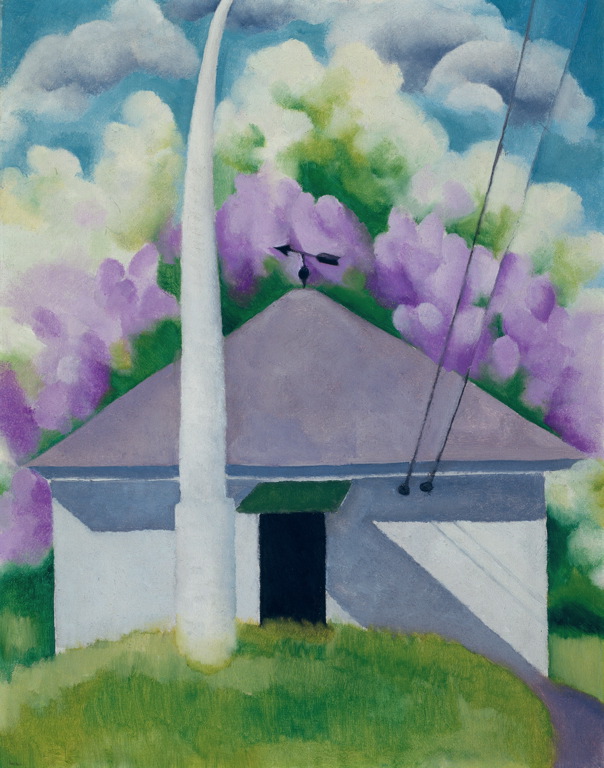
  In the house on her parent’s farm, Georgia O’Keefe was born November 15, 1887 near Sun Prairie, Wisconsin.  She was not taken outside during the cold, dark, and long upper Midwestern winter.  Spring did arrive and with it, verdancy, warmth, and the color of the sun.      

  Georgia was carried out and “placed on a handmade patchwork quilt spread on the new grass and propped up by pillows.  Those very first moments of seeing in the brilliant sunlight became indelibly etched in her memory: She precisely remembered the quilt’s patterns of flowers on black and tiny red stars…*

  I remembered that while reading a review of a new book: The Philosophical Baby: What Children’s Minds Tell Us about Truth, Love and the Meaning of Life by Alison Gopnik**.  O’Keefe was exceptional (duh!) in that virtually no memories form in most babies’ minds until about age 5.

  Their brains are different.  The part (prefrontal lobe) that filters out distractions and thus enables ‘internally driven attention’ is not yet fully formed.  “What rouses them is what is in front of their eyes, the first burst of information about cause and effect in the physical world”.

  Open to all stimuli and unable to shut any out, they are in a sense more conscious than are adults.  Gopnik compares “the lantern consciousness of childhood to the spotlight consciousness of ordinary adult attention”.  Very young brains require such copious amounts of neurotransmitters to process this inundation that they require relatively higher doses of anesthesia before surgery.

  As I know I’ve mentioned many times in this space, at birth the human brain has more connections among its 100 billion neurons as there are stars in the universe.  Some strengthen and some wither in a process labeled neural Darwinism by Gerald Edelman***.  Those connections in receipt of stimuli flourish and those that don’t disappear. 

  So in a very real sense what one does not see, hear, feel, etc as a baby one never will.  If, for some reason there is a patch on an eye over a crucial brief period neural connections will degenerate rendering it irreversibly blind.  Buckminster Fuller had poor vision, but a grand capacity for spatial visualization that he believed arose from early manipulation of blocks and other solid shapes.

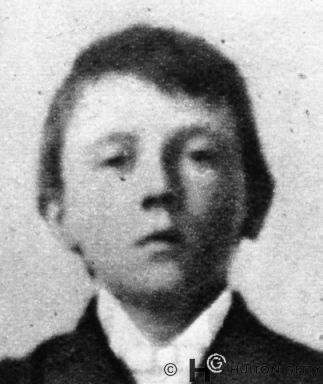
  Similarly, “although empathy does seem to be innate… the flourishing of empathy is not guaranteed”.  Which brings me to Swiss child psychologist Alice Miller.  In her book For Your Own Good, Hidden Cruelty in Child-Rearing and the Roots of Violence we read her take on the provenance of Hitler’s depravity.  She wrote “I have no doubt that behind every crime a personal tragedy lies hidden… every persecutor was once a victim”. 

  Ten years or so before Edelman developed his theory of neuronal selection Miller described the structure of the constellated narrative.  And it had nothing to do with innate drives.  Hitler’s youth was itself unmitigated horror.  He was beaten, humiliated, and demeaned by his parents while being commanded to love and respect those who might treat him thus.

  “My pedagogy is hard.  What is weak must be hammered away…I want the young to be violent and cruel… They must be able to bear pain… There must be nothing weak or gentle about them… The free, splendid beast of prey must once again flash from their eyes…”  Adolf Hitler.

  Most of Miller’s work addresses life after age five and actually gives us hope.  She holds that if a youth has an opportunity for just one positive connection, whatever might have characterized those first years, a good life is possible.  “The human soul is virtually indestructible, and its ability to rise from the ashes remains as long as the body draws breath.” 

*Portrait of an Artist by Laurie Lisle
**What Babies Know and We Don’t by Michael Greenberg; New York Review of Books March 11, 2010
***Edelman won the Medicine Nobel in 1972 for his description of the
immune system.  His theory of neuronal development remarkably, but I guess logically, parallels his earlier work.  
****Painting on top is “Spring by Georgia O’Keefe from the Art Institute in Chicago.
*****Photo is of a young Adolf Hitler
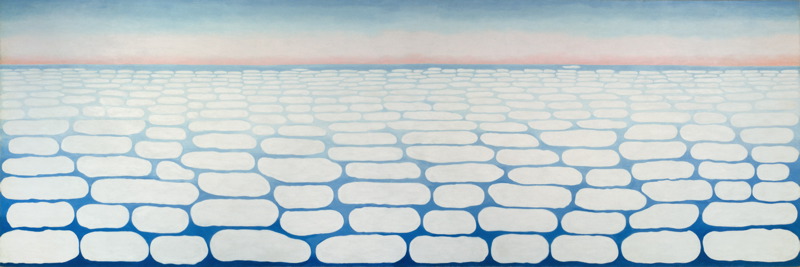
******Painting at bottom is “Sky Above Clouds IV by Georgia O’Keefe from the Art Institute in Chicago. 
 

Hurrah for Stromness

March 20, 2010

  You’re listening to “Farewell to Stromness” by Peter Maxwell Davies.  Written for piano, I came across this version on a classical guitar CD I picked up for inspiration.  I’ve ordered the sheet music so that I can put it under my pillow for the homeopathy method of music instruction.

   Stromness, counting some 1500 residents, is the second largest town on what’s called ‘Mainland’ of the Orkney archipelago off the north coast of Scotland.  In the seventies significant uranium deposits were discovered nearby and Margaret Thatcher was in favor of their development.  Locals were not. 

  From the photos above we can see that mining of the stuff would have had devastating impact.  Davies wrote the music as part of his ‘Yellowcake Review’ in protest*.  It’s an achingly emotional recapitulation of a cerebral journey over and around the island. 

  With the first few notes, one is enjoined, soon nearly overwhelmed at the realization of what could come to pass, and then hesitates briefly to gather strength.  How could such a thing be contemplated?  Then onward with determination to experience it all in case the philistines hold sway. 

  The Orcadians’ campaign was successful and the uranium lies undisturbed.  Hurrah! Now, each time I listen to the short piece, I’m pervaded with the fragile good fortune of our place on our planet. I’d be fascinated to hear if any MPs or Thatcher heard this music during consideration of the issue.  Wonder if a savage beast was thereby soothed.  Wouldn’t have been the first time that art inflected political discourse.

  All of that having had transpired, it is, uhm, interesting to note that some years later a string arrangement of “Farewell to Stromness” was performed at the blessing of the wedding of Prince Charles and Camilla.  With all of the myriad back stories behind that event, I think I’d have chosen differently.  Music is a language, and maybe it’s me, but somehow something seems to have been lost in that translation. 

*We became familiar with the term ‘yellowcake’ during the Valerie Plame affair.  It is an ironic trivialization of both the substance as well as the proposed excavation in the Orkney Islands.

Sursum Corda

March 12, 2010

  Like De Tocqueville, the fact that director Peter Weir hails from another land gives him objectivity toward our county that one born in the USA would not have.  His take, in the film “Witness”, has the sacred and profane of America revolving around each other like a binary star system.  Violence and purity orbit around their common center of gravity like a black hole and bright star.  When gas spins off from one to the other bad shit happens.

  Early in the film a young wide-eyed Amish boy witnesses a horrific murder in the restroom of Philadelphia’s 30th Street Station.  With his assistance, Detective John Book uncovers sordid high level police corruption and gets seriously wounded in the process.  Their escape from urban grit takes them to an Amish community in rural Lancaster County.

  At the edge of death, Book recovers under the care of the wary Amish and is soon asked to work off his debt.  He puts on a tool belt and enters a stream of men and women flowing toward a barn raising for a newly married couple.

  Weir once said that his goal in filmmaking was to evoke as deep an emotional response as can great music.  In this segment, the music and motion combine to far far more than the sum of the parts.  They conjure up the image (in this mind anyway) of peasants raising Chartres from the fields of France up toward heaven, souls all aflutter. 

  Indeed, this part of the film could even be read as the last stage of Book’s recovery – a near death experience.  Under an incredibly beautiful soft white light men work serenely together, knowingly pass hammer or beam or refreshment on to the next, unasked.  Women draw from the bounty of the communal acreage to create a sumptuous shared repast. 

  Unfortunately (for Book), the music stops, dirty cops appear, Satan gets his due, and Book falls off his cloud back to earth.  It’s not his time yet and he has to leave.  We’re dang pleased he got to visit though and will forever be moved by the memory.*

*Amazing, isn’t it that the language spoken in the clip doesn’t  really affect its impact?  (Though I’ll admit if I can find it in English, I’ll switch…)

Drug Free, I Promise!

March 5, 2010

  At about dusk one night not long ago, I was closing the gate at my office and had a hallucination that took over my consciousness completely – if only for a moment.  It was of my wife at home in the kitchen.

  She was wrestling a rarely used vessel and an associated implement from the dusty far reaches of a deep cupboard.  It had been a wedding present and I don’t think it’d seen the light of day since the birth of our first child nearly thirty years ago.  It soon dissolved, I secured the gate, and drove home.

  Just inside the back door of our house, I gasped when I saw that wife was using the vessel from my vision and had to have gone through those exact motions at the moment I saw them.  I asked what in the world had induced her to procure that setup to which she responded that she had been looking for something else, came upon it, and decided to use it instead. 

  Holy dogs, it wasn’t like I’d flashed a winning lottery number or been visited by divine guidance (or retribution for that matter) but, whatever, it was beyond coincidence.  Tha occurrence and others similar came to mind when reading the “Best Ideas of the Year” bit in the last issue of the New York Times Magazine that year.  It was about a forthcoming book entitled Extraordinary Knowing by Elizabeth Lloyd Mayer.

  Ms. Mayer was a psychologist and professor at UC Berkley.  Her eleven year old daughter’s harp had been stolen and they were desperate for its return.  Weeks went by with no leads when a friend suggested they avail themselves of the services of a dowser.

  Skeptical, but, “well why not?”, she contacted the American Society of Dowsers who referred her to one in Arkansas.  She called and after a pause the gentlemen told her that the harp was still in the area and asked her to send him a map of it.  The map was soon returned with a location marked upon it.  “Not good enough for a search warrant” said the police so Ms. Mayer decided to post photos of the harp on telephone poles around that neighborhood.

  Days later a phone call led to the return of the instrument and a changed Elizabeth Lloyd Mayer.  She began an exploration of the “inexplicable powers of the human mind” and first found, to her amazement, that several eminent colleagues at Berkeley had had related experiences, but were loathe to discuss for fear of possible harm to their professional reputations.

  Her investigation is filled with fascinating anecdotes, history, psychology, neuroscience, and quantum physics.  She suggests that extraordinary intuition is “quintessentially characterized by its random non repeatable quality and its absolute dependence on its highly idiosyncratic deeply personal capacities and dispositions of the knower…”. 

  An adept told her that: “Our minds resist intuitive knowing.  Once you learn to relax that resistance, you can start to reclaim intuition from its suppression by the rational mind.  The more you work with it, the more remarkable your knowing becomes.  You free the receptive state from it armoring by the ego.  You learn to live closer to receptivity.”

  If there was ever a reason to clear up neuroses, this had got to be it.  Could maybe tune into something really cool.

But Still…

February 26, 2010

  Now, toward the end of a particularly long and drawn out winter, the thought of spring has entered my mind.  Not because I’m tired of winter really.  I’m not.  I enjoy running in the dark cold icy early am.  There are elements of isolation and adventure that dissipate under the sun. 

  I like all of the seasons and especially look forward to the points of transitions in between.  As one approaches, unformed ideas for new adventure well up in profusion.  As the nature of the new season manifests itself so do new plans.

  In the spring of 1689 Japanese poet Basho set out on a five month journey across north central Honshu to visit to visit landmarks of nature and civilization as well as to spread the form of verse that he transformed from an antiphonal game into something more sophisticated.

  His recording of that journey in prose and poetry is regarded as among the most important in Japanese literature.  The Narrow Road to the Interior begins: “The sun and the moon are eternal travelers.  Even the years wander on.  A lifetime adrift in a boat or in old age leading a tired horse into the years, every day is a journey and the journey itself is home.”

  The travel narrative is articulated by a form of linked verse called renga.  There are three syllabic units: 5-7-5; 7-7; 5-7-5.  Two of the units must relate to each other in sequence, but three cannot – thus regular shifts in flow. 

  The opening unit is called a hokku and sets the tone and place usually invoking some aspect of nature denoting the season.  (Stand alone hokku came to be called haiku.)

  This is probably Basho’s best known haiku:

Into the old pond
A frog suddenly plunges
The sound of water. 

  What really interests me in all this is that some think that Basho was a ninja.  From a low samurai family, he was raised in an area where ninja were recruited and trained.  The funding of the journey remains a mystery and he traveled the considerable distance of this journey so efficiently that secret techniques were suspected.  Finally, at the time of his travels, there was turmoil in the shogunate and such discreet services would likely have been procured.

  The powers of observation and perspicacity of a great poet might have served a spy well.  An artist’s personality would have allowed him to move through a populace with syncopation and quietly productive conviviality.  As opposed to Karate and a Walther PPK.

  Probably this is all fantasy.  Basho had become a Zen monk and the title of the work would have one consider the interinextricability of his inner and outer journeys.  But still…

It’s Lucky He Didn’t Take The Stairs

February 19, 2010

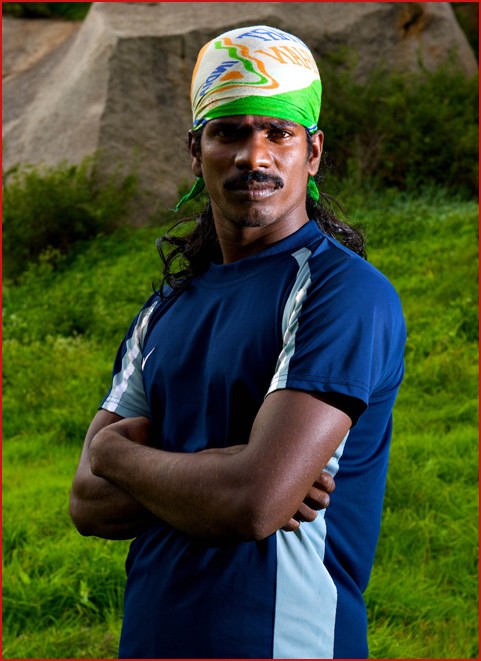
  That’s Jyoti Raj in a series of youtube videos gone viral.  It’s an incredible display of bold athleticism performed upon an interesting bit of topography.  From this point of remove, it is impossible to judge the size of the holds or texture of the stone so as to develop a sense of the difficulty, but the ground would come up pretty fast regardless.

  I’d seen the video some months ago and have thought of the fellow occasionally since.  I wrote an essay in high school about the motivational question behind alpinism and am always interested in new inflections.  “Because it is there” never did much for me.

  I was thus thrilled to find in the January 2010 issue of Climbing Magazine* that someone had tracked the climber down and asked a few questions.  Turns out that the footage was shot at sixteenth century Chitradurga Fort in southern India.

  Mr. Raj was a wild child and ran away from home at age 7 after having been kicked out of school.  He somehow made his way to a larger metro area more than 500 miles away where he found work at a ‘sweet shop’ which he left after five years of abuse. 

  Thence to Chitradurga where a family took him in and for whom he ran errands in turn for his keep.  At about age eighteen he was accused of theft and decided to leap to his death from atop a large cliff.  He made it to a perch about fifty feet up, but decided  to get more air to ensure that impact would do more than break bones.

  To his astonishment, as he continued up, people began to gather and cheer.  Heartened, he also found that he enjoyed the vertiginous kinesthetics and returned the next day to begin his exploration of the  seven story fort walls nearby.

  Had he taken the stairs, his would have been the only and last hurrah.  But just as important as his first applause, the concentration necessary to make the upward progress extirpated the negative cerebrations long enough for his mind to clear and absorb the new view.

  That was three years ago.  Now a local celebrity, he has become reacquainted (if not reunited) with his family and teaches climbing to young people.  Why climbing?

  “It gives meaning to my life.  It’s the only thing I’ve ever enjoyed, because life has otherwise been full of hardship.”  Funny how things sometimes turn out…

*Article on page 28 by Dev. S. Sukumar

Psychic Rewilding

February 12, 2010

  In last Sunday’s New York Times Magazine there was an article by Daniel Smith entitled “Is there an Ecological Unconscious?” which addressed the stress and discomfort visited upon the psyche of those subjected to forced dislocation (eg Trail of Tears) or environmental degradation (eg exploitation of newly discovered nearby coal deposits).

  Researcher Glenn Albrecht coined the term solastalgia to describe this condition of “place pathology” leading to the diminution of “one’s heart’s ease”.  The article reminds us that Freud attributed just about everything to sex and how modern psychology is primarily concerned with urban interpersonal interaction, largely ignoring the primal bond between humankind and the rest of nature.

  The premise of echopsychology is that “an imperiled environment creates an imperiled mind” and that there might be a relationship between a resilient environment and a resilient mind.  Research shows that natural settings are far more effective than urban for the enhancement of cognition.  Researcher Peter Kahn calls for a ‘rewilding’ of the psyche.

   Well, yippee ki-yay, I quite agree.  “More and more”, he writes, “the human experience of nature will be mediated by technological systems.  We will, as a matter of mere survival adapt to these changes.  The question is whether our new, nature-reduced lives will be impoverished from the standpoint of human functioning and flourishing.”

  How much of a stretch is it then to ask about the degree to which TV, digital social networking, video games, etc are responsible for global warming?   Well a lot I guess, but you get my point.  How can one have a meaningful sense of self and surroundings without a vigorous dose of the environment from time to time?

  Paradoxically, it dawned on me that an emerging departure from rectiliniarity in architecture enabled by technology might be relatedly salubrious.  I have long been interested in the emotional generosity inherent in good design and wonder if this will prove to be an unexpected and fecund vector.

  Japanese architect Toyo Ito has said that: “I sometimes feel that we are losing an intuitive sense of our own bodies.  Children don’t run around outside as much as they did.  They sit in front of computer games.  Some architects have been trying to find a language for this new generation, with very minimalist spaces.  I am looking for something more primitive, a kind of abstraction that still has a sense of the body.”     

  I have only read about and seen photos of Ito’s built work and am eager to one day experience a product of his line of thinking.  New York Times critic Nicolai Ouroussoff calls him an “urban poet”, “someone who has been able to crystallize, through architecture, the tensions that lie buried in the heart of contemporary society.”*

  No two of his projects are alike, maybe not even remotely similar.  Ouroussoff: “By embracing ambiguity, his work forces us to look a the world through a wider lens.  It asks us to choose the slowly unfolding narrative over the instant fix…  A building that seems to have been frozen in a state of metamorphosis”

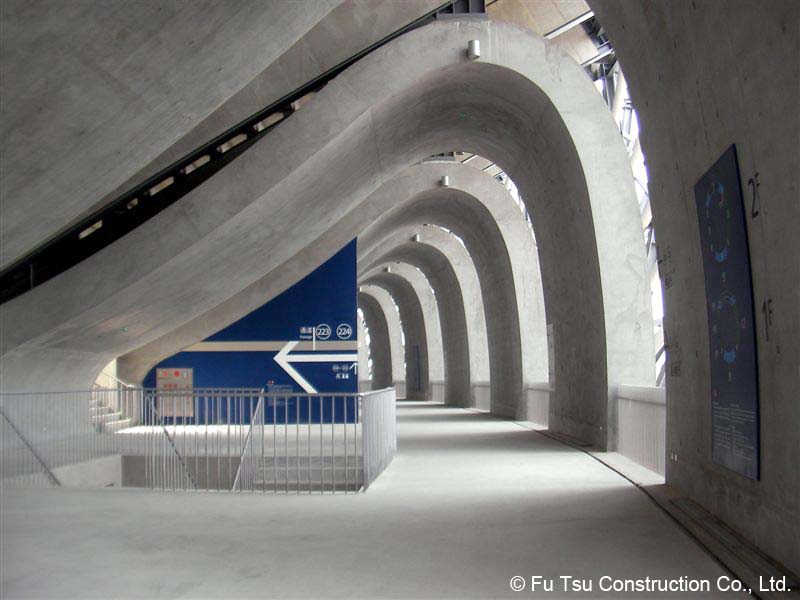
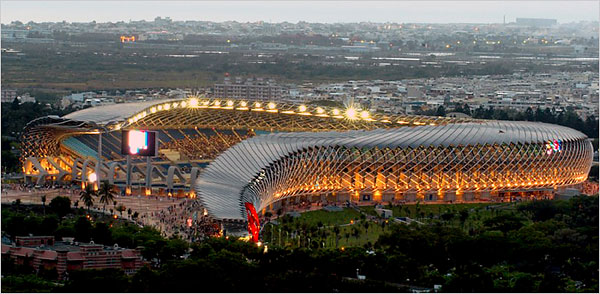
  The photos are of his stadium in Kaohsiung, Taiwan.  Ouroussoff tells us that it is “a space that manages to maintain the intensity and focus of a grand stadium without that intensity becoming oppressive.”  As opposed to other stadiums, “it seeks to maximize our awareness of (the outside world) while still creating a sense of enclosure.”

  Might such places help relieve solastalgia?  Help rewild a psyche, even?

*NYT 6 12 09