I Promise Not To Pavlov The Guitar

February 5, 2010

  Ok, it’s been four weeks, four lessons, and practice every day now.  Me and the guitar are getting along just fine.  I’ve learned how to play (and read) E, F, and G on the first smallest string.  In case you don’t know, you twang a string over the sound hole with a pick with your right hand while sometimes pressing down in a certain place up on the fretboard (neck) with a finger or fingers on your left hand.

  Similarly, I’ve learned how to play B, C, and D on the second string and G and A on the third.  It is very helpful when the particular bit of music under assault is recognizable.  So far I can conjure up stuff that sounds like Jingle Bells, Au Clair de la Lune, and Love Me Tender.  It’s fun.

  However, last week I started to try and learn a ‘cord’ and it has been frustrating.  To (try to) play a cord you strum several strings in quick succession with the pick while (usually I think) holding down one or more of them with your left hand.  It has proven difficult because I have a tough time positioning one finger to hold down a string without touching those around it. 

  It sounds awful if you don’t get it right.  Terrible.  It’s  like when you’re splitting wood, overshoot, and the axe handle thuds the log. First time in this process for which profanity was required.  Dog got up and hid.  Another beloved (but long departed) canine member of the family was smart and learned to hide whenever I touched my tool belt – confident that f-bombs were sure to follow.  I promise not to Pavlov the guitar.

  Saving grace might be Beethoven.  A few measures (lines) of The ‘Ode to Joy’ from his 9th Symphony was the first music I confronted with this new (to me obviously) technique.  Was reminded of what brought me here in the first place.  What is it in this simple arrangement of a handful of notes that this fat fingered near sexagenarian can work out well enough that his spirits lift and soul rises?

  Ludwig Van was fifty-four when he wrote it and had been deaf for ten years.  At its premier, thus unable to direct, he sat by the stage facing the orchestra counting time.  Upon conclusion of the performance contralto Caroline Unger had to step forward and turn him around so that he could see and accept the wild acclaim.

  What is it about music?  In what dimension can one, unable to hear, strum a heartstring with such pervasive and profound reverberation?
Implant

January 29, 2010


   A while back (cf 7/24/09) I mentioned a bit about a tooth extraction.  Even though the gap was unobtrusive enough that wife didn’t fit about my place in daughter’s wedding photos, dentist said that it had to be filled.  Otherwise other teeth would slowly shift and faults would form. Mandibular plate tectonics.

  Both dentist and MD with the pliers said that an implant was the way to go.  Research confirmed their recommendations.  “A Dental Shift: Implants Instead of Bridges” wrote Jane Brody in the NYT 11/17/09.  I read about the procedure and asked my dentist friend what was the longest I could wait before setting something up.

  He told me and I added another month and made the appointment.  Yesterday was the day.  Began with the same daunting consent form.  “Swelling, bruising, and pain can occur…Jaw fracture is quite rare… etc.” At least I still didn’t have to worry about the effects of antibiotics on the potency of any birth control.

  This operating room was much bigger than last time.  “Need more stuff for implants” said nurse.  “And room to move”.  I noticed the defibrillator on the wall as she took my blood pressure.  “Let me cover you up and Doctor will be right in.”  She did a pretty good job, but I had worn a red sweater just in case.

  Doc came in, put the same hockey puck back in the left side of my mouth, numbed me up, and unrolled his tool pouch.  “Just like the ‘surgeon’ at the end of Braveheart” he chuckled. I tried to find something on the ceiling to count.

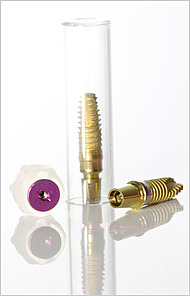
  “First gotta drill me a hole.  You ready?”  Sounded just like a hammer drill going through a wall.  Only louder.  He drilled and drilled.  I began to worry about an inadvertent trephination.  He withdrew the bit just in time and screwed the implant in finger tight which wasn’t very far.  Could feel the sharp threads with my tongue.

  He fastened a lever onto it and leaned forward.  It was a ratchet.  OMPH clinkity, OMPH clinkity, OMPH clinkity.  “Ok let’s see how we did.”  Put one of those cardboardy bits of film in mouth and took x-ray.   “Dang”.  Ratchet in reverse he backed it out and drilled some more.

  Final tightening underway, all I could think about was the countless number of times I have stripped threads while undertaking some mechanical or home repair.  Just this side of that sort of mess with neck at ninety degrees and all cervical vertebrae in subluxation, he stopped, threw a few stitches with racquet string and “voila”.

  “Uh, that doesn’t feel much like a tooth” I said.  “Won’t celery fibers and stuff get hung up around it?”

  He laughed.  “Don’t worry, we have to wait a few weeks to make sure it’s snug and not infected. Then we’ll spin on a nice new tooth and you’ll be good to go.  Nurse here will tell you what to do to stay out of trouble.  Soft foods for a week…”

  Jeesh.  I wrote the big check, stepped outside, sighed, and took a deep breath.  The way negative wind chill frosted the thing up like a finial on a fencepost in the Gulag.

Buttons

January 22, 2010


  The only thing I remember, well the first thing that comes to mind I guess, about Mrs. Nichol’s sixth grade music class is the way she’d draw a circle on the blackboard and make me stand there with my nose in it for most of the period.  I mean who cared about Saint Saens, whole notes, or the fact that Anton Dvorak had actually been in Iowa?

  The only interesting thing I recall was listening to her describe her husband’s malaria.  He’d been in the Navy during WWII.  I never’d heard of anything you couldn’t shake. Anyway, I didn’t like music, the circle didn’t work, and I became intimately familiar with every corner of the principal’s office. 

  The sounds of the sixties perked up my ears, but being a-political and an emotional nitwit nothing found more than passing resonance.  I began to wake up in college – I’m probably not alone in having had an epiphany in front of Disney’s Fantasia.  The Beethoven’s Sixth segment was to my mind what Kool-Aid was for the Dead. 

  All of a sudden I had an incredibly eclectic taste in music and an incipient thirst for understanding.  What is it?  It’s got to be more than epiphenomenal…  Everybody has at least a little rhythm.  Why is it so great to hear Gene Kelly “Singing in the Rain” by the produce at the grocery store when the mini-sprinklers go on?  Wasn’t that a wonderful movie?  Can’t you just see him twirling about the lamppost, drenched?

  Long determined to launch a serious investigation, I didn’t have a clue about how to begin until wife fixed me up with guitar lessons recently.  Month into it now and I’m fascinated.  I can read a few notes, make annoyingly recognizable sounds, and am amazed at the mind state that’s induced.

  The first lessons were a bit awkward for sure.  I’m easily three times as old as most of the students in the facility.  Years older than most of the parents reading People Magazine in the lobby as a matter of fact.  But after practicing a little bit every day I have begun to feel like I did the first time fiddling with buttons on a shirt that was not my own…

   What’s up with the elephants?  In February of 2007 on the radio program “Speaking of Faith” was a segment with acoustic biologist Katy Payne.  It is going to be rebroadcast Sunday.  You should listen.  Or visit the site: http://speakingoffaith.publicradio.org/  Her descriptions of whales composing complex songs are incredible.  Her stories of emotional networks maintained between and among elephants miles apart are enthralling. 

  She’s a Quaker working at the Bioacoustics Research Program at Cornell.  “I see my responsibility as being to listen.  My church is outdoors.  And I must say that if I could ask these animals that I like so much if there’s anything equivalent to what we speak of as being faith, I would love to do that.  We just don’t know.”

  “Many animals make sounds, everything from crickets to humans to whales.  Birds, of course.  Frogs.  And these sounds, in the case of animals, are thought of in relation to reproduction and courtship.  In humans, although they may serve exactly the same function, they’re thought of in relation to aesthetics.  And one of the aspects of my work has been to say, ‘Look, we don’t have to have two languages for this.’

Know how stupid the average guy is?

January 15, 2010


  In the highly esteemed journal Nature this week was a report of recent research indicating that men have evolved more rapidly than women*.  The study compared the Y chromosomes (the bit that makes a man male, (you know XY instead of XX) of chimps and humans. 

  Chimps are our nearest living relatives and over the last six million years our genetic codes have only diverged about two percent.  Except the Y chromosome which is some thirty percent different.  That’s a big change in a relatively short period of time.

  There are several possible explanations for the Y being “such an evolutionary powerhouse”.  One is that since the Y is a loner and not part of a pair like all of the rest and thus can mutate more easily.  Another has to do with the randy attitude of female chimps in heat.  Since they seek out many partners, there is huge evolutionary pressure on the males to produce the most and best sperm…

  I probably should support my own team and heckle the laggard other, but while reading the piece a George Carlin routine came to mind.  “Know how stupid the average guy is?  Just think – half of them are stupider!”  For proof, just check out the Darwin awards which are given annually to the nuttiest manner by which people have removed themselves from the gene pool during the previous twelve months.

  A woman has only won first prize once.  A random perusal of the site** turned up the story of a drunk twenty year old Californian dude who caught a rattlesnake.  Snake slithered its tongue to whiff the environment and get its bearings. (Snakes’ tongues are involved in their olfactory process)  Genius stuck out his tongue in response into which snake sunk its fangs.  Tongue swelled up choking the poor dumb guy to death***.

  Or take the first words the masterpiece of the great French poet Charles Baudelaire: Les Fleurs du Mal (Flowers of Evil):

Stupidity, delusion, selfishness, and lust
torment our bodies and possess our minds,
and we sustain our affable remorse
the way a beggar nourishes his lice

  Now, I certainly don’t feel that way all of the time and am dang glad I don’t have to go to hen parties, but will admit that I am an easy and logical target for regular self deprecation.  Wife agrees.

*http://www.nature.com/nature/journal/vaop/ncurrent/full/nature08700.html

**http://www.darwinawards.com/

***If this reminds you of anything you’ve previously read in this space, please don’t tell anyone.  (7/7/09)

****cf post of October 9, 2009

Have Any Breath Mints?

January 8, 2010

  I can see a television when I shave in the morning and while I often watch CNN or the local news, sometimes I turn to Despierta America on Univision (must see!) or VH1 or a movie channel.  While flipping through early on New Year’s Eve I found, in black and white on AMC, hay bales moving around a field to the tune of Three Blind Mice.  Remember that one?  The Three Stooges are awesome!! 

  I couldn’t stop laughing and nearly cut myself.  Wife rolled her eyes, tisk-tisked me, and asked when I was going to grow up.  For the umpteenth time.  Jeesh.  She’s lost hope.  Nyuk, nyuk.  After she left though I began to wonder about the evolution of humor.  Later I googled the notion for a bit and found but turgid prose. 

  Hobbes’ thought that life is “solitary, poor, nasty, brutish, and short” before the grace of government came to mind.  Seems logical to me that it might have been an evolutionary advantage to have been able to be funny while standing around a campfire gnawing on mammoth bones.  Life would have been tough (to coin a phrase). 

  I’ll bet that the hot cave chicks were turned on by a smiling fellow able to flatulate via his axilla while the others stood around in a inchoate state of depression.  How else could Fred Flintstone ever have attracted Wilma?

  Base humor must go back to the moment of our awakening, or I guess I mean back to when we first developed a sense of self awareness.  Once you leave speculation and get to recorded history there are plenty of examples. 

  In the Greek play Peace by Aristophanes for example (421BC), a giant dung beetle plays a major role transporting the main protagonist to heaven to plea for the gods’ intercession.  Bystanders are urged to avoid moving their bowels and thereby distract Trygaeus’ coprophageous mount.  It is an antiwar comedy celebrating the coming of peace after ten years of war on the Peloponnesian Penninsula.

  Interesting that the work of which the Stooges were most proud was also related to war.  They considered their best to be “You Nazty Spy” which in 1940 was a mockery of Hitler and the Third Reich.  Moe played Hitler, Larry was Ribbentrop, and Curly did Hermann Goering.    

  Certainly the standard of humor of an age rides the zeitgeist.  There was no need of subtlety during the thirties.  The Stooges appeared in their first film in 1930.  The Marx Brothers’ Duck Soup came out in 1933.  Etc.

  It’s 2010.  Where are we now?  Lord help us.  Here’s a clue:  

Hi Yo

January 2, 2010

Make sure your sound is on and press this:

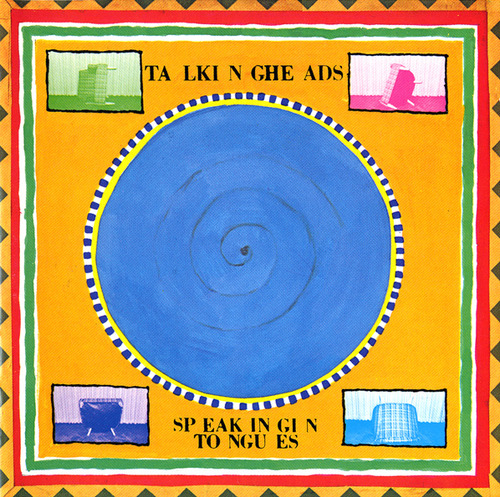
Isn’t that a beautiful song?  After the near blasphemy of my last post, I figured that today, at the end of one year and the start of the next, I’d better do something with, well, feeling.  The song is “This must by the Place” by the Talking Heads 

You don’t even have to be able to make out all of the lyrics to get a lift and indeed songwriter and lead singer David Byrne wrote: “The less we say about it the better, Make it up as we go along”.  Perfect.  I obviously overthink most shit.  And an overwrought exegesis can wither the wonder out of fine prose, poetry, or lyrics.

Nonetheless (here I go) I gotta write something.  The music by itself would be sort of catchy and the words alone ok free verse, buthe combination is far more than the sum of the parts.  Together they convey a glimpse of interpersonal joy.

The line “I love the passing of time” made me think of “the power of standing still” in Frost’s Masterspeed.*  The simple enjoyment of the company of another.  If one couldn’t enjoy “the power of standing still” with another, he or she would never come to say “Out of all those kinds of people, you got a face with a view”.

Isn’t that beautiful?  A face with a view.  Jeesh.  Byrne’s obviously not thinking about physical beauty, but about the initial allure of a radient depth and later the rich mindstream procured by a look into the eyes of a loved one.  All of the memories, good and bad, coalesce into a sense of wonderment.

And oh yes, time goes by so quickly: “share the same space for a minute or two”.  But it is delicious: “And you love me till my heart stops”.  Even though he’s far from perfect she has “Eyes that light up, eyes that look through you, Cover up the blank spots”.   Blank spots?  Heh, heh, what about the warts and bad habits?

“Hi yo I”ve got plenty of time
Hi yo, you got light in your eyes”

Damn.  Home is where I want to be.

Home is where I want to be
Pick me up and turn me round
I feel numb – burn with a weak heart
(so I) guess I must be having fun
The less we say about it the better
Make it up as we go along
Feet on the ground
Head in the sky
It’s ok, I know nothing’s wrong… nothing
Hi yo I’ve got plenty of time
Hi yo, you got light in your eyes
And you’re standing here beside me
I love the passing of time
Never for money
Always for love
Cover up and say good night … say goodnight
Home is where I want to be
But I guess I’m already there
I come home – she lifted up her wings
Guess that this must be the place
I can’t tell one from another
Did I find you or you find me?
There was a time before we were born
If someone asks, this is where I’ll be … where I’ll be
Hi Yo we drift in and out
Hi Yo sing into my mouth
Out of all those kinds of people
You got a face with a view
I’m just an animal looking for a home
Share the same space for a minute or two
And you love me till my heart stops
Love me till I’m dead
Eyes that light up, eyes look through you
Cover up the blank spots
Hit me on the head ah ooh.

*cf post of September 4, 2009.

** The song was recorded in 1982, the year son was born who turned me onto it…and courtesy of whose genius you just listened to it!

***The song also has a parenthetical name: Naïve Melody due to an apparent simplicity which I don’t really understand, but it sure works and I’m workin’ to understand.

Hallelujah

December 25, 2009

  Appropriate time of year to think about sharks, right?  What, you don’t think so?  You will – at the end of our review of what makes them Terminators of the deep.  First, their skeletons are cartilaginous instead of bone, yielding flexibility and energy efficiency.  Jaws aren’t attached in back allowing for horrifyingly huge portions to be torn apart by an endless supply of sharp teeth. 

  Sharkskin is basically a corset of dermal teeth which not only is protective, but also has hydrodynamic properties.  Sharks have an acute sense of smell.  Most see well.  They can hear us splashing on the beach from far away.  Their Ampullae of Lorenzini detect the electromagnetic fields all living things produce helping to locate you  even if you’re floating quietly in the dark.

  Jeesh.  Think that’s not enough?  Consider aspects of their reproduction.  First, males have two penises.  Hmm, get me some of that shark fin soup.  And, hallelujah, if there are no males around, the females can produce pups on their own!

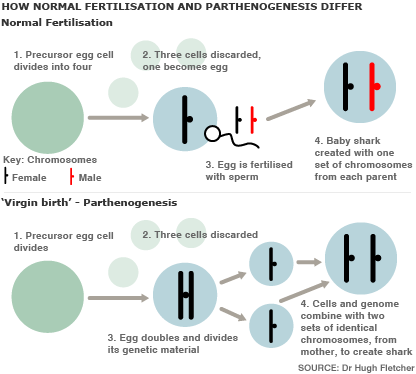
  It’s called parthenogenesis. Virgin birthed shark offspring are all females, but they can, and will, mate with males as a future opportunity might present itself. Switching back and forth is called heterogamy. Dang if sharks don’t have quite the bag of tricks.

  Make you feel superfluous guys?  Well, before going for the saltpeter, note that (some will disagree) it is not known to have occurred naturally in a mammal although it has been in many other animal groups.

  Some species of bees and wasps have exhibited parthenogenesis.  Some crustaceans, snails, flatworms, and wild turkeys too.  Several species of reptiles can reproduce parthenogenetically including whiptails, geckos, rock lizards, and Komodo dragons.  Interestingly, in order for the process to commence in some lizards, one female must sort of go through the motions with another to stimulate egg production.

  At the cellular level the process varies considerably from one species to another and can involve either meiosis or mitosis.  (The diagram above relates only to sharks)  Some of the progeny thus produced will result in genetic identity with the mother and others will be unique.  Like I’ve said, truth is stranger than fiction.

Big Wow

December 18, 2009


   Ok kids, if you’ve been paying attention, you realize that I (and others) think that there’s more going on in one’s mind than can be described by any process identified thus far.  That I (and others) disagree with many scientists and probably most neurobiologists who believe that consciousness will one day be understood as a biological process albeit one quite complex.

  I once read a complicated book, The Emperor’s New Mind by British polymath Roger Penrose.  He’s a respected scientist who thinks like I do.  I guess I should say thinks like I would if I had an IQ of 220 or so and didn’t have to use a calculator to do simple math.  Simply put, he believes that consciousness is the result of quantum processes that occur in structures far smaller than atoms (Planck scale) called microtubules in the brain.

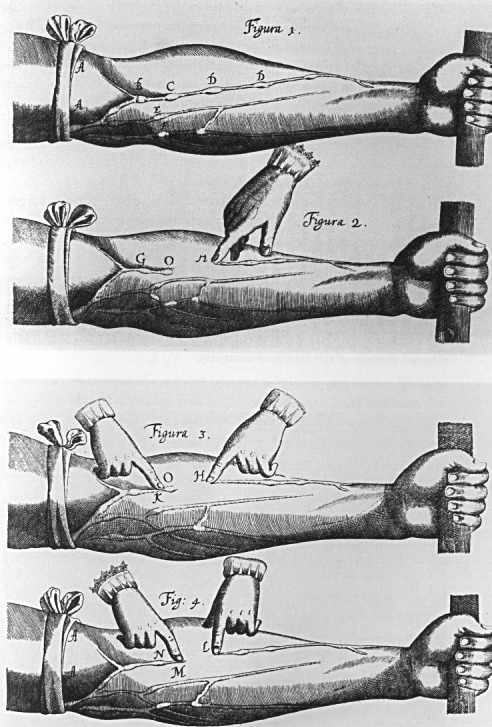
  Furthermore he says, “It doesn’t even act according to conventional quantum mechanics.  It acts according to a theory we don’t yet have.”  He then goes on again to draw an analogy with the research of William Harvey who was the first (westerner anyway) to describe the circulation of blood in the body circa 1616.  Prior to this it was thought that darker blood originated in the liver and lighter in the heart; that the two types had different purposes; and were consumed throughout the body.     

  Harvey figured out that arteries carried blood away from the heart and veins back to it and was certain that the two types of vessels had to connect, but couldn’t prove it without a microscope powerful enough to see things the size of capillaries. 

  Penrose is a widely respected physicist and has won many awards and though some might disagree, most take him seriously.  He theorizes that at that very small scale there is an abstract realm of Platonic ideals/mathematical reality that influences the quantum processes and thus the biochemistry, and thus the drama of our lives. 

  A rich connection with this dimension allows gifted mathematicians, musicians, artists, etc to make discoveries.  Given the spectacular ability of mathematics to describe our universe, this sort of makes sense even if it is difficult to fathom – if you know what I mean. 

  Where did this all come from?  Penrose says that consciousness, all consciousness arose with the big bang.  An Italian astrophysicist calls it the “Big Wow”.  Where will this take us as understanding grows?  Hold on to your chairs, truth is always stranger than fiction.  Suffice it to say that, though they have evolved at different speeds, religion and science will converge.

  “Half the people in the world think that the metaphors of their religious traditions, for example, are facts.  And the other half contends that they are not fact at all.  As a result we have people who consider themselves believers because they accept metaphors as facts, and we have others who classify themselves as atheists because they think religious metaphors are lies”.  Joseph Campbell.

  Nothing like a closed mind to screw stuff up.  Here is an exchange between two open ones:* Penrose’s partner in the development of their theory (Orch OR – Orchestrated Objective Reduction) Stuart Hameroff and Sam Hamil neurobiologist and author of The End of Faith;

Hamil: I do not rule out the possibility of our finding some sound, scientific reasons to believe in things that appear very spooky to most scientists at present – from telepathy to mathematical idealism.  And the fact that I do not rule such things out has made many atheists uncomfortable.  I do not foresee however, our finding good reasons to believe that the Bible was dictated by an omniscient being who disapproves of sodomy, but occasionally fancies human sacrifice.  These claims really do strike me as being “without intellectual merit.”

Hameroff: I agree with you.  My take is that there exists a fundamental Platonic wisdom embedded in the Planck scale (along with qualia, spin, charge, etc) which has inspired mankind to write the great books and act “in the name of God”… but man being man, many such efforts are misdirected, co-opted and perverted.

*http://AndrewSullivan.theatlantic.com/the_daily_dish/2007/03/

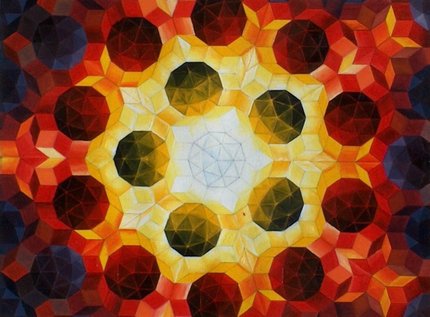
** Image at top is an oil painting by Urs Schmid of a Penrose tiling.  Look it up…

***Interesting to note that “anesthetic gases selectively erase consciousness soley through very weak quantum forces.”

Snow

December 11, 2009


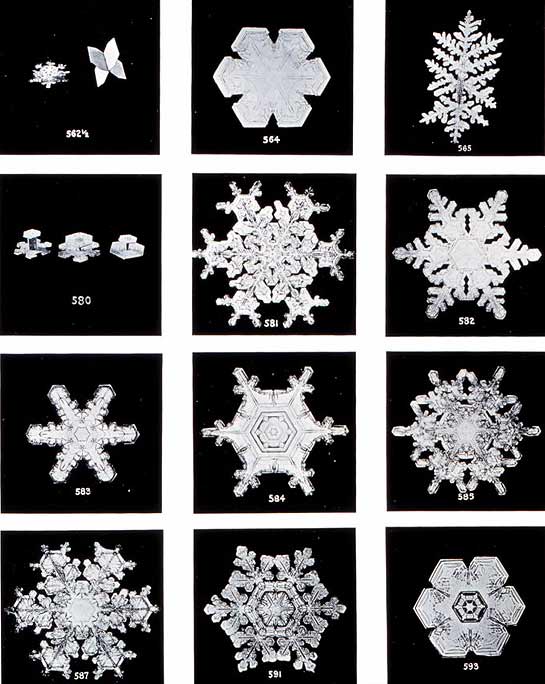
  I remember hearing years ago in school something to the effect that Eskimos have more than a hundred different names for snow.  Recent investigation of that thought took me to a ponderous discussion of linguistic relativism.  Whatever the number, it seems obvious to me that a people living in an environment so dominated by a substance would develop a very nuanced relationship with it.

  Consider recreational users of backcountry in winter.  Skiers, hikers, climbers etc.  With experience, they’ll develop acute sensitivity to the nature of the snow through which they tramp, slide, andor ascend and not only because it governs the nature of their progress.  The evolution of a particular season’s snowpack determines its proclivity to avalanche.

Neve is granular snow on the upper part of a glacier
Sastrugi is snow sculpted and packed by wind erosion
Graupel is that type of snow that looks like little Styrofoam balls
Hoar is frozen dew
Depth Hoar is made of cup shaped large grained faceted crystals near to the ground in a larger snowpack formed by temperature gradients.
Surface Hoar is a dangerously slippery layer of frost formed upon an existing snowpack.  Little to impede succeeding layers from sliding off…

  Those are just a few.**  None would enter the consciousness of one bereft of experience.  Couch potato or equatorial vision of snow would suffer from what New Yorker art critic Peter Schjeldahl calls the “pandering ghosts” of a reproduction.  An image of snow on a mountain would reflect their preconceived notions – would show them what they wanted to see.  Like an un-defrosted freezer in the case of the former and an air conditioned heaven maybe in the latter.

  Wilson “Snowflake” Bentley was a New England farmer who found endless joy in, you guessed it, snowflakes.  He was born in 1865 and never lost the magic that all but the grim and grisly find in a season’s first snow.  “When a snowflake melted that design was forever lost.  Just that much beauty was gone, without leaving any record behind” he wrote.

  He spent a lifetime photographing snow crystals.  Some 5,000 separate images he recorded.  Imagine how difficult it must have been!  Cold obviously, but how to get individual crystals onto a slide without breathing on them or causing them to fracture.  In an accompanying narrative, he’d then wax exuberantly about their beauty. 

  In a paper written in 1902 he used the words beauty or beautiful nearly fifty times.  Snow crystals Nos 716 and 718 were “very choice and beautiful”.  Nos 722 and 723 were “charming patterns in snow architecture.”  They were “gems from God’s own laboratory”.  No 781 is “wonderfully beautiful…”.

  What a great way to go through life, eh?  

  Finally, here’s a somewhat less tranquil manner by which to get up close and personal with a whole lot of snowflakes:

*cf photo with that of post 11-7-08

**http://www.avalanche.org/~uac/encyclopedia/

***I learned of Bentley in a wonderful book: Exuberance – The Passion for Life by Kay Redfield Jamison.

****While reading about snowflakes, I also learned that it is an incredible experience to listen to them hitting the surface of a body of water from a position beneath it.  Have to remember to check that out.

Hippocrates Says I’m Old

December 4, 2009

  While back I mentioned that my knee hurt.  Now knees.  Have previously had pain when I ran in the same pair of shoes for too long or wore arch supportless deck shoes too often.  Brother MD prescribed Advil and new shoes.  Always worked until about this past July. 

  Of a sudden the pain in left knee was too great to run. First time in thirty years. Laid off a few days and then hit road again.  Right thigh began to hurt because of significantly altered gait.  Now sometimes kneebones hurt just lying in bed.

  Switched to biking till pushed my luck in early darkness once too often.  Now stare at the bottom of a pool for what seems an eternity.  This morning the Stones’ song Time Is On My Side came to mind. “You’ll come running back…” go the lyrics. Hope!  Then dawned on me that it ain’t in this case and I might not.  Besides, the song basically betrays the singer’s misogyny and has nothing to do with exercise.

  Time does fly though.  And ever faster.  A given slice obviously forms a smaller percentage of the total with each passing moment.  A year in the life of a twelve year-old is a whole lot different than one in, say, someone in their fifties.  Stephen Hawking posits that there might be a related specific ratio. 

  Whatever.  For me, once the rhythms of a school calendar became a thing of the past my perception of time began to blur.  It sped up after I finished school, slowed down with kids, and then really accelerated as the last graduated from college.

  It’s interesting that motion through space and time are intertwined.  Sitting here at my desk, virtually all of my motion is through time.  Out for a run (I wish), a larger portion of my motion would be through space.  Einstein’s special theory of relativity holds that the combined speed of an object’s motion through time and space is exactly equal to the speed of light.

  What’s really amazing has to do with the fact that motion through time slows as motion through space picks up.  Relatively.  Experiments have proven that time passes more slowly for one running along the river (dang!) than for the lazy dopes home asleep in bed.  The difference though would only be noticeable when the moving object was considerably closer to 300,000,000 meters/second.  Time would stop for an object as it hit the speed of light.

  Have to find a way to warp speed.  Is it too late for astronaut school?  I don’t get scared easy; I love good views; and the weightless environment would be perfect.

  Oh oh. Better hurry.  Here is how Hippocrates counted life’s stages:

Infant (paidon)   0-7
Child (pais)     8-14
Boy (meirakion)   15-21
Youth(neaniskos)  22-28
Man (aner)        29-49
Elderly(presbytes)50-56
Old (geron)       57+