Canvas Cover for a Soul

July 10, 2009

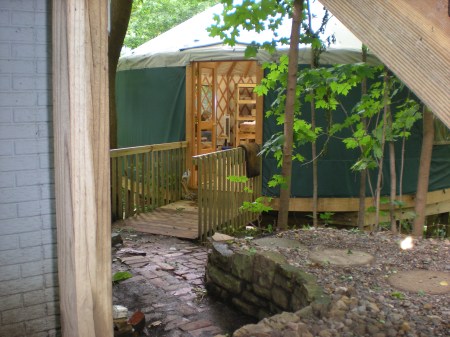
 Yurt door 010

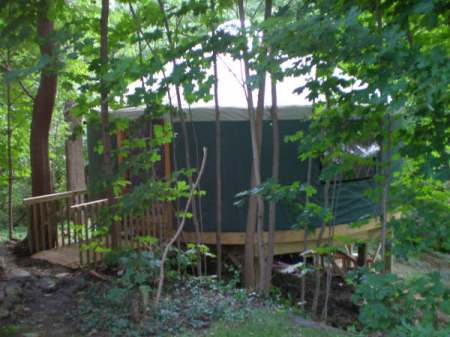
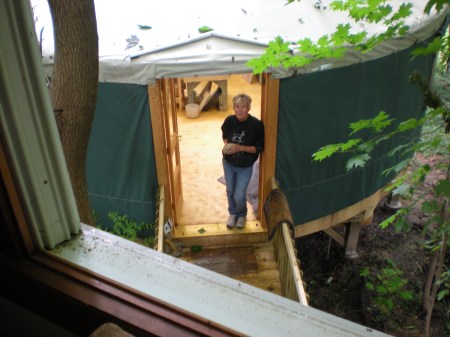
   The aforementioned yurt serves as divine studio space for my potter wife.  It replaces a cold wet cryptish corner off our basement which made a cell at Guantanamo something for which to yearn.

  Development of that transmigration required more than a few days and much ideation.  First thought was a familiar exercise in rectilinearity set akimbo in our front yard.  Then an appendage also in front.  Then she considered the expansion of the existing dingy cellar.

  Somehow the tent-like structure more common on the steppes of Central Asia came into her consciousness and she quickly concluded that yurt it would be.  (Well, she and the dog…)

  It is wonderful, even from this visitor’s perspective.  Its shape and nature fit organically on the side of the ravine in back of our house.  It looks almost to have grown there.

  We’re in the middle of town and abut an interstate.  Even so, from within looking out, all that can be seen is green.  Work started after woods leafed out, and thus I’ll bet neighbors (not far) across the way won’t have seen it till fall.

  It really is neat, made all the more special by being a few paces away from the house.  Going from one to the other in the rain you’ll get a bit wet.  Perfect.  Forces awareness of one’s place in the universe.

  To this philistine, it seems also perfect for the artist. Entering, it’s like stepping into a cloud with the world left far behind.*  I can’t wait to see where it takes her.

  Reminds me of some of Tadao Ando’s work in which sun, wind, and clouds are design elements.  His Azuma house, with which he first gained recognition similarly forced residents to interact with nature. 

  Contrast these to the emphasis on surface gloss found all too often in new additions to the built environment both public and private.  Lipstick might look nice, but it doesn’t necessarily tell much about the pucker.  Know what I mean?

  Anyway, this arrangement of site, structures, and stuff combine at night to make a softly glowing spot for wife to consider what another potter called “The Mud-Pie Dilema”**.
Yurt door 005

  More later. 

*Speaking of which – you should hear what heavy rain sounds like therein.  No need for thunder!

**The Mud-Pie Dilemma: A Master Potter’s Struggle to Make Art and Ends Meet by John Nance

Spirit of Place

July 3, 2009

  lawn

  Ok.  I’m just about ready to rest my case.  I’ve written several times of the special beauty of my lawn.  The photo above ought to put all doubts to rest.  Representative of a good part of my small plot is that arrangement of several grasses, flowered clover, yellow oxalis, and wild strawberries. 

  Most people spend untold hours in the cultivation of their yards, but end up with only blade after boring blade of the same dang thing.  I spend as little time as possible and, well, results speak for themselves. 

  As opposed to most, I don’t attempt to inflict my own narrow opinion of what it should look like upon the earth.  Instead, I endeavor to create a condition in which such subtle wonder can unfold of its own accord.  Believe it or not, I planted virtually none of what you see above.

  What is more is that those colors are nearly perfect counterpoint for the string of Tibetan prayer flags strung across my roof high above.  It is said that with each flutter of every panel a prayer is repeated. They are nearly always moving.

Prayer Flags 010

  Perhaps that’s how the character of my lawn developed, having not always been so.  Only several years after the death of a brother (in whose memory I connected our chimney and roof vent pipe with the red, blue, green, white, and yellow squares) did things begin to change.  Or at least to my notice.

  It was imperceptible at first.  Then we had several seasons and several families of ducks that made home in front of our house.  And elsewhere coons and deer and cats and dogs and varieties of rodents wild and domesticated.  Five tree houses and now a yurt.  Once, while digging a hole for a fence post I found an ancient stone hatchet head.

yurt 1

  The prayer flags eventually wear out and I replace them with new crisp colors covered with tiny uchen letters.  It is somehow comforting to watch them waft in the breeze.  (Even though some folks ask just why we have our laundry line way up there in the encircling crown of maple and ash!)

  We’ve been here thirty + years and I absolutely don’t mean to say that I’ve things just the way I want them.  Yes, I trim and fertilize from time to time, but that’s just so these particular emergent rhythms don’t dampen.

  DH Lawrence wrote that “Different places on the face of the earth have different vital effluence, different vibration, different chemical exhalation, different polarity with different stars: call it what you like.  But the spirit of place is a great reality.”*

  We’re all – flora, fauna, parents, and children – deeply imbued with the great reality of the spirit of our contorted tiny bit of the planet.

*Speaking of Lawrence, it may be obvious, but I’m also trying to make sure that the gamekeeper my wife runs off with is me…

Cedar Rock

June 26, 2009

  Walter 10

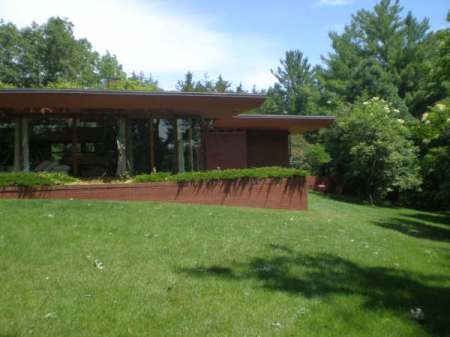
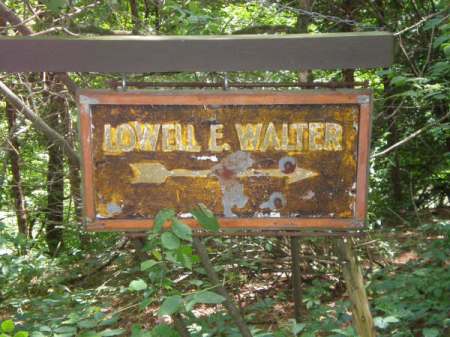
  Of the ten structures in Iowa designed by Frank Lloyd Wright, the one nearest my home is in between Dubuque and Waterloo, just south of Highway 20 near Quasqueton.  The original owner, Lowell Walter named it Cedar Rock for the limestone formation on the site at the shore of the Wapsipinicon River. 

  It is one of Wright’s designs for which he coined the term “Usonian” – short for United States of North American.  His intent with this departure from the more well known Prairie Style was to make innovation and good design affordable and available to Middle America*.

Walter 3

  The site is of a spectacular beauty that would surprise those many not familiar with Iowa away from Interstate 80.  It is secluded, heavily wooded, and perched above a wide and swift Wapsipinicon river.  Local lore has it that a Native American tragedy akin to Romeo and Juliet played out nearby.

Walter 8

  The design is called tadpole in plan with the ‘head’ being the all important open square “Garden Room” and ‘tail’ the rectangular living spaces articulated forty-five degrees off the southeast corner.  Wright wrote Walter “there will be no basement or attic” which tone pervades every square foot.

  He designed each space, selected every object, and arranged it all with incredibly great painstaking care.  Upon a return visit, he would scold and say “you can use that pitcher, but it must be returned to its original position precisely so”.  The Walters wanted a queen sized bed, but Wright would not have it.  He insisted upon two doubles like a curator establishing symmetry in a gallery.

  It is a wonderful sculptural object well rooted, plinthless, in its site like an earth toned dolman laid flat.  But it wouldn’t be a great place in which to live.  Once shorn of initial zeal, it’d stale one’s concept of heaven.  Who’d want to live in a monastery? 

  It must though be said that compared with the contemporaneous Farnsworth House (Mies van der Rohe) and the Glass House (Philip Johnson) Wright’s ‘Organic’ approach makes the Walter’s Garden Room more down to earth.  

  There is an antiphonal relationship between the greenery inside and out made possible by the abundant glass and light surrounded by the solitude of the site.   It should come as no surprise that Wright was familiar with Japanese gardens and the “capturing with window” technique. ***

   Also, there were several elements of the original design that would today evince environmental concern including in floor heating and related elements of passive climate control as well as a thick concrete roof intended to be covered with fertile soil and vegetation.

  There is one bit of neat whimsy.  Wright’s Prairie Style homes often have stained glass windows which would be too expensive for the Usonian concept.  Here, Wright arranged brilliant blobs of colored glass in small niches in a wall by way of allusion. 

Walter 7

  The boat house is down a path about fifty yards away and is serene.  It sits above the river with wide views up and downstream.  There, one could indeed quietly revel in the sound of water and muse about our place in the universe.

*The Walters were not middle class having built a fortune and retired in their forties.  Original project budget was $20,000, but ended up at $150,000.  And that was in 1950. Today that’d be more than a $1 million.  Walter wrote Wright of his frustration with delays and overruns to which FLW responded: “We were brave men to try to set up the last work in heaven way off in the mid-western prairie-miles from anywhere?”

**See post of November 7, 2008

*** The Walters left a $2 million trust to provide for the well being of their cherished country home.  The trust is now bust and it will be interesting to see what the Iowa DNR will do with the place especially in these turbulent times. 

Walter 12

**** Do visit.  It is part of the state park system and the staff are fervent, knowledgeble, and enthusiastic.

http://www.iowadnr.gov/parks/state_park_list/cedar_rock.html

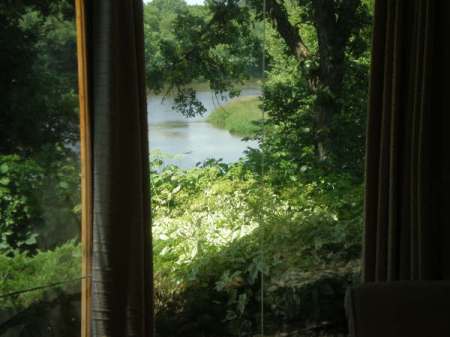
*****The top photo is of the entrance at the articulation point between Garden Room and living spaces.  Garden Room to the left.  Second photo is from the Garden Room looking through a glass corner.  Third photo is same place outside looking in.  Fourth photo is looking downstream from the boathouse.  Last photo is perhaps extreme, but not undemonstrative.

Haka

June 19, 2009


  That’s New Zealand’s “All Black” rugby team doing the “Ka Mate Ka Mate” Haka.  Haka is a Maori term which traditionally was a general term referring to any sort of native dance.  Purposes range from a variety of ceremonies such as funerals, to entertainment, to an organized expression of hatred for another tribe, to war mongering.

  In traditional Maori culture women performed both supporting and lead roles in Haka.  In fact the old legend Tinirau and Kae involves only women and tells a tale of the first Maori tribe.  Tinirau loaned his pet whale to a neighboring chief, Kae, to ferry him home.  Instead of sending the whale back to Tinirau, Kae killed and ate it. 

  Tinirau then gathered his best female dancers and sent them to Kae’s village.  They did not know what he looked like, but were told that there was a gap in his teeth.  They performed with such skill that Kae laughed, was thus recognized, and a spell cast upon him.  There is a moving rendition of this Haka in the wonderful movie “Whale Rider”.

  Today, the term brings to mind in most a vigorous performance by men – often with apparent bellicosity.  Western awareness of Haka most frequently relates to the All Blacks.  New Zealand’s national team has long been at or near the top of world rugby.  In fact, the national consciousness troughs with a championship loss much like Brazil does with soccer.

  All Black was originally a derogatory epithet applied to the team’s first European tour in 1905 because it included several dark skinned Maoris.  They thereafter played with vigor and adopted the black uniforms they sport to this day.

  The team performs a Haka before each game to “adrenalize” and is most frequently the “Ka Mate Ka Mate” Haka as above.  This Haka is of the legend of warrior chief Te Rauparaha.  A series of skirmishes leaves him hidden, crouching in a pit alone, protected from opponents spell casting by neutralizing effects emanating by his wife sitting above.

  Empowered, he appears and does the “Ka Mate Ka Mate” moves which are associated with the following words: 

Aha ha!  I die, I die
I live, I live
I die, I die
I live I live!
For this is the hairy man
who has fetched the sun
and caused it to shine again!
One last step up
Then step forth
Into the sun
The sun that shines! 

  Would adrenalize me.  And have the opposite effect if I watched perform it in preparation for kick off. 

  Interesting cultural side note.  The name of a prominent regional team is “The Crusaders”.  Games begin not with Haka, but with knights on horseback.  Imagine if a US football team adopted that name?  It’d be all over Al Jazeerah in a heartbeat. 

  While now on the subject of cultural insularity I’m reminded of a TV schedule insert I saw recently in a French magazine.  Through the course of a week were notices for a series called Les Peoples du Soleil about the ancient indigenous peoples of Latin America.  Problem was that there was a photo of a Mayan pyramid with the note about the Inca segment and one of Machu Pichu alongside the bit about the Maya.

  I’ll bet that they have enough history to study in Europe that those decimated by their emissaries (Cortez Pizarro et al) get short shrift.  Most American kids would notice the mistake, let alone a succession of proofreaders.  Is it a stretch to infer there from anything about the attitude of the European majority towards minorities?

Hawk One Up

June 12, 2009

  Hawking up

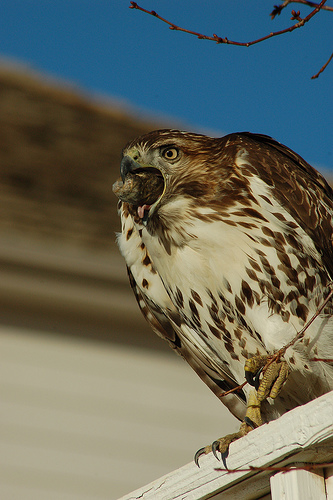
  Ever watch a hawk cough up a pellet?  It’s kind of gross, but interesting nonetheless. 

  The other day just as I walked out of my garage a goshawk swooped in to snatch a chipmunk feeding just below a birdfeeder.  Happened so quickly that I would not have been able to sort it out had not the bird flown high up into and upon a branch of a nearby tree.

  Mercifully, the poor little critter (Sammy) was dead by the time I got binoculars and approached. Goshawks are of the type that dispatch their quarry by ‘footing’.  Repeated rapid application of talons.   Ouch.  Yep, that’d work.

  I was careful at first not wanting to spoil the hard earned meal.  I read somewhere that raptors’ energy requirements are so high that a significant percentage of their attacks (“stoops”) must succeed or they starve.

  Apparently the bird felt secure enough in its position that it paid me no heed whatsoever.  It tore through the small carcass ravenously.  Watching through the binoculars I realized why the editors of natural history films cut quickly away from, say, lions tearing through a zebra. 

  It is too easy to anthropomorphize and imagine one’s self subject of some cruel twist of fate.  Wrong place wrong time. Disrespected the gods – like Prometheus.  Or something. (Just read an article in the New Yorker about the new infestation of Florida by released pets.  Matter of time until a kid ends up lengthwise inside a big snake it said.)

  Anyway, half through the macabre repast the hawk began to choke.  Its beak was opened way obtuse and head jerked quite vigorously up and down.  I thought uh oh, what’ll I do if it passes out and falls to the ground?  If I tried to help, it might turn my hands into mince meat.

  Slowly it dawned on me.  I’ve found and examined owl pellets before, but seen none in production.  Birds of prey have no teeth and thus must  rip their prey apart and swallow by the chunk. 

  Some species definitely engage in torture: they catch and hold, don’t foot, start the meal at the rear of their victim and work forward.  Lying in your bed have you ever thought you heard a baby screaming in the woods?  Likely it’s the scream of a rabbit being devoured by an owl.  Falconers sometimes slit the throat of the unlucky in related situations.  Eases the conscience as well as attenuating the sound effect.

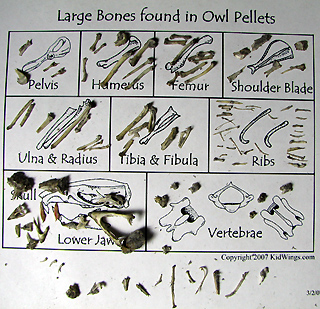
  Their digestive systems slowly separate the stuff, turn the meat into energy and the bones etc into a mass which they regurgitate.  It’d scratch coming out the other end I guess…  These pellets can be picked apart and some pieces identified as feather, hair, bone etc.

owl pellet

  Relieved, my goshawk returned to its meal.  Once done, it took wing and knocked what was left to the ground.  To call what fell picked clean would be an understatement.  To a naïf it would clearly be evidence of some sort of natural horror – actual provenance completely indeterminable.

  Clean plate club.  Parent would be proud. 

*Don’t know if this is more or less gross, but it also did not dawn on me until then where the phrase “hawk up a loogie” originated

Discontented

June 5, 2009

  Of all sorts of contractors, bridge builders are those most in tune with nature.  Homebuilders, general contractors, and road builders take steps to hew to unremitting schedules of which their predecessors would never have dreamed.  In the winter, they thaw the ground.  Once the framing is up, they enclose with polyethylene sheeting and plumb and electrify.  Once there is a lid on a project there is not much that will slow them down.

  Bridge projects however are often remote and astride a force of nature that won’t be ignored.  Thus the crews are more independent, flexible, and solemn than other types.  They know they can’t bullshit mother nature.  River comes up, they move to higher ground and wait for the sun to return.

  Something humane in that sort of pace.  Primal maybe.  I was thinking about it this morning, first when running along the river.  Ran under a bridge and saw a few carp swirling about thinking of spawning.  It’s really turbulent when they all get the idea.  Ducks and geese with their rafts of ducklings and goslings.  Felt sorry for one duck and drake pair whose progeny had dwindled to just two.

  Driving to work I noticed the fluff of the cottonwood trees along the river.  Jeesh it gets thick.  Every year the algorithm in my mind takes me first to dandelions and then “oh ya, there’s too much too high, it’s the cottonwoods’ turn”.

  For one sitting in an office remembering a nasty recession at the beginning of a career while sweating a new one, the throes of Mother Nature’s rhythms hold allure. 

  Freud wasn’t exactly thinking about the economy or weather when he wrote Civilization and Its Discontents, but, well, it’d sure be great to have a sailboat and shove off.  Leave the razor’s edge behind.

  At sea the choices are clear and Mother Nature won’t be trifled with.  There’s work, relaxation, and terror.  One emerges from this last either stronger and respectful or, uh, quite wet.

  “Confronting a storm is like fighting God.  All the powers seem to be against you and, in an extraordinary way, your irrelevance is at the same time both humbling and exalting.”  Francoise Legrand.

  “For the truth is that I already know as much about my fate as I need to know.  The day will come when I will die.  So the only matter of consequence before me is what I will do with my allotted time.  I can remain on shore, paralyzed with fear, or I can raise my sails and dip and soar in the breeze.”  Richard Bode.

Seagull Sunset

 March 29, 2007

Rain

May 29, 2009


  Approximately 70% of the earth’s surface is water.  Our bodies are about 60% water.  Brains 70%.  Blood 80%.  H20 is us.  Why is it then that many if not most of us consider a rainy day gloomy?

  Truth be told, most of my customers work outside and thus (this is another thing not to tell my wife and kids) I prefer that it rains on weekends.  (Added benefit: my dandelions and ground ivy don’t get thirsty and I don’t have to disturb them…) 

  Interestingly, raindrops do not form in the familiar teardrop shape.  Shape depends on size.  Small ones are nearly spherical.  Medium drops are flat on the bottom.  As they fall, large ones become concave on the bottom like a mushroom cap.

  Obviously, gardens and crops need rain to grow.  Farm belts – breadbasket areas are used to receiving amounts adequate and appropriate for cultivation.  Annual variations can cause moderate to disastrous problems.  Wars have been fought over water.  It is predicted that related disputes will only increase with the growth of the planet’s population and the turbulence in our climate.

  Inhabitants of arid regions probably prize the resource most highly as evidenced by the following two cultural examples.  The movie Chinatown was about the political machinations behind the irrigation of the San Joaquin Valley in California.  The currency in Botswana is called “pula” which is the Setswana word for rain.

  Not surprisingly then, one who could call forth a deluge was considered to have special powers long before we took up the plow and hoe.  Prehistorically, a rainmaker was a shaman or medicine man who through ritual and/or incantation was thought to be able to make the heavens weep.  More lately it’s more like a man, a plane, and silver iodide.  (Or pollutants – in urban areas rainfall is 20%+ more likely on Saturdays than Mondays)

  Metaphorically, it is also a positive term.  In the business world a rainmaker is one with a particular facility to recognize incipient financial opportunity, instinctually know how best to fertilize it, and finally to coax out liquidity in torrents.  In the movie “Rainmaker” Dustin Hoffman plays a savant who, possessed of a special mathematical aptitude, was enable to “count cards” and make his brother, played by Tom Cruise, a lot of money in Vegas.

  My kids always yawn when I remark about how great it smells as rain finally comes at the end of a long dry spell.  It is great isn’t it?  The scent is caused by the fact that clay soils and rocks absorb and accumulate an oil produced by some plants, petrichor (means blood of the gods), which is released by contact with moisture.

  I love rainy days.  All sorts.  To be in the lightest of rains is like walking in a cloud.  Standing still you don’t notice or hear the fall of drops, but move forward and you begin to push through a curtain of mist.

  In a hard rain, it’s neat to run down along the river by the large arrangement of water lilies near my home.  Before dawn for the best effect.  Even though drenched and being sharply pelted, one’s attention is drawn inexorably forward toward the incredibly resonant sound up which is newly mysterious and intriguing every time.  

  As you approach, you naturally begin to parse the theretofore blended sounds of rain on water and on the uplifted broad thick leaves.  Close by, the emerging new sound becomes almost ominous until alongside they’re separate. Oh ya wow.  There’s a moment of perfect antiphony just before they begin to blend together again as you move on by.

  Torrential thunderous downpours let you know you’re alive by the fear they strike.  (I love that they’re called “tormentas” in Spanish. Perfect!)  The level of instilled terror is directly related to the precarity of one’s position.  Top of a mountain or middle of the ocean will be found to be pretty scary in a big storm.  Basement of NORAD in the mountain in Colorado less so.

  Lighteningless rain sounds wonderful under a thin roof or in a tent.  Pull up the covers and relax.  Can’t do anything outside anyway.  Once, at scout camp, I was laying upon my back on cot under a simple canvas fly in a hard rain.  It was late afternoon and nearly lulled to sleep I turned over to watch mother mouse drag five fuzzie young pups out of a puddle to safety beneath me.  I had forgotten about the rescue until several years ago I saw them again dry, older, and more accomplished singing “Blue Moon” and “That’s Amore” as the Chorus in the movie Babe…  (Another unbelievably great flic)

  Before he died, my brother (who took the above short clip about three months before his death) gave my kids a rain stick.  You know, those things that when up-ended imitate the sound of rain on a thin roof with great virtuosity.  Thought to have originated in Chile they are made out of dried cacti with the thorns removed and then forced back in.  They are neat and never cease to amaze this simple mind.  Here’s what Seamus Heaney has to say: 

The Rain Stick 

Up-end the rain stick and what happens next
Is a music that you never would have known
To listen for.  In a cactus stalk
 
Downpour, sluice-rash, spillage and backwash
Come flowing through.  You stand there like a pipe
Being played by water, you shake it again lightly
 
And diminuendo runs through all its scales
Like a gutter stopping trickling.  And now here comes
a sprinkle of drops out of the freshened leaves,
 
Then subtle little wets off grass and daisies;
Then glitter-drizzle, almost-breaths of air.
Up-end the stick again.  What happens next
 
Is undiminished for having happened once,
Twice, ten, a thousand time before.
Who care if all the music that transpires
 
Is the fall of grit or dry seeds through a cactus?
You are like a rich man entering heaven
Through the ear of a raindrop.  Listen now again.

Carpe Diem? Huh? And Then What?

May 22, 2009

Andrew grad Franklin field 09 

  Carpe Diem seems like the most natural and obvious of exhortations to shout at a graduation.  Seize the day.  Certainly, commencement exercises must constitute a major point of transition (fulcrum hopefully) for most participants.  But “hurry up and get on with your life” is probably not the best advice for a young broadly educated mind.

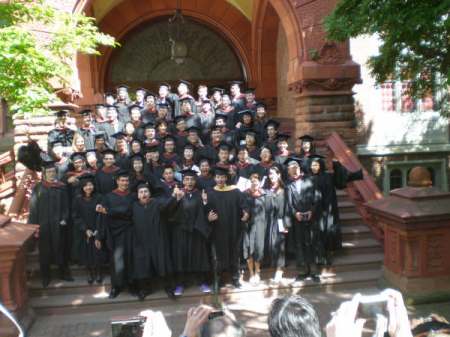
  Graduation ceremonies should always be powerful experiences for all attendees and the aforementioned such was no exception.  As the students and faculty began to file in the orchestra began to play and the trickle soon became a swarm.  I first thought back to graduations past until I noticed that tears had welled up in the eyes of both sisters as brother came into view.  Wife choked a bit, and well, me to.

   Made me think of brain science and what it can and cannot explain.  We have what have been called mirror neurons.  A set of neurons fires when you do something.  Mirror neurons fire when you observe somebody do that thing.  Researcher V.S. Ramachandran calls them “Ghandi” neurons because “they’re dissolving the barriers between you and me”.*

  That’s neat and interesting, but incomplete.  Other researchers have shown that phenomena related to consciousness can be observed, measured etc, but not consciousness itself.  Some think it a matter of time till it is seen how thoughts emerge from the brain, but none do now.

    As I’ve said above, while it may well be understood one day, I do not believe it will be found to be a sum of the parts sort of thing.  Stuart Kauffman again: “Whatever its source, consciousness in emergent and a real feature of the universe…. These phenomena, then, appear to be partially beyond natural law itself.”

  It is much easier for me to consider tenderness amongst siblings with that observation in mind than, say, mirror neurons.  We are more than the sum of the parts.

  While in Philadelphia I saw one of the two of Galileo’s telescopes known to be still in existence.  Fascinating to look at and think about.  They got him into trouble.  Not so much for debunking heliocentrism as for challenging the then prevalent western world view that spirituality was the only source of knowledge.    

  In her remarks the wonderfully enthusiastic Penn President Amy Gutman told those in cap and gown that their toughest challenge would be to find: “What matters most to me?”.  Not an easy question for most to answer, but indeed perhaps the most important.  I’d add that it is probably be just as important to learn to live in that question.  If you carpe diem with questions answers will follow.

Andrew grad Myerson 09

   That’s what Galileo did.  “It [the earth, not the sun] moves” he told the Pope and was placed under house arrest for blasphemy. He continued wide ranging research for the next ten years until his death investigating the speed of light and the nature of tides among other things.  Very significantly,  he developed the basic principle of relativity.

   Einstein wrote: “Pure logical thinking cannot yield us any knowledge of the empirical world; all knowledge of reality starts from experience and ends in it.  Propositions arrived at by purely logical means are completely empty as regards reality.  Because Galileo saw this, and particularly because he drummed it into the scientific world, he is the father of modern physics – indeed of modern science altogether”.

  Or as Uncle Ed helped translate from another tradition: “Whatever you see is a reflection of your own mind.  The essence of mind has, from the very beginning, has been free of conceptual limitations.  Having recognized this truth, free your mind from grasping at phenomena and clinging to thought…”**

Andrew Board spring 09

*New Yorker May 11, 2009: Profiles

**Path of the Bodhisattva, Vimala Publishing

***Hint: Above image is not through a telescope, has not really yet been seen in 3D, but is indeed way out there and has not been seen before.

My Name Is Nobody

May 15, 2009

Road trip. Mind can’t help but wander. Remember in college I took a seminar entitled “Literature of the Trip”. Started with Odysseus. Modern era was ushered in by Kerouac and On The Road which was an exploration of the newly unlimited freedoms of the American Dream. Here in the US, we emerged from WWII with comparatively unscathed success and with the west also won continental ontological parameters disappeared and a search for new meaning began.

It was the ‘Beats’ who led the quest. I’d long thought that the term related to a musical concept. However, upon reading background notes to Kerouac’s second book I learned otherwise. First it was a term employed to relate a sort of “exalted exhaustion” and then in reference to a Catholic vision of beatitude. Evolution of etymology is interesting, isn’t it?

Jung wrote that “The more a man’s life is shaped by the collective norm, the greater is his individual immorality”. The collective norm doesn’t point the way ahead. It obviously aggressively reinforces the status quo. Or worse, to a banal evil. Kerouac was the perfect sort of person to break new ground. Among other factors attenuating any rootedness was the fact that he was French Canadian and English was his second language.

Makes me think of the current Hispanic diaspora. To me it’s heroic. Operatic even. The struggle of those forging north, setting out for the territory ahead, Tom Joad like is only a current example of an innate capacity for adventure that lies dormant in a dominant culture. At least in 3D. I say more power to them. Poetic justice for us.

Kerouac and other artists of his time didn’t end well for the most part. Forward scouts often end up carrion by some means or other. Boredom at the end of the journey often led to substance abuse, suicide etc. After their return George Rogers Clark went on to great things, but Merriwether Lewis self destructed…

This here road trip is for a graduation and the ensuing second stage in the diaspora of our family. Some of the same stuff applies. Hunger, a new skill set, and a sense of adventure seem, in this case, to point over the western horizon.

Grandma’s along for this trip. She’s made it to eighty-one without any stripped gears even though having traversed some difficult terrain and uncivilized territory. Perhaps she will offer up her perspective on how to find one’s way through unfamiliar territory.

Dog Is My Co-Pilot

May 8, 2009

sauger mirror

Dogs aren’t impressed by large vocabularies or fancy philosophizing.  They’re experts on nonverbal communication.  They catalyze mindfulness of the way things are and prevent one from being forever lost in thought.  They present the universe in a canine microcosm to young children with whom they form special bonds.

Once, years ago, I was reading one of the Babysitters Club series to our oldest child.  Kristy and the Snobs. Met the family dog Louie early on and was engrossed in the narrative well enough that I didn’t pick up on the clue when Louie was limping and Kristy said “We’ll tell Mom, but it’s probably nothing” on page 7.

Next evening I read that “… last night he walked right into a table when he was aiming for me” and still didn’t get it.  But by chapter 12 “Louie was in bad shape” and I can remember thinking that “this is a kid’s book, this can’t be happening”.

It is often said and written that children’s books are the most difficult to write and that kids make for the most demanding of audiences.  Their books are comprised of sparse spare prose and a straightforward storyline.

More importantly, you can’t bullshit a kid.  One juvenile non-sequitur and it’s over, you’ve lost them.  They’ll yawn and/or interrupt and interest completely lost, you’ll have to start something new next time.

Not coincidentally, in Children’s Experience with Death author Rose Zeligs maintains that “You cannot ever fool a child.  He is closer to the deep inborn collective unconscious and senses any default in … dallying with the truth.  No matter what the seriousness and shock the truth may invoke, the child must not lose trust in those who attempt to serve him, be they parents or professionals…”

The momentum of this particular story soon became relentless and I started to worry how I was going to handle it.  It was not easy.  Louie was old.  He had accidents of all sorts.  Poor eyesight combined with a bit of confusion led to his tumbling down the basement stairs.

Mom took Louie to the vet who said that he “was deteriorating rapidly (translated into regular speech that meant ‘getting worse fast’)”.  Chapter 12 ended with an ominous recommendation by Dr. Smith.

Not far into chapter 13:

“The receptionist called Mom’s name then, and she stood up.  David Michael and I gave Louie last pats and kisses, and then Mom disappeared down the little hallway.  When she came back a few minutes later, her arms were empty…”

Child psychologist Zeligs also wrote that: “Being closer to the earth and sky [the rural child] learns to accept death as part of life’s rhythms”.  Most children no longer live on farms and not all have pets.  The arts can help touch the earth.  Scientist Stuart Kauffman (who I introduced in my last post) wrote that Shakespeare is just as important as Einstein. I quite agree.

We had zillions of those Babysitter Club books around the house.  They all look the same and their titles are almost interchangeable. Unbelievably, perhaps, even so – two more times did I find myself lying in bed with a child and coming across Louie unprepared.  It never got easier.

I can’t wait to get home and pat our dog.  He’s twelve.

* FYI God Is My Co-Pilot is an autobiographical account by Col. Robert L. Scott of a life of flying in general and at the controls of a fighter over China in WWII.  It was a huge best seller when published in 1956, and is a great tale of ambition, determination, and bravery.  However, it has more recently been criticized for ethnic insensitivity.  “Japs”, “Huns”, “Darkies”, etc.