Wahoo

December 12, 2008

 Several days ago I listened to the husband/wife team of Dorothy Cheney and Robert Seyfarth discuss their book Baboon Metaphysics on NPR’s Fresh Air.  (Terry Gross is the interviewer nonpareil!)  It was a fascinating discussion of the incredibly complex fabric of baboon society. 

  The title was taken from words of Charles Darwin: “Origin of man now proved.  Metaphysic must flourish.  He who understands baboon would do more toward metaphysics than Locke.”  Darwin therewith asserts a greater complexity to the mind than Locke’s (and later BF Skinner et al’s) tabla rasa.

  From the book: “Darwin disagreed – both with the conclusion that animals’ thoughts and behavior are entirely based on instinct and with the view that human thought and behavior are governed entirely by reason”.

  For example, brains scans of two day old humans show that they pay more attention to faces than other visual stimuli and focus more intently on speech than other auditory stimuli.  Had to have been in the recipe.

  On the program Ms. Gross played recordings of a variety of baboon vocalizations described as “grunts, screams, and wahoos”.  It was interesting to listen to several different ‘speakers’ in succession.  The voices are distinctly each their own. 

  The information transmitted by the grunts and other utterings is complex and structured.  There is a matriarchic hierarchy to baboon society which can be divined by careful observation of the patterns of the vocalizations. 

  To test their theory the researchers recorded the grunt of a higher ranking female followed by the scream of a subordinate and then played them back in reverse order.  The whole troop was dumbfounded.  Apparently there is no place for an uppity baboon.

  Another interesting aspect of their research was based scatological evidence.  Collecting poop was easier and less intrusive than drawing blood as a means to obtain and evaluate glucocorticoid levels which rise and fall with stress.  When a particular baboon falls victim to a predator those hormone levels rise in each member of the group, but more greatly the closer the relation.  Stress is also evidenced in the friendless.  And furthermore the hormone levels fell when estranged family members were observed to be reintegrated as apparent acts of compassion.

  From their research, Cheney and Seyfarth extrapolated two conclusions regarding baboon metaphysics, brains, and evolution.  “First, natural selection often creates brains that are highly specialized.  Arctic terns migrate each year from one end of the earth to another, ants navigate across the Sahara, bees dance to signal the location of food….Yet… there is no evidence that [they] are generally more intelligent than other species…. they are more like nature’s idiots savants…”

  Secondly that “The domain of expertise for baboons – and indeed all monkeys and apes – is social life”.  And it sure sounds like the grunts, screams, and wahoos hold it together.

  Which, uh, brings me to Robert Frost.  In the December 4 New York Review of Books an article about Frost shows that he too thought that: “the brute noises of our human throat…were all our meaning before words stole in”.

  In fact, his theory was that the essence of effective poetry is to be found in “sentence sounds”. * “It is everything in the sound of poetry; but not as inventor or creator – simply as summoner”.**

  The author of one of the reviewed books, Mark Richardson, “notes the Darwinian drift” of Frost’s thinking.  He also mentioned that Frost had been influenced by Herbert Spencer’s observation: “variations of voice are the physiological results of variations in feeling”. 

  My wife knows just what is going on (and what course of action to take) by noticing if I’m grunting, or screaming, or wahooing.  Heck, so did my dog.  She would hide whenever she heard me grab my tool belt.

  Baboons are very distant relatives.  We humans took the path less traveled by – left the jungle long ago.  Lived in caves for a while.  Learned how to emote in many different languages.  Still are social creatures.  Sure will be interesting to see how, having added nuance to our grunting and howling, our “sentence sounds” will evolve through keyboards, flat screens, and emoticons.

NB It dawned on me that I had hidden (well, lost) somewhere at home a recording of Robert Frost reading some of his own poetry.  Took me a while to find it.  Longer still (and a few grunts) to coax the turntable into cooperation.   Compelling to listen to his intonation of Fire and Ice.  And to remember Kennedy’s inauguration while listening to Frost read his The Gift Outright: 

The land was ours before we were the land’s
She was our land more than a hundred years
Before we were her people.  She was ours
In Massachusetts, in Virginia
But we were England’s, still colonials,
Possessing what we still were unpossessed by,
Possessed by what we now no more possessed.
Something we were withholding made us weak
Until we found out that it was ourselves
We were withholding from our land of living,
And forthwith found salvation in surrender.
Such as we were we gave ourselves outright.
(The deed of gift was many deeds of war)
To the land vaguely realizing westward.
But still unstoried, artless, unenhanced,
Such as she was, such as she would become. 

* In the 12/11 Economist Nobel laureate Seamus Heaney describes his own speech patterns as “Phonetic grunting”.

**cf “The repetitive pattern of his picking seems to procure the rasp of his voice like hot firing synapses do obsessive thought” in Freewheelin’ above: 6-6-08


Hair City

December 5, 2008

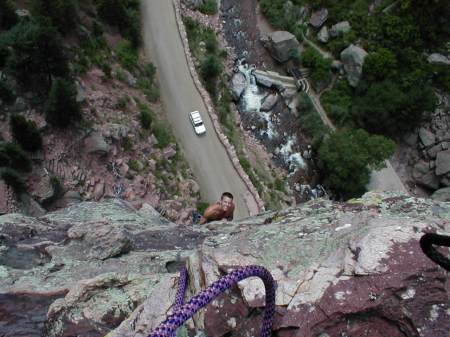
  I started taking all of my children rock-climbing at a very early age and have enjoyed the experiences more than I ever could have imagined.  Usually.  Upon a few occasions terror and/or minor injury was/were unwelcome companions.  Matter of fact I probably did visit both upon each repeatedly.  Has made me realize that child abuse is not as easy to define as I’d thought.  And that perhaps it is sometimes inflicted without intent.

  Early one morning many, many years ago son Andrew and I made our way to the base of a cliff overlooking the river.  As we hiked beneath its lush deciduous canopy that was yet spring green, Andrew gestured toward a broad soaring bird that we could only sporadically glimpse.

  “Look at the hawk!” he exclaimed.

  “Vulture” I corrected without really looking.

  Our goal was the Sentinel, a free standing pinnacle 120 feet tall on the river side and about half that on the other due to eons of rock fall and other organic detritus fallen from the top of the main wall thirty feet to the east.

  We first climbed the easy east face.  It is solid gray limestone with many large solution pockets, natural handholds, and fossils so that route finding is not a problem and the experience pleasant.  The fact that a discrete summit is gained makes it all the more fulfilling.

  Then in the fifth grade (I think) Andrew was strong and kinesthetically adept.  He could do the most pull ups in his class and had no problem with the tight-wire in our front yard.  Thus, it seemed to make sense to search for greater challenge.

  I remembered a climb on the west face that could be done in three pitches, had wide ledges, and great views out across the river which is over a mile wide there and dotted with islands and lots of boat traffic.  As I recalled, the climbing was all chimneys with a traverse across a wide flat ledge halfway up.  Perfect.

  At its base, I tied Andrew into a tree and began the first short pitch.  The chimney was much dirtier than I’d remembered – filthy actually.  I quickly reached the small ledge and set up a belay.

  Andrew was up in a flash ever excited and unconcerned about the dirt.  I tied him to the belay anchor and took the step right and up to begin the traverse into the main chimney.  Andrew was less than thrilled as I disappeared from view and his side of the banter grew a bit tremulous.

  Indeed, I did move more slowly than I’d anticipated.  The ledge was not wide, but rather narrow.  And difficult to protect.  If Andrew slipped, he would take quite a swing.  Oh well, I thought, I’ll get to the bolts at the base of the main chimney, bring him over, and then cruise to the top.

  Only there were no fixed anchors, the rock was rotten, and the chimney wasn’t as I’d remembered either.  It’s walls were sharp, jagged, friable and constricted to a bulge a few yards up making for tricky passage. 

  It even thought momentarily about spitting me out and thus unleash the ravages of gravity upon us both.  I corralled such thoughts and relegated them to the place the Dalai Lama sends thoughts of women.

  Andrew called several times after my slow progress wondering what every second does when the leader’s progress is slower than expected: what sort of terror might lie ahead.

  He made it across the traverse slowly calling up “Dad I’m scared”.

  “You’re doing fine Andrew” I croaked.  We both knew that the choices were few and that the difficulties, for him, had just begun.

   He started up the crack.  Up, down, up, down, up down.

   Shit.  How do you holler technical advice to a little guy you can’t see, who’s never heard the terms, and you know is fighting back fear so that he can please his dumb old man?  I gave him a bit of tension from time to time, but knew that a tight rope would not help him through the bulge.

  He came to it and began to wrestle with the crux.  A flake broke off and crashed loudly below sending a flock of starlings into the wind.  The air then filled with the sounds of utter and complete despair.  I felt like Judas.

  He did though surmount the difficulties and soon I watched his little hand slap the top of the block upon which I sat.  He clambered toward me and came into my arms.  After a bit he turned and took in the view.  Without looking at me, he asked if we had to go on.

  No way off but up.  “Soon we’ll be in the sun” I said.

  “Ok”

  As it happened, the leading arc of the solar disc edged over the top just as I began the last pitch – cascading rays down upon us and illuminating the zillion motes of dust that theretofore had been invisible. We were like exhausted pilgrims in a nave.

  I reached the top quickly and Andrew followed smoothly with a surprising return of confidence – quiet though he did remain.  Upon the small summit platform, he sat serenely gazing toward the distant rolling hills.

  As I bent over the rappel anchors a broad shadow stroked the loose coils of rope, the surrounding rock, and my back.  I raised my eyes to watch Andrew track the winged dihedral floating just above our heads.

  We exchanged no words for many minutes until he said matter-of-factly “Dad, it is a hawk, a red tail”.

  As the raptor then rose effortlessly on a thermal up into the sun, its backlit tail feathers twitched in fine manipulation of pitch and roll and shone rust red.

   *NB As you can see below, many more adventures did ensue.  And thankfully yet another of my father’s aphorisms has held true (so far): “Son by the time you can take me on you won’t want to”…

hair-city1

yellow-spur-ledge1

atop-wind-tower

Very, Very, Very Fine House

November 28, 2008
nikon-transfer-497
Our house, is a very, very, very fine house
With two cats in the yard
Life used to be so hard,
Now everything is easy ’cause of you. 

      Graham Nash wrote “Our House” in 1969 when Sally and I were in high school dating (though she in Massachusetts and I in Iowa).  While certainly a CSN fan, I was not particularly fond of that song. It thus came as quite a surprise when its lyrics began to run through my mind some thirty-five years later.

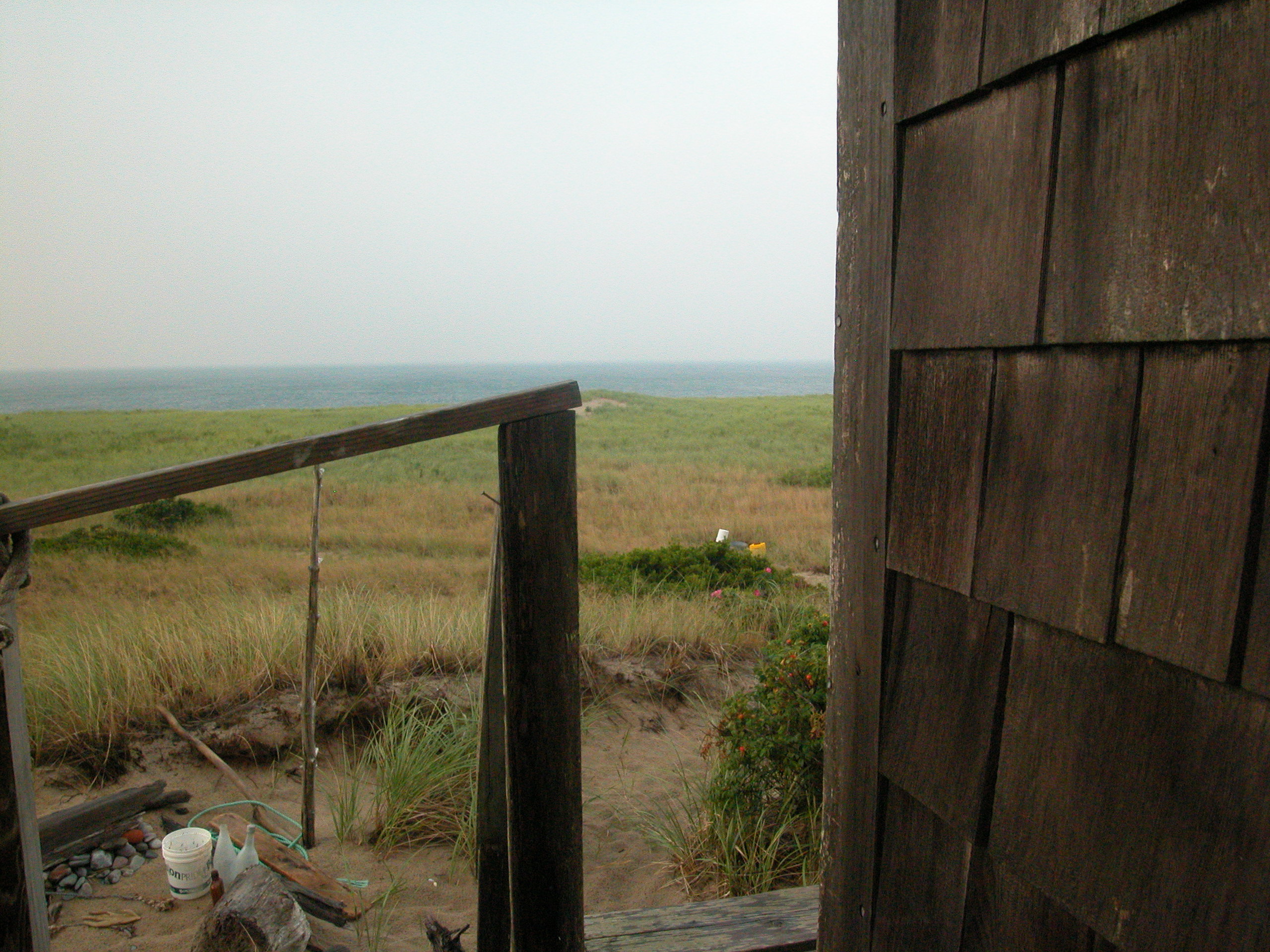
      We were on Cape Cod in an isolated one-room shack that was perched upon a sand dune.  It looked as in and out of place as a piece of driftwood – one that had been part of a tree, gone through the hands of man, and back to those of nature over the course of many many years.

      While not exactly alone, it was hundreds of yards from its closest neighbor, which was similarly bereft of electricity or running water.

      My wife was one of several, out of hundreds of artist applicants, to have an opportunity to live in the cabin for two weeks alone (or almost) with their thoughts and work.  I was only able to visit for three days, but even so they were several of the best of my life.

      The shacks were originally built in the 1800s to serve as life saving stations offering aid to the victims of shipwrecks just off the coast.  Thousands have occurred since the Mayflower first furled her sails nearby.  They fell into disuse after 1914 with the construction of a strategic canal that obviated the dangerous passage.

      The then empty gray boxes were discovered by those who had already made nearby Provincetown a dynamic and vibrant artists community.  Maybe America’s first.  Thoreau spent time there.  Eugene O’Neil was living in one when he learned of his first Pulitzer Prize.  Kurt Vonnegut wrote Player Piano there. Norman Mailer had a place.  Painters such as Hans Hoffman, Mark Rothko, and Helen Frankenthaler have lived and worked in these parts.

      Jackson Pollack visited the area several times and apparently had even stayed in the shack in which we found ourselves. He was thereabouts heard to have said that “he fucked Mrs Benton” (Mrs Thomas Hart…) which episode though must have taken place in town – not in the shack.  It’s too far from anywhere for an illicit tryst.  Not the place for a quickie.  Wrong juju.

      The hike in sets the tone emotionally and otherwise.  You park your car just outside of Ptown at the intersection of Snail Road and US Highway 6, pack your things and enter a natural archway through a thick wood. 

The trees end suddenly though, leaving one to face the steep slope of a fifty-foot sand dune.  A one-hour trudge up down over and across hot sand leads to the north coast. The two steps forward and one back routine make it much tougher going than most mountain trails. 

      And a horse of a different color at night.  Once, after a wild time in Ptown we made it back to a quiet fogbound trailhead at 10:00 PM.  We nonchalantly chattered about the evening for an hour or so until we realized that we’d lost our way.  Fortunately, as I’ve mentioned before, I always carry a compass and with a few course corrections soon found ourselves home.

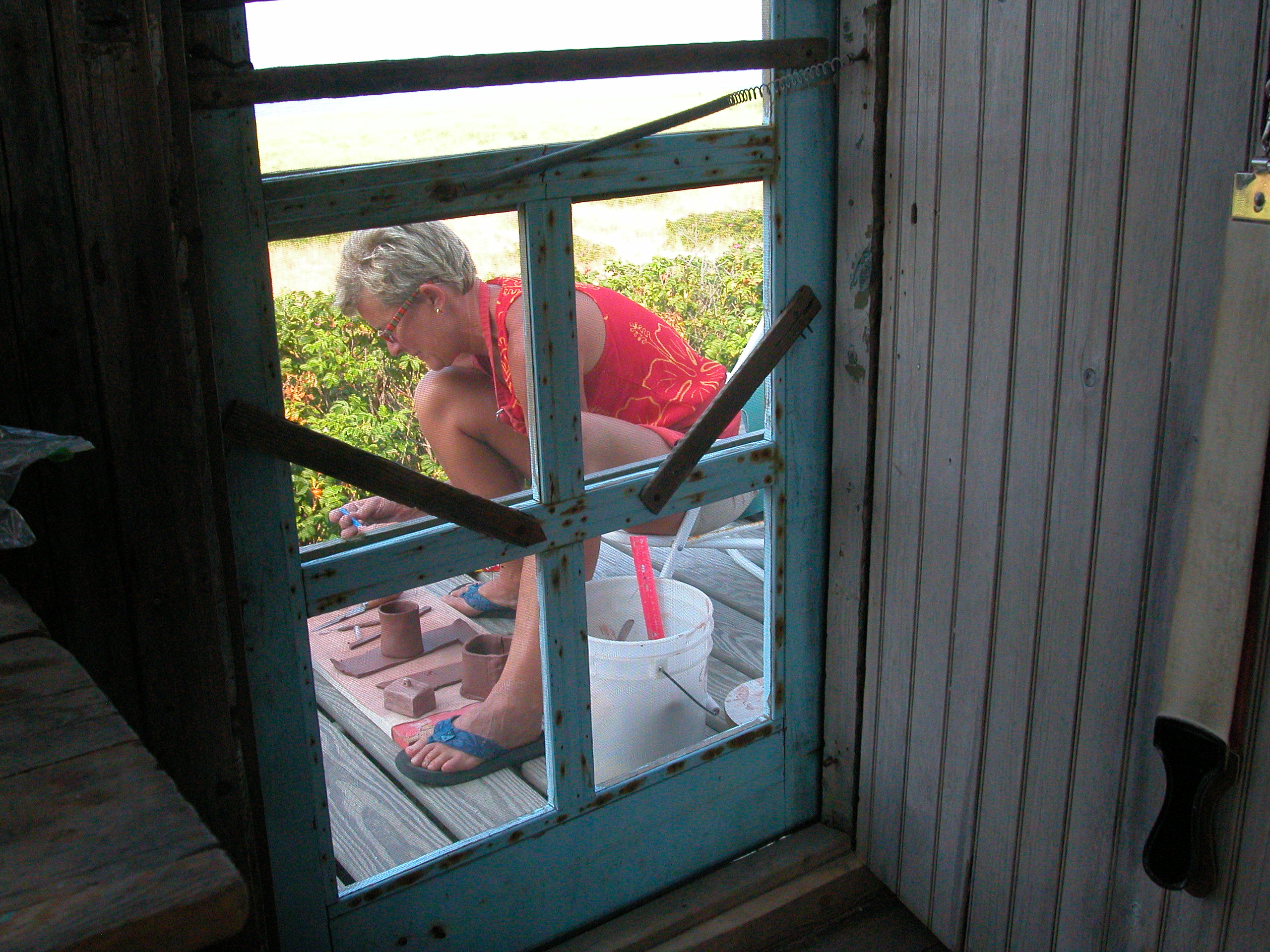
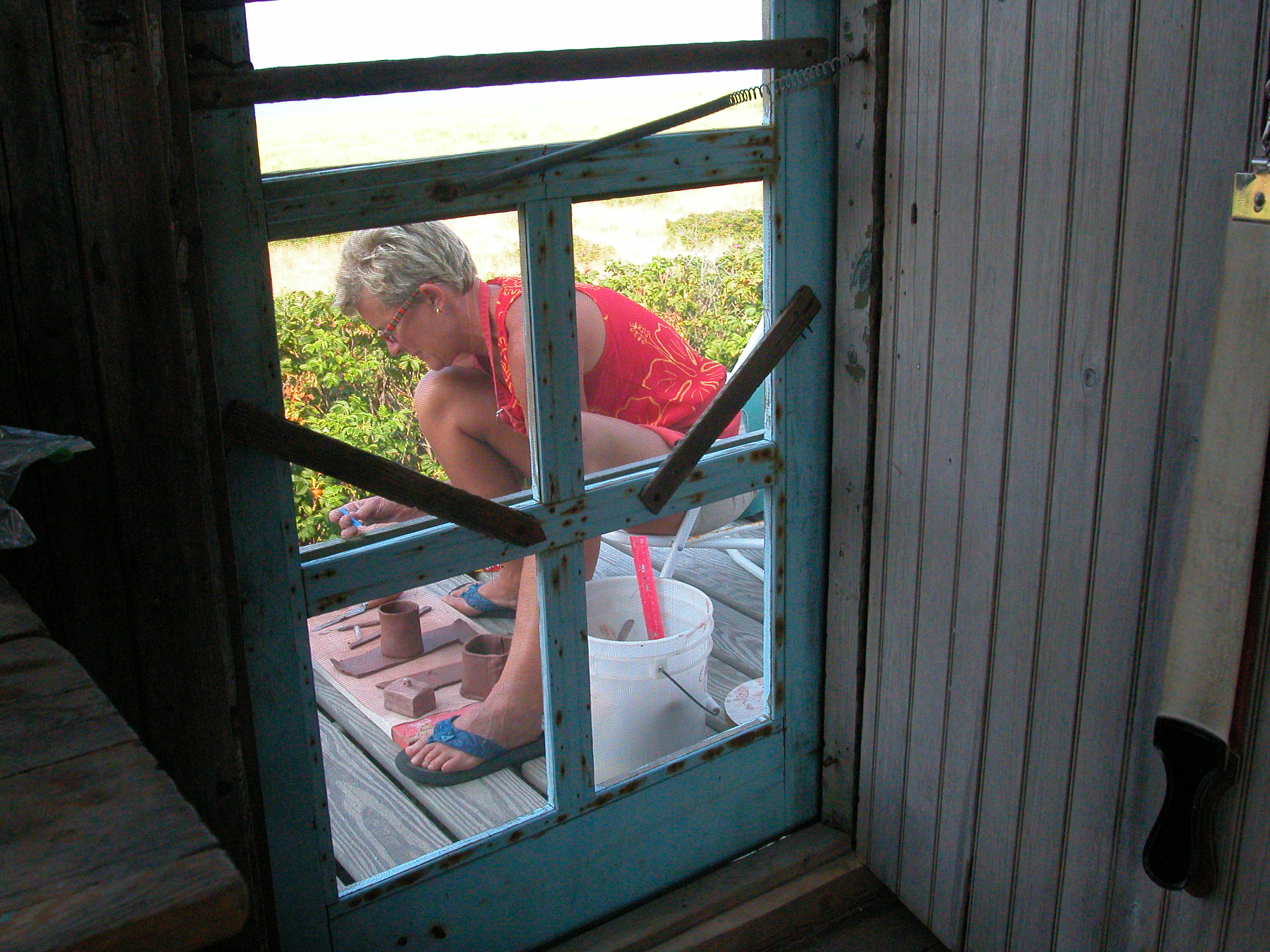
      Upon awakening the first morning there, I turned slightly to look through the screen door to watch Sally on the deck intent upon her clay.  The ocean rolled in the distance and fishing vessels bobbed about.  She hadn’t always worn glasses, but looked great in them.  Her long honed mode of concentration was at its peak. 

nikon-transfer-4791

      Other mornings were similar.  After watching her work a bit, I’d make a pot of filtered coffee, we’d eat a bit of breakfast, and then walk on the beach.  Sometimes for hours without seeing another soul.  Only twenty miles from Boston and the whole eastern seaboard! 

     We were lucky though.  During most of the year vehicular traffic is apparently allowed on the shore, but through the course of our sojourn the endangered piping plovers were breeding.  The National Park Service makes certain that their relationships are allowed to flower.

      Ya, during our walks over those few days we did talk about our kids, folks, work, world events, etc, but they somehow seemed far away and ok.  Life used to be so hard.

      Upon conclusion of our strolls we’d disrobe and swim.  Not an original thought. Thomas Hart Benton wrote in 1937 “once or twice I’ve seen a young Venus come naked out of the Martha’s Vineyard sea, but generally it’s something to make you wish you hadn’t lived so long.”  Well, I’m still aiming for 100.

      Then lunch, after which Sally would put in several more hours of work at her clay or watercolors.  I’d usually take a well-deserved nap.  Just before dinner we’d bathe in water we’d drawn from the well several hours before and allowed to warm in a galvanized tub out front.

      Once home – without her – the song continued to play in my head and I was somehow compelled to locate and read letters that Sally had written to me back in high school.  The nature of the relationship manifest therein was, well, syncopated, but the tone, the sparkle of their author was clearly recognizable and fresh.

      Déjà vu.

November 21, 2008

sauger-on-bed 

  I once had a wilderness experience in which I was all by my lonesome for four days.  It is amazing how thought patterns change in the absence of human interaction.  For me at least ‘monkey mind’ – jumping from one thought to the next haphazardly – disappears and is replaced with much longer cycle time.

  The days were filled with physical intensity and focus.  The nights were filled with stars and cerebration.  (“Stars, stars, stars!”  I wrote in my journal.*)  I can still recall the seeds of a cucumber sliding over my tongue down my parched throat and somehow making a connection between them and Orion’s belt.  I dunno.

  When I made it back to the Mirror Lake bus stop the only others there were a mother and young son.  Son looked at me and moved closer to his mother.  She looked at me and held him tightly.

  I said hello and hoped that they’d ask what I’d been up to so I could regale them with my tale of glory.  No response.  I suppose the Mom subscribed to a corollary of the theory I frequently repeat to my daughters: the only decent boy they’ll ever meet is their brother, myself included.

  Wife’s gone again and all this was running through my head last night.   Certainly, it is not the same at all just to be at home alone for several evenings in a row complete with any number of phone conversations.  But, still, one’s mind finds a different gear. 

  I agree with the French philosopher Pascal: “All men’s miseries derive from not being able to sit in a quiet room alone.”  If one cannot be comfortable alone with one’s own thoughts, how can he/she possibly have honest interaction with another?

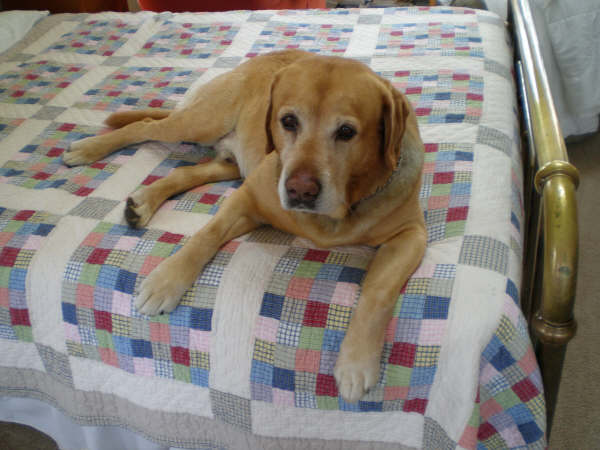
  Even a dog. Know how you can talk to someone and be thinking about something completely different? Staring into the eyes of mine last night it dawned on me that a dog, at least a smart one, knows if you’re day dreaming or not.  With a dog you must commit.  They wait for engagement.

  How’s that for deep thinking?

  I also agree with Donne that “No man is an island”, but one is unable to really deeply understand that without an experience of real solitude. 

*While looking back in my journal I saw that I had been wondering how I measured up to others my girlfriend/future wife had been dating.   I was pretty much of a bum at the time.  In retrospect it is funny to have been concerned.  The ones I saw were all weasels.

From The Heart

November 14, 2008

  The clip is the opening spectacular from the Bollywood flic Dil Se.  It neatly launches the story about an All-India radio reporter who becomes so infatuated with a mysterious and beautiful woman that he doesn’t realize that she’s a terrorist until it is too late.  Way too late.

  The film is dark, foreboding, and does not attempt to  convey optimism about the potential for peaceful coexistence between and among India’s many ethnic and religious groups.  The interwoven bits of romance lighten up the political part of the narrative in the same way that the fantasy of Tralfamadore does the story of the WWII firebombing of Dresden in Vonnegut’s Slaughterhouse 5.

  Dil Se was controversial when it came out in 1998 because it had only been a few years since a female suicide bomber had taken the life of Rajiv Ghandi.  It failed at the box office in India.  Since then it has been shown at many international film festivals and has drawn praise and a following. 

  I’m sure you’ll agree that the video is incredible on many levels.  The music alone is wonderful and has become wildly popular around the world.  It was employed by Spike Lee – to provocative effect – on the soundtrack of his Inside Man. 

  The music combined with the position of its performance – atop a train moving through rugged topography – makes what could be a dream sequence for a lyrical thrill seeker as well a poetic look at love.

He whose head is in the shadow of love
will have heaven beneath his feet.
Whose head is in the shadow of love..
Walk in the shadow.
Walk in heaven, walk in the shadow. 

  Culturally, it brings several things to mind.  First, it would not seem odd or staged or maybe not even dangerous to Indians or people in much of the third world that passengers would be allowed to ride on the top of a train.  Makes one aware of the existence of a spectrum of personal responsibility with abdication on one (our) end and self reliance on the other.

  Secondly, it interesting to know that while Richard Gere was threatened with jail for kissing an Indian actress on the lips on stage at an AIDs awareness rally, it is apparently not there found unacceptably erotic that the dancer at the beginning of this movie initially lends her chest to the surrounding landscape and then sets her hips to swaying like, well, uh, if I went into the kitchen at home and my wife was moving thus I’d know what was on the menu.  And my silverware would be ready.


November 7, 2008

bedroom-fall-11

  The two main types of Japanese garden design are almost perfectly complementary.  The first, “shakkei” or “borrowed scenery” involves the incorporation of distant scenery into the experience of the visit.  For example, shrubs may be trimmed and limbs of a maple tree pruned so that a distant mountain is perfectly framed.

  The other garden type, the courtyard, employs its elements – rocks, water, flowers, bushes, etc – to “create the illusion of more than can be seen”*.  Descendents of special gardens carefully arranged to enhance and facilitate tea ceremonies, the more modern urban courtyard gardens often include steppingstones, lanterns, and a ritual water basin in addition to raked gravel and greenery.

  In both cases nature is viewed as an ally – not something to be wrestled into submission.  All elements of each were (are) considered to be alive and importantly to remain alive.  They’d obviously change with the seasons and would impact the visitor differently with each turn.

  It may seem obvious (and should be obvious to an architect), but one of many formal techniques used to “borrow” scenery is called “capturing with window”.  It is far from the most subtle of methods, but effective nonetheless. 

  Once, in 16th century Japan the respected leader of early Edo culture Kobori Enshu criticized the garden of a powerful territorial lord for being cramped and confining.  Infuriated, the daimyo ordered an artificial hill removed and a window cut in the guesthouse to perfectly frame two mountains and a lakeshore.

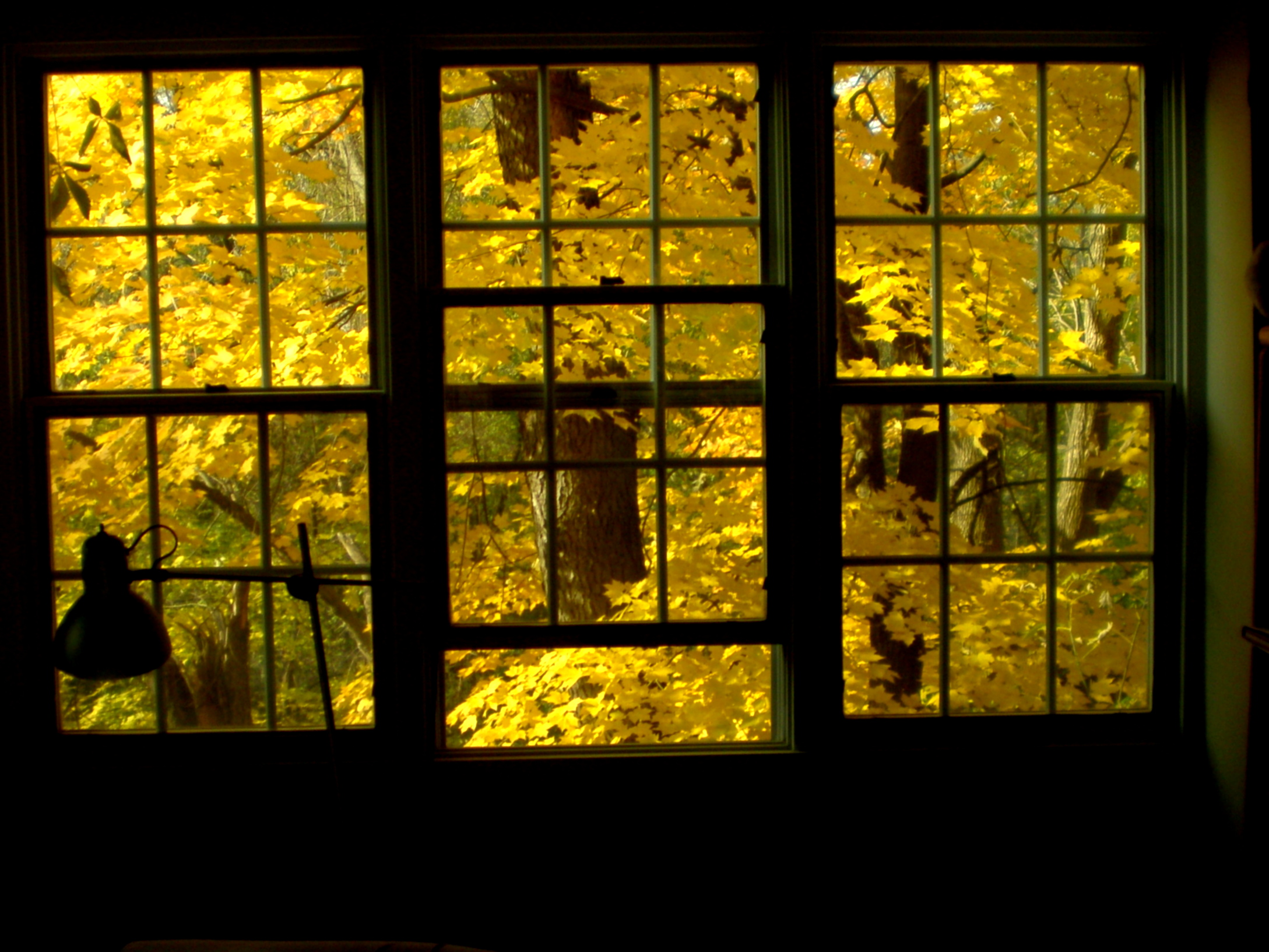
  The small ravine behind our house can certainly not be said to have been cultivated exactly, but as you can see above the presence of the latter upon the former has been salubrious.  Especially during these few days of fall.

  The maple tree is on the west side of our house, just behind our second floor bedroom.  Was it not there, the tree’s leaves would bear the brunt of the full force of the sun every day.  The juxtaposition that does exist however serves to shield the leaves from most of the day’s direct sunlight.  Thus, once the photosynthetic pigments are drained for the season, those that remain are able to luxuriate.

  A fortuitous circumstance I’m sure all will agree.  At its peak, the quality of the light infuses one with an incredible spiritual tumescence.  As the days progress and familiarity is bred, the mind is led from one happy memory to another. School in New England, expansive western hillsides covered with Aspen, and oh ya, Maine just a couple weeks ago…

  “Although this house may lack solutions to a great many of its occupants’ ills, its rooms nevertheless give evidence of a happiness to which architecture has made its distinctive contribution.”  Alain de Botton  The Architecture of Happiness 

*Space and Illusion in the Japanese Garden by Teiji Itoh

True

October 31, 2008

  Hemingway wrote: “… a thing is true at first light and a lie by noon and you have no more respect for it than for the lovely, perfect weedfringed lake you see across the sun-baked salt plain.  You have walked across that plain in the morning and you know that no such lake is there.  But now it is there absolutely true, beautiful and believable.”

  What a way to go through life.  If something is beautiful one should simply allow it to be so.  There is beauty all around if you’re open to it – especially if out in nature’s throes.  Your choice. 

  The river flows east and west here, a geographical anomaly with which I’ve never really become comfortable. (I guess it’s probably the reason I always carry a compass.) Rivers flow north to south in this hemisphere, right?

  Anyway, at sunrise, over these particular few days of fall, this orientation of the landscape makes for an incredible display on my drive to work in the morning.  Traveling west along its northern bank, the sun flames up over the horizon behind me and spectacularly engulfs our downtown some distance ahead as the river bends a bit southward – windows cracklingly ablaze and masonry all coppered up.

  Each year, for a moment, I ask myself if it is that time of year, or might there really be a fire?  I’m forced to turn off my radio and concentrate.  Soon, I realize that it’s my bit of autumnal bliss and relax and sometimes even pull over.  As I’ve said above, I’ve always enjoyed pyrotechnics.

  Further along, just before my office, a wooded island blocks view of the river (as long as limbs are leafed).  During these few days, by now several minutes past dawn, its canopy is burst ablaze, flames blowing about wildly, and spreading ever eastward.

  These are events of existential relativity just like rainbows and, uh, the proverbial tree falling in the forest.  You’re not there, they are fundamentally not seen or heard.  The rainbow only occurs in the brain of one with vision and in the right place at the right time.  Similarly, the tree may fall in the forest, but there is no sound if there is no tympanum upon which the sound wave for to fall.

  Shame, crime, sin to miss or dismiss or – more – not to enjoy any such sweet “spot of time”. 

Tip tops of trees
At dawn – peak autumn color
Like flames in a breeze

Poetry for Physicists

October 24, 2008

  I don’t like to revisit the same issue – at least not directly – but, well, in an entry level undergraduate physics course I read a book entitled: Physics for Poets  and I’ve thought ever since that there should also be something called Poetry for Physicists

  This came to mind recently while reading reviews of a new production of the opera Doctor Atomic which follows events leading up to the explosion of the first nuclear weapon in 1945.  The libretto was assembled from historical documents by Peter Sellars.  The end of the opening chorus goes like this:

A weapon has been developed
that is potentially destructive
beyond the wildest nightmares
of the imagination;
a weapon so ideally suited
to sudden attack
that a country’s major cities
might be destroyed overnight
by an ostensibly friendly power.
This weapon has been created
not by the devilish inspiration
of some warped genius
but by the arduous labor
of thousands of normal men and women
working for the safety of their country.

  Certainly I am glad Hitler didn’t cook it up before we did and the several hundred thousand Japanese who perished probably did substitute for many thousands of Allied deaths.  Somebody was going to figure it out and we’re lucky it was us.

  What did take me aback though was that during a recent dress rehearsal the composer, John Adams, met with one of original scientists who told him: “I didn’t know a single person at Los Alamos who wasn’t enthusiastic about using it.  Not a single person.”

  I’m no military strategist and won’t attempt to suggest what better course of action might have been taken, but will state the obvious: with such terrible power must come responsibility and perspective.  I wonder how that responsibility would have been managed if those with even the vaguest notions of what the ramifications of E = MC2 might be were versed in, say, ancient Greek literature.

  For example, in Sophocles’ Oedipus the King the title character meets King Laius on the road to Thebes and kills him due to a prideful perception of disrespect.  Only later does he find that Laius was his biological father.  Or the Odyssey in which that title character lands himself a ten year detour by haughtily mocking the Cyclops who was able to use information contained in the taunt to exact revenge.

  It isn’t a lack of knowledge or information that got those fellows into trouble, it was arrogance and a lack of humility.  There is actually a name for the concept – hubris – and it is well to keep in mind.  (Like every time I open my mouth!)

  Perhaps those scientists would have been chastened by knowledge of the myth of Prometheus.  He was the Greek god who gave fire to our ancestors and was punished by Zeus for having done so.  Chained to a rock, his liver was torn out and eaten by eagles, only to have it grow back and torn out again day after day. 

  Or how about something more recent:

Some say the world will end in fire,
Some say in ice.
From what I’ve tasted of desire
I hold with those who favor fire.
But if it had to perish twice,
I think I know enough of hate
To say that for destruction ice
Is also great
And would suffice.   Robert Frost

  As the pace of change ever increases discerning vision will only become more critical and as Nathalie Sarraute wrote: “Poetry is what makes the invisible appear”.

October 17, 2008


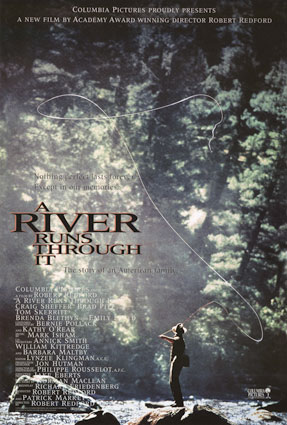
  Ever read or see A River Runs Through it?  Rare case of a wonderful book and movie both of which came to mind when I noticed that a new Norman Maclean Reader just came out.  River Runs Through It is the achingly beautiful autobiographical story of a Scottish Presbyterian minister father, two sons – one turbulent and one well grounded, and fly fishing on the Blackfoot River in Montana.  “In our family there was no clear line between religion and fly fishing.”

  Mr. Maclean wrote that his purpose was to explore the “topography of certain exposed portions of the surface of the soul”.  It is the soul of the tumultuous one, Paul, which lacks the sheltering layers most humans are able to maintain.  The exposure causes him to fall in with the rhythms of nature both harmonious and discordant.  He is a masterful fisherman, but also drawn to gambling and drinking and fighting.   

    “A river, though, has so many things to say that it is hard to know what it says to each of us.”  Norman listens attentively.  At one the two brothers are fishing together and a big one gets away.  “Poets talk about ‘spots of time’, but it is really fishermen who experience eternity compressed into a moment.  No one can tell what a spot of time is until suddenly the whole world is a fish and the fish is gone.  I shall remember that son of a bitch forever.”

  The ‘poet’ Maclean invoked was Wordsworth:

There are in our existence spots of time,
That with distinct pre-eminence retain
A renovating virtue, whence-depressed
By false opinion and contentious thought,
Or aught of heavier or more deadly weight,
In trivial occupations, and the round
Of ordinary intercourse-our minds
Are nourished and invisibly repaired;
A virtue, by which pleasure is enhanced,
That penetrates, enables us to mount,
When high, more high, and lifts us up when fallen.

  Paul (played by Brad Pitt in the flic) had no capacity for reflection or introspection.  The river carries him wherever it goes.  At the end, after he is found beaten to death, there is an exchange between the father and Norman.  Father: “Do you think I could have helped him?”  Son: “Do you think I could have helped him?”  “How could a question be answered that asks a lifetime of questions?”  Maclean asks the reader.  He concludes: “I am haunted by waters.”

  Paul reminded me of Meriwether Lewis who, like he, apparently reveled and managed well in the dangers and difficulties that filled the expedition he led with William Clark, but once back in civilization and society floundered.  Easy street was his most difficult traverse.  He was found dead of gunshot wounds two years later.  It’s disputed, but most thought it suicide.

  Huck Finn bore some resemblance to both Lewis and Paul Maclean, but knew himself well enough to say: “But I reckon I got to light out for the territory ahead of the rest because Aunt Sally she’s going to adopt me and sivilize me, and I can’t stand it.  I been there before.”

  I can’t stand it either.  I’ve been there before too. 

Note 1: At the movie’s end, at the last light of day while we watch a now nearly ancient Maclean cast his fly towards a cliff on the far side of a rushing river, the reading of the final lines by director/narrator Robert Redford is a coda more perfect than any other I can recall:  “Eventually all things merge into one, and a river runs through it.  The river was cut by the world’s great flood and runs over rocks from the basement of time.  On some of the rocks are timeless raindrops.  Under the rocks are the words.  And some of the words are theirs.  I am haunted by waters.” 

Note 2:  Perhaps I’m in luck.  Maclean didn’t start writing until his “biblical allotment of three score years and ten” after being prodded/encouraged by his children who had long listened to his story telling.  I remember driving a blue Ford pick up with a manual transmission talking about the Genius (aka Genii) in the bottle while one kid or another would shift when I’d push in the clutch…  And it was they who organized this space for me…

First Do No Harm

October 10, 2008

  Several weeks ago I mentioned something about financier George Soros’ back.  He employed it as sort of an economic indicator.  I’m reading his book The New Paradigm for Financial Markets.  It came out last April.  Wish I’d read it then. Or asked him about his back.  His advice in a memo written in January was to sell US stocks.  The Dow Jones Average is now some 30%/4,000 points less than at the end of that month.

  His purpose in writing the book is to put forth in detail his “theory of reflexivity” underlying his tremendous investment success.  “The theory of reflexivity seeks to illuminate the relationship between thinking and reality.

  “My starting point is that our understanding of the world in which we live is inherently imperfect because we are part of the world we seek to understand”… Understanding a situation and participating in it involves two different functions.  On the one hand people seek to understand the world in which they live.  I call this the cognitive function.  On the other, people seek to make an impact on the world and change it to their advantage. I call this the manipulative function.  When both functions are in operation at the same time they may interfere with each other.”

  Application of his theory in the financial markets leads him to: “the conclusion that both the financial authorities and market participants harbor fundamental misconceptions about the way financial markets function.”  His theory clearly is contrary to prevailing opinion that markets are inherently efficient.    

  Application of his observations to the current political scene is quite provocative in its description of the path that led to the current pickle we’re in.  “The primary purpose of political discourse is to gain power and to stay in power.  Those who fail to recognize this are unlikely to be in power.  The only way in which politicians can be persuaded to pay more respect to reality is by the electorate insisting on it… The electorate needs to be more committed to the pursuit of the truth than it is at present.”

  It’s not just Machiavelli.  The point is that once in power a ‘prince’ might manipulate realty with a certain goal in mind, but end up at the wrong end of the field in disaster.

  The road to hell is paved with good intentions.  An article in the business section of the October 7 online edition of the Economist admonishes: “First do no harm.” And then asks: “Do bosses need their own Hippocratic Oath?”

  Oddly, considerations of the above brought to mind another book recently read: The Architecture of Happiness by Alain de Bolton.  It is a wonderful treatise on the tremendous impact architecture and design have on our existence.  “The places we call beautiful are the work of those rare architects with the humility to interrogate themselves adequately about their desires and the tenacity to translate their fleeting apprehensions of joy into logical plans – a combination that enables them to create environments that satisfy needs we never consciously knew we even had.”

  But the reason consideration of Soros led to M. de Bolton is the latter’s description of how few are needed to effect positive change.  “Lest we begin to despair at the thought of how much might be required to bring about a genuine evolution in taste [and whatever else], we may remind ourselves how modest were the means by which previous aesthetic revolutions were accomplished.”

  Starting with the renaissance and ending with much of the western world’s modern built environment he shows how hugely generative and positive movements have been spawned by just a few tenacious individuals.  “The Italian Renaissance was the work of only about 100 people… It took a mere 200 pages of Le Corbusier’s Towards a New Architecture to decide the appearance of much of the built environment of the twentieth century.”

  He concludes: “We owe it to the fields that our houses will not be the inferiors of the virgin land they have replaced.  We owe it to the worms and the trees that the buildings we cover them with will stand as promises of the highest and most intelligent kinds of happiness.”

  Yup.