October 3, 2008


  The Stranger by Christopher Van Allsburg is a book I wanted badly to buy, but did not.  Why not?  Sticker shock.  It was autographed and priced at $250.  Our well worn copy at home will have to do.

  It came out in 1986 and ranked right up there with the Polar Express for at least two of our kids and perhaps even a bit ahead with the one born in 1985.  It is, for me, the ne plus ultra of children’s picture books.  Perfect combination of colorful, compelling artwork, spare yet fruitful prose, and prescient allegory woven discreetly into the fabric of the narrative.

  To a kid it reads as the story of an enigmatic stranger knocked temporarily into amnesia by an auto on a dark country road.  By this adult, now some twenty years after publication, on its pages can be seen hopeful resolution of careless interaction of man and nature.

  “It was the time farmer Bailey liked best, when summer turned to fall”.  Driving home, thinking he’d hit a deer, Farmer Bailey finds a strangely clad itinerant lying in front of his vehicle.  Taken to the Bailey home he is doctored and fed.  This is the caption to the cover picture above:

  – Mr. Bailey lent the stranger some clean clothes.  The fellow seemed confused about buttonholes and buttons.  In the evening he joined the Baileys for dinner.  The steam that rose from the food fascinated him.  He watched Katy take a spoonful of soup and blow gently across it.  Then he did exactly the same.  Mrs. Bailey shivered.  “Brr” she said.  “There’s a draft in here tonight”. –

  The stranger seems able to communicate non-verbally with the wildlife and stays with the Baileys for a while working tirelessly in the fields.  Until, that is, he notices that the autumn hues in the distance are not shared with the still verdant deciduous trees of the Bailey farm.

  After putting back on his own clothes, off he hurries leaving fresh frost and fall colors not far behind.  In the frost on the Bailey’s window is written “see you next fall”.

  It’d be terrible if fall didn’t come.  I can’t imagine living in a place where the seasons do not change.  Whether it be the luxuriant transformation of bean fields from green to golden or maples from green to orange to red, one can hardly not be filled with wonder or reverence as witness. It’s like the slap in the face by a zen master to make sure you’re paying attention.

  It’s an amazing process.

  The green energy producing chemical chlorophyll is unstable and rapidly decomposes in sunlight.  Thus, obviously, plants must continuously synthesize it.  Come shorter days and cooler nights a corky membrane grows between stems and leaves constricting the flow of nutrients and the chlorophyll disintegrates.  Green gone.

  Other more stable compounds are left behind.  Carotene (which helped transfer light energy to the chlorophyll) absorbs blue-green and blue light thus appearing yellow.  Leaves containing it, (aspen, soybeans) will thus turn bright yellow as the chlorophyll disappears. 

  Some leaves contain anthocyanins which absorb blue, blue-green, and green light thus reflecting red.   Unlike chlorophyll and carotone this is a component of cell sap and not part of the cell membranes.  As the concentration of sugar in the sap increases the yellowing leaves turn red.  The more sugar, the brighter the red.  Maple syrup.  Forty gallons of sap = one gallon of syrup.

  Best colors come with dry sun filled days coupled with dry cool but not freezing nights. 

Autumn morning sun
Hallows the dirt and stuble
Noble shades of brown

Last One I Caught Was A Yellow Swallowtail, I Think…

September 26, 2008

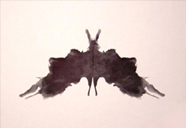
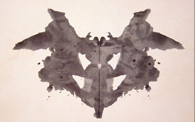
  While out in Maine I went into a really neat gallery/used book store.  There were many volumes I tried to convince myself to buy, but in the end walked away with only two:  A Rorschach Workbook and Child Rorschach Responses – both published in the early ‘50s.

  Yep the images above are five of the ten official Rorschach Ink Blots. Aren’t they beautiful?  Luscious I’d have to say.  Whoops, did I just reveal something about the depths of my psyche?

  A brief investigation courtesy of Google showed that the Test is still given though probably not nearly as frequently as fifty years ago.  And that there is no dearth of skeptics.  I remember discussing Rorschach with an elderly psychologist a few years ago and found him to be defensive, but yet still an advocate.  He held that so much data had been amassed over the years that the normative boundaries could reasonably and clearly be defined.

  No matter what, administration of the test must be interesting, especially after the accumulation of considerable experience.  The subject’s response is called a “Performance” because “The Rorschach test is based upon the assumption that behavior is meaningful and that when a person is presented with unfamiliar, nonstructured material, he will behave in his own individual way”.  

  A subject is initially given a vague instruction such as: “People see all sorts of things in these ink blot pictures; now tell me what you see, what it might be for you, what it makes you think of.”  The examiner then begins to present the ten cards from a deck which is always stacked in exactly the same order.

  Once the subject begins (hopefully ) to expound, the examiner takes careful, precise, and detailed notes.  How long it takes to react to each card is recorded as well as how long it takes to complete a response. 

  Then, “An inquiry, following the performance proper, is conducted to obtain sufficient information so that a response can be scored correctly.”  The examiner asks just enough questions to determine: where on a particular blot something was seen; essential info regarding form, movement, color, and/or shading of each discrete perception per card; content clarification if needed.

  All of the above is scored using a complex system of annotation to “facilitate the analysis of the record as a whole”.  A bar graph is created with the ‘determinant’ categories – movement, color, shading etc.  across the x axis and frequency of related responses on the y axis.  The result is called a Psychograph.

  Location categories are tabulated by percentage: location responses of a specific sort, (whole card, large detail, small detail) are divided by total number of responses.  So if thirty total responses were given of which eight were takes on the whole image on a particular card, then that score would be 8/30 or 27%.  These figures are compared to the “expected” percentages.

  “Normal expectancy” is that 20-30% involve the whole card; 45-55% large details; 5-15% small details; and less than 10% a combination of large details, small details, and some portion of the white space.

  Content is given one of three denotations.  ‘Popular’ if typical; ‘Original’ if rare, but good with respect to form and content; and ‘Bizarre’ if very rare, nebulous, and conceptually deficient.

  The Handbook includes many sample responses for every category.  As one might expect, there is incredible range – soup to, uhm, nuts.  My favorite thus far (with consideration to the maintenance of a certain decorum in this space…) is from the ‘Content’ category for card #8 which is the upper right most above: “The pink is the evil which is slowly destroying the good in the World.  Evil is triumphing and destroying the good”.  Whoa.

  Child Responses covers ages two to ten with age group specific observations made in six month increments up to the age of six.  It is filled with an incredible amount of detail.

  For example at age five: the total number of responses is slightly fewer than the two preceding ages; 58% of responses include the whole card; “content categories shift again to a more mature group… animals, objects, humans.  First age plants and trees are not an outstanding category.”  Sex difference not marked at this age.  Colored cards are much preferred. “All the dark ones don’t look so good.”

  What’s a typical response to card #8 from a five year old girl?  “I don’t know what this is.  Another butterfly.  Or a piece of candy.”

  How could this not be fun with kids? “Results of the present investigation point clearly and unmistakably to the conclusion that many types of response which are considered pathological or at least suggestive of disturbance in the adult occur quite normatively and characteristically at certain ages in the child”.

  Yes, I suppose that one’s early, florid imagination is usually trimmed (like that dang lawn) by the demands of life.  First half of one anyhow.  Well to recall Shunryu Suzuki’s observation in Zen Mind Beginner’s Mind: “In the beginner’s mind there are many possibilities, in the expert’s there are few”.

  I don’t know about you, but I’m fixin’ to break out my butterfly net again pretty soon…

Lobstah

September 19, 2008

  The persistence of vision is an interesting phenomenon.  It’s a conjunction of physics and biochemistry that allows our visual stream of consciousness to be seamless.  Like how the scene behind a picket fence looks essentially unbroken if you ride by quickly.  Or how a movie appears continuous rather than a succession of cells.

  It’s all because the biochemical transmission of nerve responses from retina to the back of your brain is much slower than the transmission of light.

  I’ve long wondered if there is some sort of analogue in our memory banks.  Long periods of separation from friends or loved ones often seem to disappear into some sort of synaptic negligibility.  You pick up where you left off almost as if it had been in mid-conversation.

  Recently however, I’ve begun to believe Heisenberg’s Uncertainty Principle is what is operative.  It basically holds that all pertinent facts about something unseen cannot be known with precision – only probabilities.  And that actual observation can yield surprise.

  A week or so ago for example I hadn’t seen oldest daughter for quite some time and stood not far from Casco Bay in wait.  Saw something catch the sun in the distance and lost my balance.  She had the lines of a really sweet sloop, fine sailcloth trimmed tight, on a run, heading towards me at speed.

  I swear last time I saw her she gripped my index finger to steady herself in the surf on the warm gulf shore of Florida.  

  But now, what with Maine’s rugged coast, it was critical that I quickly regain an even keel.  I wasn’t sure whether to tack or jibe or heave to and only at the last minute was, thankfully, after all these weeks, rescued by my navigator. 

  I looked into her compass and found my sea legs again.  We listened together about a candle burning at both ends, briefs, pro bono, and the state supreme court.  First part of her passage may have been tough, but we could tell that her grip on the tiller was firm and her ability to read the wind solid. 

  Soon it was time to shove off.  We sheeted in and  made for  points north.

Flirtatious Attempts at Self Selection

September 11, 2008

  Clear and very cool this morning when I took the dog for a run along the frayed edges of the fog blanketing the river.  I wondered if the commercial fisherman usually there was out in his 20′ jon boat.  I’d never noticed him to have a light and certainly no foghorn.  He’s been there regularly for years and I concluded that he must know how to be safe.

  Dog shot about like a bullet which caused me some angst.  Every year for the past few, at about this time, I come to realize that his sluggishness just days or weeks prior was not due to age but heat.  What a jerk am I sometimes.  Awful when I repeat.

  Previous few weeks it’d been us three boys.  Son took off for London yesterday and so now it’s down to Sauger dogger and me.  Current nature of our crib belies that fact.  We had fun.  Ah well, I’ll get after it and no one will be the wiser.

  Turning away from the river back toward home thought shifted to the concept of ‘no self’.  No self in the sense that one doesn’t have an immutable center, that what you are is largely the evocation of your own evolving particular interpersonal milieu. 

  Andrew had his elaborate DJ setup in our living room and took it all out for a number of gigs while home.  Watching him perform and seeing how the crowd drew enjoyment and naturally fell into its rhythms and beats made me realize that our “own personal interpersonal milieus” are just like bits of music – improvisational jazz.  We’re all instruments playing off each other and the environment.

  Your particular array of pets has inflected your personality in a particular if subtle way.  The sense of your place probably had a greater impact.  You’d be profoundly different had your family been constituted other than it was.  So What?  Take Five.

  Music has always been part of our nature.  “Darwin suggested that human ancestors, before acquiring the power of speech, endeavored to charm each other with musical notes and rhythm.  It is because of music’s origin in courtship that it is firmly associated with some of the strongest passions an animal is capable of feeling.”

  (In that regard, this dad watching his son perform couldn’t help but notice a steady stream of alluring young women approach in what sure seemed like flirtatious attempts at self selection.  OMG)

  A “Dr Miller sees music as an excellent indicator of fitness in the Darwinian struggle for survival.  Since music draws on so many of the brain’s faculties, it vouches for the health of the organ as a whole.  And since music in ancient cultures seems often to have been linked with dancing, a good fitness indicator for the rest of the body, anyone who could sing and dance well was advertising the general excellence of their mental and physical genes to a potential mate.” 

  Guess I better work on my moves so that I can bust a really good one some few days hence. 

Note: Quotes above came from my trove of clippings:  9/16/03 NYT

Where’s the Clearasil? Or, uh, Proactiv?

September 5, 2008

  Like just about everybody, I wish I had a whole lot more lettuce than I do, but, hey, life is good.  That’s why, I guess, I wonder about how big of an issue it really should be that the mega rich have become richer at a faster pace than the rest of us.

  Why care?  Most agree, from shrinks, to sociologists, to rock stars that after you reach a relatively modest threshold, the correlation between net worth and happiness rapidly weakens. (Besides, every redistributive effort thus far has failed miserably.  Just ask Gorbachev.  Or even better – Deng Xiaoping.)

  Think how ecstatic you’d be if all of a sudden your desire for more ‘stuff’ evaporated.  And you care less about the Jones.  Think how full your house is of junk that has long not seen the light of day.  Things that still fit and/or are far from the end of their useful lives.

  You’d be able to relax a bit more and enjoy the company of your roommate.  Which reminds me that mine is still away.  And the funny thing is that my friends at the Economist found out and included a bit in the 8/30 issue to help keep my mind on the subject.  (And off of the magazine covers son has left strewn about.) 

  It is a review of a book titled September Songs: The Good News about Marriage in the Later Years.  The author “turns her attention to couples in their 50’s and 60’s and finds older marriage is full of unexpected pleasures”.

  “Older couples expressed lower levels of anger, disgust, belligerence and whining and higher levels of one important emotion, namely affection.”

  “The nest empties.  Retirement approaches… As in late adolescence people once again have to forge an individual identity.  Without a growing family or a career to provide self-definition, older people must answer anew the teenage question, ‘who am I?'” 

  What fun!  Hope I don’t get pimples again.  Wife never had any.

  We’ll have to look in the mirror and see what we see…

Hazel

August 27, 2008

 The hardest part about filling this space every week (more or less) is settling upon a topic.  As by now must be abundantly clear, my peculiar combination of a short attention span and compulsive ideation make for a very cluttered radar screen.  Lots and lots of targets.

  Not this week though.  Wife is gone.  For a month.  Woe is me.

  Son Andrew is around for a fortnight or so which is certainly wonderful.  We don’t waste much time cleaning the house or sorting laundry or making beds and often urinate off of the deck in between flippin’ the burgers.  Dude, pass the remote…

  But when it comes time to retire to the couch in our bedroom at the end of the day, to read the paper and watch the news a bit before turning in, I miss her.  If there’s a center to our universe, that’s it. 

  There commenced the series of events leading to the arrival of three new souls onto this planet.  It’s there that we’d recapitulate teacher conferences and discuss what we’d learned.  There we’d think about the coming summer and whether it’d be travel by canoe or backpack.  Or just what plan to hatch the next weekend.

  But more than anything, sitting there during the last moments of each day we re-synch our gears.  Every day for thirty-one years.  Thirty-one years today!

  We met in kindergarten, but my first vivid memory is from the sixth grade.  We were studying South America in Mrs. Patterson’s class and Sally volunteered that there was good skiing in Chile.  How she knew I don’t know, but I was impressed.  I asked her out to Fun Night, but she’d been invited to a sleepover at a friend’s house.

  The friend lived next to my grandmother so I invited myself over and was obnoxious.  I ignited a flare I’d found by some railroad tracks and dripped molten magnesium all over her sleeping bag.  Not good.

  Later, during an early ‘70s spring break we were sitting on a beach watching a sunset when she turned away and asked what color her eyes were.  I’d already known her for many years, but didn’t get the answer right.  Worse.

  My excuse for these and innumerable other inexcusables is that from the beginning I’ve been spellbound by not so much the physical package (incredible though it may be) but her sparkle, her verve, her zest for life.  And all of that has only grown richer.  I very lucky boy.

  Some believe that a pair can traverse many lifetimes together. You live a life, die, are reborn, and find each other all over again.  Time comes I’ll never stop looking.  But I figure if I work hard enough at noticing stuff now maybe I won’t have to wait till kindergarten next time.

Scratch That Thought

August 22, 2008

  OK, I’ve always told my kids to listen to the little voice in their heads to keep them out of trouble and on the right path etc.  Maybe that’s been bad advice.

  Last weekend I was listening to the “Speaking of Faith” radio program on NPR during which host Krista Tippitt listened to best selling author Eckhart Tolle recount a seminal experience.  While riding public transportation to his university he often was seated near a certain schizophrenic who was always engaged in animated two-part conversations with herself.

  His realization was that he was frequently, though more quietly (but not silently!), similarly engaged.  Aren’t we all? You know: “I’m a dope.  What should I do now? No, that’s never worked. He’s an idiot. She’s hot.  Get out of my way moron.  Oh, sorry, I didn’t realize you were blind”…

  Furthermore, as I’ve mentioned (way )above , Julian Jaynes, one time head of the psychology department at Princeton wrote an unbelievably well wrought and erudite argument to the effect that the human preconscious mind was characterized by what we’d now classify as (mostly) auditory hallucinations. 

  And that today, while we’ve added the layer of consciousness, there is still plenty of evidence – vestigial and otherwise – of our ancestral selves.  In fact, it is exactly those vestiges that must be left behind to make way for behavior of a higher order. 

  “… athletic trainers… urge their trainees not to think so much about what they are doing. The Zen exercise of learning archery is extremely explicit on this, advising the archer not to think of himself as drawing the bow and releasing the arrow, but releasing himself from the bow and releasing the arrow, but releasing himself from the consciousness of what he is doing by letting the bow stretch itself and the arrow release itself from the fingers at the proper time.”

  Just think of the number of times you’ve gotten yourself in a stew and made it worse by continuing to stir.  Your mind takes over and you find yourself its captive.  You identify its interpretation of an event based upon sketchy sensory input.  Often later to have been found faulty or incomplete. 

  Michael A. Singer gives this advice: “The best way to free yourself from this incessant chatter is to step back and view it objectively… If you’re hearing it talk, it’s obviously not you.  You are the one who hears the voice.  You are the one who notices that it’s talking.”

  So, uh, notice what’s going on in your head.  Wait for it to go away.

  (And write home from time to time)

Las Animas

August 15, 2008

  In the 8/10/08 NYT there was an article about the recent tragedy on K2 titled: “Does Climbing Matter Anymore”?  Tragedy it certainly would have been if just one had perished let alone eleven, but only a couch potato would ask that question.  It is actually more of a koan and the answer is the Louis Armstrong response to the ‘what is jazz’ question:  “if you have to ask, you’ll never know”.

  Commercial endeavors (a big and growing) aside, adventurers know what they’re getting into and do so with purpose and resolve.  No matter if it’s the Himalaya or an unnamed wood, they understand that there is grave existential peril in a comfy slouch.  

  For some reason, the piece brought to mind a trip taken many years ago…

  We were headed, by narrow gauge rail, toward the Chicago Basin at the head of Needle Creek in Colorado’s San Juan Mountains.  Our car was several back from the engine, but even so, its spewing plume made me feel like an erstwhile citizen of Herculaneum.  I could not understand how my wife and kids were not bothered and instead hopped from side to side describing the scenery with ebullience.

  The angular bits of coal dust soon floating across my cornea triggered not exactly a pain response, nor diverting anticipatory thoughts of the wilderness that we had barely entered, but instead memories of recent car troubles, problems at the office back home, and dinner the last night in Aspen.  Why had we left?

  El Rio de Las Animas Perditas, the river along which the rails mostly traveled, was far below yet beckoned hypnotically.  I sank into my seat resignedly to obsess and await what might lay before.

  Just as I entered the state between wakefulness and sleep, the train stopped at the ghost town of Needleton which lies approximately midway between the railroad’s eponymous northern and southern terminuses; Silverton and Durango.  We jumped out, hustled back to the boxcar to retrieve our backpacks, and watched the train depart and disappear.

  The steep ten mile hike up along Needle Creek was in a word, brutal, but at least my thought pattern began to make sense.  I was again in the wilderness with my family.  Did we have the right stuff?  Would we be safe?  Would we have fun?

  Well not right off. First, cartographic aphasia led to several wrong turns, a trip to the top of a pile of rubble some distance from the day’s goal, and hours lost.  Then the water pump/purifier performed poorly and during attempted remediation an o-ring popped into the stream.  Finally, it rained intermittently during the hike up and through the night.  One of our tents leaked and all five of us spent the first night huddled together in the other – a few with pre-oedemic headaches.   

  Nonetheless next morning the pervasive beauty began at least to inflect my cortical cramping.  We set out to hike yet higher and reached a pair of lakes at about 12,000 feet.  There were of course no trees, little vegetation, and the water virtually sterile due to its hibernal solidity.

  The surface upon which our vibram almost squeaked had been polished smooth by the icy meniscus’ expansive ancestors and was ensconced high up in and surrounded by the castellated rim of the cirque.  The air was still, though laden with the smell of brimstone and the sounds of the neophyte creek.  Sally and I watched our three children silently stepping from rock to rock as if in performance of some Shinto rite.

  It is amazing – the grandeur of the infinite – that with which one becomes suffused in an area so devoid of life’s layers.  Wondering about how that sort of stark emptiness could be so fulfilling, so sort of spiritually tumescent, I recalled a proposition of physics which as written by one Alan Wallace has it that: “there is more energy in a cubic yard of empty space than in all the matter of the known universe”.  It must be that energy which has led native peoples around the globe to impute magic and divinity to such purlieus.

  After further exploration and a bit of rest we decided to move our camp down valley from whence to find a seldom visited lake about which we’d somehow heard.  Why it held allure I’ll never be certain.  There was no trail marked on the map and our guidebook described its approach as steep, indistinct, discontinuous, and treacherous.

  Indeed, though we were amazed at the myriad flora, fauna, and signs of men long gone that we had missed on the way in, we could not even determine which drainage would lead up to the darn place.

  Frustrated my group became as we covered the same steep mile several times in search of both some sort of indication of previous trail bifurcation as well as simply a way to cross the now adolescent torrent.  Our only encouragement was an animated description of hidden beauty by some wild eyed sacerdote.

  Our persistence was soon rewarded when another stranger offered assistance.  This one, a local fishing guide, showed us where to cross and described in general (the nature of the mountainside did not lend itself to detail) the way to the lake which was several thousand feet up and over a subtle ridge replete with turrets, hidden streams, and it was true – no real trail.

  “Purty well hid” he said looking upwardly as he twirled his mustache.  “Awful purty though; awful purty.”  In parting, he blew a wad of tobacco juice across the trail in front of us.

  The next morning we started up through the trees as directed.  They were dripping wet and seemed more like a forest of kelp.  After an hour or so of bushwhacking and log hopping, vestiges of the old miner’s trail did appear.  It was discontinuous – segments averaged about 100 yards in length – but we soon found ourselves able to follow it quite well by naturally filling in the blanks and being aware of the degree of arc and slope of a stretch, interpolating, and allowing reawakened internal guidance to lead us to the next short section.

  Occasionally, the way disappeared completely for quite some distance having been wiped out by landslide or avalanche and overgrown.  We would then build a little cairn at the breakpoint as we dropped into each new bit of destruction we had to cross to reach more virgin wood.

  More serious were the hazards created a bit past the more or less halfway point as the ridge’s rocky ossature began to protrude.  Mossy cliff edges were hard to identify due to the soft lighting and surrounding mist.  Fortunately, their position had been fixed in our minds while scanning the terrain the previous afternoon.

  As we rose, clouds obscured our view of the valley below and Mt. Eolus and subsidiary peaks to the north.  Once though, during a brief respite and snack, a hole appeared through which we watched massive disembodied blocks of orange granite seem to float in space.

  By the middle of the afternoon, light could be seen through the trees above.  Negotiation of a broken dark cliff band led to the top of the ridge, but not yet quite to our destination.  An old path led first to a absolutely still shallow tarn by which we sat briefly to watch trout dart back and forth with their dorsal fins protruding above the surface.  The glistening triangles were interesting counterpoint to the similar shapes on the far horizon.

  Our lake rested in a peneplain one hundred yards to the south and was larger than we had expected; several acres or so.  Behind and around it sloped a meadow resplendent in yellow and green which itself was collared by a rolling monadnock.  Its highest point looked like a turtle’s head beginning to emerge from the folds of its neck.

  As we approached, the clouds parted allowing the sun to set our wet garb steaming and reveal the lake’s luminescence as well as transmute the meadow into its almost iridescent apprentice.  It is in such a place, upon such a surface that Tibetan Lamas trek to read the names of the future.

  We looked in and saw ourselves.  Needed sunglasses.  The kids scurried around the edge for about half an hour while Sally and I watched and wrung out.  They first clambered around bone bleached piles of tailings and then continued around the lake, in birth order, toward a position opposite us.

  Their animations were uncharacteristically subdued and we speculated about the nature of their conversation.  I will forever hear the soft tones of their voices lilting across the invisible surface barely discernible from the sound of the gently falling water nearer to us.

  The clouds eventually drew back together reminding us that we were ill prepared for a night at 12,000 feet and serving effective notice that one must not long tarry in such a place lest the right of return be forsaken.

  Our descent was pure, clean, and mostly silent.  We had little trouble finding our way even though, if anything, the air grew more murky.  The cairns led us across the desolation zones and in between those we discovered keloid scars left by miners on the uphill sides of trees for unenlightened colleagues.

  Needleton was thriving the next afternoon with others in wait of a ride back to Durango.  Abigail flagged down the beast as it approached puffing and belching.

  We threw our gear into the boxcar and slowly climbed on board without a look back.  Pilgrims.

Before Shit Happened…

August 8, 2008

  If you buy the idea that developments in the arts of a time or  civilization are due to tremors in its underpinnings, then get this: the cave paintings of Paleolithic artists were largely unchanged for some twenty five thousand years! Must not have been any neurotic cavemen.  Or angst.  Or civil displeasure.  I read this in an interesting article by Judith Thurman in the 6/23 New Yorker.

  Isn’t that amazing?  Just think of all of the different movements of art that rode tumultuous waves of change in the twentieth century alone: Fauvism, Die Brucke, Cubism, Futurism, Orphism, Der Blaue Reiter, Constructivism, Suprematism, Dada, De Stijl, Art Deco, Bauhaus, Surrealism, Regionalism, Abstract Expressionism, Op, Pop, Minimalism, Conceptualism, Performance, Earth, Post Modernism, etc, etc. 

  She writes: “Paleolithic artists transmit[ed] their techniques from generation to generation for twenty-five millennia with almost no innovation or revolt.  A profound conservatism in art is one the hallmarks of a classical civilization.  For conventions of cave painting to have endured four times as long as recorded history, the culture it served… must have been deeply satisfying – and stable to a degree it is hard for modern humans to imagine.”  In addition, she points out that there has not been found any depiction of human conflict in cave art.

  Thurman tells us that the life expectancy way back then was about eighteen.  The brevity of the average was due to high infant mortality.  However, those making it through could expect to live for another thirty or so years due “to the rarity of infectious diseases and abundance of protein… considerably longer than the Greeks, the Romans, or the medieval peasants who built Chartres”.

  The zeitgeist way back then – for all of those centuries and all those generations – must have been characterized by an overwhelming sense of natural rhythm.    

  Must have been sweet.  But then we invented agriculture and began to try to remake the world according to an endless variety of parochial visions.  Shit happened and the rest is, well, history.

  As I have asked before, and will again, now that we are all elbow to elbow and our existence is at the very least wildly syncopated:  whither now that zeitgeist?

“Oh yeah? The fruit of my loins can beat the fruit of your loins any day of the week” – Homer Simpson

August 1, 2008

Back to work next week…