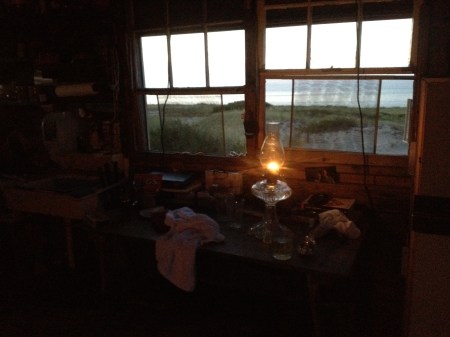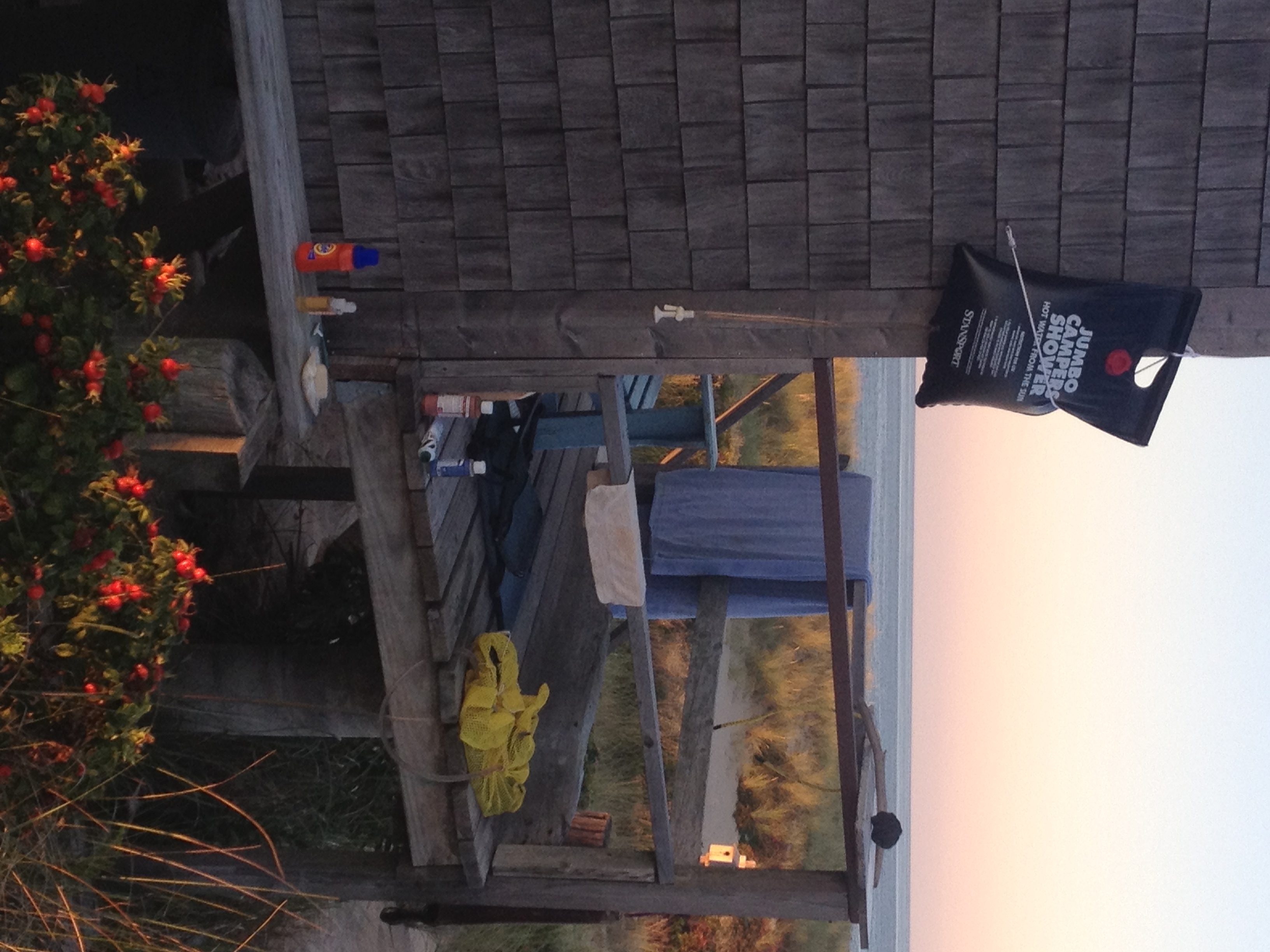
No Neighbors No Electricity No Running Water

September 7, 2012


  In about 300 AD Lu Chi wrote in his Wen Fu(The Art of Writing): “The poet stands at the centre of the universe contemplating The Enigma”.  Well, that’s usually where my mind is.  Thinking big thoughts, asking the big questions.

  Not here.  I’d like to think that here I’m less of a stick in the mud.  Here it’s more like Louis Armstrong’s famous “If you have to ask the question you’ll never know the answer”.  Or, as poet Michael Carey put it: “Nature speaks to those who listen and those who listen when nature speaks rarely speak at all”.  (Seen that before?)

  Sitting in yonder house of the crescent moon, – door wide – watching the waves and whales and gulls and seals you realize that you’re not so very different, alimentary on down.  And who’s to say about relative emotional tone?  The feeling part is one of the brain’s oldest.  Hmm…  An outhouse experience here is far more edifying than the Sunday Times on the throne at home.

  After thirty-five years of figuring stuff out together, where better to celebrate than the shack you see up top and below?  We sorta wonder how the kids are doing at their four cornered points of remove and how the folks are faring back home, but what could we do from here?

  We do speak and listen and eat and walk the beach and two in a bunk when it feels right; draw water from the well, and solar shower out back to wash the salt off after a cold swim in the sea.  It’s been incredible.

  Hey Sally, look, Thar she blows!

  Perfect.

Rich

September 2, 2012

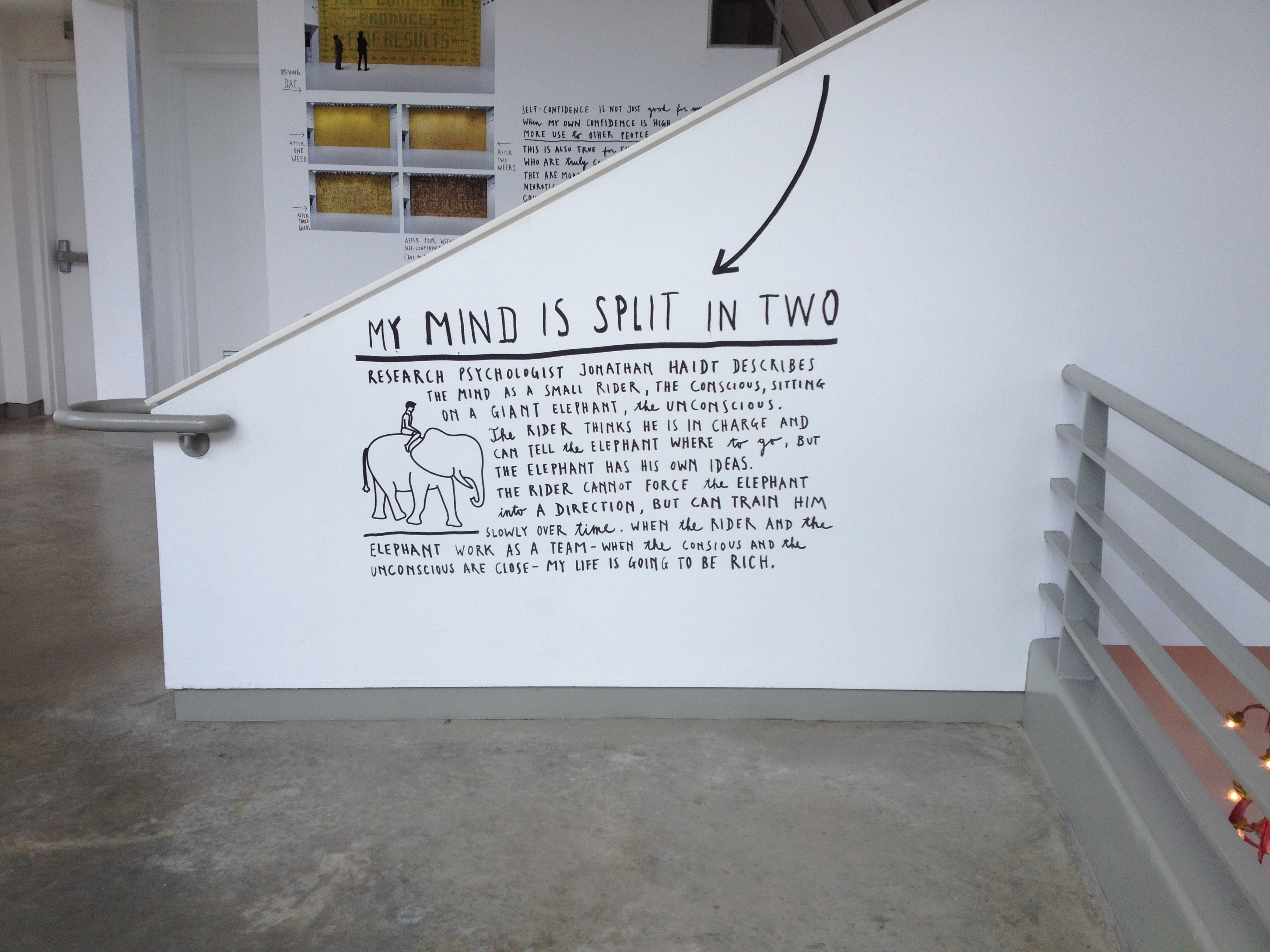
   The above is one installation in an exhibition by Austrian Stefan Sagmeister that just ended at Philadelphia’s Institute of Contemporary Art. Comprised of video, print, sculpture, interactive installations, and graphics, the show was an exploration of happiness.  It was entitled, appropriately, The Happy Show.

There was lots of fun and provocation.  This bit citing psychologist Haidt is one of my favorites.  If you’ve read much of my stream of BS leading up to this you’ll likely guess that I totally buy the metaphor of elephant and rider.

And that sitting here in a very lonesome shack by the sea without electricity or running water watching waves and whales and gulls and seals, the pachyderm and its obsessive passenger have had meaningful and productive intereaction.  Matter of fact we’ve gotta go pump water before it gets dark.  More later.

*In case your resolution isn’t fine enough:

“Research psychologist Jonathan Haidt describes the mind as a small rider, the conscious. Sitting on a giant elephant, the unconscious.  The rider thinks he is in charge and can tell the elephant where to go but the elephant has his own ideas.  The rider cannot force   the elephant into a direction but can train him slowly over time.  When the rider and the elephant work as a team – when the conscious and unconscious are close – I’m going to be rich.”

Hudson Bay

August 17, 2012


  Broke out laughing on the subway deep in the bowels of Philadelphia a week or so ago.  Kids had finally convinced me to load music into my Iphone and I was listening to Beethoven’s Sixth as it ended and “shuffled” into Jimi Hendrix and All Along The Watchtower.  Yep, life in the big city fer sure. 

  I was there with great purpose toward which was made significant progress along with interesting new friends.  I enjoyed myself immensely as perhaps you could tell.  Nonetheless it was good to get home and empty my suitcase even though roommate and little black angel had made north.

  To Marine on St. Croix, MN they’d traveled for the latest in an incredible succession of artist-in-residencies.  Plan was for me to join them just a few days later, but I didn’t relish the thought of more time in the saddle so soon.  Reports were very good however, and I lonely, so en route I went.

  Seven hour traffic jam.  Last two miles took one hour.  I was furious and could only barely tone down my requests for directions to the off grid destination.  “Jeesh, I’m going to have to do this again day after tomorrow to get home.”  “Don’t worry, she chuckled, you’re going to love it!”    

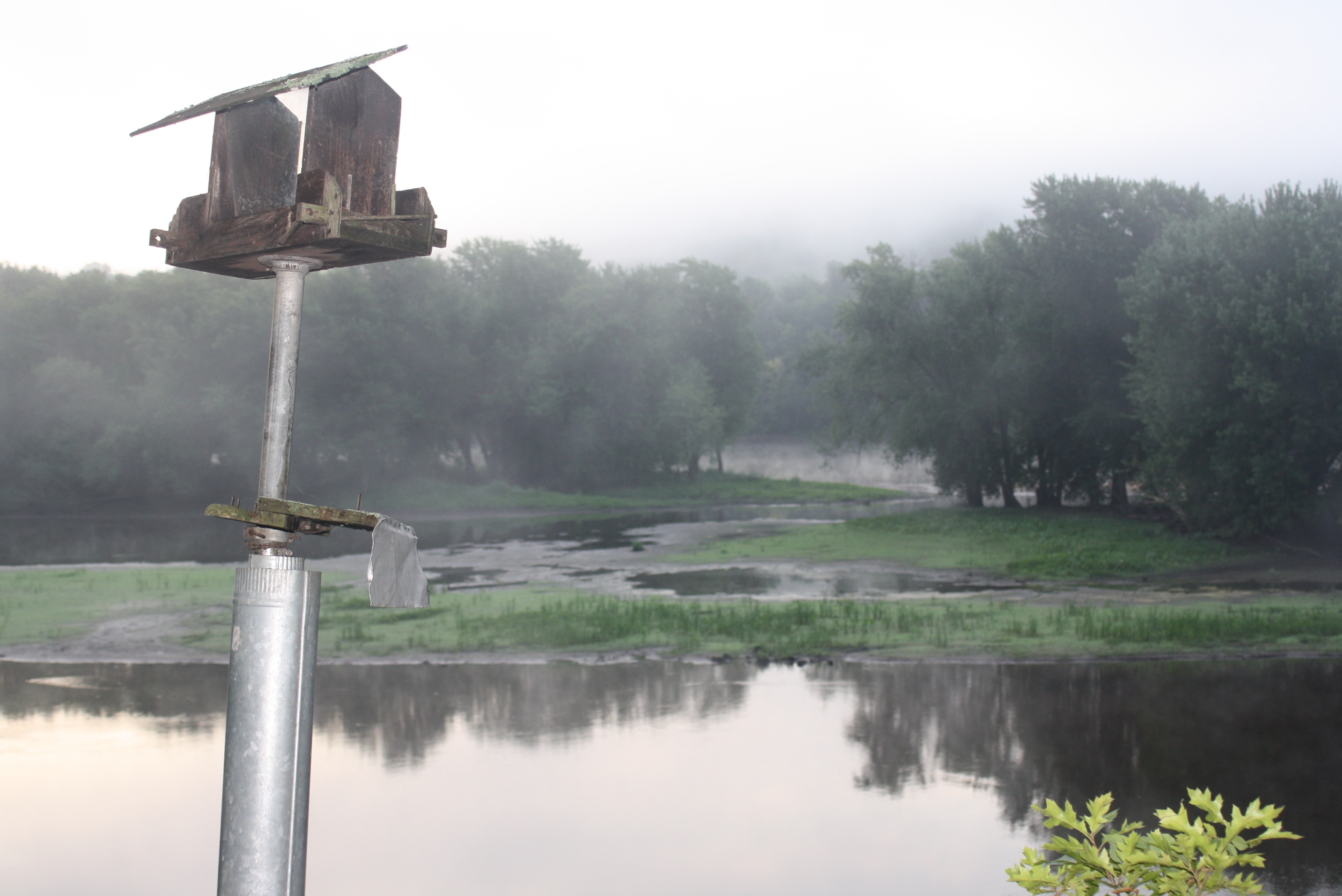
  Finally there they were by the side of the highway on an unsigned barely perceptible path through the woods.  Drove the mile in to a modest dwelling at the edge of a cliff looking over the St Croix River.  No sounds but us, the birds, and the bees.  Been record hot at home, but got so cold that night we had to pull up the Hudson Bay.  It was glorious.

In the middle of the night, when we get up
……we look at each other in
complete friendship, we know so fully
what the other has been doing.  Bound to each other
like mountaineers coming down a mountain,
bound with the tie of the delivery room…
surely this is the most blessed time of my life*

* From True Love by Sharon Olds

beats museums all to hell

August 10, 2012


  OK.  I’m really good at shopping for women’s clothing.  Scratch that.  Really good at accompanying roommate and/or daughters while they’re on the hunt.  It’s great.  They’re not the least bit interested in my opinions so I’m free to occupy myself as I see fit.  If you’re still with me, take note:  The nature of the particular venue makes all of the difference. 

  The trick for outlet malls and other similarly dismal points of the built environment – in which everything seems bland, temporary, and, well, cheap – is to take along reading material.  Given the opportunity to plan ahead, I usually take a copy of Le Monde and a small dictionary.  My rudimentary French draws broadsheet perusal out over several hours and at day’s end I’m left with interesting insights.

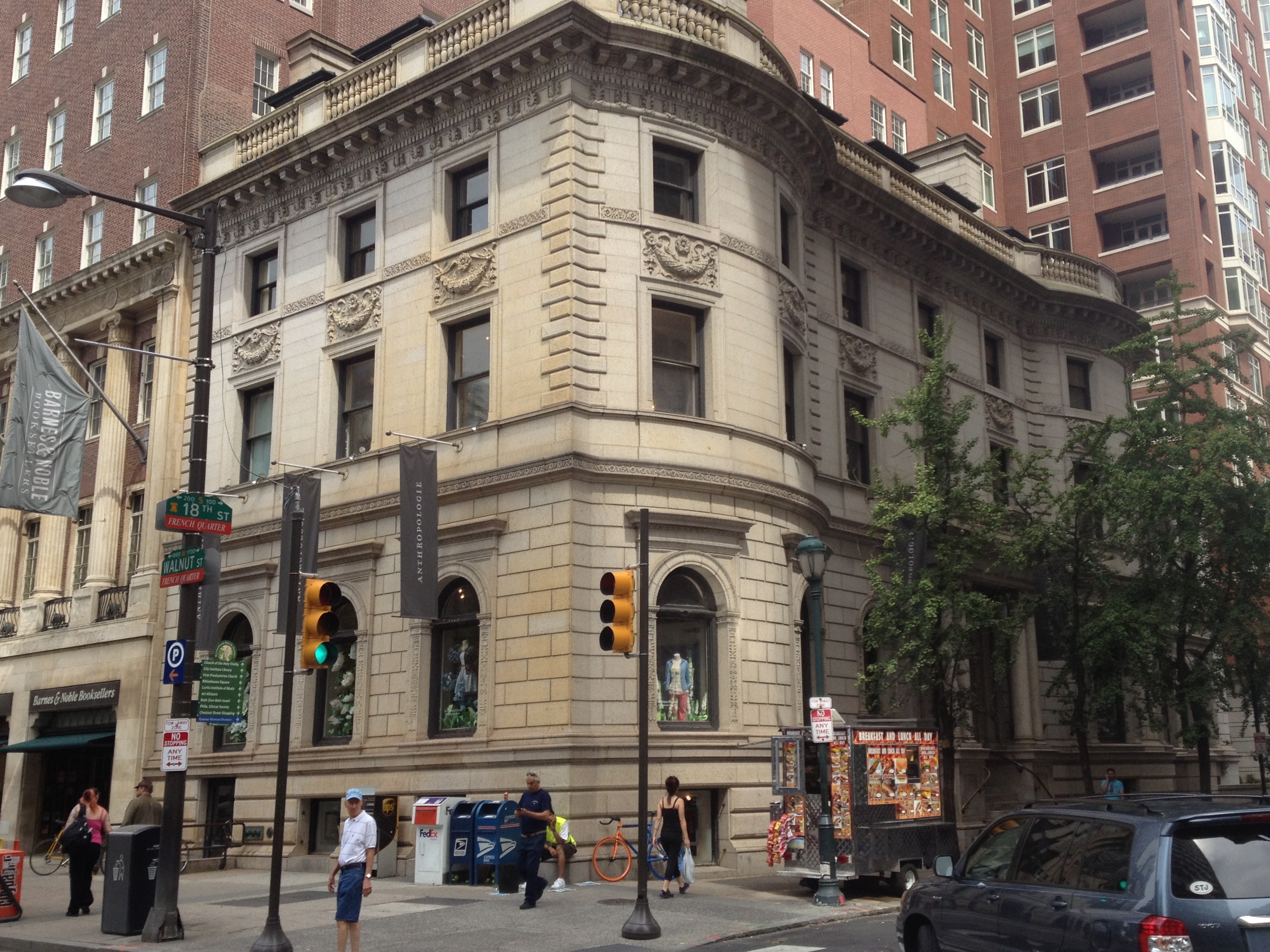
  By contrast, a visit to an establishment characterized by considered sensitive design can be more than pleasant.  Take the above for example.  That is the entrance to Anthropologie’s flagship store in Philadelphia.  It was designed by the prominent Boston firm of Peabody and Sterns as a townhouse for a member of the Drexel family in about 1898.

  Sarah Drexel Van Rensselaer and her husband Alex were wealthy, active, and generous members of Philadelphia high society.  During a 1901 circumnavigation, they were received by the Japanese Royal family, The Court of St James, The Viceroy of India, and the Rajah of Singapore.  A contemporary account of the housewarming for this pied-a-terre at 18th and Walnut said that they wore $10 million in jewelry*.

  Anyway, as I’ve indicated (and you can see), the place has been repurposed and gloriously so.  As Sir David Chipperfield said of another great spot: “…people need to go inside and be there for a while before realizing that, you know, this is actually quite a nice place to be…”**    

  It is indeed wonderfully generous space in which to simply move about.  And the opportunity therein to watch loved ones – and others – preen makes for a singular emotionally tumescent experience.  No one in my family will believe this, but I think it beats museums all to hell.

*From the Drexel University Archives

**As quoted in the August 2012 United Airlines Hemispheres in-flight magazine describing his Figge Art Museum in Davenport, Iowa.

***During a recent visit I attempted to photograph a few lovely young birds adjusting their feathers, but was advised that a few of Philadephia’s finest were on their way.  I decided to leave and allow them to enjoy the experience on their own…


We Are Alive

August 3, 2012


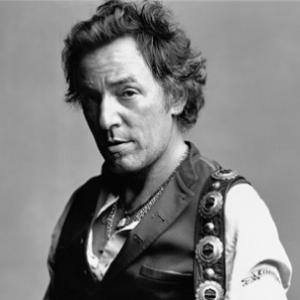
 In the July 30, 2012 issue of The New Yorker there is an interesting profile of rocker Bruce Springsteen.  Interesting to me for something “wingman” guitarist Steve Van Zandt said.  Back in the day one was judged by how well he was able to duplicate play from the radio – “cord for cord, note for note.”

  “Bruce was never good at it.  He had a weird ear.  He would hear different chords, but he could never hear the right chords.  When you have that ability or inability, you immediately become more original.  Well, in the long run, guess what: in the long run, original wins.”

  OK big deal you say.  Well, Pythagoras found, more than 2500 years ago, that there is a mathematic correlation to music that pleases.  Vibrating strings of different lengths, but in certain ratios make sounds good to hear while other relationships will be dissonant. 

  Subsequent observations of the universe led him and his followers to wonder – if musical harmony could be described by numbers, why not the whole universe – a “harmony of spheres”?  An almost contemporaneous biography of Pythagoras held that elevated minds such as his could audibly perceive the music made by the regular motions of heavenly bodies.

   No question that math does an excellent job at describing the cosmos with such things as the Golden Ratio and Fibonacci Numbers being found in wide and disparate corners of it.  And through the ages, artists and musicians of all stripes have attempted to tease out methods of their employment that might yield grand success.

  To no avail.  “History has shown however, that the artists who have produced works of lasting value are precisely those who have broken away from academic precepts.”*  Duh again. OK.  But what is truly amazing to think about are these relationships on the grandest of scales. 

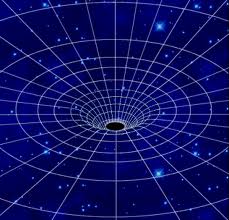
  Einstein showed that without the presence of matter or energy in the universe, there would be no space-time warp.  No gravity.  No harmony.  No dissonance.  No originality.  Perfection. Boring.  But, of course, not to worry.  There are inclusions, imperfections, noise.  As the Springsteen article is entitled: “We Are Alive”.

*Golden Ratio, Mario Livio

Can’t Wait To Try Their Pharmacy

July 27, 2012


  Know what bugs me?  Crappy generic store branded stuff.  Like the matches of which you see some on the right above next to proud green strike anywhere Diamonds on the left.  What makes a bad match?  Thanks for asking.  I’m gonna tell ya.

  Few days back, there was an, uh, odor I hoped to dispel with first the flame and then the smoke of a struck match.  I opened the box, pulled one out and across the abrasive panel when it broke.  Next one ignited and then broke, fell onto my shirt, and burned a hole.  Oh well, work shirt. 

  Next one ignited, broke, fell onto the carpet, and seemed to have gone out.  It was in a corner and the carpet is dark and wife didn’t see.  Almost ‘oh well’ again, but didn’t want to burn the house down so dumped a glass of water on it which I did have to explain later.  (“Uh, was watering plants”) I’d by then forgotten about the odor, but in retrospect I’m pretty sure it was long gone.

  What’s more is that the cheap ones hail from a poor country in which forests are rapidly being decimated by the indiscriminate use of wood as fuel for cooking.  On the back of the box of good ones is a statement of which the following is part: “…sourced from responsibly managed Aspen forests of Minnesota…”

  Store where we mostly shop stocks only those on the right.  As of recently I should say.  There used to be a choice.  I’m no genius, but I’m sure management figured that the process of match procurement for the average consumer involves negligible consideration of price or quality.  Thus, remove the good ones, sell the replacements at the same price, and double the profit.

  Matches were invented in China* in or around AD 577 when it was found that dry sticks coated with sulfur would facilitate the sharing of an established flame.  Robert Boyle (remember Boyle’s Law?) figured out that a stick coated with sulfur would ignite when dragged across a piece of paper coated with phosphorus. 

  As further refinement a John Walker in 1826 soaked small sticks with a mixture of potassium chlorate, antimony sulfide, starch, and gum, and allowed them to dry.  Move tip across a rough surface and voila – a flame.  This solution was poisonous however and sickened factory workers.  So after some experimentation, in 1910 the Diamond Match Co substituted sesquisulfide for the phosphorus and patented the modern match.

  And now some pencil neck has taken us a few steps back.  Can’t wait to test their pharmacy…

*cf post of July 2, 2011 to read about the invention of fireworks.

**Most of the history of matches above was drawn from an article by Lisa De Nike in the Fall/Winter issue of The Boss.

Soixantaine

July 20, 2012


  Often here and elsewhere I’ve referred to my fingers and toes while in the throes of some mathematical endeavor or other.  I like to say that one shouldn’t do math in public.  Anyway, honestly, seriously, there is little doubt in researchers’ minds that the popularity of the base ten system is due to the fact that we have ten fingers.

  You know, the mode of the place value system (invented by the Babylonians in about 2000 BC and of whom more in a moment) in which a number in one spot represents ten units of that to its right.  10 = ten units of 1. 100 = ten units of ten and so on. 

  Fingers AND toes.  Systems have been based on other numbers.  Like twenty.  In fact and to no surprise twenty seems to have been the most popular base, after ten, across cultures and history.  Vestigial remains of a base twenty system can be observed in French where the number for eighty, quatre-vingts, translates as four twenties.

  Another system with modern remains was that of base sixty used by the Sumerians in Mesopotamia. How in the world they arrived at that state of affairs is uncertain and subject to debate.  One researcher posits an intermingling of two cultures: one using base five and the other twelve.  The modern connections?  Units of time and degrees of a circle.

  And years in a life.  This one anyhow.  Just turned.  And had the sublime pleasure to spend a few days with five-sixths of my tribe at an exhilarating point on the map about twelve hours west of here.  During the course of a wonderful dinner one night I looked slowly around the table asking myself just how I came to be so lucky.  Boring maybe, but oh so lucky.

*Much of the numeracy above came from the fascinating book: The Golden Ratio by Mario Livio     


Voici Mon Secret

July 6, 2012


  Most will instantly recognize in the image above the style of Roy Lichtenstein.  It is indeed one of his paintings and is representative of what is probably the most widely familiar part of his career – apparent reproductions of comic book panels complete with thought balloons and Ben-Day dots.

  Icons of 60’s pop culture, they epitomized “cool”.  In an essay* Martin Filler tells us that Lichtenstein and Andy Warhol were “the foremost exemplars of Cool among their generation of American visual artists…that quality of being simultaneously with-it and disengaged, in control but nonchalant, knowing but ironically self-aware, and above all inscrutably undemonstrative.”  Like Steve McQueen and Miles Davis.

  I had only a vague awareness of Lichtenstein’s oeuvre beyond those executed during the course of that decade and thus found much of interest in a retrospective up now at Chicago’s Art Institute.  Though there are elements common through much of the work, there’s also was an evolution I’d not expected.  Filler tells us that Lichtenstein was “Acutely concerned about repeating himself…”

  Below you see a photo of one of his “Landscapes in the Chinese Style” which was his last series, having been painted in the late nineties.  Healthy and active, Lichtenstein expected to live to 100, but died in 1997 at seventy-three of an infection he contracted while in a hospital with pneumonia. 

  Though greatly taken by traditional Chinese painting and the sense of nature conveyed therein, he said that “I’m not seriously doing a kind of Zen-like salute to the beauty of nature…”, and though Filler and others suspect that the artist “intended to capitalize on the increasing presence of high-rolling Chinese collectors”, it is difficult – for me at least – to not feel my spirits lift while looking at Lichtenstein’s last works.

  Reminds me (for some reason – the following bit being not perfectly apropos) of something from St Exupery’s Petit PrinceThe Little Prince:  “Voici mon secret.  Il est tres simple.  On ne voit bien qu’avec le coeur.  L’essential est invisible pour les yeux”.  “Here is my secret.  It is very simple.  One can only see well with the heart.  What’s essential is invisible to the eyes”.


*New York Review of Books June 21, 2012

**Gagosian press release March 2012


Almost Perfect

June 29, 2012


  If you keep your eyes open and wits receptive, it’s amazing the cool stuff you come across.  Just yesterday, for example, I was driving by the jobsite you see above and did a double take.  At first, I thought that a piece of concrete pipe had loosed its restraints and was rolling toward disaster.

  Then, lo, a pair of steel arms lowered it to the ground gently as a nursemaid.  Beautiful bit of industrial choreography.  Had to stay to watch the whole process and was amazed at its efficiency and the economies of movement and energy.  One person unloaded the whole truck without assistance or requirement for outside power.

  Learned that the thing is a Pipemaster 100 and was invented in 1956 by Hank Schmidgall not far from here and has become an industry standard for all of the obvious reasons.  Easy one person operation – driver does it all.  Don’t have to wait for a crane or backhoe.  Thus no delays and can haul more pipe in a day. 

  Then later, on my way home, I couldn’t believe my eyes.  The Weinermobile!  I’d been struck with great good fortune twice in one day.  This bit of only-in-America was designed by Oscar Mayer’s nephew Carl in 1936.  There are now eight on the road: six built on a GMC chassis and two on that of a Mini Cooper. 

  Their horns can play the jingle (I wish I were a…) in twenty-one different genres from Cajun to Rap to Bossa Nova.  After multiple circumperambulations I drove home quickly, determined to find my Weiner Whistle.  Well, it wasn’t to be a perfect day, but one could hardly complain.

Let There Be Light

June 22, 2012


  Having been in the ER several times during the past week or so due to the aforementioned incident, I took the opportunity to sort of Rosetta Stone the placard you see above.  It was prominently mounted on a wall in every patient room I’ve visited thus far.  (Just one more visit to go!)

  Even though I’ve never had to worry about being in labor (rest assured my roommate would agree with that statement – whatever meaning you might ascribe to the phrase) the translation of that bit is what interests me most.

  I know a little Spanish and enjoy watching Despierta America (Wake up America) on Univision in the early AM.  You should watch it.  It is interesting even with the sound off, for the wonderful cultural counterpoint it conveys vis The Today Show, Good Morning America, et al.

  Anyway, the title and first phrase up to the conjunction translate easily word for word.  But then in English it says “…or are in labor…” and in Spanish “O Esta Dando A Luz” which I knew didn’t say anything about work or labor – trabajo.  I knew that Luz meant light.

  Turned to one of my research assistants, daughter #1, who informed me that the phrase does indeed mean “in labor”/giving birth, but translates literally as “…or you are giving light”.  I think that is beautiful, interesting, and further provocation for my sodium ion exchange (that’s what moves stuff along in one’s neurons).

  Had I ever have had the prospect of being in labor, I wonder if the nature of my anticipation of such an event would have differed if I’d  known it described exclusively by one or other of the phrases.  I’ll go out on a limb and say that it would have.  

  On the one hand, whatever combination of excitement, nervousness, and trepidation one might feel, to view the penultimate stage of a pregnancy in terms of work would be way different than, say, as the dawn of a new universe.

  Furthermore, that metaphor, “dando a luz” would (in my mind anyway) evolve through a series of metaphiers from the initial “giving light”, to the newborn’s astonished visage, to the acquisition of literacy, to a college mortarboard, and to a bright eyed effort to make the world a better place.

  But then I’ll never be pregnant and in all honesty the process of giving birth does not look that much like any sort of serene experience.  I would never have chosen the word “labor”.  More reminds me of William Wallace’s last experience of life in Braveheart.  Torture. I’ve watched it three times.  Birth that is.  Braveheart many more.

*Interested in metaphors and their contribution to consciousness?  Go to post of February 4, 2011