Go Figure

March 30, 2012


 Frank Lloyd Wright once said that: “a doctor can bury his mistakes, but an architect can only plant vines”. I’m sure that he’d agree though that plantings can also enhance good and great architecture.  After all, it was he who first used the word “organic” in a design related context.

  “Garden and Building may now be one.  In any good organic structure it is difficult to say where the garden ends and where the house begins or where the house begins and the garden ends… I am really an emissary of the ground…”*

  Well, in the photo above it is clear where building ends, but the effusion of color is all the more effective for that fact.  It’s a Canadian Redbud in front of the Public Library in Davenport, Iowa just a few blocks north of theMississippi River.  Yep, north.  The river flows east to west there for a stretch.

  The building was designed by Edward Durell Stone in 1969 and clearly recalls his Kennedy Center inWashington DC which went up in 1962.  I’ve always figured that DC’s cherry blossoms prefigured the DPL’s  redbuds.  Whatever, they look marvelous for a few days each spring.

  Furthermore, the ephemeration of twig and color before the geometrical background pattern brings to mind first how short will be our visit upon this bit of the cosmos and then just how incredibly it is all underpinned by mathematics.  Go figure.

*Frank Lloyd Wright, The Future of Architecture, 1953

Davenport Public Library

Kennedy Center

All Ok

March 23, 2012


  The thing about sailing is that you’ve got to pay attention to the wind.  Ya, I know, duh.  But it’s that the more time you spend on the water, the finer your attention becomes.  Minor changes in course or sail trim can make for a huge change in progress – upwind or down.  And careless disregard, especially downwind, can “do considerable damage, up to and including bringing down the mast”*.

 Everybody on board pays attention – whether it be with the top of their mind or a few synapses back.  All can but notice if they’re getting the crap shaken or welcoming the more smooth interludes.  Life under sail is an incredibly refreshing, invigorating step away from the quotidian.  Whatever might transpire.

  Recently for example yours truly, in an incredible display of skill and prowess, managed to foul the dingy line.  Twice.  First time was a real mess.  Daughter voiced concern as the yellow polypro line tightened around her arm as other end wrapped around the propeller.  Someone yelled to kill the engine before it dragged her under.

  Examination with mask and snorkel found a potentially serious problem.  The line was not only tightly cinched around the propeller, but shreds were also drawn into its coupling with the shaft.  An inability to clear it would have had us adrift until rescue.  Or grounding.

  Son, son-in-law, and I took turns holding our breaths and using an assortment of tools in an effort to clean things up.  It was easy to saw through the exposed coils, but the stuff wedged in proved problematic.  The extra buoyancy of the salt water helped by holding us against the bottom of the boat while working.

  After some progress, we heard a banging on the side of our boat – the “Buff”.  I surfaced and was told breathlessly that there were a bunch of barracuda about.  Sure enough there were a dozen or so of the snarly looking fish grimacing at us.  They were about a yard long and only sort of menacing, but their jagged under bite was hard to miss. 

  After quite a bit of time and effort and bursting lungs, it seemed like we’d gotten it all.  Fired up the engine, engaged the prop, and bingo! Forward and reverse both worked just fine.  So much more satisfying than working on computer problems, dealing with the TV remote, or “recalculating”.

  Shut it back down, hoisted sails, and made for the next port.  Dropped anchor and let out the prudent five times depth rode (chain).  Watched landmarks on shore to make sure anchor wasn’t dragging.  Seemed ok, but crew member donned mask, snorkel, and fins to make certain.  All okay.  Time for a glass of wine. 

*Nigel Calder’s Cruising Handbook

Life Shrinks or Expands in Proportion to One’s Courage -Anais Nin

March 18, 2012

Or, uh, be careful what you wish for.  As I mentioned a few weeks back, this chicken is about to cross the road and wonders what’s on the other side – free range or a barbecue.   Miss Nin’s comment came to mind at this juncture because I heard her speak at a previous flex point – college commencement so many years ago.  Nearly forty now.

I had no clue why she was deserved of an honorary degree.  What’s so great about sleeping around?  And why would you want to write about it?  Interesting to me now is that the realization that I then had far less knowledge of what was going on inside my head than did she.

All those voices!  Id, ego, anima, shadow et al; Mom, Dad; and cultural stereotypes roared up a cacophony while my own only piped up a few notes now and then – most notably in the throes of  life’s more beautiful duties.  Cannot but take a while though I guess, for experience and effort to begin create a melody out of all that noise.

It’s quiet at first, but soon enough clarity increases and then the dynamics ensue.  As it becomes more crisp and apparent you can either begin to not worry about scorn or embarrassment and try to hum along or else at your peril drown it out with some sort of overindulgence.  It won’t go away.  In other words: “the requirement [is] that a man, whatever his age or station, pull out of his reflexive behaviors and attitudes, radically reexamine his life and risk living out the thunderous imperatives of his soul”.

Further, “The terror he may feel on the high seas of life is understandable, but in relinquishing the imperative to sail on, in giving over to an ideology or to dependency on someone else, he loses  his manhood.  It is time to come clean, acknowledge the fear, but live the journey.”*

Gulp.  We shall see what we shall see.

*James Hollis, What Matters Most

The Importance of Grocery Stores

March 2, 2012

  I have always loved the grocery store.  Fondness for their aisles probably began in my youth when Mom would take my two brothers and me to a big bright new chain store Sundays after church.  It was a bit of organic joy after a somber hour in the hard pews of our grand cathedral.

She’d give us each lists of items to retrieve and we’d race to return first, forgetting (for the moment) our itchy wool trousers.  Years later I’d do the same (well, the grocery store part) with my kids only with more, uh, vigor than Mom ever allowed.  Wife did most of the shopping and appreciated my help when I did, but wouldn’t accompany me/us for fear of embarrassment.

I loved to juggle produce and found citrus to work best because apples would bruise.  I only tried eggs once.  Kids thus in a dynamic mood, I’d send them out in search of the makings of one of their mothers fine meals while I’d cruise the produce with my shiny rolling collection point.

Much to my surprise such tutelage instilled in my progeny more than just the usual bad habits.  Youngest daughter is working on her Masters in (Elementary) Education.  Here’s part of an essay she wrote followed by professor comment:

“For me, I have found grocery stores to be incredibly enjoyable…I can connect what I am learning at the store to other environments…In school, I am able to take my conversations and information from the grocery store and discuss ideas with my classmates or use the ideas in my teaching.”  “Grocery store as a literate environment is a new one for me – very clever.”

I enjoyed doing homework with all three and began to realize I’d miss my role in their education as the time approached for the last to go off to college.   When she did an important part of my consciousness went into withdrawal with troubling results and ramifications.

For example, back in the supermarket recently, I spied the item pictured below.  Looking about I couldn’t believe my good fortune as I watched brother approach.  “Hey man, I left my glasses in my truck, could you read this to me please so that I can be sure to take home what wife hopes for?”  It was awesome!

*The title above was shamelessly purloined from daughter’s essay…

Hija

February 24, 2012


  Hear about that horrible fire in Comayagua Honduras this week?  Daughter called to express concern.  She taught third grade in that city 2003-2004.  We visited. Flew into Tegucigalpa where the landing strip is too short for a big jet and thus its nose protrudes over the edge of a cliff when it finally comes to rest.  Everybody claps.  Beat up truck tows it back to “terminal”. 

  Bus from the capital city to Comayagua was a used yellow school bus from the US still sporting the name of its alma mater.  Several hour trip not for faint of heart.  While passing another bus going uphill around a curve the driver’s accomplice leaned out the door to beat the hood of the sensible with a baseball bat while laughing uproariously.

  Going downhill was even more disconcerting because of the increased speed and noise from the chickens as we rocked and rolled.  I put my feet up on the back of the seat in front of me, but the copilot pointed at them with his slugger.  Don’t know if I’d committed some sort of cultural faux-pas (er, paso en falso) or if he was insulting my manhood.

  Relieved to arrive alive we made our way to the Hotel Casagrande.  Daughter had given us two choices – “a really nice, but sort of expensive place that would be convenient or one further away that would be less expensive”.  “How much for the expensive place?”  “$25.00/night with breakfast.”  No foolin’.

  Daughter speaks Spanish – obviously – but purpose of the Escuela was/is to make the students Spanish/English bilingual.  It is a private school for the children of the local elite and expensive by Isthmus standards.  It was clear that her students loved her and vice versa.  She worries after them these years hence because of the oozing of the drug trade down from Mexico.  Hope none of her former charges were in that hoosegow* conflagration… 

  We traveled around the country for a week ending back in Tegucigalpa.  Went up to visit the Galeria Nacional de Arte, but were initially disappointed to find it closed.  Shot the breeze with the guards a bit and ended up getting a private tour.  The space was a converted colonial building made all the more interesting by its lack of most modern museum accouterments.

  Daughter hailed a cab to see us back to the airport.  Driver was worse even than that of the aforementioned bus and used sidewalks and green space as passing lanes.  Hija spoke to him sternly and fury immediately blazed in his eyes.  The taking of instructions from a female was not part of his life experience.

  I couldn’t believe it, but curbside at the airport daughter told him to wait while we embraced and goodbyed.  He’d drive her to the bus station to start her way back to Comayagua.  Oh lord.  I told wife if she hadn’t made me have kids we’d have a whole lot more money and a whole lot less heartache.

*From the Spanish: juzgado – courtroom

**Piece above is “Pasion por Amapalo” (Passion for Poppy) acrylic on canvas by Jorge Restrepo.  cf www.jorgerestrepo.com Show was called “Urdimbres” (Waves) and was up in the Honduran National Gallery of Art 15 to 30 April, 2004

***Ironically, the Honduran island of Roatan is often mentioned as a beautiful and muy barato place to retire.  We visited and agree.

Final Answer

February 17, 2012

  In the Science Tuesday section of the 2/14/12 NYT was an interesting article about novelty seekers*.  Heretofore a positive answer to questions like “Are you easily bored – do you thrive in conditions that seem chaotic” were linked to problems like attention deficit disorder, alcoholism, and worse.

  New research suggests that “Novelty-seeking is one of the traits that keeps you healthy and happy and fosters personality growth as you age… is a crucial predictor of well being… can lead to antisocial behavior, but if you combine this adventurousness and curiosity with persistence and a sense that it’s not all about you, then you get the kind of creativity that benefits society as a whole…”

  They call it “neophilia” and describe its role in the evolutionary success of our forebears.  We’d never have left the shade much less Olduvai had we not, at least some of us, a healthy dose of curiosity.  And novelty-seeking combined with two other traits (persistence and self-transcendance) turns out to be “a crucial combination… in people who flourished over the years… [and have the] greatest satisfaction with life”.

  There was an online quiz accompanying this article and I figured I might as well take it.  Tone was set with question #1.  I wanted to answer no to “Do you ever speed” but unfortunately I’d won a $168.00 speeding ticket earlier in the day.  Suffice it to say that the final results indicate that I ought to live forever and be quite happy**.

  Such knowledge couldn’t come at a better time since, after thirty-five years at the same job (no sick days) it is now time for plan B and my roommate and I are excited.  In case she reads this and takes the quiz though I must hasten to add that I didn’t get a ‘perfect’ score.  To the question: “Away at a convention a gorgeous married colleague from another city suggests a rendezvous, you…” 

  I checked C “You feel insulted”.  Final answer.

*”What’s New? A Penchant For Novelty Has Benefits” by John Tierney

**”You tend to enthusiastically approach the new and different as potentially rewarding and downplay any risks involved.  You may live too fast and die too young, but you also explore, experiment and otherwise push the envelope for the rest of us, often in productive ways.  You’re innovative, adventurous, and extravagant but also apt to be impulsive, irritable, and overindulgent regarding food, alcohol, drugs, and other temptations.”

Don’t Be A Stranger

February 10, 2012


  Much to my chagrin and way too late I just found out that the Wall Street Journal has an “extreme sports correspondent”.  If anyone out there knows what he gets per column inch please don’t tell me.  It would probably make me throw up.

Anyway, the most recent bit* was about climbing The Nose of Yosemite’sEl Capitan.  The route goes up the line between light and dark in the photo above and the top is some 3,000 feet above the valley floor. (The Burj Khalifa is about 2,700 tall) The first ascent in 1959 required an effort spanning thirty days.

Record time now is just over two hours which blows my mind.  Nose in a Day (aka NIYAD) – summit in twenty-four hours – is a relatively common occurrence and I’m close to convincing myself that with a bit (well, lot) of training and a young partner I could maybe accomplish that feat.  The considerable traffic over the last fifty years has made the path quite plain and clean.

Interesting thing is that though there is risk in opting for speed, there is also an element of safety.  The weather can change quickly, trapping those halfway through the more typical four or five day vertical journey.  Climbers die there every year.  Not long ago a pair froze to death not far from the finish.

In about 1975 I climbed up the dang thing with an amazing guy by the name of Ted Davis.  Ted’d left the states and the draft forCanadasome years before, but in those days of border porosity it was no problem to go back and forth with anonymity.

I’d never met a “draft dodger” and was predisposed to disrespect.  My number in the draft lottery was 101 to which the board never got close so military service got little serious consideration in my numb naïve mind.  Grizzly Ted took great pleasure filling in all of the blank spaces.  Including gratitude for those who did find themselves in harm’s way.

Politics had never come up with any of my other climbing buddies.  Neither did Buddhism, meditation, vegetarianism, or the environment until I met Ted.  He railed against the clear-cut decimation of northern forests and operated a company – Yossarian Enterprises – that replanted by the thousands.

Ted had climbed the Nose the previous year and invited me to accompany him for an attempt up a route more difficult and less traveled.  Two days in, about half way up, tired, hot, and cramped, we found ourselves atop a huge flat ledge.  It was wonderful to be able stretch out and reorganize our gear.  But then sun went down and stopped evaporating what turned into a waterfall.  We got soaked to the bone.

Water and green slime characterized the next few rope lengths (150’ ea).  The 25th was vegetated, rotten, running with water, and punctuated with a few dead mice(!).  Whenever you’d extend an arm to the rock, whether to place or remove protection, the water would course down your sleeve.  We should have turned back, difficult though that would certainly have been.

Day later we got to the tiny and sloping Sous Le Toit ledge.  Out of the waterfall we hoped to dry out.  Weather took a turn for the (even) worse.  It got much colder, windy, and began to snow.  Ropes froze.  Blizzard.  We put on our cagoules and climbed into our bivy sack.  Knees to chest we were for twenty-four hours.

We played umpteen games of twenty questions of which I won only about five.  We talked about his journey north and how his family felt about it.  It’s been a long time, but I clearly remember him describe his family’s disagreement, but still fervent support.  This was tremendous food for thought and I’ve come back to it again and again as first a brother and later as a parent.

Next day as clouds began to pull away from the Captain we began to hear the swoosh swoosh of helicopter blades.  I started to move around to get organized and recommence our upward progress.  Ted told me to “hold on a moment.  They’re here to rescue someone and we don’t want them to think we need help”.  I didn’t think we did either, but would have enjoyed a sympathetic fly-by expression of concern.

We topped out the next evening and started the hike down, but it was overcast and pitch black.  We decided that it would be dangerous to continue and best to spend one more night in the other realm.  Ted had some matches and we stoked a small fire till just before dawn.

That summer was the last time I laid eyes on Ted Davis.  We kept up correspondence and had several near misses, but never again crossed paths.  He died of cancer a few years ago and it pains me no end that but for a few miles and weeks we could have hiked together with our kids in Colorado several summers in a row.

Few days after he died daughter called with a big decision to make and had spent a lot of time alone in contemplation.  I told her that was a good approach and quoted from a book Ted had given me: “Perhaps the deepest reason why we are afraid of death is because we do not know who we are… Without our familiar props, we are faced with just ourselves, a person we do not know, an unnerving stranger with whom we have been living all the time but who we never really wanted to meet”**.
*Wall Street Journal February 2, 2012

**Sogyal Rinpoche, Tibetan Book of Living and Dying

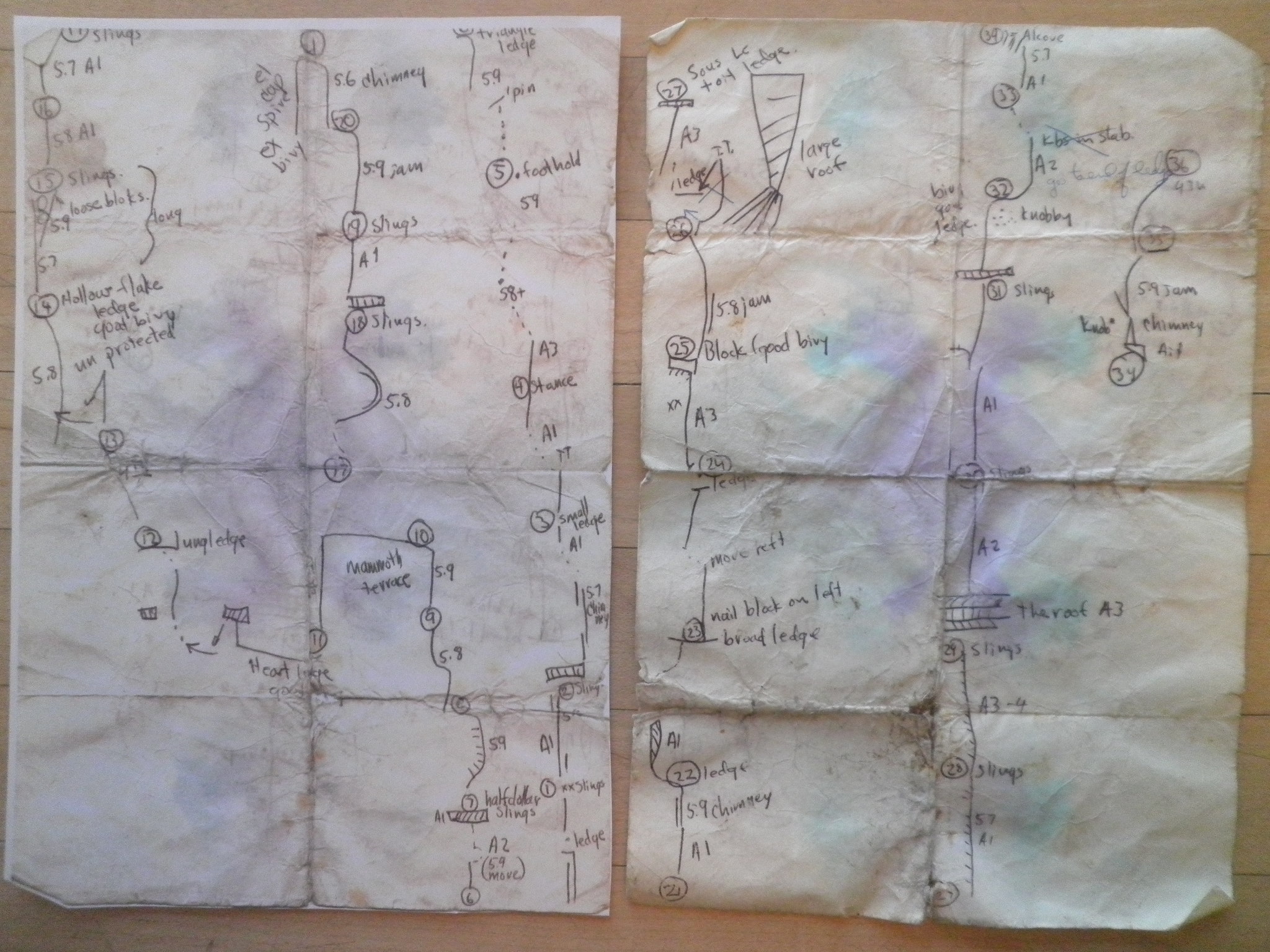
***The route Ted and I did, the Salathe, is left of the Nose, goes up to the heart shaped depression, around its left edge, then straight up.  The ‘document’ just above is the topo we drew with the help of several other friends who’d recently climbed the route.

It’s True Even If It Didn’t Happen*

February 3, 2012


 OK. It is probably either because I’m an insecure misfit or else am in search of an excuse for misanthropic behavior, but I’m again going to quote my bud Carl Jung: “The more a man’s life is shaped by the collective norm, the greater is his individual immorality”.

  Why now?  Well, because, as you may have heard, it is the fiftieth anniversary of the publication of One Flew Over The Cuckoo’s Nest.  On NPR I just heard the bit from the movie where Jack Nicholson playing McMurphy asks Nurse Ratched to modify the work schedule so the guys can watch the World Series.  “A little change never hurt, huh? A little variety?”

  She wouldn’t have it.  “What you’re asking is that we change a very carefully worked out schedule.”  Conform.  Hew to the baseline.  Don’t raise your hand, ask questions, or use your outside voice inside.  That was in 1962 and the tumult in western society was just getting started. 

  Thinking back upon all that, I find it incredible that in one sense popular culture is more misdirected than ever.  Globally now even.  As Irish poet John O’Donohue told Krista Tippett**, “One of the huge confusions of our time is to mistake glamour for beauty.”  It’s like the metaphor from The Cuckoo’s Nest that pervades is the lobotomy…

*A great line from the book.  And I guess it would apply to all great fiction…

**On Being 1/26/12

How to Age Exhuberantly

January 27, 2012


  OK kids, you’ve got to check out this book: 30 Lessons for Living –  Tried and True Advice from the Wisest Americans.  It is the distillation of 300 interviews undertaken by a professor at Cornell University with elderly Americans deemed by outside consensus to have lived a good life.

The lessons are spread over several different areas of concern, but “there was no issue about which the experts were more adamant and forceful” than work.  The title of that chapter is “Glad to get up in the morning – Lessons for a successful and fulfilling career”.  And it ain’t about the money, bub.

“You know those nightmares where you are shouting a warning but no sound comes out?  Well, that’s the intensity with which the experts wanted to tell younger people that spending years in a job you dislike is a recipe for regret and a tragic mistake”.  Big money may not accompany one’s bliss, but following it is the only way a happy denouement might.

And there’s a related lesson in this week’s Economist: “Exercise and Longevity – Worth all the sweat”.  Doctors (including Dr Brother) have long known that regular vigorous exercise helps thwart all kinds of ailments, from headbone to footbone to decrepitude.

Research is beginning to suggest that exercise helps by enhancing ‘autophagy’ which is the body’s own process of scrapping and recycling surplus, worn-out, or malformed proteins.  It thus slows down the biological clock.

Combine a fulfilling career and vigor and you just might get, well, somebody like Lucien Freud, pictured above in his eighty-third year.  He died last summer at 89, but for the nearly sixty years leading up to two weeks before passing he worked with a subject for several hours in the morning, a different one in the afternoon, seven days a week, standing up.

“And the moment he lifted his hands, most of his ailments seemed to melt away.”  Big money did follow his bliss, but to him it mattered not.  The only manner in which wealth changed him was that it diminished his love of gambling: “It’s not fun when you have the money…”

*30 Lessons for Living, Pillemer,Hudson StPress, 2011

The Lessons are for: Happy Marriage, Fulfilling Career, Parenting, Ageing Fearlessly and Well, Living Life w/o Regrets, and Happiness (Time spent worrying is time wasted – Your choice).

*Economist Jan 21 – 27, 2012

***Psychoanalyzing Lucian Freud, Vanity Fair, Feb 2012

****CF Blogpost October 12, 2010

*****And, uh, Freud didn’t read the part of the book about marriage and parenting.  He fathered at least sixteen children with six different women.  And though he clearly enjoyed himself, I guess I do not commend to you his particular brand of exuberance…

Samurai Had Knee Problems Too – As Well As Physical Therapists

January 20, 2012

Katsumoto: “Do you believe that a man can change his destiny?”

Algren:  “I believe that a man does what he can until his destiny is revealed.”

  What I’ve been doing while waiting has been to run and work out and after nearly sixty fairly intense years my knees sort of blew.  Should have noticed the symptoms earlier, but at the time it seemed like all of a sudden I was unable to run another step.  They burned while lying in bed.

  Tried to wait them out for like a month, but just got more morose and lame by the day.  Went to an orthopedic surgeon who x-rayed, said that there was nothing heinously out of order, gave me a few hits of Celebrex, and offered that “God gives us pain for a reason.”   Uh, thanks for that.

  Pills didn’t help much.  Kids suggested I go to a physical therapist which seemed to make sense and doc’s nurse gave me a referral.  I showed up at the appointed hour expecting some sort of Teutonic weight-lifter type.  “Ve vant to pump you up” and all that.

  Well, no.  A feminine voice calling my name drew attention away from The Economist and I looked up.  “I’m just back from maternity leave and you’re my first patient” she said as she turned and arched her back like a cat getting ready to prowl.  A cat in a snug yellow lycra top.  “Come this way”.

  “Knees, huh?” She took me to a small consulting room and gave me a pair of flimsy disposable shorts and told me to put them on and “I’ll be right back”.  It definitely felt weird waiting in a dark room, nearly naked, for an attractive woman younger than either of my daughters.  What the world would I tell wife?

  She returned.  “Let me watch you walk back and forth a few times.  Hmm.  Now lie face down on the table.”  I did and she grabbed my rear with a firm grip and said that she was “going to give [me] buns of steel”.  I arched my back, my eyes opened wide, and I worried more than usual about the next bit of my destiny to be revealed. 

  She massaged and probed around a bit while explaining that after doing the same sorts of exercises for six decades some sinews had stretched while others had drawn more taught putting my joints out of alignment. Finding myself composed, I asked about a few other aches and pains that somehow came to mind. 

  She felt around a bit more, gave me a new ameliorative exercise  routine, told me to get dressed, and left.  In the parking lot I called my brother to see if his knees were bothering him.  At home that night, well, I described a Teuton.  Now some months later, with mixed feelings, I can report that I’m again ready for battle.