Wash of the Zeitgeist

November 11, 2011

The three pictures you see below were all painted by Iowa native son Marvin Cone.  All come up for auction next week.  All are interesting – all the more in juxtaposition.

The first, just below, is titled “Sunlight and Shadows – Luxembourg Gardens Paris 1929”.  Though it is expected to draw the least interest and least dinero I quite like it for a number of reasons.  First, it is indeed pleasant to look at.  Though not exactly exuberant, it conveys a fine sense of the joy concomitant with a stroll through a park in the height of fall foliage.
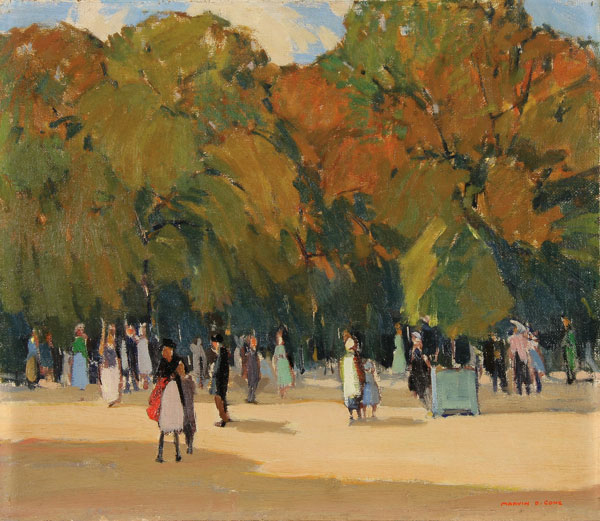
  And I know that park.  It’s not far from the Louvre and my first perambulations therein followed shortly after an eye-opening Art History 101 and during a revelatory term abroad.  I fell under the spell of the ‘City of Light’ the moment I stepped off the train.

And further to that point – the painting, having been executed in 1929, came well after the height of impressionism and a decade after the creation of cubism by Picasso and Braque probably just blocks away.  I relate in a proud and positive way to the combination of naiveté and insouciance indigenous to this great state.

The painting below – “White Barn No.1” clearly, if blandly, has turned away from what some (still!) would call European avant-gardism.  Stated more positively, it is a visual metaphor for the hard working, simple and straight-forward valued folks of our nation’s heartland.

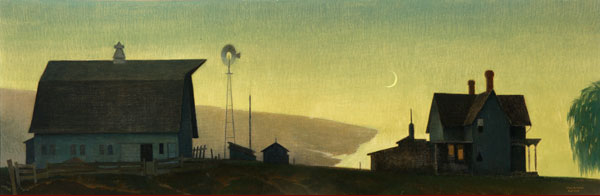
  “Farm Silhouette” at bottom is expected to make the highest bid of the three lots – $125,000 to $175,000 – and for me also has the most complex emotional tone.  On one hand it evinces a crepuscular nostalgia for rural America.

On the other, well, it made me think of the Cormac McCarthy title Outer Dark and the outer dark is not a good place to be… “They aint a soul in this world but what is a stranger to me… I’ve seen the meanness of humans till I don’t know why God aint put out the sun and gone away…”

Cone painted “Farm Silhouette” in 1948 – long after the sunset of Regionalism, after the horrors of WWII, after the incredible industrialization ofAmerica, and after he and his better known brethren (Grant Wood, Thomas Hart Benton, and John Steuart Curry) were compared with the social realists of 1930s Russia.  As an artist, on that bluff, he must have felt from afar the wash of the abstract expressionist zeitgeist.

“Farm Silhouette” is the only one of the three I’ve seen in person and an interesting experience it was.  Next to last on the scene, I took a call from a soon to arrive expert.  “Where do you have it?”  “We’re in the vault.” “Get it out of there; the blue tone of the fluorescents won’t do it justice.”

We moved to a room bathed in natural light and even though not directly before the sun, what a difference it did make.  Slapped myself in the head for the umpteenth time.*

Clearly the painting is in very good condition with original frame and stretcher.  Black light inspection showed no in-painting or restoration.  Paper trail (aka provenance) seamless all the way back to the artist.

Lot to think about…
*cf post of Sept 23, 2011.  Also, I recently listened to a tenured painting professor bemoan a temporary studio classroom lit with fluorescents.  “Unbelievably shitty…”

Route Description

November 4, 2011


  OK, I have another friend.  When he was about two or three his mother watched in horror as his great grandfather proffered to him a sip of bourbon.  Several years later while watching father and friends imbibe and pestering for a taste this friend was given a shot glass full of gin.

  Snuck some from time to time till when as a sophomore got a six pack from another friend’s older brother.  He downed five in quick succession and companion couldn’t finish the one.  Went on to college where the stuff was sanctified.  Guess that, honestly, not much happened during the week, but on weekends, well, he doesn’t really remember. 

  Vagabond years were more Dionysian than Apollonian.  Compadres were of a mind and proud to be successors to a storied group known as the “Vulgarians”.  Once, late after a revel at the Bar Nationale, one snuck up behind a gendarme and relieved him of his revolver.  Fortunately, the genius hadn’t noticed the weapon was tethered around flic neck and lost grip.

  Midst career and family this guy only occasionally lost hold and was able to cover tracks and count on short memory and collective norm.  No major bruises, breakages, or blackouts. 

  Problem really developed during shift from original indoctrination and responsibilities toward look at the future.  Seemed easiest not to deal, to make excuses, and to cover psyche’s symptoms.  Like TS Eliot wrote, “humankind cannot bear very much reality”. 

  But, then remembered Frost’s “Forgive O Lord my little jokes on thee and I’ll forgive Thy great big joke on me”.  And finally, interestingly, Michael Jackson: “If you want to make the world a better place, take a look at yourself and make a change”.

  Me? I’ve always said that my favorite drink by far is ice water.  First thing in the morning and last at night is a huge glass of l’eau glace.  Our two ice machines are always empty.  I don’t mind when berg in my large tumbler shifts, Adam’s Ale spills, and I look like a drunken idiot. 

  Plus, know what? Ice water is good for losing weight.  In a recent WSJ* were the results of a study that found that: “Drinking cold water causes the body to burn more calories and could be an effective weight loss method…”

  Yep, climb into the sack after a tall glass and it’s shivery for a while, but dreams are crystal clear. 

*11/1/11

What Good Is It?

October 28, 2011


  Across the wires earlier this week (AP I think) came the latest in the long line of contradictory studies regarding longevity.  This one holds that secrets lie in DNA.  “…it’s very hard to get there without some genetic advantages”.  How else could there be centenarians who drink like fish and smoke like smokestacks?

Made me think of Picasso for a variety of reasons not least because the anniversary of his birth was just a few days ago (October 25) and that he lived to be nearly ninety-two.  More to the point, he was conjured into this world on a puff of smoke.  Stillborn in Malaga in 1881 the attending physician gave up and gave way to Uncle Ruiz who exhaled cigar smoke into the newborn’s nostrils.

Sr. Picasso was awake, in the largest sense of the word, from that point forth and the expansiveness of his vision pervades his work and words.  Some is multivalent, some is clearly prescient: “Computers are useless, they only give you answers.”  Remember that he died in 1973.  Gates and Jobs were both only eighteen.  (BTW, Gates’ bday is today.)

Few great people would make it through the pearly gates on the first try and Picasso’s no exception.  He’s probably a drag queen in hell.  Still, though, confusingly I guess, he led his life in a fashion to be admired having done so contrarily demonstrative of the admonition of Jung that you’ve previously seen here: “The more a man’s life is shaped by the collective norm, the greater is his individual immorality.”

Picasso: “If you jump, you might fall on the wrong side of the rope.  But if you’re not willing to take the risk of breaking your neck, what good is it?  You have to wake people up.  To revolutionize their way of identifying things.  Force them to understand that they’re living in a pretty queer world.  A world that’s not reassuring.  A world that’s not what they think it is.”

You know, great artists look back upon the zeitgeist.

*Story of his birth and the quote came from: Picasso by Norman Mailer.

Round Trip Two Bucks

October 21, 2011


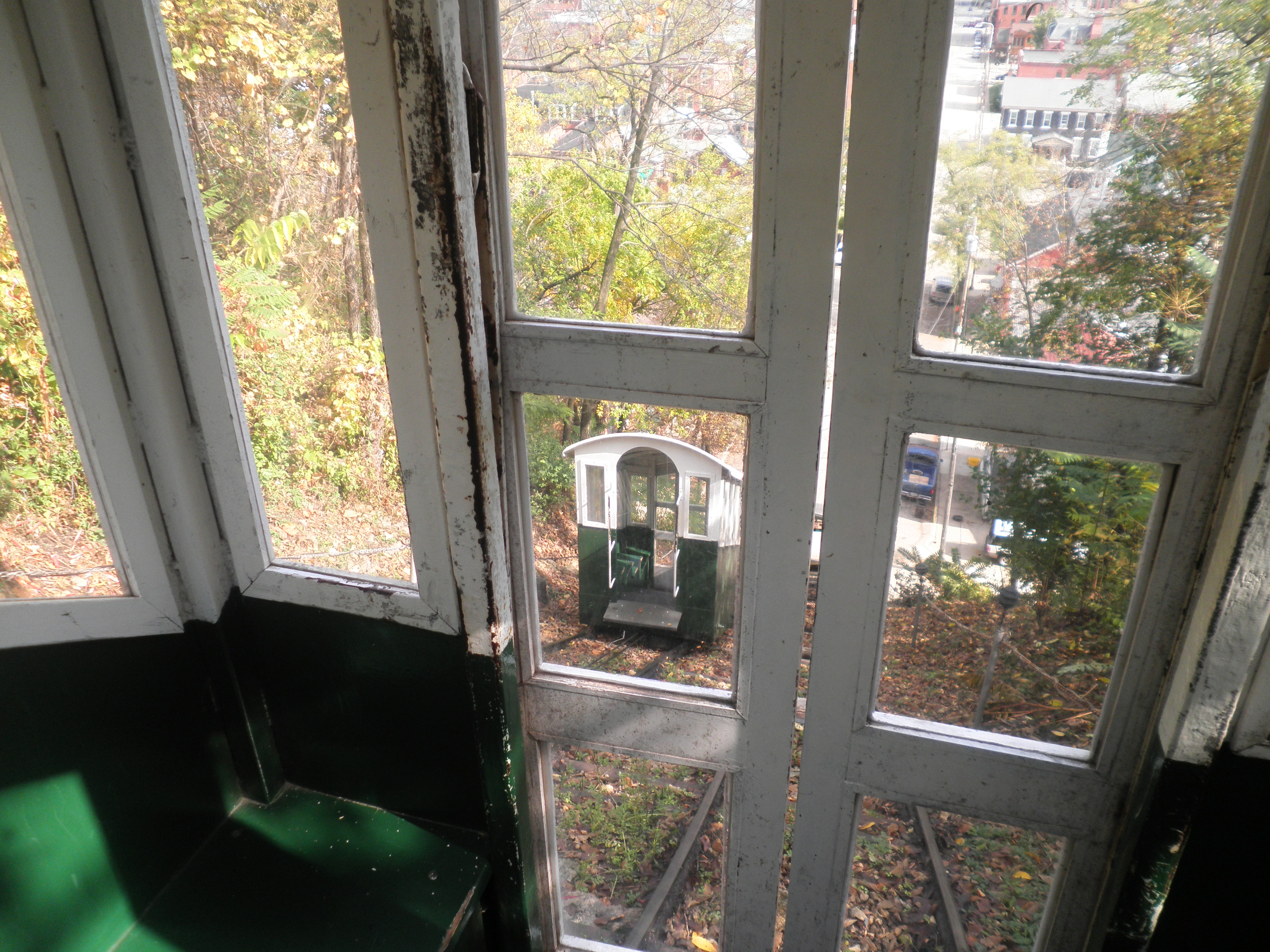
  Story goes that sometime in the late 1800’s a Mr. JK Graves, banker, formerDubuque,IAmayor, and former state senator, reached the point in his life at which he looked forward to a nap after lunch.  Problem was that his office was at the bottom of a cliff and house atop.  Buggy ride took half hour one way.

  Mr. Graves had been to Europewhere he’d seen inclined railways and decided thus to address the sleep deficit issue.  What you see here is not original equipment, but is a bit worse for wear.  Not scary though.

  Rises from a neat little neighborhood nook for a whimsical short journey up to summit pay station where a nice lady asks “one way or round trip?”.  I could always use a nap, but my bed was more than a funicular away.  “Round trip”.

  View, as you can see, was spectacular.  Those who traverse our fine state via I-80 might marvel at our agricultural prowess – or maybe just yawn – but either way get nary a notion of myriad unique opportunities for non-farm scintillation.  Arcane though some may be.

Haruspex

October 15, 2011


  The painting above is “The Ray” by Jean-Simeon Chardin (1699-1779) and is remarkable for the rendering of a gruesome scene as something compellingly sublime.  Of it Marcel Proust wrote: “strange monster…tinted with red blood, azure nerves, and white sinews like the nave of a polychrome cathedral”.

  Imagine!  An intellect as great as Proust comparing a painting of mangled dead sea ray with the central aspect of a type of architecture that reached its zenith there inFrancesome centuries earlier.  Philosopher Diderot wrote of Chardin’s talent: “secret of redeeming through skill the disgusting aspect” of a reality.

  Reminds me of writer Cormac McCarthy who accomplishes the same feat (maybe even outdoes Chardin) with his prose.  Check this out:  “His entrails were hauled forth and delineated and the four young students who bent over him like those haruspices of old perhaps saw monsters worse to come in their configurations”.

  OK. It is clearly impossible to convey, with a short excerpt, the entirety of a book in the way one can of a picture with a reproduction.   But of its essence a great writer might.  Let me elaborate a bit on that sentence and hopefully you’ll get an idea of the magnitude of McCarthy’s skill.

  Those words come near the end of Child of God and describe the final stages of a med-school dissection of the corpse of the chief protagonist and in their brevity almost recapitulate the entire work.  Elmer Ballard was a murderer and necrophiliac who roamed the hills of East Tennesse, was never indicted, and checked himself into the state home (“I’m supposed to be here”) where he died.

  Ballard was then the referent to the idea of “monsters worse to come” and one of those he indeed was.  The redemptive qualities of McCarthy’s prose McCarthy draw us inexorably through the stunning tale.  It’s not that we can’t look away – we don’t want to.

  The title of the book is also a referent of a word in the sentence quoted above.  Taken at face value, Child of God says that yep, white with the black, we are all part of the Lord’s flock.  Taken ironically: the thought of a dude up there in a robe and slippers is no less nuts than the reading the future in entrails – which is what a particular sort of ancient Roman priest (a “haruspex”) did.

  After Ballard’s remains were interred the bodies of more victims were discovered in a cave.  Here’s how the book ends: “In the evening a jeep descended the log road towing a trailer in the bed of which lay seven bodies bound in muslin like enormous hams.  As they went down the valley in the new fell dark basking nighthawks rose from the dust in the road before them with wild wings and eyes red as jewels in the headlights.”

*Chardin’s painting came to mind from reading Mary Tompkins Lewis’ take on it in the 10/8+9 WSJ.

One Fell

October 7, 2011


  Wife out of town again.  This time ministering post appendectomic daughter.  Interesting that these days doc doesn’t make one big slit, but several smaller ones instead.  Shoves flashlight into one, looks in another, and fishes vestigial organ out with a coat hanger or something through a third.

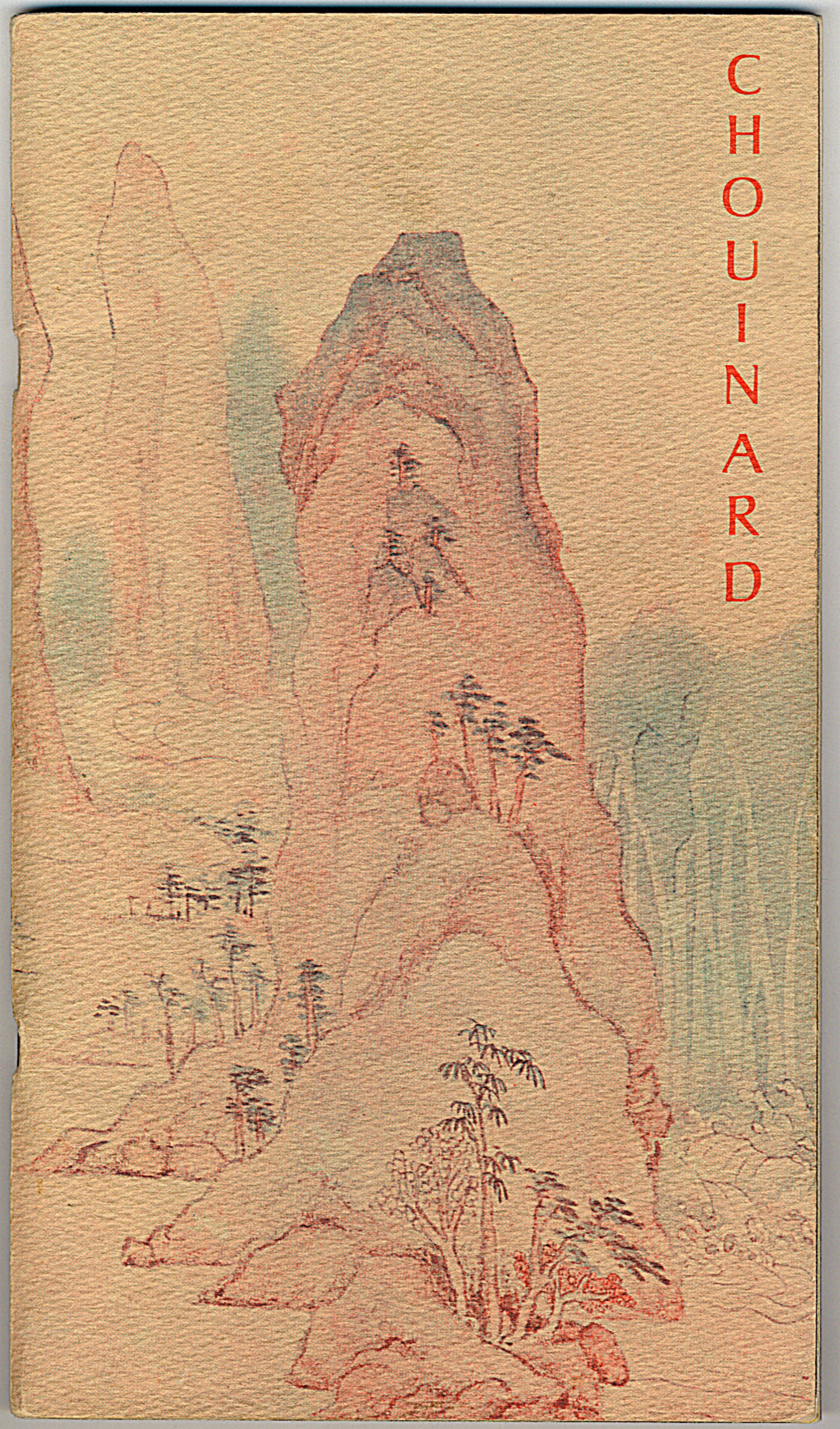
  Anyway, home alone one night and took a call from a friend I’d not seen in thirty-five years.  While talking about past exploits and future plans he reminded me of the ground breaking 1972 Chouinard Equipment Catalogue the cover of which you see above.

  It was a paradigm shifter for many reasons – not least because of its rich production values.  (Speaking of value, copies sell today for $250!)  More importantly it was an exhortation for conservation of the vertical environment – “clean climbing” as well as the proclamation of a new moral imperative to retain real adventure in the experience of it.

  What though does this have to do with my friend’s and my considerations of next moves?  Well, open the cover and the first words one reads are Einstein’s: “A perfection of means and a confusion of aims seems to be our main problem.”  Said differently, a typical life from zero to sixty.

  Takes that long to take care of business, shake things out a bit, and begin to see through the lens of your own specs, not someone else’s.  To realize as Jung wrote: “The more a man’s life is shaped by the collective norm, the greater is his individual immorality”.

  As the conversation drew to its close with warm wishes and promises to keep in touch I pulled my copy from the shelf and paged through.  I was transported to a place long gone and paths not taken.  Not yet anyway.  I turned to the last page and a lyric courtesy of the Stones: “Lose your dreams and you will lose your mind”. 

  I was electrified.  I dumped out the rest of the wine in my glass (seriously) and took dog outside to look at the stars.  One fell.  Our walk around the block felt like an airborne perambulation.  Had my friend not had me by the leash, I would have floated away.

*In case you don’t know, Chouinard went on to found Patagonia and set the pace for corporate environmental activism as well as outside cool.

**It’s never been lost to me that I was in that place long gone when my now roommate began to take serious interest in me (even though I didn’t use deodorant!).


Don’t Light A Match

September 30, 2011


  Well, news from CERN has it that there are particles moving faster than the speed of light.  Sounds like a big deal given E=MC2 and all of that.  However, reading through the blogs, it seems that Einstein’s theory already allowed for neutrinos of the “Tachyonic” sort to exist always at faster than light. 

  Dang complicated though and they’d not theretofore been detected. Guess we’ll have to wait for review of the evidence to see what, if anything, new was discovered.  But don’t you wonder where this stuff comes from in the first place though?  Scientific insights I mean? Here’s what erstwhile Princeton Psych Prof Julian Jaynes had to say about it:

  “The picture of a scientist sitting down with his problems and using conscious induction and deductions is as mythical as the unicorn.  The greatest insights of mankind have come more mysteriously.  The literature is full of insights which have simply come from nowhere.*”  Said Einstein of his theory: “Suddenly the happiest thought of my life came to me”.  And “Why is it that I get my best ideas in the morning while I’m shaving?”

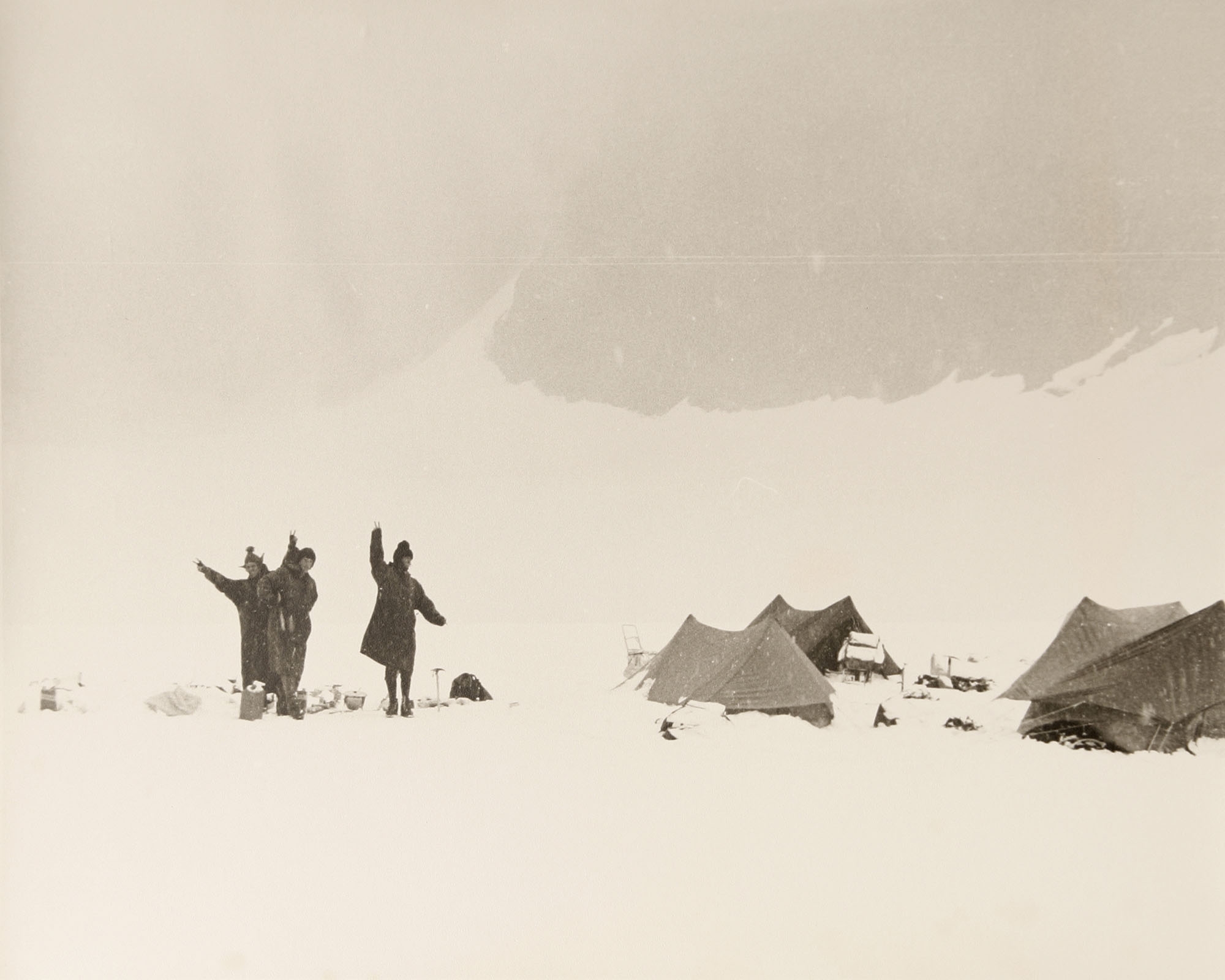
  Insights come when you stop thinking about the problem.  For example, years ago friends and I were encamped upon a glacier dreaming of first ascents up in the Interior Ranges of BC.  A storm set in and held us down for days.  One member of our party never left his tent and became more morose by the day.  Seriously depressed after several. 

  “We’re gonna die” he’d wail from inside his tent.  The situation wasn’t pleasant, but wasn’t that serious either.  Finally I decided to stick my head in and try to assuage his fears only to be nearly overcome with horrible odor of freeze-dried frijoles begotten methane.

  “Hey man” I said to him in recoil, “get the hell out of there and breathe some fresh air before you get really sick.  You got something muy bad goin’ on in there.  Don’t light a match.  Seriously.”  He moaned a bit, I persisted, and soon he emerged. 

   Five minutes later he was smiling.  Storm hadn’t broken, but his head was clear and he offered a few suggestions for elegant new routes of which no one had yet thought and which ended up years later with multiple stars in a guidebook.  Same here.  My best ideas always come  shazam while breathing outside air.

*From his Origins of Consciousness in the Breakdown of the Bicameral Mind – to which I’ve previously and frequently referred.

**Gotta be honest.  I came up with some of this while perusing two books that’ll I’ll shortly wrap and give as birthday gifts:

The Courage to Create by Rollo May and Confronting the Quantum Enigma by David J. Kreiter.  And dang if, since I just bought them yesterday, I’m not going to have to go out and buy again for myself.

Sunlight and Socks

September 23, 2011


  Next time you’re trying to match a pair of dark socks and fold them up into one of those little balls, go to the trouble of holding them next to each other in direct sunlight.  Don’t be surprised if two first thought to be mates turn out not to be when smiled upon by the sun.

  Sunlight of course is a natural cause of degradation – stuff fades.  But it also is by far the best source of illumination with which to regale an object’s reflection toward perception by a visual system human or otherwise. 

  That quality is behind the motivation of some architects to go to great and expensive lengths to incorporate natural light into special spaces by means of skylights and elaborate translucent roofing systems.

Though such design elements can be problematic (leak), their effects upon objects below can be magnificent.

  Italian architect Renzo Piano established his career with series of museums exploring such possibilities with first the Menil, then Twombly* in Houston, the Beyeler in Basel, and lately the top floor of the new addition to the Art Institute in Chicago.

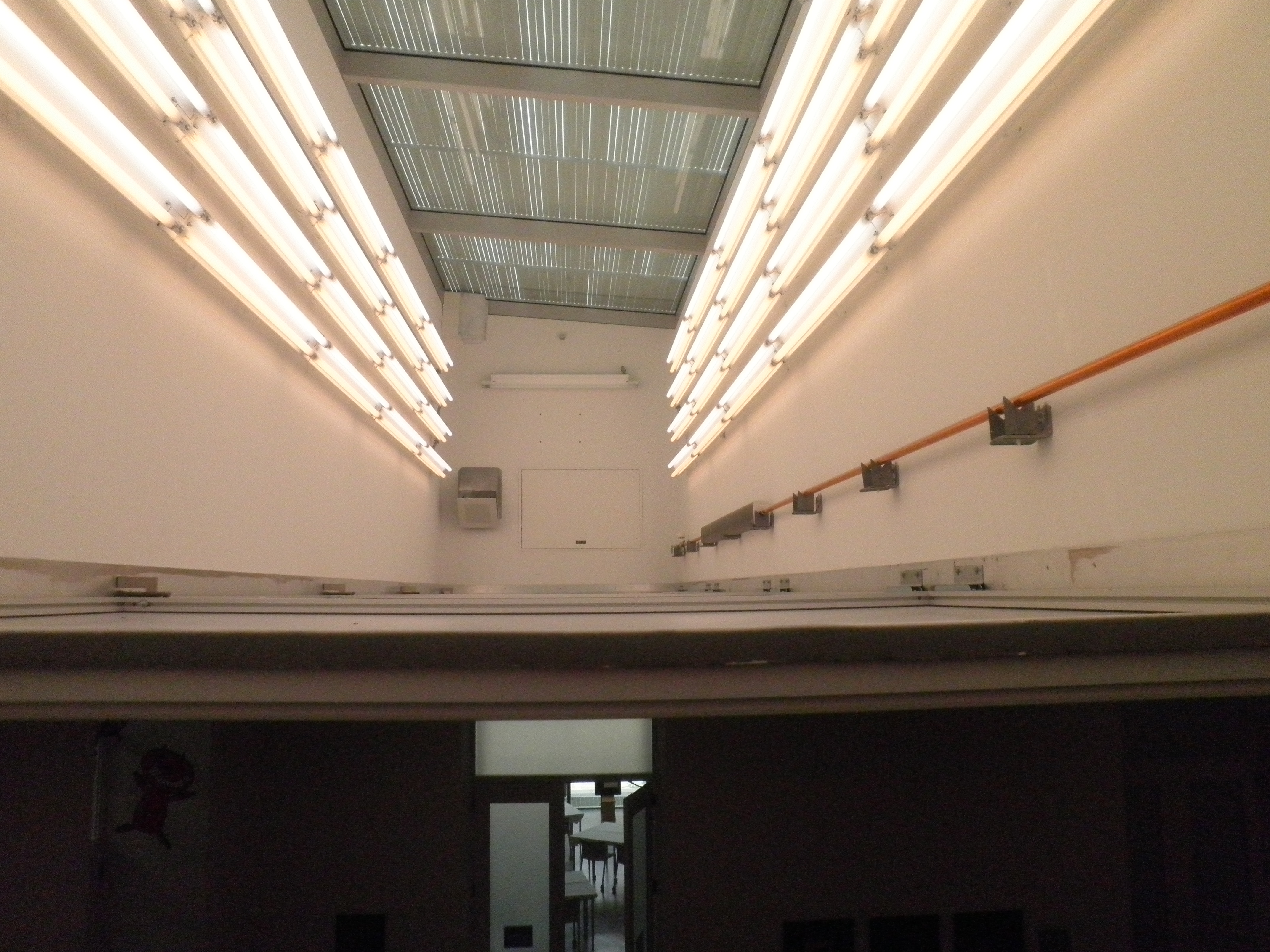
  Andy Sedgwick of Arup was the engineer of several of those solutions and it is his sketch of the light boxes for the Figge Art Museum that you see above.  Though rough, it is conceptually demonstrative of the finished product. 

  Their several components begin with the glass lights (panes) on top, then mechanical louvers to allow for modulation, then on the sides supplemental fluorescent tubes (cloudy days, night), and finally “stretched diffusing fabric”.  This last, in the end, turned out to be special scrim imported from France.

  Louvers opened, the finished product exudes the sort of generosity that Abbott Suger referred to during the early stages of gothic architecture as the “metaphysics of light”.  Standing below one once on a sunny summer afternoon, I looked down from Chase’s Mrs. Chase in Pink **to watch shadows of huge Midwestern cumulus roll across the floor.  Sent shivers up and down my spine.

*The light in the Twombly reminded me of a near death experience: cf 3/4/11 below.

**And Mrs Chase and I go way back: cf 4/10/09

Nice Shorts

September 16, 2011


  Just after the first of the year a twentysomething, uh, friend noticed a problem.  Performing a Lance Armstrong inspired inspection while showering he noticed a bit of topography that had not previously been there.  Uh, oh.  Oh well, probably nothing.

  Was something and it got bigger over the course of the following few months.  “Jeesh, better look into this” he thought.  “But how?” he wondered being a long way from last doctor visit and starting to get a bit nervous. 

  Tough not to think of stuff like that once your mind wraps around it.  “I don’t give a shit if I never win the Tour de France” he thought.  “But I know I don’t want my olive skewered or whatever else treatment might involve.”  Thoughts of excision came soon to his mind.  Dirt nap next.

  After calling a few friends he found himself at a clinic about which he’d been told by one who’d used it to procure allergy medicine.  “I got a lump on my leg” was all that he’d given when making the appointment.  “Right or left?”  “right”.

  Nurse guided him back to a room where he sat in wait upon one of those weird uncomfortable tables.  Door opened after a few minutes and in walked an attractive woman approximately five years his senior.  “Hi, I’m Dr. Anniston, what seems to be the problem?”

  Friend isn’t shy, but for a moment lost track of his thoughts.   “Problem with your left leg?” Doc asked.  “Not exactly.”  “Not exactly?”  Sigh.  “I noticed something in the shower a few months ago and it’s only gotten bigger”. 

  “Oh I see.  Right one I take it then?”  “Ya.”  “OK, stand up, drop your pants, and we’ll have a look.”  His attention lapsed again for a split second as he recalled the old bit regarding the wisdom of leaving home in less than perfect underwear.

  She pulled up a stool sat down and waited for clothes to hit the floor.  “Nice shorts”.  Palpated left then right then each again.  After a few moments of this she said “you’re probably ok, but we had better have an ultrasound.  Nice to meet you and we’ll be in touch with the results.”

  The procedure was done a few days later.  Was much less embarrassing.  Pants only part way down, towel covering all but the one orb.  Nonchalant technician rubbed the thing with warm gel and then gently passed a wand all around it while peering into a screen.  Didn’t say much except at the end to proffer tissue and to expect a call.

  Later that afternoon, it came: “Hi, this is Dr. Anniston.  Would you like to meet me later today?  I’m working late.”  “Uh sure, at the clinic?”  “No, 1323 Montana Santa Monica, R and D.  8:00 PM, ok?”  “Uhm OK”.  That had all transpired so quickly and he’d been taken so aback that he didn’t ask any questions.  He was terrified.  “R and D, that can’t be good” he thought.  On the drive over he debated whether or not to call friends or folks.  Decided against it. 

  Everything was ablur and it was too dark to read addresses anyway.  He parked the car in a spot he knew had to be close and made his way.  Heart racing three times his resting pulse, he almost got hit in a cross walk. 

  Found the place and went in.  There were lots of people.  It was a bar*.  Doc walks up, big smile, hot pink low cut wrap around dress.  “Call me Andrea and let’s have some drinks.  “You’re fine and I thought it’d be fun to celebrate!”

*http://www.hillstone.com/#/restaurants/cafeRandD/

**coincidentally, “friend” did some design work for men’s grooming products company Axe some of which are depicted in advertisement below.


Think With Your Hands

September 9, 2011


  OK, the other day I was near a bookstore in its final death throes, having been killed by the internet, Amazon, et al.  Sign said “80% off” so I decided to go in and see if there was anything interesting left.  There was!  Edward Tufte’s Visual Explanations – Images and Quantities, Evidence, and Narrative. 

  The Boston Globe calls the book “A Visual Strunk and White”.  The New York Times calls Tufte: “The Leonardo of Data”.  No understatements.  With wit, verve, and beauty the author convincingly shows how good design matters.

  One of many cases in point.  We learn that it was poor design that allowed the Space Shuttle Challenger to explode, and I’m not referring to the engineering of the Shuttle or its launch vehicle themselves, but rather that of charts engineers used the day before the launch in an unsuccessful attempt to convince NASA that an explosion was likely.

  The physical problem was that the cold temperatures predicted for launch date would attenuate the resilience of critical rubber o-rings allowing propellant to escape and conflagrate.  The chart below is but one of several holding data describing the danger.  Of their many faults Tufte cites inadvertent visual dissembling: “Chartjunk”. In contrast “Good design brings absolute attention to data”.

  Then he recounts the famous experiment undertaken by the Nobel Prizewinning Physicist Richard Feynman in front of the commission investigating the accident.  Using a small c-clamp he’d brought with him, he squeezed an o-ring and put it in a glass of ice water for a few moments.

  As he removed and released the bit of rubber, it became immediately apparent that the cold kept it from springing back.  “I believe that has some significance for our problem”.  The utter clarity of his presentation and his deadpan understatement blew the minds of the masses who saw it on TV or read about it in the printed press.

  “Never have so many viewed a single physics experiment.  As Freeman Dyson rhapsodized:  “The public saw with their own eyes how science is done, how a great scientist thinks with his hands, how nature gives a clear answer when a scientist asks her a clear question.”

  So, now, my questions are first: Without shelves loaded with books in a store through which to meander, how will one be able to occasion such moments of serendipitous edification?  Seriously.  And more important (again) what will the internet do to the potential for the development of great minds that “think with their hands”? 

  Here’s a response to question #2.  Reformed nerd Nick Carr has written a Pulitzer nominated book, The Shallows, What the Internet is Doing to Our Brains and penned an article for The Atlantic titled “Is Google Making us Stupid?”  Slate called his work “Silent Spring for the literary mind”.        

  Carr believes that “…there’s legitimate reason to be fearful.  I’m just suggesting that data technology is becoming so dominant that we’re losing the opportunity and the encouragement to engage in what I think is the highest form of thought.”*

  I’m gonna get some sort of grip exerciser. 

*”The Reluctant Luddite.  Nicholas Carr is a Net user of the first order, but he believes his brain is paying for it.”  Article by Dirk Olin in the Sept/Oct ’11 Dartmouth Alumni Review.