Archive for the ‘architecture’ Category

My Kind Of Town

March 27, 2009

chicago-skyline-day-2

  Next time you stay overnight in Chicago and get up for your morning run, make sure to go south along the lake a bit, past the Shedd Aquarium, and then east out the Solidarity Drive peninsula to the Adler Planetarium.  Then turn around and look back. 

  You will see why the Economist called it “…architecturally the most interesting city in America”.  And a better point of vantage could not be had.  If done just as I described you’ll already be on an endorphin high and with your first look, your breath will be taken away as it was just after first hearing the major movement of some great piece of music.  You will agree with (Chicagoan) Frank Lloyd Wright that “architecture is nothing more than frozen music”.

  With each repeat of this experience, I get the feeling that the final reverberation ended just the second before I turned.  Instruments are at rest.  Orchestra standing about to bow.  Remember – this is far removed from the sounds of the city.  In the early AM there is near silence out there.

  When I noticed a nearby statue I figured it must be of a great composer, seated, listening to a performance of his finest work.  Upon closer inspection however, it turned out to be of Copernicus which in a sense is just as appropriate.

  Chicago’s architecture would not be nearly so moving and dramatic had it not been for the great fire of 1871 which burned a wide swath to the ground.  From the ashes arose what is there now there to be seen.  A big bang of sorts.  It thus makes sense to have that important early cosmologist looking upon what hath been wrought.

KC-GULL-3C-830PM_MET 0624 C03 KOZ24

  It is especially fulfilling to consider this particular measure of the built environment as of a whole rather than of its pieces.  It is a nearly perfect oeuvre of quite large scale and, in comforting contrast to the terror and turmoil about these days, shows what can be achieved through harmonious collaboration. 

  Iris Murdoch wrote: “Good art, whatever its style, has qualities of hardness, firmness, realism, clarity, detachment, justice, truth.  It is the work of a free, unfettered, uncorrupted imagination.  Whereas bad art is the soft, messy self-indulgent work of an enslaved fantasy.  Pornography is at one end of that scale, great art at the other end.”*   Hardness, firmness, realism; doesn’t that sound like Chicago?

  It is incredible to learn that the city was built upon a swamp; that its name relates to the onions found therein by Native Americans; and that the land from Michigan Avenue to the lake was reclaimed and filled with the conflagration’s remains;

  As Carl Sandburg wrote in his Chicago Poems:

Come and show me another city with lifted head singing
so proud to be alive and coarse and strong and cunning

  And:

By night the skyscraper looms in the smoke and the stars
and has a soul

  My kind of town.

chicago-skyline-night

FASHION TIPS

March 13, 2009


         mid-light                                        retro-bustier1

  Hi girls!  Well, I said I’d get to fashion tips one day…  Such a steady and deep stream of women’s clothing catalogues flows through our mailbox that it would be impossible for me not to have honed a related set of skills.  Read what follows, but don’t tell your mother what I’m up to.  I’m pretty sure that she wouldn’t be interested.  Your brother will understand.

  The girl on the right (Victoria’s Secret – ‘Beach Sexy’ Collection) is real nice, I’m sure.  And I too would do just about anything within reason for the bucket of shekels she probably takes away for her efforts.  Nonetheless, she looks like something you’d see in a window in Amsterdam.  Why else would the company sell their undergarments in multiples?  The only point that comes across has to do with something one is born knowing how to do even if it does take some number of years to rev up.

  The girl on the left (Patagonia Spring 2009) is nearly atop the most famous boulder problem in the whole world.  It’s called Midnight Lightening and is in Yosemite National Park.  It was attempted many times when I was hanging out in the Valley, but was not climbed until the year after my last serious visit (1978).  Once she presses up, she will be past the crux of the extremely difficult (5.13b) forty foot route.  Gently holding both lips between her teeth (opposite of the pout on right) and not setting her jaw, she makes it look easy.

  That photo and shots like it in other catalogues and depicting other sports make me remember stuff like: the fact that your mother could throw the softball farther than I could in grade school and still is a much better skier; the girls state tennis tournaments; the Big 10 Women’s Soccer Tournament; climbing with you; and climbing in Yosemite myself.  

  Only after all that does it dawn on me that the girl is cute.  Uh, for her age.  And realize that since she’s obviously not a hack (to the contrary, world class) she must be particular about the quality of her gear.  It has to be comfortable and move with her.  She’s not getting paid so it’s gotta last.

  The cover of the Title Nine catalogue sitting on the kitchen table just now has an attractive woman in a bathing suit holding her surfboard and young son.  Thus we can see that she was able to convey a thought similar to that on the mind the young lady above right without, well, having to resort to skankitude.

  Finally, in the spring Athleta catalogue there are some attractive running outfits.  The caption for one reads: “Turn Every One of Your Runs INTO A SPECTATOR SPORT”.  The getup looks great and is not risqué, but that intent compels me to advise you to take care.

  You know that I never wear a shirt if it is anywhere near warm enough and certainly wouldn’t begrudge women any opportunity for ventilation and vitamin D.  Furthermore, I won’t ask you to consider a habit or burqua.   However, in the case of clothing, less is not necessarily more*.  Unless you’re chumming for sharks and ok with the ensuing mindless frenzy, remember that form should follow function*. 

* I paraphrased architects Mies van der Rohe and Louis Sullivan so that your brother wouldn’t feel left out of the discussion.

**Left photo by Rich Wheater: http://www.richwheater.com  Check out his site.

November 7, 2008

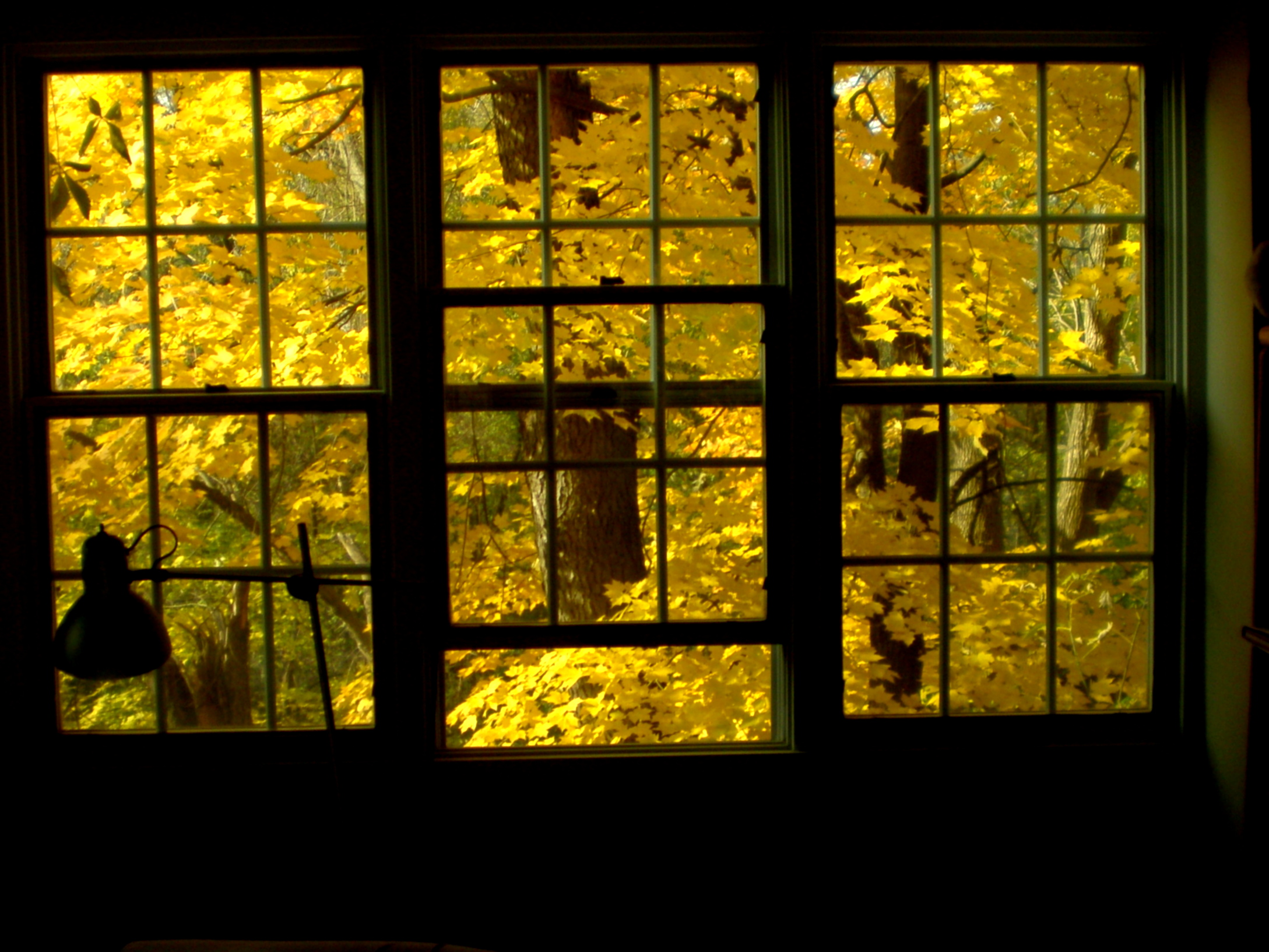
bedroom-fall-11

  The two main types of Japanese garden design are almost perfectly complementary.  The first, “shakkei” or “borrowed scenery” involves the incorporation of distant scenery into the experience of the visit.  For example, shrubs may be trimmed and limbs of a maple tree pruned so that a distant mountain is perfectly framed.

  The other garden type, the courtyard, employs its elements – rocks, water, flowers, bushes, etc – to “create the illusion of more than can be seen”*.  Descendents of special gardens carefully arranged to enhance and facilitate tea ceremonies, the more modern urban courtyard gardens often include steppingstones, lanterns, and a ritual water basin in addition to raked gravel and greenery.

  In both cases nature is viewed as an ally – not something to be wrestled into submission.  All elements of each were (are) considered to be alive and importantly to remain alive.  They’d obviously change with the seasons and would impact the visitor differently with each turn.

  It may seem obvious (and should be obvious to an architect), but one of many formal techniques used to “borrow” scenery is called “capturing with window”.  It is far from the most subtle of methods, but effective nonetheless. 

  Once, in 16th century Japan the respected leader of early Edo culture Kobori Enshu criticized the garden of a powerful territorial lord for being cramped and confining.  Infuriated, the daimyo ordered an artificial hill removed and a window cut in the guesthouse to perfectly frame two mountains and a lakeshore.

  The small ravine behind our house can certainly not be said to have been cultivated exactly, but as you can see above the presence of the latter upon the former has been salubrious.  Especially during these few days of fall.

  The maple tree is on the west side of our house, just behind our second floor bedroom.  Was it not there, the tree’s leaves would bear the brunt of the full force of the sun every day.  The juxtaposition that does exist however serves to shield the leaves from most of the day’s direct sunlight.  Thus, once the photosynthetic pigments are drained for the season, those that remain are able to luxuriate.

  A fortuitous circumstance I’m sure all will agree.  At its peak, the quality of the light infuses one with an incredible spiritual tumescence.  As the days progress and familiarity is bred, the mind is led from one happy memory to another. School in New England, expansive western hillsides covered with Aspen, and oh ya, Maine just a couple weeks ago…

  “Although this house may lack solutions to a great many of its occupants’ ills, its rooms nevertheless give evidence of a happiness to which architecture has made its distinctive contribution.”  Alain de Botton  The Architecture of Happiness 

*Space and Illusion in the Japanese Garden by Teiji Itoh

First Do No Harm

October 10, 2008

  Several weeks ago I mentioned something about financier George Soros’ back.  He employed it as sort of an economic indicator.  I’m reading his book The New Paradigm for Financial Markets.  It came out last April.  Wish I’d read it then. Or asked him about his back.  His advice in a memo written in January was to sell US stocks.  The Dow Jones Average is now some 30%/4,000 points less than at the end of that month.

  His purpose in writing the book is to put forth in detail his “theory of reflexivity” underlying his tremendous investment success.  “The theory of reflexivity seeks to illuminate the relationship between thinking and reality.

  “My starting point is that our understanding of the world in which we live is inherently imperfect because we are part of the world we seek to understand”… Understanding a situation and participating in it involves two different functions.  On the one hand people seek to understand the world in which they live.  I call this the cognitive function.  On the other, people seek to make an impact on the world and change it to their advantage. I call this the manipulative function.  When both functions are in operation at the same time they may interfere with each other.”

  Application of his theory in the financial markets leads him to: “the conclusion that both the financial authorities and market participants harbor fundamental misconceptions about the way financial markets function.”  His theory clearly is contrary to prevailing opinion that markets are inherently efficient.    

  Application of his observations to the current political scene is quite provocative in its description of the path that led to the current pickle we’re in.  “The primary purpose of political discourse is to gain power and to stay in power.  Those who fail to recognize this are unlikely to be in power.  The only way in which politicians can be persuaded to pay more respect to reality is by the electorate insisting on it… The electorate needs to be more committed to the pursuit of the truth than it is at present.”

  It’s not just Machiavelli.  The point is that once in power a ‘prince’ might manipulate realty with a certain goal in mind, but end up at the wrong end of the field in disaster.

  The road to hell is paved with good intentions.  An article in the business section of the October 7 online edition of the Economist admonishes: “First do no harm.” And then asks: “Do bosses need their own Hippocratic Oath?”

  Oddly, considerations of the above brought to mind another book recently read: The Architecture of Happiness by Alain de Bolton.  It is a wonderful treatise on the tremendous impact architecture and design have on our existence.  “The places we call beautiful are the work of those rare architects with the humility to interrogate themselves adequately about their desires and the tenacity to translate their fleeting apprehensions of joy into logical plans – a combination that enables them to create environments that satisfy needs we never consciously knew we even had.”

  But the reason consideration of Soros led to M. de Bolton is the latter’s description of how few are needed to effect positive change.  “Lest we begin to despair at the thought of how much might be required to bring about a genuine evolution in taste [and whatever else], we may remind ourselves how modest were the means by which previous aesthetic revolutions were accomplished.”

  Starting with the renaissance and ending with much of the western world’s modern built environment he shows how hugely generative and positive movements have been spawned by just a few tenacious individuals.  “The Italian Renaissance was the work of only about 100 people… It took a mere 200 pages of Le Corbusier’s Towards a New Architecture to decide the appearance of much of the built environment of the twentieth century.”

  He concludes: “We owe it to the fields that our houses will not be the inferiors of the virgin land they have replaced.  We owe it to the worms and the trees that the buildings we cover them with will stand as promises of the highest and most intelligent kinds of happiness.”

  Yup.

Better Take Off Your Shoes And Socks

May 2, 2008

  It has long been posited that the fabric of our universe can elegantly be described mathematically.  I’ve always sort of bought this intellectually, but without a gut level embrace because of all the, well, numbers.  All of those sliding blackboards in superposition – covered with chalk numbers, parentheses, and strange symbols – seem hopelessly unintelligible.

  Fortunately (for my daydreaming), recent research in neuroscience has provided another point of entry.  In the March 3, 2008 issue of the New Yorker, Jim Holt wrote about “Numbers Guy” Stanislas Dehaene. 

  “Over the decades, evidence concerning cognitive deficits in brain damaged patients has accumulated, and researchers have concluded that we have a sense of number that is independent of language, memory, and reasoning in general… In Dehaene’s view, we are all born with an evolutionarily ancient mathematical instinct… [and so are salamanders, pigeons, raccoons, dolphins, parrots, and monkeys] The number area lies deep within a fold in the parietal lobe called the intraparietal sulcus.”*

  “Our number sense endows us with a crude feel for addition … But multiplication is another matter.  It is an ‘unnatural practice’… Give a calculator to a five-year-old, and you will teach him how to make friends with numbers instead of despising them…”  Tell me if this last bit doesn’t ring true.

  OK, if time-space is the macro and one’s brain micro what are examples in between? Or is there a disconnect like between quantum physics and the theory of relativity? One occurred to me while reading about a concept known as the Golden Section.  It is the proportion resulting from the division of a straight line into two parts so that the ratio of the whole to the larger is the same as that of the larger to the smaller: 1: (√5+1)2. 

  Gwyn Headley writes: “The inexplicably satisfying proportions of the Golden Section have been appreciated since before Euclid”.   Google the term and you will find it neatly describing stuff ranging from the Pyramids at Giza to the Parthenon to Leonardo’s Annunciation in the Uffizi, to an endless array of elements of modern design.

  Furthermore, the closely related Fibonacci sequence can be used to describe such disparate things as the elegant spiral of the shell of the Nautilus to a smooth golf swing.

  The more this connectedness sinks in, the more I’m nearly overtaken by, well, The Marvelous.

  Holy dogs, if I had been on this scent earlier I would have made Mr. Gates wish he’d finished Harvard.  But shoot, now I know my attention will soon drift. 

*  Interesting thing here is that Holt goes on to say that “Brain imaging, for all the sophistication of its technology, yields a fairly crude picture of what’s going on inside the skull, and the same spot in the brain might light up for two tasks even though different neurons are involved. Quoting Dehaene: Some people believe that psychology is just being replaced by brain imaging, but I don’t think that’s the case at all”. 

  There are physicists and other thinkers who use this fact to hold that while consciousness may be present in a brain, it is not a product of it.  See, I’m getting off track.  More later.

Spiritual Fecundity in Chicago

April 4, 2008

  Be interesting to know what were like the childhoods of architect Tadao Ando and ceramicist Toshiko Takaezu.  The installation of a selection from the oeuvre of the latter in a gallery designed by the former together create an experience far beyond corporeal beauty. 

  If there can be a soul of a building, one such numinous sanctuary is Ando’s space in Chicago’s Art Institute. Commissioned in 1989 to exhibit from the Institute’s Japanese screens, the small room is unforgettable.

  Upon entering, through the center of the short end of the dimly lit rectangular room, one looks through four rows of one foot square oak columns.  The vitrine is arranged along the long wall on the right and continues across the back wall straight ahead.  It is illuminated.  The view through the oak and cast shadows is to be as if, upon the porch of a traditional Japanese house, one looks inside.

  Ando says: “Not everything can be accounted for reasonably…there are things in society that cannot be explained just in functional terms. I have provided functionless columns and walls…I feel this irrational quality is important. The modernism of the past became insipid because it rejected such irrationalism”.

  Takaezu’s pots draw from the range of her career and are interspersed with several from important mentors and contemporaries.  Well represented in the twenty or so are examples of her vertical closed vessels.  She says of these: “The most important part of a piece is the dark, black air space that you can’t see.  Just as what’s inside each person is also the key to humanity”.

  Some of her pieces are indeed human scale and elsewhere stand outside in fields or gardens.  Some, holding small ceramic balls, sound when gently shaken.  Visitors here might be disappointed at their inability to move around and touch her work.

  Like a compassionate abbess, Takaezu must be fine with it.  “When I was a small girl in Hawaii, I was fascinated by my shadow because it was taller than I.”  Here her pots are stroked by even taller shadows.  Her fertile dark spaces are clearly manifest behind the glass, but reserved.

  She knows that if, on the opposite benches perhaps, you linger long enough with an open heart, with her invitation, and with Ando’s generosity, you just might get a glimpse inside.

  An audience with the screens too is very fine, but different – for the historicity.  Come back in a few months and see them if you have yet not.  But don’t miss this.     

  At the Art Institute of Chicago through June 8, 2008.

Conquistadors of the Useless

January 21, 2008

  OK, everybody has read somewhere that there are more connections in one’s brain than there are stars in the universe.  Still, given all the possibilities, what sort of constellation would yield a ‘Conquistador of the Useless’? (French alpinist Lionel Terray’s self description) 

  Much to the chagrin of my wife, the Buddha, and other reasonable folk disdainful of metaphysical inquiry, it’s a question that has disturbed my rest for nearly all of my fifty plus years.  Perhaps it is related to the fact that I share the same birthday and thus sign as George Leigh (“because it’s there”) Mallory.  (Gemini)  

  I’m not there yet, but my research has begun to bear fruit and I at least have an idea what role mountains have and what part they might continue to play in the evolution of consciousness.Good news too, there’s sex involved. Julian Jaynes connected several of these issues in his ponderously titled, but enthralling The Origins of Consciousness in the Breakdown of the Bicameral Mind.

  The sex part.  Jaynes held (and offered compelling evidence) that it was the relatively sudden development of brainpower that propelled sexuality from its more perfunctory role in mating into the pervasive dynamo we know today.  Think about it – what would your sex life be without the ability to reminisce, ruminate, and look forward? 

  But how did the human analogue of pollination come to be writ so large?  Air-conditioning some believe, in a manner of speaking. When our anthropoid bipedal ancestors left the trees for the savannah, they left behind shade, protection from the sun’s searing rays.  Since a primary order of business for a warm blooded creature is temperature regulation, most importantly that of the brain, incremental improvements in an ability to radiate heat would be a distinct advantage.  Particularly in the sub-Saharan environment.  Thus an incipient outer bit of tissue might have proven advantageous first as a radiator, later a tool designer, and much later an ‘art film’ producer as natural selection grew the cortical covering.     

  However, Jaynes theorized that, even after development of the cerebral cortex, functioning of the humanoid brain was not quite modern.  A key aspect of his hypothesis was that the still preconscious brain was characterized by intermittent hallucinations.  Both visual and auditory, these were experienced as proclamations of gods and were catalyzed by a range of stimuli.       

  Mountains among other things.  Even today, it’s not too tough to recall the incredible feelings of awe inspired by a view of the Tetons, a look down into the Grand Canyon, or from atop the Bastille, or Rainier.  They form a connection to immanence not casually left behind.   In fact, as our forebears migrated, they developed means that at the very least allowed for the manifestation of those feelings wherever they set up camp or built cities. 

  Prehistoric burial mounds, Hittite ziggurats, and The Cathedral of Notre Dame are all examples.  Regarding this last, Abbot Suger, the French cleric behind Gothic architecture described the experience he had in mind to engender as “metaphysics of light”. The manipulation of space and light continues to characterize the practice of great architecture.  Recently, for example, a huge generating plant along the Thames in London was converted into the Tate Modern museum of art by a pair of Swiss architects.  Entry into its cavernous great hall evokes a similar constellation of feelings while dissipating neurotic thought and making the visitor receptive and ready to see.   

  Whew! This tortured path has long led me to assume these evocations and the activities of their origin like climbing and skiing, to be vestigial or at least atavistic.  And further, that their pursuit is dangerously quaint and more akin to bugs being drawn to light than to celestial connections.  Recently however, consideration of the convergence between certain lines of neuroscience and spirituality has led my wandering mind in another direction.  I’ve come to the conclusion that these feelings of awe, of immanence, of new direction might rather be precursorial.  

  Perhaps those of us willing, eager to leave certain comfort behind for unnecessary experiences of adventure may have something in common with those on the periphery of, say, Mayan society long ago.  Mesoamerican artisans and craftspeople maybe.  What were they thinking as they led the way to the jungle leaving home, the priests, and nobility behind?      “Gee, if only they had cut out more hearts and run more thorns through their tongues and genitals we would all be in clover now.”  

  Or not.  They must have been anxious in the extreme because of diminished resonance with what had for generations represented the foundation of their experience.  In any case, brooding and doubting had to be better than being the next in line.  The call of the wild proved irresistible.  Furthermore, Jaynes presented evidence showing that similar metamorphical events were occurring in roughly contemporaneous cultures around the world. 

  Is there a lesson in all of this some thousands of years later?  Well, is there?  I guess it depends upon the dominant society and its continued success or a lack thereof…  Does anyone still think we are at ‘the end of history’?   Whither now the zeitgeist?    Ah whatever.  But hey, the next time you’re enjoying the view, hold that thought.  Remember, in wilderness is the preservation of the earth.  And who knows what else.