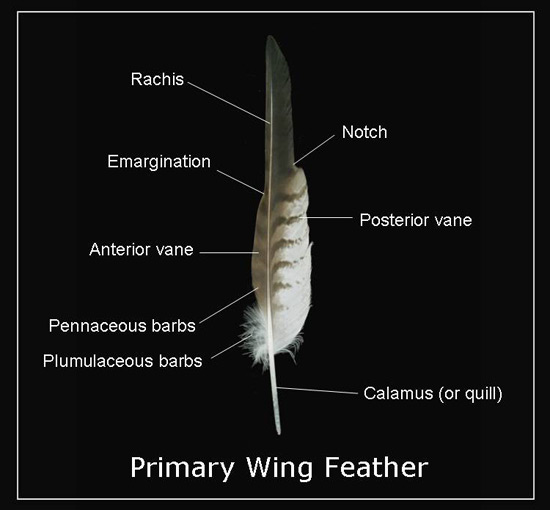

Know that a bird’s flight feathers are analogous to the blades on an airplane’s propeller? It is actually the other way around of course, birds came before airplanes after all, but that is the manner in which the astonishment came to me.
And I’m not the Lone Ranger. Long before Kitty Hawk there were attempts at manned flight designed around the avian wing. The problem was propulsion. Wright Brothers, or someone else, would have been aloft sooner had they understood how birds do more than just glide.
OK, you’ll remember that the mechanics of flight revolve around a curved surface – an airfoil. As it moves through air (or water – think penguins) the molecules flowing over the curved top must move faster than those with the shorter path to travel below. This creates a drop in air pressure above and lift*.
Well, the outermost part of a wing – the hand wing – is composed of stiff slightly pointed primaries which are longitudinally asymmetrical. When a bird in flight flaps downward the narrower portion of the primaries curve creating airfoils and voila forward ‘lift’ occurs.

The several primaries on both wings of a bird combine into an analogue for a multi-blade propeller. One on each wing. Try it yourself next time you find a feather. Hold it by the bare part of the shaft and move it through the air as had its original owner. You won’t take off, but you’ll get the idea.
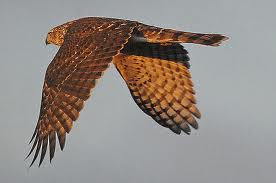
My favorite bird? Cooper’s Hawk. It is incredible to watch them Top Gun song birds. Cuts bird seed budget line item way back.
*Bernoulli’s principle, developed in the eighteenth century, explains the ramifications of the pressure differential, but not why the air moves faster on top than underneath. Explanations of flight and lift always bothered me because I was unable to get that part. I’m happy to report that the Kutta-Joukowski theorem, developed in the twentieth century addresses that aspect. It is complicated and I don’t completely understand, but feel better to know that I might one day.





 The Subtle Landscape